
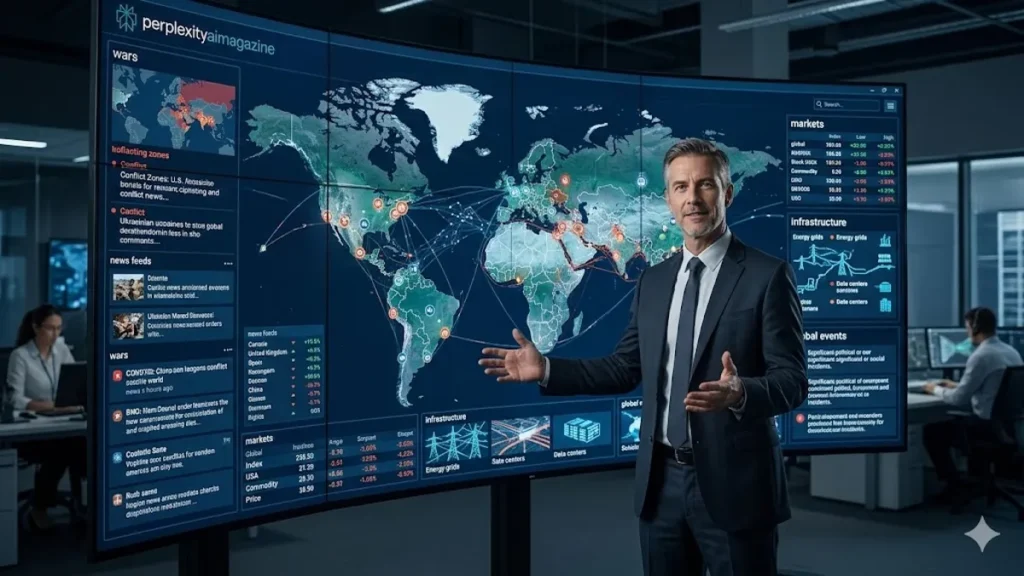
The idea of tracking wars, markets, infrastructure and global events in a single interface once belonged to intelligence agencies and defense contractors. I see that barrier eroding. A new generation of entrepreneurs is attempting to build AI-powered global intelligence platforms that aggregate open-source data, apply machine learning and present the world’s volatility through one unified dashboard. The ambition is clear: to create a system that can correlate troop movements with oil prices, infrastructure outages with market swings and protests with shipping disruptions, all in real time. – AI-powered global intelligence platform.
At the center of this effort is a blueprint that blends open-source intelligence feeds with scalable software architecture. Platforms such as World Monitor demonstrate that public data streams, including ADS-B aircraft tracking, AIS maritime signals, news websites and satellite fire detection, can be fused into a coherent situational awareness map. Artificial intelligence models then summarize and score these signals into country-level instability indices. What once required classified pipelines can now be approximated through public APIs and cloud infrastructure.
Yet the challenge extends beyond aggregation. An entrepreneur building such a system must design predictive alerts, integrate secure encryption standards such as AES-256 and deploy resilient architecture capable of operating in unstable regions. The opportunity lies in democratizing geopolitical intelligence, positioning the platform as a “Palantir for small and midsize businesses” while maintaining compliance and trust.
The Vision: A Unified Intelligence Dashboard
The core vision behind an AI-powered global intelligence platform is integration. I imagine a dashboard where a user can observe military mobilizations, stock volatility, cyber alerts and infrastructure disruptions layered on an interactive map. Data from GDELT events, financial APIs such as Alpha Vantage and satellite imagery providers converge into one interface. – AI-powered global intelligence platform.
World Monitor, an open-source project available on GitHub, illustrates this concept by tracking more than 220 military bases across nine countries, aggregating live news from more than 100 websites and correlating flight or ship movements with geopolitical events. Its Instability Index scores countries from 0 to 100 based on signal convergence.
Such a system can highlight patterns that would otherwise remain fragmented. For example, spikes in protests combined with internet outages and unusual aircraft activity might signal escalation risk. Amy Zegart, a senior fellow at the Hoover Institution, has argued that open-source intelligence is increasingly central to modern security analysis, noting that “the intelligence advantage now often lies in who can best synthesize public information.” An AI dashboard operationalizes that synthesis at scale.
Read: AI Learns Software Tasks From Videos With Watch & Learn Breakthrough
Building the Tech Stack
A robust platform requires deliberate engineering choices. On the frontend, frameworks such as React or Vue combined with Vite enable rapid development and modular architecture. Interactive mapping libraries like Leaflet or Mapbox allow visualization of conflict zones, trade routes and infrastructure nodes in 3D overlays. – AI-powered global intelligence platform.
On the backend, Python frameworks such as FastAPI or Flask can orchestrate data ingestion pipelines. Large language models summarize news articles and classify events. Tools like LangChain can structure OSINT workflows, integrating feeds from NewsAPI, ACLED conflict data and Sentinel Hub satellite imagery. Supabase or PostgreSQL supports real-time databases and authentication.
Deployment strategies often rely on Docker containers and scalable cloud services such as Vercel. Encryption standards including AES-256 protect data in transit and at rest, essential for users operating in politically unstable regions. Bruce Schneier, a cybersecurity expert, has emphasized that strong encryption is foundational to trust in digital systems, stating that “security is not a product, but a process.” For an intelligence platform, that process must be continuous.
From MVP to Enterprise Product
Entrepreneurs can bootstrap development by forking open-source repositories such as World Monitor. I would begin with aggregation features that already cover news, markets and military posture. From there, custom AI agents can extend capabilities.
One agent might parse social media signals and satellite imagery to detect troop mobilizations. Another could correlate earthquakes with supply chain disruptions, linking infrastructure damage to commodity price fluctuations. Testing locally enables refinement of event correlation algorithms and user preference filters.
Monetization follows a tiered model. A freemium version offers aggregated data and basic summaries. A Pro tier at $29 per month introduces predictive alerts and advanced analytics. Enterprise packages include custom integrations, compliance documentation and priority support. Positioning the platform as a cost-effective alternative to enterprise intelligence solutions widens its appeal. – AI-powered global intelligence platform.
Commercial Competitors and Market Positioning
Enterprise-grade platforms already dominate the high end of geopolitical analytics. Companies such as Recorded Future, Dataminr and Palantir Foundry provide integrated intelligence systems at annual costs ranging from tens of thousands to millions of dollars. Their strength lies in proprietary feeds, dark web monitoring and integration with classified data streams.
| Platform | Focus Areas | Pricing Model | Competitive Edge |
|---|---|---|---|
| Recorded Future | Cyber threats, geopolitical risk | Enterprise subscription | Dark web intelligence and forecasting |
| Palantir Foundry | Government, defense analytics | Custom enterprise contracts | Classified data integration |
| Dataminr | Real-time event detection | Enterprise subscription | AI alerts from vast social streams |
| World Monitor | Public OSINT dashboard | Open-source | Accessible and replicable |
The startup opportunity lies between open-source accessibility and enterprise exclusivity. By layering premium APIs such as Reuters feeds or commercial satellite imagery onto an open backbone, an entrepreneur can offer advanced capabilities at a fraction of traditional enterprise cost. – AI-powered global intelligence platform.
Predictive Analytics and Risk Scoring
The defining feature of a next-generation intelligence dashboard is predictive analytics. Rather than simply summarizing events, the system must identify correlations and emerging risks. ACLED data on conflict incidents, for instance, can be paired with commodity price movements to anticipate supply disruptions.
The Instability Index concept aggregates multiple signals into a composite score. A sudden spike in flights near a conflict zone, combined with sanctions updates and energy price volatility, could trigger alerts. The challenge lies in balancing sensitivity and specificity to avoid false positives.
According to the 2023 Global Risks Report by the World Economic Forum, geopolitical confrontation and economic instability rank among the top threats to global stability. An AI platform that quantifies such risks in real time could provide strategic advantage to traders, analysts and infrastructure operators.
Security, Compliance and Resilience
Security is not optional in intelligence software. I would prioritize AES-256 encryption, role-based access controls and multi-factor authentication. Offline resilience mechanisms, such as cached data layers, allow operation during internet disruptions.
Aetherion Intelligence, a defense-focused platform, demonstrates what enterprise-grade resilience looks like. It integrates satellite imagery, darknet monitoring and predictive pattern recognition while maintaining military-grade encryption and low-latency deployment. – AI-powered global intelligence platform.
| Aspect | Enterprise Platform | Startup Model |
|---|---|---|
| Data Sources | Satellite, classified feeds | Public OSINT plus premium APIs |
| AI Depth | Predictive mobilization analysis | Event summarization and correlation |
| Security | Military-grade encryption | AES-256, cloud-based controls |
| Users | Governments, defense | Analysts, SMBs, regional firms |
The startup must strike a balance between scalability and compliance, ensuring GDPR and regional data standards are respected.
Ethical Dimensions and Data Integrity
Open-source intelligence offers transparency but also carries ethical risks. Data from social platforms may include misinformation or manipulated narratives. Verification layers must assess credibility before generating alerts.
Timothy Snyder, a historian who has written about information warfare, has warned that “the defense of truth is itself a civic responsibility.” An intelligence dashboard must therefore incorporate validation pipelines, cross-referencing signals from multiple sources to reduce amplification of false data.
Moreover, the use of crowd-sourced prediction markets introduces probabilistic uncertainty. Transparency about methodologies and limitations builds user trust.
Strategic Growth and Regional Focus
Entrepreneurs can validate their platform through regional applications. For instance, firms monitoring infrastructure projects under the China-Pakistan Economic Corridor may seek dashboards correlating seismic activity, protests and supply chain flows. Targeted beta programs with local businesses create feedback loops.
Scaling the product involves modular expansion into variants: geopolitics, finance and technology monitors built on a shared codebase. Venture capital pitches may frame the startup as democratized situational awareness for mid-market firms.
Global expansion requires partnerships with academic institutions and think tanks for validation. Publishing white papers on predictive accuracy strengthens credibility.
Takeaways
- An AI-powered global intelligence platform can unify wars, markets and infrastructure data in one dashboard.
- Open-source intelligence feeds provide scalable foundations for startups.
- Predictive analytics and instability indices differentiate aggregation from insight.
- Encryption and compliance are essential for trust and enterprise adoption.
- Tiered monetization bridges accessibility and sustainability.
- Ethical safeguards must address misinformation and bias.
Conclusion
The dream of a unified global intelligence dashboard reflects both technological progress and geopolitical complexity. I believe entrepreneurs now stand at a rare intersection. Public data streams have multiplied, cloud infrastructure has matured and artificial intelligence models can synthesize vast signals into comprehensible narratives.
Yet ambition must be matched with responsibility. Building such a platform requires careful engineering, rigorous validation and unwavering commitment to security. The line between democratized intelligence and misinterpreted data can be thin.
If executed thoughtfully, an AI-powered intelligence dashboard could empower analysts, traders and infrastructure operators to navigate uncertainty with clarity. In a world where events cascade across borders within minutes, the capacity to see connections before they become crises may prove invaluable.
FAQs
What is an AI-powered global intelligence platform?
It is a software system that aggregates open-source data on wars, markets, infrastructure and global events, using AI to summarize, correlate and score risks in real time.
How can a startup compete with enterprise intelligence firms?
By leveraging open-source foundations, tiered pricing and premium APIs, startups can deliver cost-effective alternatives tailored to small and midsize businesses.
What data sources power such platforms?
Common sources include ADS-B flight tracking, AIS maritime data, news feeds, ACLED conflict datasets, financial APIs and satellite imagery providers.
Why is encryption important?
Strong encryption such as AES-256 protects sensitive data and builds trust among users operating in unstable or high-risk environments.
What are the main ethical challenges?
Risks include misinformation amplification, bias in data sources and overreliance on probabilistic predictions without transparency.
