
I remember the first time I typed a sentence into an AI image generator and watched a picture appear seconds later. The moment felt uncanny, almost like witnessing imagination turn directly into pixels. That experience has now become routine across design studios, marketing teams, and hobbyist communities worldwide. Yet one question continues to dominate discussions among artists, developers, and entrepreneurs: which AI image generator is actually the best? – Midjourney vs DALL-E.
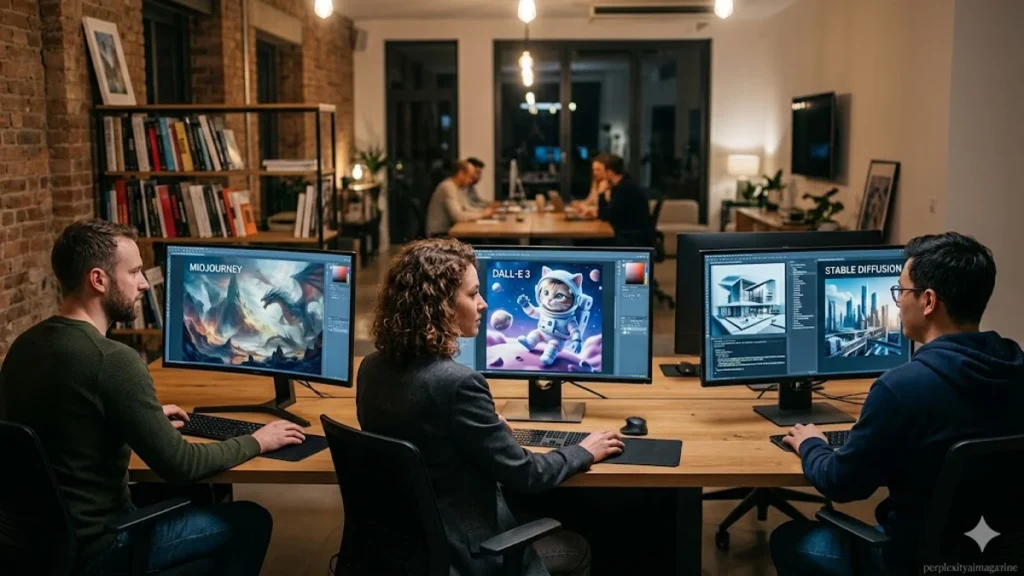
The short answer is that no single system wins every category. Midjourney, DALL-E 3, and Stable Diffusion 3.5 each represent a different philosophy of generative AI. Midjourney prioritizes artistic polish and cinematic aesthetics. DALL-E 3 focuses on accessibility and natural language interaction through conversational interfaces. Stable Diffusion emphasizes control, customization, and open development.
Within the first moments of using these tools, the differences become clear. Midjourney produces images that often resemble finished artwork straight from a design portfolio. DALL-E 3 responds to everyday language and can render detailed scenes with surprisingly accurate text. Stable Diffusion, meanwhile, invites users to build entire creative pipelines, modify models, and generate images locally on personal hardware.
This divergence reflects a broader shift in artificial intelligence. Instead of competing only on output quality, these systems compete on usability, flexibility, and ecosystem support. Artists want expressive visuals. Businesses want fast marketing assets. Developers want programmable systems they can adapt.
Understanding these trade-offs matters because generative imagery is moving quickly from novelty to infrastructure. Advertising agencies use AI visuals in campaigns. Game studios explore AI concept art. Social media creators generate endless visual content. The choice between Midjourney, DALL-E 3, and Stable Diffusion increasingly shapes how digital images are produced across industries.
The question is no longer whether AI can create images. The question is which approach to creativity works best. – Midjourney vs DALL-E.
The Rapid Rise of AI Image Generation
Generative AI imagery accelerated dramatically after the release of several foundational models in the early 2020s. In 2021 OpenAI introduced the original DALL-E model, demonstrating that neural networks could translate text prompts into images. The announcement captured global attention because it revealed a new capability: language could directly instruct visual creation.
Within a year, competition intensified. Stability AI released Stable Diffusion in August 2022, an open-source model capable of generating images on consumer GPUs. Its release triggered an explosion of experimentation across developers, researchers, and independent creators. Midjourney, a startup founded by David Holz, launched its own model the same year, emphasizing artistic aesthetics rather than technical openness.
By 2023 and 2024, each system had matured into a distinct ecosystem. DALL-E 3 integrated deeply with ChatGPT, allowing conversational prompt refinement. Midjourney refined its visual style with multiple model updates, producing images often praised for cinematic lighting and dramatic composition. Stable Diffusion evolved into a modular framework supporting extensions such as ControlNet, LoRA training, and node-based workflows. – Midjourney vs DALL-E.
According to Stanford University’s 2024 AI Index report, generative AI adoption across industries expanded rapidly, particularly in creative workflows (Stanford Institute for Human-Centered Artificial Intelligence, 2024). Image generation became one of the most widely used categories, alongside large language models.
The shift was not purely technical. It represented a transformation in how visual ideas are produced. Instead of commissioning sketches or searching stock libraries, creators could describe a scene and iterate instantly. The friction between imagination and execution began to collapse.
Understanding the Three Major Systems
Each leading AI image generator operates on similar deep-learning principles but emphasizes different priorities. The contrast becomes clearer when examined across usability, control, and technical architecture.
| Aspect | Midjourney | DALL-E 3 | Stable Diffusion 3.5 |
|---|---|---|---|
| Core Philosophy | Artistic visuals | Conversational generation | Open customization |
| Interface | Discord / web | ChatGPT integration | Local or custom UI |
| Accessibility | Medium | Very easy | Technical |
| Model Control | Limited | Limited | Extensive |
| Local Execution | No | No | Yes |
| Typical Users | Designers, artists | Beginners, marketers | Developers, researchers |
These distinctions shape how different communities adopt the tools. Designers gravitate toward Midjourney because of its polished outputs. Casual users often prefer DALL-E 3 because they can simply describe an image in natural language. Developers and power users favor Stable Diffusion because they can modify every component of the generation pipeline.
The result is less a rivalry and more an ecosystem of complementary approaches.
Midjourney: The Artist’s AI
Midjourney’s reputation rests largely on its aesthetic consistency. Images generated by the platform frequently resemble concept art, cinematic stills, or stylized digital paintings. The model appears tuned to produce visually striking results even when prompts are relatively simple. – Midjourney vs DALL-E.
This artistic orientation stems from the platform’s design philosophy. Rather than exposing extensive technical parameters, Midjourney emphasizes creative exploration through prompts and style references. Users interact with the system primarily through Discord commands or its web interface.
| Feature | Midjourney Strength |
|---|---|
| Visual Style | Highly cinematic and artistic |
| Lighting & Composition | Strong dramatic aesthetics |
| Learning Curve | Moderate |
| Text Accuracy | Improving but inconsistent |
| Custom Training | Limited |
Midjourney’s outputs often include sophisticated lighting, balanced composition, and dramatic color grading. Many images resemble illustrations suitable for marketing campaigns, book covers, or game concept art.
However, the system occasionally sacrifices precision for style. Complex prompts may produce unexpected elements, and text within images can still be inconsistent. For many creators, that trade-off is acceptable because the overall visual impact remains strong.
Andrew Price, founder of Blender Guru, once noted in a discussion on AI art tools that Midjourney’s outputs “often look like something a professional illustrator might have produced after hours of work” (Price, 2023).
For visual storytelling, Midjourney often delivers immediate aesthetic impact.
DALL-E 3: Accessibility Through Conversation
DALL-E 3 represents a different vision for AI image creation. Instead of requiring structured prompts or specialized interfaces, the system integrates directly with conversational AI. Users simply describe what they want in everyday language.
This approach dramatically lowers the barrier to entry. A beginner can request an image such as “a realistic photograph of a scientist working late in a laboratory” and receive multiple results without understanding prompt engineering.
The system also benefits from advanced prompt interpretation. Because DALL-E 3 integrates with language models, prompts can be expanded and refined automatically before generation. – Midjourney vs DALL-E.
Sam Altman, CEO of OpenAI, described the approach during the model’s release, explaining that “DALL-E 3 understands significantly more nuance and detail than previous systems” (OpenAI, 2023).
One area where the model stands out is text rendering. Labels, signs, and captions inside generated images appear more accurately than in many competing models. This capability makes it useful for product mockups, advertising visuals, and informational graphics.
However, customization options remain limited compared with open-source alternatives. Users cannot easily retrain the model or adjust its internal architecture. The focus remains on simplicity and ease of use rather than technical experimentation.
Stable Diffusion: Power and Control
Stable Diffusion occupies the opposite end of the spectrum from DALL-E 3. Instead of emphasizing simplicity, it prioritizes flexibility. The model is open source, meaning developers can download the weights, modify them, and run the system locally.
That openness transformed the AI art community. Thousands of extensions, plugins, and custom models emerged within months of the original release. Tools like ControlNet allow creators to guide image composition using sketches, poses, or depth maps.
For professionals building production pipelines, these capabilities are invaluable. Artists can train LoRA models to replicate specific styles or characters. Developers can automate batch generation. Researchers can experiment with architectural changes. – Midjourney vs DALL-E.
According to Emad Mostaque, founder of Stability AI, the open approach was intentional. “We wanted to democratize image generation so anyone could build on it,” he said in a 2023 interview (Vincent, 2023).
Running the system locally also provides privacy advantages. Sensitive creative projects can remain entirely offline, and organizations can integrate the model into internal workflows.
The downside is complexity. Installing Stable Diffusion typically requires a capable GPU, software setup, and familiarity with specialized interfaces like ComfyUI or Automatic1111.
For many users, that technical overhead represents both the model’s greatest strength and its biggest obstacle.
Comparing Image Quality
Visual quality remains one of the most debated aspects of AI image generation. Each system excels in different styles and scenarios.
Midjourney often produces the most visually polished images with minimal prompting. Its outputs feature dramatic lighting and balanced composition, making them suitable for concept art and promotional imagery.
DALL-E 3 tends to excel in clarity and prompt interpretation. Scenes described in natural language often appear accurately rendered, including objects, settings, and textual elements.
Stable Diffusion can match or surpass both systems in realism when configured carefully. With advanced workflows and model tuning, it can generate highly detailed photorealistic scenes or precise design layouts.
AI researcher Nathan Lambert has argued that “open systems like Stable Diffusion can eventually surpass proprietary models because the community iterates rapidly” (Lambert, 2023).
However, raw output quality depends heavily on user expertise. A beginner may achieve stronger results faster in Midjourney or DALL-E 3, while experienced users can unlock extraordinary detail through Stable Diffusion customization. – Midjourney vs DALL-E.
Pricing, Accessibility, and Infrastructure
Beyond image quality, practical considerations influence which tool people adopt. Pricing models, hardware requirements, and accessibility shape the real-world usability of each system.
Midjourney operates entirely as a subscription service. Users pay monthly for GPU generation time, starting around ten dollars. The system runs in the cloud, eliminating hardware requirements.
DALL-E 3 is integrated into ChatGPT, where limited free access exists. Paid tiers such as ChatGPT Plus provide expanded generation capabilities.
Stable Diffusion differs dramatically. The model itself is free and open source, but running it locally requires computing hardware capable of handling large neural networks.
| Factor | Midjourney | DALL-E 3 | Stable Diffusion |
|---|---|---|---|
| Entry Cost | Subscription | Free / subscription | Free model |
| Hardware Needed | None | None | GPU recommended |
| Cloud vs Local | Cloud | Cloud | Local or cloud |
| Scalability | Limited by plan | Platform limits | Unlimited locally |
These differences influence adoption patterns. Casual users typically gravitate toward cloud services. Developers and studios often invest in local setups for scalability and customization.
Creative Workflows and Use Cases
Different creative fields tend to favor different AI image generators.
Marketing teams often choose Midjourney for visually striking campaign images. Social media creators use it for thumbnails and concept visuals. Its polished aesthetic reduces the need for post-processing.
Product designers frequently prefer DALL-E 3 when generating mockups or idea sketches. The ability to describe scenes conversationally speeds up brainstorming sessions.
Game developers and visual effects artists increasingly rely on Stable Diffusion pipelines. With ControlNet and other tools, they can generate consistent characters, pose variations, and environment concepts.
Creative technologist Gene Kogan has argued that generative art tools represent “a new collaboration between human direction and machine improvisation” (Kogan, 2022).
In practice, many professionals use multiple systems simultaneously. A designer might generate initial inspiration in Midjourney, refine compositions in Stable Diffusion, and prototype marketing visuals in DALL-E 3.
The future of creative workflows may involve orchestration rather than exclusivity.
The Broader Impact on Creative Industries
AI image generation has sparked both excitement and controversy. Artists debate copyright concerns and training data ethics, while companies explore productivity gains.
The U.S. Copyright Office ruled in 2023 that AI-generated images without substantial human modification cannot receive copyright protection (U.S. Copyright Office, 2023). The decision raised questions about ownership and creative authorship.
Meanwhile, creative industries increasingly experiment with generative visuals. Advertising agencies use AI concept art to pitch campaigns. Fashion brands prototype designs digitally. Film studios explore AI-generated storyboards.
A 2024 survey by McKinsey & Company found that generative AI adoption across creative and marketing functions has expanded rapidly, particularly in content creation workflows (Chui et al., 2024).
The technology continues evolving quickly. New models appear regularly, improving realism, consistency, and control. What began as experimental art tools are gradually becoming part of mainstream production.
Key Takeaways
- Midjourney excels at visually polished, artistic images with minimal prompting.
- DALL-E 3 offers the most accessible experience through conversational interaction.
- Stable Diffusion provides unmatched customization and local deployment capabilities.
- Image quality varies depending on style, prompt complexity, and user expertise.
- Pricing and hardware requirements strongly influence which system users adopt.
- Many professionals combine multiple AI tools within a single creative workflow.
Conclusion
The search for the “best” AI image generator often misses the larger reality: these systems are designed for different creative philosophies. Midjourney focuses on beauty and visual drama. DALL-E 3 emphasizes accessibility and intuitive interaction. Stable Diffusion champions openness and technical flexibility.
Each approach reflects a different vision of how humans should collaborate with machines. Some creators want a tool that produces stunning visuals instantly. Others prefer conversational simplicity. Still others want full control over models and pipelines.
Rather than replacing traditional creativity, these systems expand the toolkit available to artists, designers, and developers. They shorten the distance between imagination and execution, allowing ideas to be visualized at unprecedented speed.
As generative models continue improving, the distinctions between them may blur. Image realism will increase, customization will grow easier, and new hybrid workflows will emerge. But the fundamental choice will remain the same: whether creativity should prioritize polish, accessibility, or control.
In that sense, the question of which AI image generator is better may never have a single answer. The best tool depends on what the creator hopes to build.
Click Here to Read More about AI Tools!
FAQs
Which AI image generator produces the most artistic images?
Midjourney is widely considered the most artistically polished generator. Its outputs often feature cinematic lighting, dramatic composition, and visually striking color palettes, making it popular among designers and digital artists.
Is DALL-E 3 easier to use than other AI image tools?
Yes. DALL-E 3 integrates with conversational interfaces, allowing users to generate images simply by describing what they want in natural language.
Can Stable Diffusion run on a personal computer?
Yes. Stable Diffusion can run locally on personal hardware, typically requiring a capable GPU with sufficient VRAM for smooth image generation.
Which AI generator is best for photorealistic images?
Stable Diffusion can produce highly photorealistic images when properly configured. DALL-E 3 also performs well for realistic scenes, especially when prompts include photographic details.
Do professionals use multiple AI image generators?
Yes. Many designers and developers combine tools such as Midjourney, DALL-E 3, and Stable Diffusion within a single creative workflow to leverage their different strengths.
