
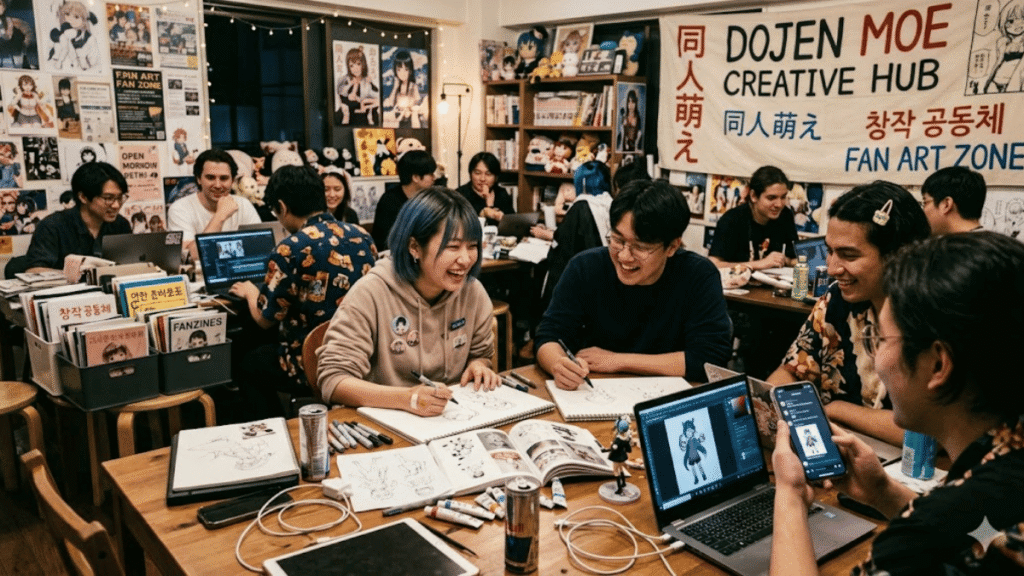
“Dojen moe,” a term that appears to blend elements of “doujin” (fan-created works) and “moe” (a Japanese concept describing affection toward fictional characters), refers to a niche but increasingly visible cultural phenomenon centered on emotional attachment to fan-generated characters and narratives. At its simplest, dojen moe describes the intense, often personalized affection fans develop toward characters emerging from independent or community-driven creative ecosystems rather than mainstream media. Within the first moments of understanding the term, it becomes clear: this is not just about fandom—it is about emotional ownership, intimacy, and identity formation in digital spaces.
The concept builds on decades of Japanese pop-cultural evolution, where “moe” became a defining emotional response in anime, manga, and gaming communities. Meanwhile, “doujin” culture—self-published works often created by fans—expanded the boundaries of storytelling, allowing audiences to become creators. Dojen moe exists at this intersection, where affection is not passively consumed but actively constructed.
As digital platforms globalize these once-localized subcultures, dojen moe has begun to influence broader creative industries. It shapes how characters are designed, how stories are told, and how communities organize themselves. Yet it also raises questions about emotional dependency, intellectual property, and the blurred line between creator and audience. In examining dojen moe, one uncovers a deeper narrative about how people connect—not just with stories, but with the idea of belonging itself.
Origins: From Doujin Circles to Emotional Microcultures
The roots of dojen moe lie in Japan’s postwar creative landscape, particularly the rise of doujinshi—self-published works often distributed at events like Comic Market (Comiket), which began in 1975. These works allowed fans to reinterpret existing characters or create entirely new ones, fostering a participatory culture long before the internet amplified such practices.
“Moe” as a concept gained prominence in the 1990s, describing a specific emotional response—affection, protectiveness, or adoration—toward fictional characters. Scholars like Hiroki Azuma have argued that moe represents a shift in consumption patterns, where audiences focus on character traits rather than overarching narratives.
Dojen moe emerges when these two forces converge. Unlike traditional moe, which often centers on commercially produced characters, dojen moe is rooted in grassroots creativity. Characters are frequently shared within small communities, evolving collaboratively. This creates a unique dynamic: fans are not just consumers but co-authors of the emotional experience.
By the early 2010s, online platforms such as Pixiv and Twitter accelerated this process, enabling rapid dissemination and iteration of fan-created content. What was once confined to physical gatherings became a global, always-on ecosystem.
Anatomy of Moe: Emotional Design in Fiction
Understanding dojen moe requires unpacking the mechanics of “moe” itself. At its core, moe is an engineered emotional response, often triggered by specific character traits—innocence, vulnerability, or distinctive quirks.
The table below outlines common moe elements and their psychological impact:
| Moe Trait | Description | Emotional Response | Usage in Dojen Moe |
|---|---|---|---|
| Innocence | Childlike or pure demeanor | Protectiveness | Highly prevalent |
| Vulnerability | Emotional or physical fragility | Empathy | Central to attachment |
| Quirkiness | Unique habits or speech patterns | Affection | Customizable by creators |
| Visual Design | Stylized features (large eyes, etc.) | Attraction | Adapted in fan art |
| Narrative Ambiguity | Open-ended backstories | Imagination | Expanded collaboratively |
Dr. Patrick W. Galbraith, a leading scholar of Japanese media culture, notes that “moe is not inherent in characters—it is a response shaped by audience interaction.” This insight is crucial for understanding dojen moe, where that interaction becomes participatory and iterative.
The Role of Digital Platforms
The transformation of dojen moe from a niche phenomenon to a global trend is inseparable from digital infrastructure. Platforms such as Pixiv, Tumblr, and Discord have enabled communities to form around specific characters or aesthetics, often independent of any official source material.
These platforms facilitate rapid feedback loops. A character design posted online can receive thousands of interactions within hours, prompting revisions, spin-offs, and collaborative storytelling. This accelerates emotional investment, as users feel directly involved in the creative process.
The following table illustrates the evolution of distribution channels:
| Era | Primary Medium | Speed of Distribution | Community Interaction Level |
|---|---|---|---|
| 1970s–1990s | Print (doujinshi) | Slow | Localized |
| 2000s | Forums, blogs | Moderate | Expanding |
| 2010s–Present | Social media | Instant | Global, real-time |
Dr. Mizuko Ito, a cultural anthropologist, emphasizes that “digital platforms have turned fandom into a form of social infrastructure.” In dojen moe, this infrastructure becomes the foundation for emotional communities.
Identity and Ownership in Fan-Created Worlds
One of the defining features of dojen moe is the sense of ownership it fosters. Unlike traditional media consumption, where characters are controlled by corporations, fan-created ecosystems distribute creative authority among participants.
This decentralization has profound implications. Fans can modify characters to reflect personal experiences, cultural contexts, or emotional needs. In doing so, they blur the line between fiction and identity.
“Dojen moe allows individuals to project themselves into narratives in ways that traditional media rarely permits,” said Dr. Marc Steinberg, a media studies scholar. “It’s a form of identity construction as much as it is entertainment.”
However, this sense of ownership can also lead to conflicts, particularly around intellectual property. As fan creations gain popularity, questions arise about who “owns” a character or narrative—a tension that has become increasingly visible in digital spaces.
Economic Dimensions: From Hobby to Industry
While dojen moe originates in grassroots creativity, it has begun to intersect with commercial interests. Platforms like Patreon and Booth enable creators to monetize their work, turning fan-driven projects into viable income streams.
This shift has created a hybrid economy, where amateur and professional boundaries blur. Some creators transition from doujin circles to mainstream industries, bringing with them the aesthetics and sensibilities of dojen moe.
The commercialization of fan culture raises ethical questions. Does monetization undermine the collaborative spirit of doujin communities? Or does it provide necessary support for creators?
Industry analyst Keiko Tanaka argues that “the monetization of fan culture is inevitable, but it must be balanced with respect for community norms.” This balance remains an ongoing challenge as dojen moe continues to evolve.
Psychological Implications: Attachment and Escapism
The emotional intensity associated with dojen moe has drawn attention from psychologists. The phenomenon aligns with broader patterns of parasocial interaction, where individuals form one-sided relationships with fictional characters.
In dojen moe, these relationships are often amplified by interactivity. Fans not only engage with characters but also influence their development, deepening emotional investment.
Dr. Sherry Turkle, a sociologist of technology, has noted that “digital environments allow people to explore relationships in ways that feel safe and controllable.” Dojen moe exemplifies this dynamic, offering a space for emotional exploration without real-world risks.
However, concerns remain about overreliance on fictional attachments. Critics argue that intense engagement with fan-created worlds may lead to social withdrawal or unrealistic expectations.
Globalization and Cultural Translation
Originally rooted in Japanese culture, the principles of dojen moe have spread globally, adapting to diverse contexts. Western fan communities have embraced similar practices, often blending them with local storytelling traditions.
This globalization has led to new hybrid forms, where cultural influences intersect. Characters may incorporate design elements from anime while reflecting narratives rooted in different cultural experiences.
The spread of dojen moe highlights the fluidity of modern culture. It demonstrates how localized practices can evolve into global phenomena, shaped by digital connectivity and shared creative tools.
Takeaways
- Dojen moe combines fan-created content (“doujin”) with emotional attachment (“moe”)
- It reflects a shift from passive consumption to participatory storytelling
- Digital platforms have accelerated its growth and global reach
- Emotional attachment is central, often driven by collaborative creation
- Economic opportunities are emerging within fan-driven ecosystems
- Psychological impacts include both positive engagement and potential risks
Conclusion
Dojen moe represents a profound transformation in how people relate to stories, characters, and each other. It is not merely a niche cultural trend but a lens through which to understand broader shifts in media consumption and identity formation. In a world increasingly mediated by screens, the boundaries between creator and audience, fiction and reality, continue to blur.
What makes dojen moe particularly compelling is its emphasis on participation. It invites individuals to co-create, to invest emotionally, and to find community in shared imagination. Yet this same openness introduces complexities—ethical, psychological, and economic—that challenge traditional frameworks.
As digital culture continues to evolve, dojen moe offers both opportunity and caution. It underscores the power of storytelling to connect people, even in fragmented, decentralized spaces. At the same time, it reminds us that the ways we engage with fiction can shape our understanding of reality itself.
Click Here to Check Out More Interesting Blogs!
FAQs
What does dojen moe mean?
Dojen moe refers to emotional attachment to characters created within fan-driven or independent creative communities, blending “doujin” culture with “moe” aesthetics.
How is dojen moe different from traditional fandom?
Unlike traditional fandom, dojen moe involves active participation in character creation and narrative development, fostering deeper emotional engagement.
Is dojen moe only found in Japan?
No, while it originates from Japanese culture, similar practices have spread globally through digital platforms and fan communities.
Can creators make money from dojen moe content?
Yes, some creators monetize their work through platforms like Patreon, though this raises questions about intellectual property and community norms.
Are there psychological risks associated with dojen moe?
While it can provide emotional engagement and creativity, excessive attachment may lead to social withdrawal or unrealistic expectations.
