

I have seen the error countless times: “This site can’t provide a secure connection” followed by the cryptic phrase ERR_SSL_PROTOCOL_ERROR. It appears suddenly, often when trying to access a website, and leaves users unsure whether the problem lies with their device, their network, or the site itself. – www.xnxx.com sent an invalid response. err_ssl_protocol_error.
At its core, this error means that the browser and the server failed to establish a secure HTTPS connection. Instead of loading the page, the browser halts the process to protect the user. The issue is not limited to any one website. It can occur on any domain, from corporate portals to personal blogs, and even high-traffic platforms.
Within the first few seconds of encountering this error, the user is already caught in a complex negotiation between encryption protocols, certificate validity, and network configurations. Understanding why it happens requires unpacking how HTTPS works, how SSL and TLS evolved, and how modern browsers enforce security standards.
What appears as a simple error message is, in reality, a safeguard—one that reflects the internet’s ongoing struggle to balance accessibility with security. – www.xnxx.com sent an invalid response. err_ssl_protocol_error.
The Mechanics of HTTPS and SSL/TLS
I often begin by explaining that HTTPS is not just a protocol but a promise. It guarantees that communication between a user and a website is encrypted and authenticated.
This encryption relies on SSL (Secure Sockets Layer) and its successor, TLS (Transport Layer Security). When a browser connects to a server, it initiates a handshake. During this process, both sides agree on encryption methods, exchange certificates, and establish a secure channel.
If any step fails, the connection is terminated.
| Component | Role in Connection | Failure Impact |
|---|---|---|
| SSL/TLS Protocol | Encrypts communication | Connection blocked |
| Certificate | Verifies identity | Browser distrust |
| Cipher Suite | Defines encryption method | Handshake failure |
| Server Configuration | Enables secure protocols | Protocol mismatch |
According to the Internet Engineering Task Force, TLS has replaced SSL due to vulnerabilities in earlier versions (IETF, 2018). Modern browsers now reject outdated protocols, making compatibility essential.
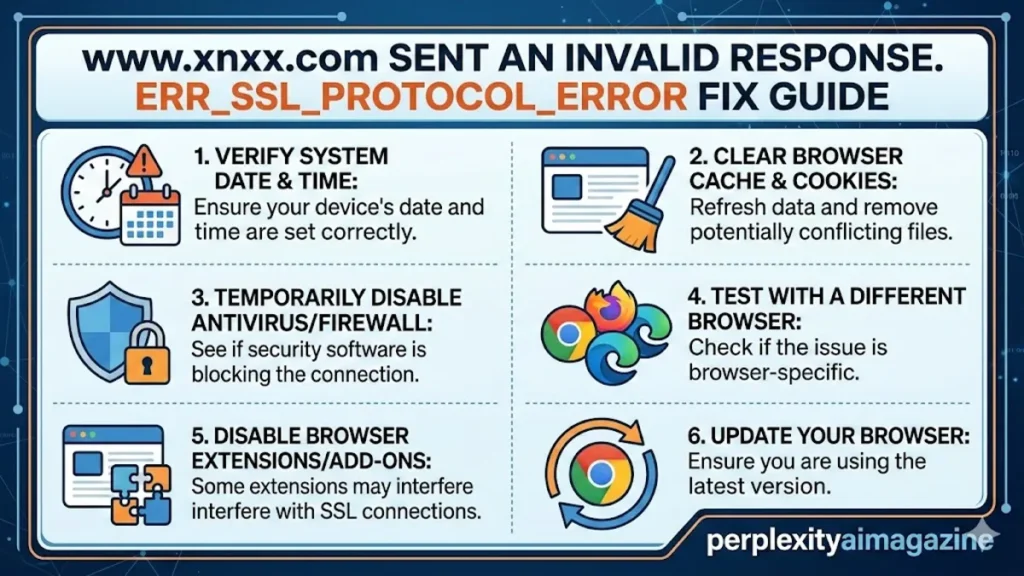
What ERR_SSL_PROTOCOL_ERROR Actually Means
When I encounter this error, I interpret it as a failed negotiation. The browser attempted to establish a secure connection but could not agree with the server on how to proceed.
This failure can occur for several reasons:
- The server uses outdated SSL/TLS versions
- The certificate is misconfigured or invalid
- The browser rejects weak encryption
- Network interference disrupts the handshake
Google’s Chromium documentation describes this error as a “generic SSL protocol failure,” indicating that the exact cause may vary (Chromium Project, 2023).
Unlike more specific errors, this one does not pinpoint the issue. Instead, it signals that something fundamental in the secure connection process has broken down. – www.xnxx.com sent an invalid response. err_ssl_protocol_error.
Browser Security and the Evolution of Standards
I have watched browsers become increasingly strict over the years. What worked a decade ago may now trigger errors.
Modern browsers enforce minimum TLS versions, typically TLS 1.2 or higher. They also reject certificates signed with weak algorithms such as SHA-1.
| Year | Security Change | Impact |
|---|---|---|
| 2015 | SHA-1 deprecated | Certificates invalidated |
| 2018 | TLS 1.0 phased out | Older servers blocked |
| 2020 | TLS 1.2 required | Legacy systems fail |
| 2023 | TLS 1.3 adoption grows | Faster, more secure |
As security researcher Troy Hunt explains, “Browsers are the gatekeepers of web security, and their policies evolve rapidly” (Hunt, 2020).
This evolution improves safety but creates compatibility challenges for older systems.
Server Misconfiguration: A Common Culprit
In many cases, I find that the problem originates on the server side. Misconfigured SSL settings can prevent proper communication.
Common issues include:
- Disabled or unsupported TLS versions
- Incorrect certificate installation
- Missing intermediate certificates
- Improper redirect rules
These problems often arise during server migrations or updates.
According to Cloudflare, “SSL errors frequently stem from incomplete certificate chains or mismatched configurations” (Cloudflare, 2022).
Even a small misstep in configuration can result in a complete failure to establish a secure connection.
The Role of Certificates and Trust Chains
Certificates are central to HTTPS. They verify that a website is who it claims to be.
When I analyze SSL errors, I often trace them back to certificate issues. A certificate must be valid, unexpired, and signed by a trusted authority.
Browsers rely on a chain of trust:
- The website’s certificate
- Intermediate certificate authorities
- Root certificate authority
If any link in this chain is broken, the browser refuses the connection.
As Let’s Encrypt notes, “Trust is established through a chain that must be complete and verifiable” (Let’s Encrypt, 2021).
This layered system ensures security but increases complexity. – www.xnxx.com sent an invalid response. err_ssl_protocol_error.
Network Interference and Local Factors
Sometimes, the issue is not with the server but with the user’s environment.
I have seen cases where antivirus software, firewalls, or proxy servers interfere with SSL connections. These tools may inspect encrypted traffic, causing protocol mismatches.
Other local factors include:
- Incorrect system date and time
- Corrupted browser cache
- Outdated browser versions
These seemingly minor issues can disrupt the delicate handshake process.
Why Some Websites Trigger the Error More Often
Certain types of websites are more prone to SSL errors, especially those with:
- Frequent configuration changes
- High traffic loads
- Multiple server endpoints
- Legacy infrastructure
In these environments, maintaining consistent SSL configurations becomes challenging.
As web security expert Scott Helme notes, “Complex systems increase the likelihood of misconfiguration, which is a leading cause of SSL errors” (Helme, 2019). – www.xnxx.com sent an invalid response. err_ssl_protocol_error.
Diagnosing the Problem: A Practical Approach
When I troubleshoot this error, I follow a structured process.
First, I check whether the issue is site-specific or system-wide. Then, I verify certificate validity using online tools or browser inspection.
Next, I examine server configurations, ensuring that TLS versions and cipher suites are compatible.
Finally, I consider local factors such as browser settings or network interference.
This layered approach helps isolate the root cause efficiently.
The Broader Implications of SSL Errors
SSL errors are not just technical inconveniences. They reflect broader trends in internet security.
As encryption standards evolve, older systems become obsolete. This creates tension between maintaining legacy compatibility and enforcing modern security.
The rise of HTTPS everywhere has made secure connections the default. According to Google’s transparency report, over 95 percent of Chrome traffic is now encrypted (Google, 2024).
This shift underscores the importance of resolving SSL issues promptly.
Expert Insights on Web Security
“SSL errors are often symptoms of deeper configuration issues,” says Scott Helme, a security researcher specializing in web headers.
Bruce Schneier, a renowned cryptographer, has argued that “security systems fail not because of encryption, but because of implementation errors.”
Meanwhile, Google’s security team emphasizes that “modern browsers prioritize user safety, even at the cost of blocking access.”
These perspectives highlight the balance between usability and security.
Takeaways
- ERR_SSL_PROTOCOL_ERROR indicates a failure in establishing a secure HTTPS connection.
- The issue may stem from server misconfiguration, outdated protocols, or certificate problems.
- Modern browsers enforce strict security standards, rejecting weak encryption.
- Network interference and local settings can also trigger the error.
- Certificates rely on a chain of trust that must remain intact.
- Diagnosing the problem requires examining both server and client environments.
Conclusion
I have come to see SSL errors not as obstacles, but as signals. They reveal the invisible systems that protect users every time they browse the web.
The ERR_SSL_PROTOCOL_ERROR, in particular, highlights the complexity of secure communication. It is a reminder that trust on the internet is not automatic. It must be negotiated, verified, and maintained.
As encryption standards continue to evolve, these errors may become more common, not less. They are part of the ongoing effort to strengthen security in an increasingly connected world.
Understanding them is not just useful. It is essential for anyone navigating the modern internet.
READ: Error 400: redirect_uri_mismatch — Causes, Fixes, and OAuth Redirect URI Configuration Guide
FAQs
What causes ERR_SSL_PROTOCOL_ERROR?
It occurs when the browser and server fail to establish a secure HTTPS connection due to protocol mismatches, certificate issues, or configuration errors.
Can this error be fixed on the user side?
Yes, sometimes. Updating the browser, clearing cache, or correcting system time can resolve local issues causing the error.
Is ERR_SSL_PROTOCOL_ERROR dangerous?
The error itself is not dangerous. It is a protective measure preventing access to potentially insecure connections.
Why does the error appear on some websites only?
It often depends on server configuration. Some sites may use outdated SSL settings or have certificate problems.
How can website owners prevent this error?
By ensuring proper SSL configuration, using valid certificates, and supporting modern TLS versions.
