
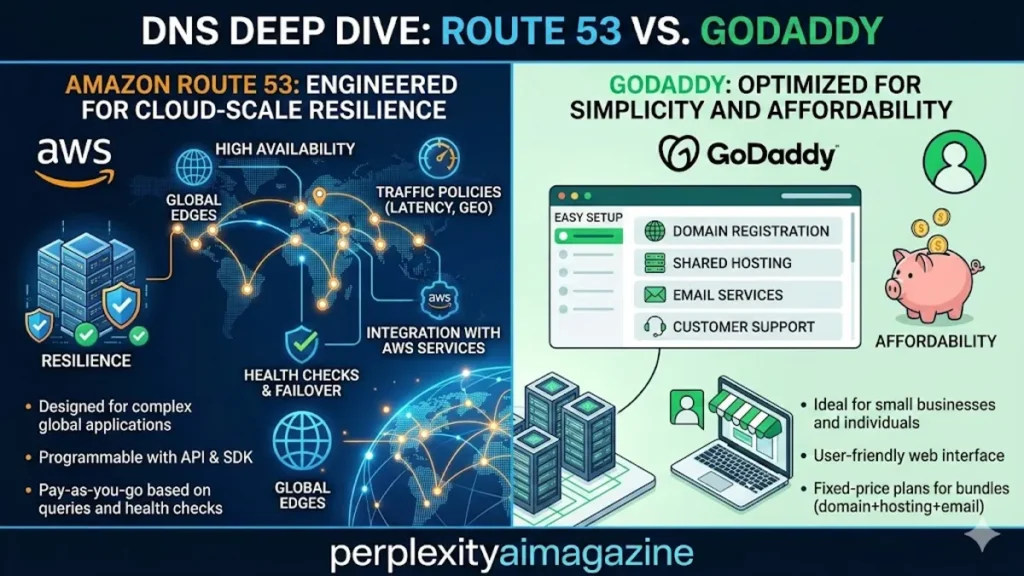
i have spent years watching how small infrastructure decisions quietly shape entire digital experiences, and few are as underestimated as DNS. At first glance, choosing between Amazon Route 53 and GoDaddy seems trivial. Both can connect a domain name to a website. But that surface similarity masks a deeper divide in philosophy, capability, and long-term impact.
Within the first few minutes of comparing them, the difference becomes clear: Amazon Route 53 is engineered for distributed systems, cloud-native workloads, and high-availability environments. GoDaddy, by contrast, is designed for accessibility, convenience, and rapid onboarding for individuals and small businesses. Each reflects a different era of the internet, and a different kind of user.
For developers, DevOps engineers, and companies scaling across regions, DNS is no longer just a lookup service. It becomes a control plane for traffic, resilience, and performance. For a small business owner launching a website, however, DNS is simply a checkbox on the way to getting online.
Understanding these distinctions is no longer optional. As applications become more distributed and user expectations more demanding, the DNS layer increasingly determines uptime, latency, and even security posture. Choosing between Route 53 and GoDaddy is not just about cost or convenience. It is about aligning infrastructure decisions with the future you are building.
The Evolution of DNS: From Simplicity to Strategic Infrastructure
i often think about how DNS began as a relatively simple solution to map human-readable names to IP addresses. Over time, it has evolved into a critical layer of internet infrastructure. The transformation reflects the broader shift from static websites to globally distributed applications.
In the early web era, DNS providers like GoDaddy focused on reliability and ease of use. Their mission was straightforward: allow users to register domains and point them to hosting providers. This simplicity remains their core strength today.
But as cloud computing matured, particularly with the rise of Amazon Web Services in the mid-2000s, DNS took on a new role. It became a dynamic system capable of routing traffic intelligently based on latency, geography, and health checks. Amazon Route 53, launched in 2010, was built explicitly for this new paradigm (Amazon Web Services, 2023).
“DNS is no longer just a phone book of the internet,” says Paul Vixie, a pioneer in DNS architecture. “It’s increasingly part of application logic” (Vixie, 2019).
This evolution explains why Route 53 feels like infrastructure, while GoDaddy feels like a product. One is embedded in the operational fabric of distributed systems. The other remains a gateway to getting online quickly.
Core Positioning: Infrastructure vs Accessibility
i have seen teams underestimate how much a provider’s philosophy affects their workflow. Route 53 and GoDaddy represent two distinct mental models of DNS.
Route 53 is tightly integrated into the AWS ecosystem. It connects seamlessly with services like Elastic Load Balancing, CloudFront, and API Gateway. This integration allows developers to treat DNS as code, automate changes, and dynamically adjust routing based on real-time conditions.
GoDaddy, in contrast, prioritizes user experience. Its dashboard is designed for clarity, not complexity. Users can add A records, CNAMEs, and MX records with minimal technical knowledge. This approach is ideal for small businesses, freelancers, and non-technical users.
| Aspect | Amazon Route 53 | GoDaddy |
|---|---|---|
| Primary Focus | Cloud-native DNS infrastructure | Domain registration and simple DNS |
| Integration | Deep AWS ecosystem | Limited external integrations |
| Target Users | Developers, DevOps teams | Small businesses, individuals |
| Complexity | High but powerful | Low and user-friendly |
“Ease of use often trades off with flexibility,” notes DNS expert Cricket Liu. “The more control you need, the more complexity you accept” (Liu, 2020).
This trade-off sits at the heart of the Route 53 vs GoDaddy decision.
Pricing Models: Predictability vs Scalability
i tend to notice that pricing is where many users initially lean toward GoDaddy, but the story becomes more nuanced over time.
Route 53 uses a pay-as-you-go model. Users pay per hosted zone and per DNS query. At first glance, this introduces variability. But in practice, costs remain surprisingly low for most use cases. A single hosted zone costs around $0.50 per month, and query pricing starts at $0.40 per million queries.
GoDaddy includes basic DNS in the domain registration cost. For a typical user, this means zero additional expense. Premium DNS features, however, come at an added cost.
| Cost Component | Route 53 | GoDaddy |
|---|---|---|
| Base DNS Hosting | $0.50/month per zone | Included with domain |
| Query Pricing | $0.40 per million queries | Included (basic) |
| Advanced Features | Paid add-ons (health checks) | Premium tiers required |
| Scalability Cost | Increases with traffic | Mostly fixed |
For low-traffic websites, GoDaddy is effectively free. But for high-scale applications, Route 53’s model aligns more naturally with growth.
Reliability and Global Performance
i have learned that DNS reliability is often invisible until it fails. At that moment, it becomes everything.
Route 53 operates on AWS’s global infrastructure, leveraging multiple edge locations and redundant systems. It is designed to handle billions of queries with low latency and high availability.
GoDaddy’s DNS is generally reliable for standard use cases. However, some engineers report migrating away from it after experiencing outages or limitations under high load.
“High-availability DNS requires geographic redundancy and fast failover,” explains AWS architect Adrian Cockcroft (Cockcroft, 2018). “That’s where cloud-native DNS services excel.”
Route 53 offers advanced routing policies, including:
- Latency-based routing
- Geolocation routing
- Weighted routing
- Failover routing with health checks
These features enable traffic optimization across regions and automatic failover during outages.
GoDaddy’s DNS, while stable, lacks this level of sophistication. It is sufficient for most small websites but less suited for mission-critical systems.
Feature Depth: Advanced Routing vs Basic Records
i often find that the true difference between these platforms emerges when complexity increases.
Route 53 allows developers to implement intelligent traffic management strategies. For example, traffic can be routed to the nearest region based on latency, improving user experience globally.
GoDaddy supports basic DNS record management. While it includes A, CNAME, MX, and TXT records, it does not offer the same level of dynamic routing or automation.
| Feature | Route 53 | GoDaddy |
|---|---|---|
| Latency Routing | Yes | No |
| Geo Routing | Yes | Limited |
| Health Checks | Yes | No |
| API Automation | Yes | Limited |
| DNSSEC | Yes | Yes (limited scope) |
“Modern applications demand programmable infrastructure,” says Kelsey Hightower, a well-known cloud engineer. “DNS is part of that story now” (Hightower, 2021).
This programmability is where Route 53 distinguishes itself most clearly.
Usability: Developer Tool vs Consumer Product
i have worked with both interfaces, and the contrast is striking.
Route 53 assumes familiarity with AWS concepts such as IAM, policies, and infrastructure-as-code tools like CloudFormation or Terraform. Once understood, it becomes a powerful control center.
GoDaddy’s interface is intuitive from the start. Users can manage DNS records without prior technical experience. This simplicity is its defining advantage.
For non-technical users, GoDaddy consistently ranks higher in usability reviews (G2, 2024). For technical teams, Route 53 offers unmatched control.
This divergence reflects their intended audiences rather than a flaw in either platform.
Real-World Use Cases: Choosing the Right Tool
i often recommend evaluating DNS providers based on the environment rather than the feature list.
| Scenario | Best Choice | Reason |
|---|---|---|
| AWS-based application | Route 53 | Native integration and automation |
| Multi-region deployment | Route 53 | Advanced routing capabilities |
| High-traffic platform | Route 53 | Scalability and reliability |
| Personal website | GoDaddy | Simplicity and low cost |
| Small business site | GoDaddy | Ease of management |
| DevOps-driven team | Route 53 | Infrastructure as code compatibility |
In practice, many professionals use a hybrid approach: registering domains with GoDaddy while managing DNS in Route 53.
Migration in Practice: A Quiet Industry Pattern
i have noticed a recurring pattern among engineers: start simple, then migrate.
Many users initially purchase domains through GoDaddy due to its accessibility. As their infrastructure grows, they shift DNS management to Route 53 for better control and reliability.
This migration typically involves:
- Creating a hosted zone in Route 53
- Replicating DNS records
- Updating name servers
- Gradually transitioning traffic
The process can be completed with minimal downtime if executed carefully.
This pattern reflects a broader truth about modern infrastructure: simplicity is valuable early, but scalability becomes essential over time.
Expert Perspectives: The Industry Weighs In
i have come across consistent themes in how experts describe this comparison.
“Route 53 is built for resilience and automation,” says AWS documentation. “It’s designed for developers building highly available applications” (Amazon Web Services, 2023).
“GoDaddy lowers the barrier to entry,” notes a review from TechRadar, “but it’s not built for complex routing scenarios” (TechRadar, 2023).
These perspectives reinforce the idea that the choice is less about superiority and more about alignment with user needs.
Takeaways
- Route 53 is designed for cloud-native, scalable, and highly available systems.
- GoDaddy prioritizes simplicity, accessibility, and low-cost entry.
- Pricing models differ: usage-based vs bundled simplicity.
- Route 53 excels in advanced routing and automation.
- GoDaddy remains ideal for non-technical users and small websites.
- Many professionals use GoDaddy for registration and Route 53 for DNS.
- The decision should reflect long-term infrastructure goals, not just immediate convenience.
Conclusion
i find that the choice between Route 53 and GoDaddy ultimately reflects a deeper question: are you building for simplicity today, or scalability tomorrow?
Both platforms succeed within their intended domains. GoDaddy democratizes access to the web, making it easy for anyone to launch a presence online. Route 53, on the other hand, empowers engineers to build resilient, globally distributed systems with precision and control.
As the internet continues to evolve, the role of DNS will only grow more strategic. It will shape not just how users find your application, but how reliably and efficiently they experience it.
For individuals and small businesses, GoDaddy remains a practical and effective solution. For developers and organizations operating at scale, Route 53 offers a level of sophistication that aligns with modern infrastructure demands.
The decision is not about which is better. It is about which is right for the future you are quietly, steadily building.
READ: How to Fix “We Couldn’t Update the System Reserved Partition” Error in Windows
FAQs
1. Is Route 53 more expensive than GoDaddy?
Not necessarily. For low traffic, Route 53 costs are minimal. GoDaddy appears cheaper initially but lacks advanced features.
2. Can I use GoDaddy for domain registration and Route 53 for DNS?
Yes. This is a common setup, combining ease of registration with advanced DNS capabilities.
3. Does GoDaddy support advanced routing like Route 53?
No. GoDaddy offers basic DNS functionality but lacks advanced routing features such as latency-based routing.
4. Is Route 53 difficult to use?
It has a learning curve, especially for non-technical users, but becomes powerful once understood.
5. Which is better for a small website?
GoDaddy is typically better for small, simple websites due to its ease of use and bundled pricing.
