
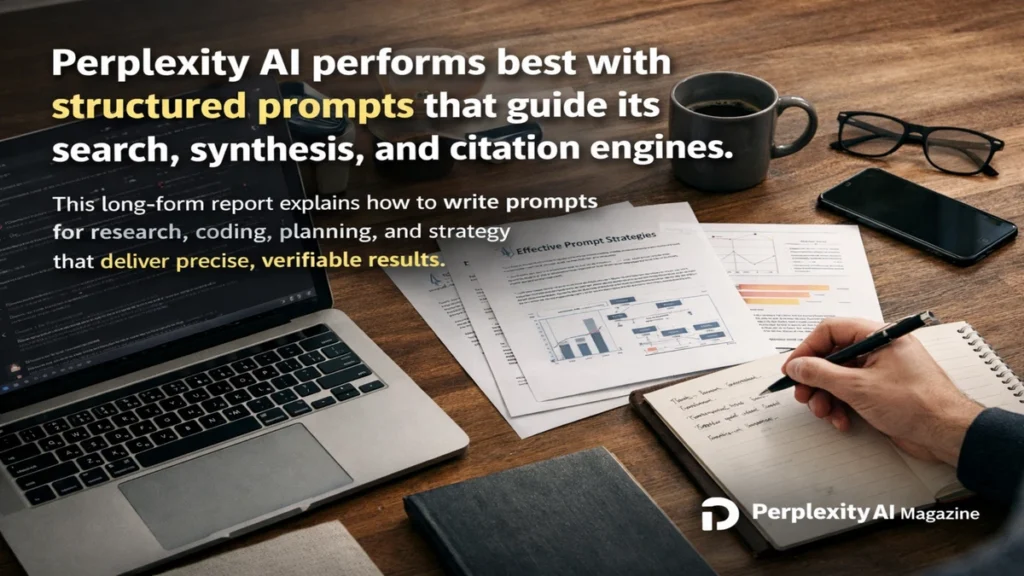
Perplexity AI is often described as an answer engine, but that description understates its dependence on human input. The quality of what Perplexity produces is tightly bound to how a question is framed. Users who type short, vague prompts get generic answers. Users who structure their prompts—defining focus, timeframes, formats, and sources—unlock something far more powerful: fast, cited research that rivals hours of manual work.
The search intent behind “perplexity prompts” is not curiosity. It is performance. Professionals, founders, students, and analysts want prompts that reliably surface real-time data, credible sources, and structured outputs. They want tables instead of paragraphs, comparisons instead of summaries, and answers that can survive scrutiny. Perplexity is uniquely suited for this because it combines conversational AI with live web retrieval, threading, and Pro-only tools like Research mode and Copilot.
In the first hundred words, the promise is clear. Well-written prompts are the difference between Perplexity acting like a smart search box and behaving like a disciplined research assistant. This article explains how to write those prompts, why certain structures work better, and how advanced users chain prompts together for iterative refinement. Drawing on real examples across research, coding, business strategy, travel planning, and competitive analysis, it shows how prompting is not a trick but a method—one that turns Perplexity into a repeatable decision-support system.
Why Prompt Structure Matters in Perplexity
Perplexity differs from traditional chatbots because it actively searches the web and cites sources. That behavior can be guided. A prompt that specifies where to look, how far back in time to search, and what format to return does not constrain the system; it sharpens it.
When users add elements like “Focus: Reddit, G2” or “past six months,” they are narrowing the search space. This reduces noise and improves relevance. Format instructions—such as “use a table with pros and cons”—signal that synthesis is expected, not narration. In effect, the prompt becomes a lightweight research brief.
Experts in information science often describe this as query engineering rather than prompt engineering. The goal is not to manipulate the model, but to align it with the task. Perplexity responds especially well to this alignment because it routes queries to different models for search, reasoning, or synthesis. Clear prompts help that routing decision, leading to more accurate and actionable outputs.
Read: Get Perplexity Pro Offer: Pricing, Discounts, and Free Access
Core Principles of High-Performance Prompts
Effective Perplexity prompts share several traits. First, they define a role or perspective. Asking the system to “act as a VC analyst” or “as a McKinsey strategist” frames the analysis. Second, they specify scope, including timeframes, geographies, or audiences. Third, they demand structure, often through tables, bullet points, or scored criteria.
Equally important is restraint. Good prompts do not overstuff instructions. They focus on outcomes rather than micromanaging process. This balance allows Perplexity to search broadly while synthesizing narrowly.
A final principle is iteration. Perplexity maintains thread context, so the first prompt rarely needs to do everything. Follow-ups like “expand section two with code examples” or “add case studies” turn a single answer into a layered analysis. This chaining behavior is where Perplexity quietly outperforms manual research.
Research and Analysis Prompts
Research prompts are where Perplexity shines most visibly. A well-constructed market scan can replace hours of browsing competitor sites and review platforms. For example, asking the system to compare top competitors with a defined focus and timeframe yields a table that surfaces patterns quickly.
| Prompt Type | Key Instruction | Typical Output |
|---|---|---|
| Deep Market Scan | Competitors, timeframe, sources | Comparison table |
| Trend Breakdown | Topic, studies, stats | Structured summary |
| Sentiment Analysis | Platform focus, date range | Thematic insights |
These prompts work because they explicitly tell Perplexity what to retrieve and how to present it. Analysts often note that the citation layer becomes more valuable as prompts grow more specific, because sources are easier to verify and challenge.
Learning and Coding Prompts
For learning, Perplexity excels at breaking down complex concepts when asked to do so deliberately. Prompts that request ELI5 explanations alongside pitfalls and practice problems create layered understanding. Adding “augment with academic papers” nudges the system toward credible sources rather than blog posts.
Coding prompts benefit from similar structure. Asking for code alone produces snippets. Asking for code with tests, optimizations, and complexity analysis produces something closer to production quality. Developers report that Perplexity’s ability to cite documentation and recent discussions helps resolve edge cases faster than static examples.
An experienced software educator describes this as guided discovery. The prompt sets the learning path, and Perplexity fills it with current, verifiable material.
Content and Planning Prompts
In content creation, Perplexity prompts act as scaffolding. Brainstorming prompts that specify platform, tone, and inspiration sources generate ideas that feel grounded rather than generic. Travel planning prompts that include budgets, priorities, and recent reviews produce itineraries that resemble human planning.
These prompts benefit from format constraints. Tables for daily schedules or bullet lists for ideas reduce ambiguity. Users often follow up by asking Perplexity to deepen a single idea or adjust constraints, such as budget or tone, without restarting the process.
Business Decision Prompts
Business prompts are among the most demanding because they require judgment. Perplexity performs best when asked to weigh tradeoffs explicitly. Pros-and-cons matrices, scored criteria, and case study references turn subjective decisions into analyzable frameworks.
A common pattern is to ask for risks and moats alongside opportunities. This counters optimism bias and forces the system to surface weaknesses. When paired with citations, these analyses become credible starting points for real decisions rather than abstract thought exercises.
The Comprehensive Business Idea Validator
One of the most effective prompt patterns is the business idea validator. By assigning the role of a seasoned analyst and demanding evaluation across problem fit, solution strength, market timing, and risk, the prompt forces a holistic view.
| Dimension | What to Ask For | Why It Matters |
|---|---|---|
| Problem Fit | TAM, SAM, pain evidence | Confirms demand |
| Solution Strength | Competitor comparison | Tests differentiation |
| Market Timing | Trends, regulation | Gauges readiness |
| Risks and Moats | Barriers, defensibility | Assesses durability |
Users report that this single prompt can surface red flags early, saving months of misguided effort. The key is insisting on sources and structure rather than enthusiasm.
Competitor Benchmarking and Tracking
Perplexity is particularly effective at competitor analysis because it can synthesize reviews, pricing pages, forums, and news. Benchmarking prompts that demand ratings, strengths, weaknesses, and threat scores turn scattered signals into a clear landscape.
More advanced users run innovation trackers weekly or monthly, monitoring patents, job postings, and product launches. By framing these prompts as timelines with impact scores, Perplexity produces living documents rather than static snapshots.
Marketing and Social Media Audits
Marketing prompts leverage Perplexity’s ability to scan public signals across ads, social platforms, and content channels. When asked to evaluate campaigns over defined periods, the system can surface recurring themes and tactics.
Social media audits work best when broken into cadence, content pillars, engagement, and growth signals. These categories mirror how human strategists think, making the output immediately usable. Visual requests, such as charts, further enhance clarity when trends emerge.
Expert Perspectives on Prompting
“Prompting is not about clever wording; it’s about clarity of intent,” says a senior product manager who studies AI adoption. “Perplexity rewards users who think like researchers.”
A venture analyst notes that structured prompts reduce cognitive bias. “When you force a table or scorecard, you force comparison. That’s where insight happens.”
An academic researcher adds that citation-driven prompts improve trust. “When sources are visible, the conversation shifts from ‘is this right?’ to ‘is this the best interpretation?’”
Takeaways
- Perplexity performs best with structured, specific prompts.
- Defining focus, timeframe, and format sharpens results.
- Research, coding, and business prompts benefit from tables and scoring.
- Iterative follow-ups unlock deeper insight without restarting.
- Pro features amplify prompt power through Research mode and Copilot.
Conclusion
Perplexity prompts are not shortcuts; they are instruments. When used thoughtfully, they turn a search interface into a disciplined research workflow. The difference lies in how users frame questions, not in hidden tricks or secret commands. By specifying scope, demanding structure, and chaining follow-ups, users can consistently extract high-quality, cited insights from complex information spaces.
As AI tools proliferate, prompting becomes a form of literacy. Perplexity’s design makes that literacy visible, rewarding clarity and intentionality. For anyone who depends on timely, trustworthy information, learning to write effective prompts is no longer optional. It is the skill that determines whether Perplexity is merely helpful—or genuinely transformative.
FAQs
What makes Perplexity prompts different from ChatGPT prompts?
Perplexity prompts should guide live search and citations, not just text generation.
Do structured prompts really improve accuracy?
Yes. Narrow focus and format constraints reduce noise and improve relevance.
Should I use long prompts?
Length matters less than clarity. Specific instructions outperform verbose ones.
How do follow-up prompts help?
They refine and deepen analysis without losing context.
Are Pro features necessary for advanced prompts?
They significantly enhance results, especially for research and multi-step tasks.
