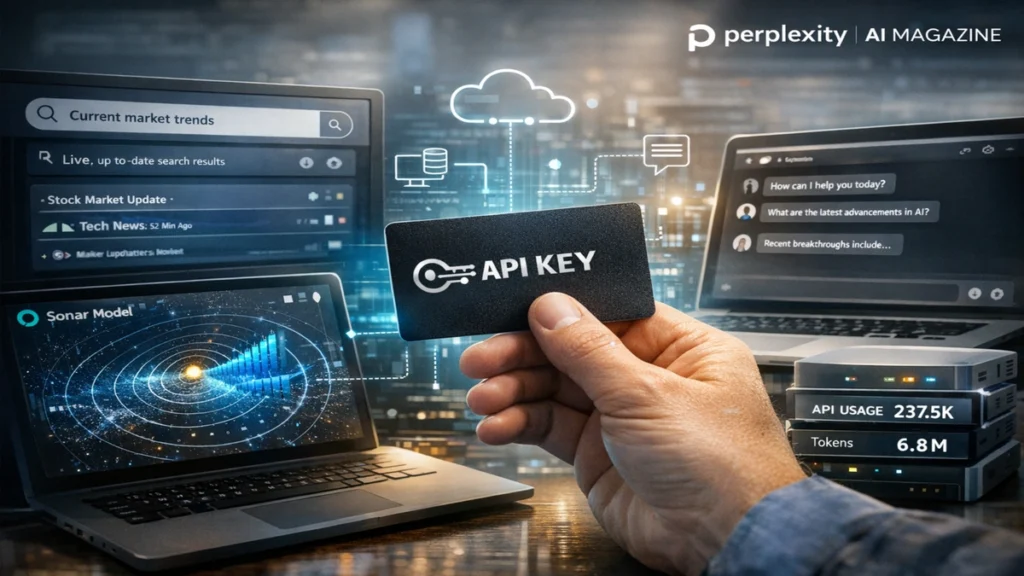
Perplexity API keys are not flashy. They are not visible in product demos or marketing videos. Yet they are the most important part of Perplexity’s platform, because they are what allow Perplexity to escape the browser and become infrastructure. An API key is the bridge between a human-facing interface and a machine-facing world, the mechanism that allows software systems to call intelligence the way they call databases, payment gateways, or mapping services.
Through a key that begins with pplx-, developers can invoke conversational AI, real-time web search, and reasoning models inside their own products. They can build research tools, internal dashboards, content systems, monitoring agents, and automation pipelines that do not just retrieve data, but interpret it. In this sense, the Perplexity API is not about adding chatbots to apps. It is about turning knowledge itself into a callable function.
This changes how software is designed. Instead of building brittle pipelines that scrape, filter, and summarize content manually, developers can delegate those steps to an external intelligence layer. Instead of maintaining large internal knowledge bases, systems can query the live web with context and reasoning built in. The result is a shift from engineering knowledge flows to orchestrating them.
This article explores what Perplexity API keys are, how they work, how they are generated and managed, how they are priced, and what their rise means for the future of software, research, and decision-making.
What a Perplexity API Key Is
A Perplexity API key is a credential that authorizes requests to Perplexity’s backend services. It identifies a developer or organization, enforces limits, meters usage, and ties activity to billing and governance. It is not a login. It does not represent a person. It represents a relationship between systems.
When a request is sent with Authorization: Bearer pplx-..., Perplexity’s infrastructure checks the key, verifies permissions, applies rate limits, logs usage, and executes the requested computation. That computation might be a conversational response, a live web search, a reasoning chain, or a combination of all three.
The key therefore functions as both a passport and a meter. It grants access and measures consumption. This dual role is what turns intelligence into a utility.
Read: rivn: How Rivian Is Turning Cars Into AI Platforms in 2026
Generating and Organizing Keys
Creating a Perplexity API key follows a simple but deliberate process. A user logs into their account, opens Settings, navigates to the API section, creates an API group, and generates a key within that group. The key is shown once and must be stored securely.
Groups exist to support governance. They allow teams to assign keys to specific applications, monitor usage, enforce limits, and revoke access when needed. This structure reflects the reality that API keys are not personal tools. They are operational assets.
A well-run organization will treat API keys like passwords, certificates, or financial credentials. They will be rotated, audited, and protected.
Step-by-Step Key Creation
Log into your Perplexity account
Open Settings from the profile menu
Select the </> API tab
Create an API group
Click Generate API Key
Name the key descriptively
Copy and store it securely
That is all that is required to turn a piece of software into a system that can think with the web.
Pricing and the Economics of Intelligence
Perplexity’s API is priced on a pay-as-you-go basis. Different models carry different costs depending on their size, context length, and whether they include live search. Pro users receive a small monthly credit, but sustained use incurs charges.
This pricing model reflects a deeper shift. Intelligence is no longer bundled into software licenses. It is sold as capacity, measured in tokens, requests, and time.
Each API call consumes compute resources. Each token represents electricity, silicon, and engineering labor. The key makes this visible and billable.
In effect, Perplexity is not selling software. It is selling cognition as a service.
Models, Endpoints, and Control
The Perplexity API exposes several layers of control.
Models define what kind of intelligence is being invoked. Some are optimized for speed, some for reasoning, some for long context, some for retrieval.
Endpoints define how that intelligence is accessed. The /chat/completions endpoint mimics conversational interfaces, allowing developers to drop Perplexity into existing architectures with minimal change.
Parameters define behavior. Temperature controls randomness. Max tokens controls verbosity. Streaming controls latency. These knobs allow developers to shape not just what the system knows, but how it expresses that knowledge.
The API is therefore not just a pipe. It is an interface to intelligence as a system.
Feature Overview
| Feature | Purpose |
|---|---|
| API key | Authentication and billing |
| Groups | Governance and tracking |
| Models | Define intelligence type |
| Endpoints | Define interaction pattern |
| Parameters | Shape behavior |
| Rate limits | Protect infrastructure |
This structure mirrors cloud computing, but applied to reasoning rather than storage or compute.
The Cultural Meaning of API-Based Intelligence
When intelligence is accessed through APIs, it stops being an individual tool and becomes a shared substrate. It becomes something embedded in products, institutions, and workflows.
Most people will not know that Perplexity is powering a system they use. They will not see the key. They will not know which model answered their question. They will simply experience software that seems more aware.
This invisibility is the true power of infrastructure.
The API key is therefore not a technical footnote. It is the hinge on which the future of knowledge turns.
Security and Responsibility
With power comes risk. A leaked key can be abused. A misconfigured system can produce harmful outputs. A poorly governed deployment can leak sensitive information.
This is why Perplexity emphasizes grouping, rate limiting, and enterprise controls. The challenge of AI is not just making it smart, but making it safe to embed.
In the coming years, governance will matter as much as performance.
Expert Reflections
One infrastructure architect described API-based AI as “the point where thinking becomes a backend service.” Another said, “We are no longer building software that uses data. We are building software that uses intelligence.” A third warned, “The hardest problem will not be scaling models, but scaling trust.”
These reflections capture the essence of the shift.
Timeline of Perplexity’s Evolution
| Stage | Meaning |
|---|---|
| Search engine | Consumer discovery |
| Chat interface | Interactive reasoning |
| API platform | Programmable intelligence |
| Enterprise | Institutional adoption |
Perplexity’s journey mirrors the evolution of computing itself.
Takeaways
- API keys turn Perplexity into infrastructure
- Intelligence becomes callable and metered
- Groups enable governance and accountability
- Pricing reflects the cost of computation
- Security becomes a core design concern
- Knowledge shifts from static to dynamic
Conclusion
Perplexity API keys are not about access. They are about transformation.
They transform Perplexity from a website into a platform, from a product into a service, from a tool into infrastructure. They allow intelligence to flow into software the way electricity flows into devices.
As more of the world’s decisions are mediated by systems that think, the quiet mechanisms that grant that thinking power will matter more than the models themselves.
The API key is one of those mechanisms.
It is the smallest, most invisible part of the system, and the most important.
FAQs
Do I need Pro to create an API key?
No. Basic access is available without Pro.
Where do I find the API settings?
Inside your account under the </> API tab.
Should I reuse one key for everything?
No. Use separate keys per application for security and tracking.
What happens if a key is exposed?
Revoke it immediately and generate a new one.
Are there enterprise controls?
Yes. Enterprises can manage groups, limits, and policies.