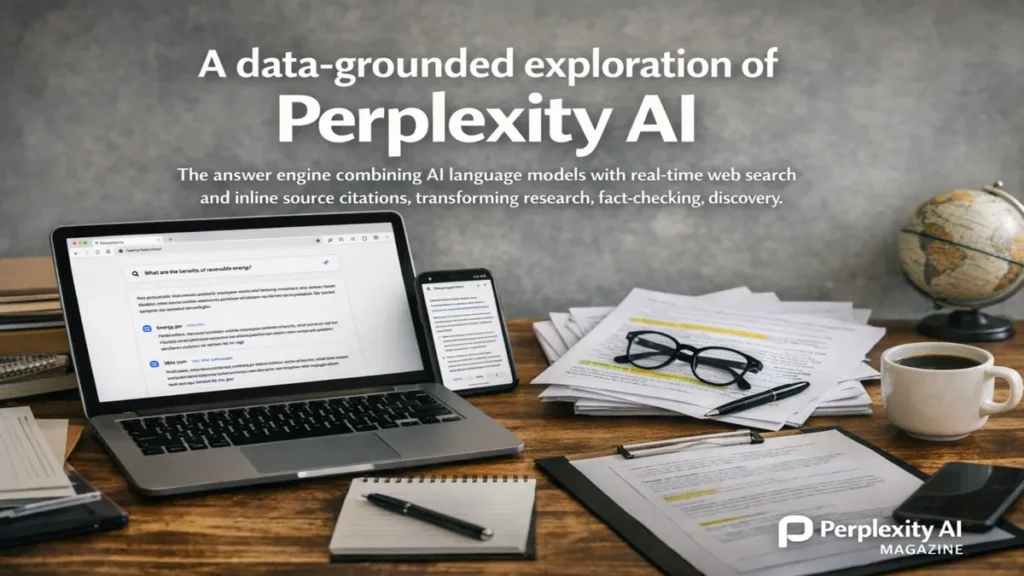
Perplexity AI sits at the intersection of search and artificial intelligence, designed to answer questions with clarity while showing its sources. In practical terms, it processes natural-language queries, searches authoritative material in real time, and synthesizes concise summaries that include verifiable citations. For users who care about accuracy—students writing papers, professionals drafting reports, journalists checking claims—this approach answers the central question of modern research: not just what is true, but where that truth comes from. – perplexity ai tool.
Within the first moments of use, Perplexity signals its difference. Instead of presenting a ranked list of links or a conversational reply without evidence, it delivers an answer accompanied by inline references. Each citation points to the underlying source, allowing readers to confirm facts quickly. This transparency reshapes how people interact with information online, replacing guesswork with traceability.
The platform’s primary purpose is iterative exploration. Users can ask follow-up questions that build on earlier results, refining context without restarting a search. This conversational flow mirrors how research actually happens—step by step, guided by curiosity and verification. Over time, Perplexity has expanded this core capability with features such as Deep Research mode, multimodal inputs, organizational Spaces, and browser-level automation, all while keeping sourcing at the center.
As generative AI tools proliferate, concerns about hallucinations and outdated knowledge have grown louder. Perplexity’s model responds directly to those concerns by grounding outputs in live data and making evidence visible. The result is not a replacement for human judgment, but a tool designed to support it, accelerating discovery while preserving accountability.
From Search Engine to Answer Engine
Perplexity reframes the traditional search workflow. Conventional search engines return pages; users must open, skim, and synthesize information themselves. Perplexity collapses that process by retrieving current material from the web and summarizing it into a coherent answer. The key distinction is that synthesis never appears alone. Every factual claim is paired with a citation.
This design choice aligns with the platform’s philosophy: answers should be efficient, but never opaque. The system’s language models handle summarization and context, while the retrieval layer ensures freshness. Together, they form what Perplexity describes as an answer engine rather than a chatbot or a link directory.
The conversational interface further differentiates the experience. Prior questions inform later ones, enabling users to refine scope without repeating themselves. This makes Perplexity particularly effective for exploratory research, where understanding evolves through iteration rather than a single query. – perplexity ai tool.
Read: Perplexity API Keys and the Rise of Machine-Callable Knowledge
Real-Time Search and Inline Citations
At the heart of Perplexity’s appeal is its commitment to real-time search. The platform does not rely solely on training data that may be months or years old. Instead, it continuously pulls information from live sources, prioritizing credibility and relevance.
Inline citations serve a dual purpose. First, they establish trust by revealing evidence. Second, they function as navigation tools, allowing users to dive deeper into original material. For researchers accustomed to cross-checking sources, this reduces friction and saves time.
This emphasis on sourcing sets Perplexity apart from many generative AI systems, where verification is often left to the user. By making citations mandatory rather than optional, the platform embeds fact-checking into the user experience.
Deep Research Mode and Autonomous Synthesis
Deep Research mode extends Perplexity’s capabilities beyond quick answers. When activated, the system performs dozens of searches autonomously, reads large volumes of material, and synthesizes findings into a structured report. This process typically completes in minutes, a task that might otherwise take hours.
The output includes summaries, contextual explanations, and a comprehensive list of sources. For complex topics—market analysis, policy reviews, technical overviews—this mode functions as an accelerated research assistant. Users can export results as PDFs or shareable pages, integrating them into existing workflows.
Despite its power, Deep Research is designed as a starting point rather than a final authority. The platform encourages review and follow-up questions, reinforcing the idea that AI supports, rather than replaces, human analysis.
Multimodal Inputs and Academic Use
Perplexity supports more than text queries. Users can upload PDFs, analyze images, or work with scanned documents through optical character recognition. This multimodal approach broadens its utility, especially in academic settings.
For scholarly research, Perplexity prioritizes peer-reviewed journals, preprints, and academic databases. Users can paste DOIs or arXiv links and receive structured summaries highlighting key findings, methods, and limitations. Pro-tier features include citation styles such as APA, IEEE, MLA, and Chicago, aligning outputs with academic standards.
This functionality makes Perplexity a practical companion for literature reviews, exam preparation, and interdisciplinary study, where navigating dense material efficiently is essential. – perplexity ai tool.
Comparison With Chat-Based AI Systems
Perplexity is often compared with general-purpose chatbots. The contrast is instructive. Chat-based systems excel at creative dialogue, brainstorming, and coding assistance, but they may require manual verification when factual accuracy matters. Perplexity, by design, prioritizes retrieval and evidence.
The table below summarizes key differences.
| Aspect | Perplexity AI | Chat-Based AI |
|---|---|---|
| Real-time search | Native and always on | Limited or optional |
| Citations | Mandatory inline sources | Often absent |
| Research depth | Deep Research mode | Slower, agent-based |
| Conversational tone | Structured summaries | More creative dialogue |
This does not make one tool superior in all contexts. Instead, it clarifies use cases. Perplexity shines where transparency and currency matter most, while chat-based systems remain strong for ideation and creative tasks.
Professional and Educational Applications
Professionals use Perplexity for rapid market analysis, competitive intelligence, and policy research. The ability to trace claims back to original sources supports decision-making in environments where accuracy carries real consequences.
Students rely on the platform for academic summaries and exam preparation. By surfacing key points with citations, Perplexity helps learners understand not just conclusions but supporting evidence. – perplexity ai tool.
Content creators and strategists use Perplexity for ideation grounded in current trends. While the platform is not optimized for creative prose, it provides a factual foundation that creators can build upon.
Organizational Tools: Spaces and Workflow Integration
Beyond search, Perplexity includes organizational features such as Spaces, which allow users to group related queries and outputs into projects. This supports longer research efforts that unfold over time.
Exports to PDF or shareable pages make it easy to distribute findings. The Comet browser extends automation further, integrating Perplexity’s retrieval and summarization capabilities directly into web navigation.
These tools position Perplexity not just as a search interface, but as part of a broader research workflow.
Strengths and Limitations
Perplexity’s greatest strength is transparency. Inline citations and real-time retrieval address core concerns about AI reliability. The platform also excels at speed, compressing complex research tasks into minutes.
Its limitations are equally clear. Perplexity is less focused on creative expression and long-form narrative generation. Context retention outside research threads is more limited than in conversational chatbots. Like all AI systems, it requires human oversight, particularly for high-stakes decisions.
Understanding these trade-offs allows users to deploy the tool where it adds the most value.
Takeaways
• Perplexity AI combines live web search with language models to deliver cited answers.
• Inline citations prioritize transparency and verification.
• Deep Research mode automates complex, multi-source analysis.
• Multimodal support broadens academic and professional use.
• The platform complements, rather than replaces, creative AI tools.
• Human review remains essential for critical applications.
Conclusion
Perplexity AI reflects a broader shift in how people seek information online. As generative systems grow more capable, expectations around accuracy and accountability have risen in parallel. Perplexity responds by making evidence visible and current, reframing AI not as an oracle but as a guide.
Its answer-engine model does not eliminate the need for judgment, nor does it promise infallibility. Instead, it offers a faster path to understanding, grounded in sources users can inspect for themselves. For researchers, students, and professionals navigating an increasingly complex information landscape, that balance of speed and transparency may prove its most enduring contribution. – perplexity ai tool.
FAQs
What is Perplexity AI?
Perplexity AI is an answer engine that combines AI language models with real-time web search and inline citations.
How is it different from a search engine?
Instead of listing links, it synthesizes answers and shows sources directly within the response.
Can it help with academic research?
Yes. It supports PDFs, DOIs, academic filters, and structured summaries with citations.
Is Deep Research available to all users?
Deep Research is available with limits on the free tier and expanded access on paid plans.
Does Perplexity replace other AI tools?
No. It complements creative and conversational AI systems by focusing on verified research.