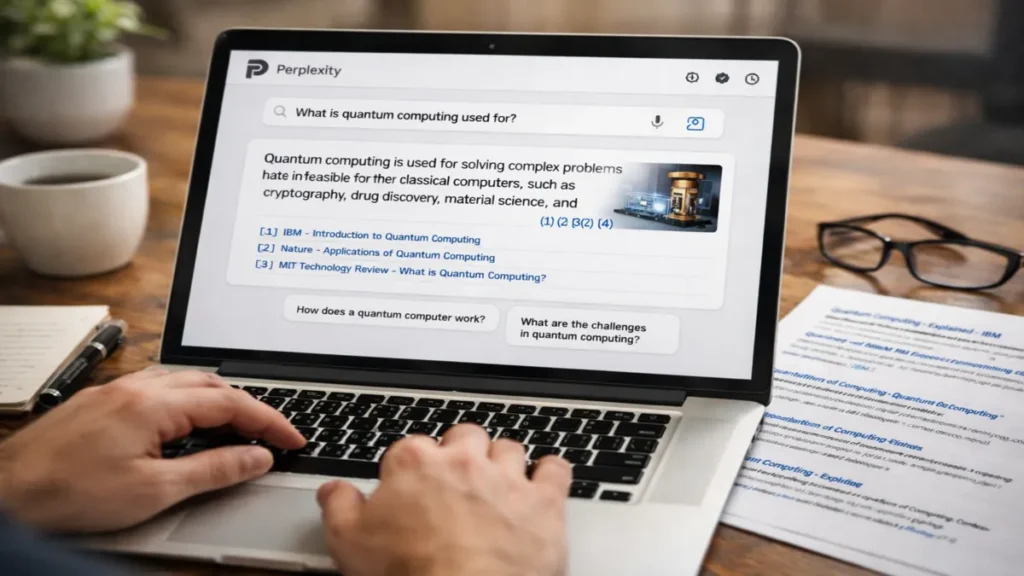
Perplexity AI emerged at a moment when searching the internet had begun to feel heavier than helpful. Pages crowded with ads, affiliate links, and search-engine-optimized filler often require more scrolling than thinking. Perplexity proposes a different experience. Instead of sending users outward into the web, it pulls the web inward, synthesizing information into a single, readable answer and showing where each claim comes from.
At its core, Perplexity is an AI-powered answer engine that combines large language models with live information retrieval. When a user asks a question, the system searches the web, selects relevant sources, and generates a narrative response with inline citations attached to individual claims. The interaction feels less like browsing and more like conversing with a research assistant.
This shift reframes what “search” is. For decades, search engines acted as maps pointing users toward information scattered across millions of pages. Perplexity acts as a guide, walking users through that landscape and summarizing what it finds along the way. The promise is speed and clarity. The risk is over-trust in a system that still interprets a noisy, imperfect web.
What Perplexity AI Is and How It Works
Perplexity AI is built on Retrieval-Augmented Generation. Instead of relying only on what a model learned during training, it retrieves documents from the web at the time of the query. Those documents are passed into the language model, which extracts key ideas and writes an answer grounded in them.
This architecture attempts to reduce hallucinations by anchoring outputs in external text. Inline citations are the visible sign of that anchoring. Each numbered link corresponds to a source that can be opened and inspected. Users are invited not just to read the answer, but to audit it.
The system also maintains conversational context. Follow-up questions are treated as part of the same inquiry, allowing users to deepen or redirect without restarting. This mirrors how human research unfolds, step by step, rather than as a series of isolated queries.
How Perplexity Differs from Traditional Search
Traditional search engines index and rank the web, then present lists of links based on relevance, authority, and popularity. Users assemble meaning by clicking, reading, and comparing.
Perplexity reverses that order. It assembles meaning first, then offers links as evidence. This change alters the user’s role from navigator to evaluator. Instead of choosing which links to open, the user chooses which claims to trust and verify.
Feature Comparison
| Feature | Perplexity AI | Google Search |
|---|---|---|
| Response format | Narrative answers with inline citations | Ranked lists of links and snippets |
| Advertising | Ad-free core experience | Ads integrated into results |
| Personalization | Conversational context | Location and account signals |
| Transparency | Visible citations per claim | Sources often implicit |
| Scope | Research and explanation | Commerce, maps, video, news |
Why Researchers and Professionals Use It
Perplexity’s strongest appeal is efficiency. Students can summarize papers in minutes. Journalists can identify primary sources quickly. Developers can explore unfamiliar technologies without drowning in documentation.
The platform becomes a starting point that compresses hours of reading into a structured overview. For people who work with information for a living, that compression is transformative.
The Limits of Citation and the Risk of Over-Trust
Citations increase transparency, but they do not guarantee accuracy. A link only shows that a source exists, not that it is reliable, current, or correctly interpreted.
Users must still evaluate domains, authorship, publication dates, and the alignment between the cited text and the claim it supports. Without that human judgment, citations can become decorative rather than functional.
Expert Reflections
“Perplexity represents a move from navigational search to explanatory search. That’s powerful, but it concentrates interpretive power in the system.”
“Citation visibility is a step toward accountability, but only if users actually click and read the sources.”
“People quickly anthropomorphize conversational systems. They treat them as knowing agents, not interfaces, and that changes how trust forms.”
Economic and Platform Implications
Perplexity’s subscription-based, ad-light model challenges the attention-driven economics of traditional search. Value is created through usefulness rather than through keeping users scrolling.
This raises questions about sustainability and fairness. If AI systems summarize content and draw attention away from original publishers, new models of compensation and attribution will be needed.
Timeline of the Search Shift
| Era | Dominant model | User role |
|---|---|---|
| 1990s–2000s | Directories and links | Navigator |
| 2010s | Algorithmic ranking | Explorer |
| 2020s | AI synthesis | Evaluator |
Ethical and Educational Consequences
As AI systems take on more cognitive labor, there is a risk that users lose practice in critical reading and comparison. Education will need to teach not just how to search, but how to audit AI-mediated knowledge.
At the same time, these systems lower barriers to complex information, offering access to those without institutional resources. The challenge is to balance accessibility with rigor.
Takeaways
- Perplexity reframes search as synthesis rather than navigation
- Inline citations improve transparency but require human verification
- The system excels at research, not at commerce or local tasks
- Trust shifts from ranking algorithms to conversational interfaces
- Economic and legal structures around content are still evolving
- Human judgment remains central to responsible use
Conclusion
Perplexity AI is less a tool than a lens, changing how people encounter knowledge. By presenting answers instead of options, it offers clarity in an overloaded information environment. Yet that clarity can conceal complexity, uncertainty, and bias if users stop questioning.
The future of search may belong to systems that explain rather than point, that converse rather than list. Whether that future deepens understanding or weakens it depends on how carefully we use these tools and how seriously we take our role as critical readers in an age of automated answers.
FAQs
What is Perplexity AI?
An AI-powered search and answer engine that provides narrative responses with inline citations.
How is it different from Google?
It synthesizes answers directly instead of returning lists of links.
Can it replace traditional search?
It complements traditional search for research, but not for shopping, maps, or multimedia.
Are its answers always correct?
No. Users must verify sources and judge credibility.
Who benefits most from it?
Researchers, students, journalists, and professionals who need fast, source-backed explanations.