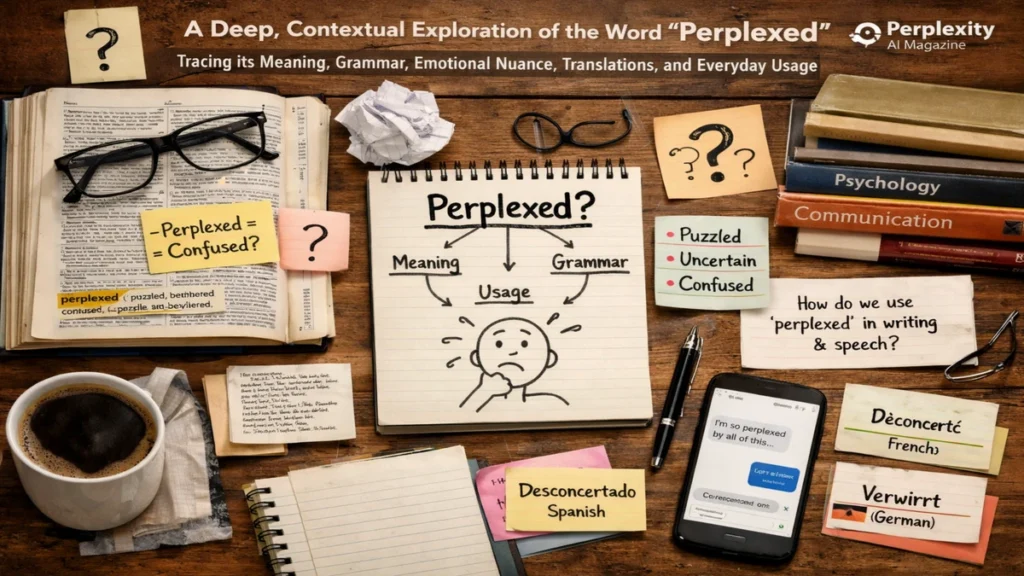
If you have ever stared at an email, a message, a rule, or a decision and felt your thoughts knot into themselves, you have experienced what the word “perplexed” names. To be perplexed is not simply to be confused, but to be mentally entangled — to sense that something should make sense and yet stubbornly does not. The word captures a very specific human state: bafflement with a touch of unease, puzzlement mixed with the awareness that clarity is missing and ought to be present. That is why people often describe not just being perplexed, but looking perplexed, because the feeling is as visible as it is internal. – perplexed definition.
In everyday usage, “perplexed” appears when expectations collide with reality. A student feels perplexed by a question that seems incorrectly worded. A manager feels perplexed by a report that contradicts every forecast. A friend feels perplexed by behavior that no longer fits what they thought they knew. The term does not describe chaos, panic, or ignorance. It describes the moment when the mind is actively trying to resolve something and failing.
This article explores what “perplexed” really means, how it differs from related words like “baffled” or “confused,” how it functions grammatically, how it translates into other languages, and why it remains one of the most precise words English has for describing mental uncertainty with emotional weight. By understanding “perplexed,” we understand something subtle about how people process complexity, contradiction, and surprise.
The Core Meaning of “Perplexed”
At its core, “perplexed” describes a state of mental entanglement. It is the condition of being puzzled, baffled, or bewildered by something that resists immediate understanding. The root idea is not absence of knowledge but obstruction of comprehension. Something is in the way of clarity.
Unlike “confused,” which can be vague or mild, “perplexed” implies effort. The person is actively trying to make sense of something and cannot. There is often a slight emotional undertone of frustration, anxiety, or discomfort. That is why “perplexed” frequently appears in narrative writing to convey both thought and feeling at once.
A perplexed person is not lost; they are stuck.
This makes the word especially useful in journalism, fiction, and academic writing, where describing the precise mental state of a subject matters more than simply stating that they “did not understand.” – perplexed definition.
Read: Is Perplexity Better Than ChatGPT? Research vs Creativity
Perplex as a Verb, Perplexed as a State
“Perplex” is the verb form. It describes the act of causing confusion.
“Perplexed” is the adjective. It describes the resulting condition.
When we say “the contradiction perplexed her,” the focus is on the thing doing the confusing. When we say “she was perplexed,” the focus is on her internal experience.
This grammatical difference is subtle but powerful. It allows writers to shift attention between cause and effect, between stimulus and response.
Nuance Table
| Aspect | Perplex (Verb) | Perplexed (Adjective) |
|---|---|---|
| Function | Causes confusion | Describes the confused state |
| Focus | External action | Internal experience |
| Example | “The error perplexed the team.” | “The team felt perplexed.” |
| Tone | Active, causal | Descriptive, psychological |
Emotional and Psychological Texture
“Perplexed” sits at the intersection of cognition and emotion. It is not just a logical failure but a felt one. That is why it pairs so often with physical imagery: a furrowed brow, a tilted head, a long pause.
Cognitive scientists describe perplexity as a state that often precedes learning. When the brain encounters information that violates expectations, it generates a feeling of perplexity that motivates deeper processing. In this sense, being perplexed is not a failure but a trigger for insight. – perplexed definition.
One linguistics professor describes it this way: “Perplexity is the emotional signal that something important doesn’t fit yet.”
A psychologist might say: “Perplexity is the discomfort that pushes the mind to reorganize itself.”
A writer might say: “Perplexity is the moment when the story stops making sense and becomes interesting.”
These perspectives show why the word persists across disciplines.
Synonyms and Their Differences
Words like baffled, bewildered, mystified, and confounded overlap with “perplexed,” but they are not identical.
“Baffled” often implies frustration and defeat.
“Bewildered” suggests being lost or disoriented.
“Mystified” implies something feels almost magical or inexplicable.
“Confounded” suggests irritation or irritation mixed with surprise.
“Perplexed” alone carries the idea of mental entanglement with an expectation of resolution.
Translation Across Languages
| Language | Translation | Nuance |
|---|---|---|
| Spanish | Perplejo | Formal, intellectual puzzlement |
| French | Perplexe | Puzzled hesitation |
| German | Verwirrt / ratlos | Confused / helpless confusion |
Each captures part of the meaning, but none map perfectly. This reflects how language shapes how we perceive mental states.
Usage in Writing and Speech
Writers favor “perplexed” when they want to convey a character’s internal tension without melodrama. Journalists use it to describe investigations that resist explanation. Academics use it to mark anomalies. – perplexed definition.
The word functions as a bridge between observation and interpretation.
“She wore a perplexed expression” tells us both what her face looked like and what her mind was doing.
Takeaways
- “Perplexed” describes mental entanglement, not simple confusion.
- It implies effort, not ignorance.
- It carries emotional weight without being dramatic.
- It differs from synonyms in its sense of unresolved expectation.
- It often signals moments that lead to learning or insight.
- It is as psychological as it is linguistic.
Conclusion
“Perplexed” endures because it names a moment we all recognize: the pause between knowing and not knowing, between certainty and understanding. It is the feeling of standing at the edge of clarity, aware that meaning is near but not yet accessible.
In that sense, perplexity is not a weakness. It is the mind’s way of acknowledging complexity. It is the friction that precedes insight, the tension that precedes understanding. To be perplexed is not to fail to think, but to think hard enough to notice that something does not yet fit.
That is why the word matters. It reminds us that confusion is not always an error. Sometimes it is the beginning of comprehension.
FAQs
What does “perplexed” mean in simple terms
It means very confused or puzzled, especially when something doesn’t make sense despite effort.
Is perplexed stronger than confused
Yes, it implies deeper mental entanglement and often emotional discomfort.
Can a situation be perplexed
No, people are perplexed; situations are perplexing.
Is being perplexed negative
Not necessarily, it often precedes learning or insight.
Does perplexed imply anxiety
Sometimes, but mild unease rather than panic.