
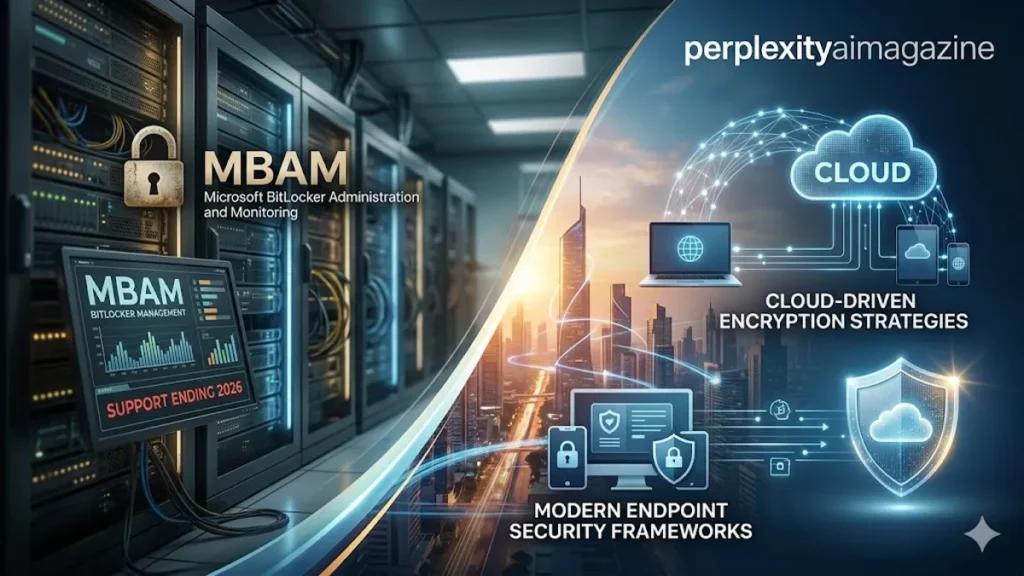
I have spent years watching enterprise security tools rise, stabilize, and quietly fade into obsolescence, and MBAM is one of the clearest examples of that lifecycle. Microsoft BitLocker Administration and Monitoring, known widely as MBAM, was once the definitive solution for managing disk encryption at scale. It simplified policy enforcement, centralized recovery key storage, and provided compliance visibility for organizations handling sensitive data. – mbam software.
In its prime, MBAM answered a critical need. Enterprises adopting BitLocker Drive Encryption required more than just encryption. They needed governance, auditing, and reliable recovery systems. MBAM delivered all of that through structured Group Policy integration, SQL-based key storage, and self-service portals that reduced helpdesk load.
Yet today, the conversation around MBAM is no longer about implementation but transition. With extended support ending in April 2026, organizations are shifting toward cloud-native alternatives like Microsoft Intune and Configuration Manager. This shift reflects broader changes in enterprise IT. Infrastructure is no longer confined to on-premises data centers. Workforces are distributed, devices are mobile, and security must follow users wherever they operate.
Understanding MBAM now means understanding both its historical importance and its diminishing role. For IT leaders, the question is no longer whether MBAM works. It is whether it still fits into the future they are building.
The Architecture That Made MBAM Essential
When MBAM was introduced as part of the Microsoft Desktop Optimization Pack, it solved a structural problem in enterprise encryption. BitLocker itself could encrypt drives effectively, but it lacked centralized management capabilities. MBAM filled that gap by creating a layered system built around policy, storage, and recovery.
At its core, MBAM relied on Group Policy templates to enforce encryption standards across devices. These policies ensured consistent cipher strength, encryption requirements, and user authentication rules. This level of control was especially important in regulated industries where inconsistency could lead to compliance violations. – mbam software.
The second pillar was its SQL Server backend. Instead of storing recovery keys in Active Directory, MBAM placed them in a dedicated database. This allowed for better scalability, improved reporting, and tighter access controls. Administrators could track encryption status across thousands of endpoints while maintaining a secure audit trail.
Finally, MBAM introduced self-service and helpdesk portals. These portals allowed users to recover lost keys without direct IT intervention, significantly reducing operational overhead. As cybersecurity researcher Niels Ferguson once noted, “Encryption without manageability is security theater” (Ferguson, 2011). MBAM transformed BitLocker from a feature into a manageable enterprise system.
Compliance and Control in Regulated Industries
MBAM’s adoption was strongest in sectors where compliance was not optional. Healthcare, finance, and government agencies relied on its reporting capabilities to demonstrate adherence to strict data protection standards.
The tool enabled detailed compliance reporting, allowing administrators to verify encryption status across all devices. Reports could identify non-compliant systems, track encryption progress, and document recovery key usage. This level of visibility was essential for audits and regulatory reviews.
In environments governed by standards such as HIPAA or PCI DSS, encryption alone was insufficient. Organizations needed proof that encryption policies were enforced consistently and that recovery processes were secure. MBAM provided that assurance through its auditing features.
A 2018 industry report highlighted that “centralized key escrow and auditability are foundational requirements for enterprise encryption deployments” (Ponemon Institute, 2018). MBAM met these requirements by combining policy enforcement with detailed tracking mechanisms.
This capability made it indispensable during its peak years. It was not merely a tool but a compliance enabler that helped organizations avoid penalties and maintain trust. – mbam software.
Infrastructure Requirements and Operational Complexity
Despite its strengths, MBAM introduced significant infrastructure demands. Deploying the system required multiple components, each with its own dependencies and maintenance requirements.
| Component | Requirement | Purpose |
|---|---|---|
| SQL Server | 2008 R2 to 2017 | Stores recovery keys and compliance data |
| IIS Web Server | Required | Hosts self-service and helpdesk portals |
| Windows Server | Up to 2016 | Runs MBAM services |
| Group Policy | Domain-based | Enforces encryption settings |
This architecture created a robust but complex environment. Organizations needed to manage database performance, maintain web servers, and ensure consistent policy deployment across domains.
Operational overhead became a recurring concern. IT teams had to monitor system health, apply updates, and troubleshoot integration issues. For smaller organizations, this complexity often outweighed the benefits.
Cybersecurity analyst Troy Hunt once observed, “The more infrastructure you maintain, the more attack surface you create” (Hunt, 2017). MBAM’s multi-layered architecture exemplified this trade-off. While it provided control and visibility, it also required significant resources to sustain. – mbam software.
The Turning Point: End of Support in 2026
The timeline for MBAM’s decline is clear and definitive. Microsoft ended mainstream support in July 2019 and placed MBAM 2.5 SP1 into extended support, which concludes in April 2026.
| Milestone | Date | Impact |
|---|---|---|
| Mainstream Support End | July 9, 2019 | No new features or improvements |
| Extended Support End | April 14, 2026 | No security updates or support |
| Post-Support Phase | After 2026 | Non-compliant for enterprise use |
This timeline has significant implications. After April 2026, MBAM will no longer receive security updates or technical support. For organizations handling sensitive data, running unsupported software introduces unacceptable risk.
Microsoft has also made its strategic direction explicit. Rather than continuing MBAM development, the company integrated its functionality into other platforms. This shift signals a broader transition toward unified endpoint management and cloud-based security.
The end of support is not merely a technical milestone. It represents a shift in philosophy. Enterprise security is moving away from isolated tools toward integrated ecosystems that combine device management, identity, and compliance.
Modern Alternatives and Strategic Direction
As MBAM approaches its end, organizations are evaluating alternatives that align with modern IT environments. Microsoft’s own solutions lead this transition.
| Solution | Deployment Model | Key Features | Best Fit |
|---|---|---|---|
| Microsoft Intune | Cloud-based | Policy management, key escrow, compliance reporting | Cloud-first organizations |
| Configuration Manager | On-premises | Integrated BitLocker management, reporting | Existing SCCM environments |
| Group Policy + AD | On-premises | Basic enforcement, key storage in AD | Small environments |
| Sophos Central | Cloud-based | Cross-platform encryption management | Mixed device ecosystems |
Microsoft Intune has emerged as the primary replacement. It integrates BitLocker management with cloud identity services, enabling centralized control without on-premises infrastructure.
Configuration Manager, formerly SCCM, provides an on-premises alternative with built-in BitLocker management capabilities. For organizations already using it, this approach eliminates the need for a separate MBAM deployment. – mbam software.
Third-party solutions also offer flexibility, particularly in environments with diverse device types or limited domain integration.
The shift toward these alternatives reflects a broader trend. Security is no longer confined to corporate networks. It must operate across cloud services, remote devices, and hybrid infrastructures.
Migration: From MBAM to Cloud-Based Management
Transitioning from MBAM to modern solutions is a structured process that requires careful planning. Organizations typically follow a phased approach to minimize disruption.
The first step involves preparing devices for co-management. This allows systems to be managed by both Configuration Manager and Intune during the transition. Administrators then create BitLocker policies within Intune, defining encryption standards and recovery options. – mbam software.
A critical phase is the migration of recovery keys. MBAM stores keys in SQL databases, while modern systems use cloud-based directories. Scripts are often deployed to back up existing keys to cloud environments, ensuring continuity.
Once keys are migrated, the MBAM client is removed from devices. Infrastructure components such as SQL servers and web portals are decommissioned only after validation confirms successful migration.
Security expert Bruce Schneier has emphasized that “security transitions are where systems are most vulnerable” (Schneier, 2015). This insight underscores the importance of maintaining MBAM infrastructure until migration is fully complete.
Azure AD and the Rise of Cloud Key Management
Cloud-based key management offers advantages that MBAM could not easily replicate. Accessibility is one of the most significant improvements. Recovery keys stored in cloud directories can be accessed from anywhere, reducing dependency on internal networks.
High availability is another benefit. Cloud platforms provide redundancy that eliminates single points of failure. This contrasts with MBAM’s reliance on local SQL servers, which require careful backup and maintenance. – mbam software.
Self-service capabilities are also enhanced. Users can retrieve keys through web portals without contacting IT support. This reduces operational costs and improves user experience.
However, cloud solutions are not without trade-offs. Automatic key rotation, a feature supported by MBAM, is not always available in cloud systems without additional configuration. Reporting capabilities may also require customization.
Despite these limitations, the overall trend is clear. Cloud-based management aligns more closely with modern enterprise needs, particularly for organizations with distributed workforces.
The Legacy of MBAM in Enterprise Security
MBAM’s legacy is defined by its role in transforming encryption management. It demonstrated that security tools must be both effective and manageable. By centralizing policies and providing detailed reporting, it set a standard for enterprise encryption solutions.
Its influence can be seen in modern platforms that integrate encryption management with broader security frameworks. Features such as centralized key storage, compliance reporting, and self-service recovery are now expected rather than exceptional. – mbam software.
As technology evolves, tools like MBAM serve as stepping stones. They address immediate challenges while paving the way for more advanced solutions. In this sense, MBAM’s relevance extends beyond its operational lifespan.
It represents a phase in the ongoing evolution of enterprise security. A phase that emphasized control, compliance, and centralized management before the rise of cloud-native approaches.
Takeaways
- MBAM played a critical role in enabling enterprise-scale BitLocker management with centralized policies and key storage
- Its infrastructure requirements introduced complexity and operational overhead for IT teams
- Extended support ends in April 2026, making it unsuitable for new deployments
- Microsoft’s strategic direction favors cloud-based solutions like Intune and integrated management platforms
- Migration requires careful planning, especially for recovery key transfer and policy alignment
- Cloud-based key management offers scalability, accessibility, and reduced infrastructure demands
- MBAM’s legacy continues to influence modern encryption and endpoint security practices
Conclusion
I see MBAM as both a milestone and a turning point in enterprise security. It solved a pressing problem at a time when encryption was becoming essential but difficult to manage. For years, it provided organizations with the tools they needed to enforce policies, protect data, and meet compliance requirements.
Yet its decline is equally instructive. Technology does not stand still, and tools that once defined best practices can quickly become outdated. The shift toward cloud-based management reflects changes in how organizations operate, how employees work, and how threats evolve.
MBAM’s story is not one of failure but of transition. It fulfilled its purpose and influenced the design of the systems that are replacing it. For organizations still relying on it, the path forward is clear. The future lies in integrated, scalable, and cloud-driven security solutions that extend beyond traditional infrastructure.
In the end, MBAM is less a relic than a reference point. It reminds us that effective security is not just about protection. It is about adaptability.
READ: Spreadsheet Formulas Guide for Excel and Sheets
FAQs
What is MBAM used for?
MBAM manages BitLocker encryption across organizations. It centralizes policy enforcement, stores recovery keys securely, and provides compliance reporting and self-service recovery tools.
Is MBAM still supported?
MBAM 2.5 SP1 is in extended support until April 14, 2026. After that, it will no longer receive updates or technical support.
Why is Microsoft replacing MBAM?
Microsoft is shifting toward cloud-based solutions like Intune and integrated management platforms to support modern, distributed work environments.
What is the best alternative to MBAM?
Microsoft Intune is the primary replacement for cloud environments, while Configuration Manager serves as an on-premises alternative.
Can MBAM still be used after 2026?
Technically yes, but it is not recommended due to lack of security updates and potential compliance risks.
