
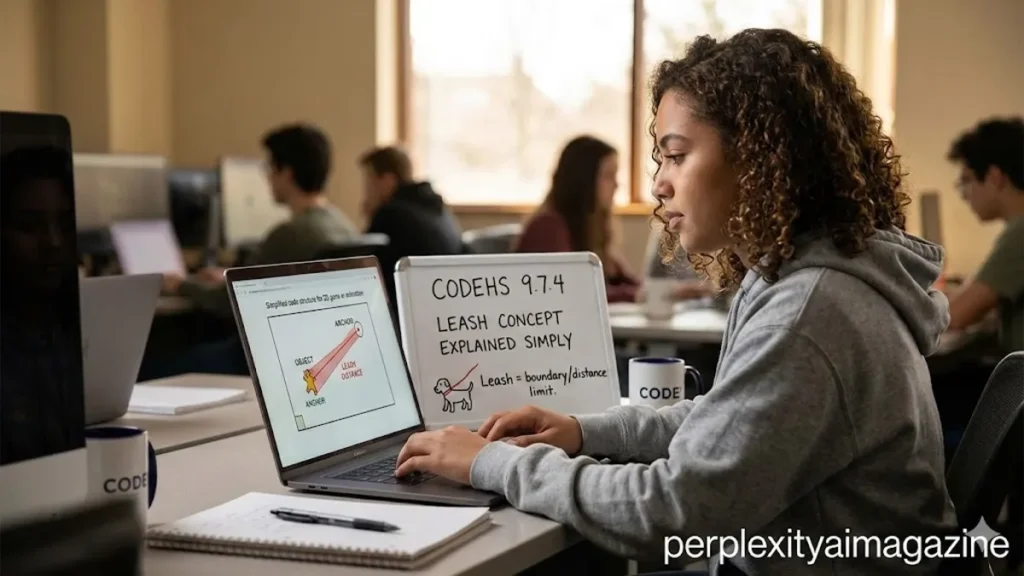
I remember the first time I encountered the “ball on a leash” problem. It looked trivial at a glance: draw a circle, attach a line, and make both follow the mouse. But within minutes, the simplicity unraveled into something deeper. The CodeHS 9.7.4 Leash exercise is not just about drawing shapes. It is about understanding how programs respond to movement, how coordinates translate into visuals, and how small mistakes ripple into confusing behavior.
If you are trying to complete 9.7.4 Leash, the goal is clear. You must create a circle that follows the mouse cursor while a line connects it to the center of the canvas. The implementation relies on event-driven programming, specifically a mouse movement handler that updates positions in real time.
Yet what appears straightforward often leads to common pitfalls. Lines disappear. Balls jump erratically. Code behaves inconsistently. These issues are not random. They reveal gaps in how beginners understand variables, object initialization, and event flow.
This article breaks down the exercise in a way that goes beyond instructions. It explores the logic behind each line of code, explains why errors occur, and connects this small assignment to broader programming principles used across industries. By the end, the leash will no longer feel like a trick. It will feel like a foundation. – 9.7.4 Leash.
The Concept Behind the “Leash” Exercise
When I analyze the leash problem, I see it as a visual metaphor for relationships in programming. One object depends on another. The line anchors to the center of the canvas, while the ball responds to the user’s input. Together, they form a dynamic system.
At its core, the exercise teaches coordinate tracking. The mouse position becomes the source of truth. Every movement generates new x and y values, which the program must interpret instantly.
This approach reflects how modern interfaces work. According to the Mozilla Developer Network, event-driven programming allows applications to “respond to user interactions such as clicks, movement, and input in real time” (MDN Web Docs, 2023).
The leash itself is simply a line whose endpoint changes continuously. The ball is a circle whose position updates with offsets to maintain its center alignment. But the conceptual leap lies in understanding that nothing moves on its own. Every change is triggered by an event. – 9.7.4 Leash.
Computer science educator Harold Abelson once emphasized, “Programs must be written for people to read, and only incidentally for machines to execute” (Abelson et al., 1996). The leash exercise embodies that idea. It forces clarity in logic.
Breaking Down the Starter Code
The starter code provided in CodeHS often gives students a framework: variables for the ball and line, a start function, and placeholders for logic. What matters is how these pieces interact.
Inside the start function, the canvas dimensions are retrieved. The center is calculated using width and height divided by two. This ensures the leash originates from the true middle, regardless of screen size.
The line is initialized with both endpoints at the center. At this stage, it is invisible because it has no length. The ball is created with a defined radius and positioned so its center aligns with the same coordinates.
The critical step comes next: attaching the mouseMoveMethod. This function connects user movement to program behavior. Without it, nothing updates.
Core Components of the Leash Program
| Component | Purpose | Common Mistake |
|---|---|---|
| Circle (ball) | Visual object following mouse | Forgetting center offset |
| Line (leash) | Connects center to mouse | Not updating endpoint |
| start() | Initializes objects | Missing object creation |
| mouseMoveMethod | Handles movement events | Calling multiple times |
The elegance of the program lies in its structure. Everything is created once. Everything else is updated dynamically.
The Role of Event-Driven Programming
Event-driven programming is the invisible engine behind the leash exercise. When I reflect on its importance, I see it as the moment students transition from static code to interactive systems.
In traditional programming, instructions execute sequentially. In event-driven systems, code waits. It listens. It reacts.
The mouseMoveMethod embodies this concept. Each time the cursor moves, the function receives an event object containing coordinates. These values drive every update.
According to Microsoft’s developer documentation, event-driven programming “enables responsiveness and interactivity in graphical applications” (Microsoft Docs, 2022). This principle is used in everything from web apps to video games. – 9.7.4 Leash.
In the leash exercise, the event loop is implicit. Students do not see it, but they rely on it. Each movement triggers a redraw, creating the illusion of continuous motion.
This shift in thinking is subtle but transformative. It teaches programmers to design systems that respond rather than dictate.
Why the Ball Needs an Offset
One of the most common errors I have seen is the ball appearing slightly off from the mouse. This happens because of how shapes are positioned in CodeHS.
The setPosition method places the top-left corner of the circle’s bounding box at the specified coordinates. But visually, users expect the center of the ball to align with the cursor.
To correct this, the radius must be subtracted from both x and y coordinates. This adjustment centers the ball properly.
This small detail reflects a broader concept in graphics programming: coordinate systems rarely align with visual intuition.
Positioning Logic Explained
| Coordinate Type | Meaning | Adjustment Needed |
|---|---|---|
| Mouse position | Desired center | None |
| Shape position | Top-left corner | Subtract radius |
| Final placement | Centered ball | Correct alignment |
As computer graphics expert Foley notes, “Understanding coordinate transformations is essential for accurate rendering” (Foley et al., 1996). Even in simple exercises, this principle applies.
Common Errors and Why They Happen
Debugging the leash exercise often reveals patterns. The same mistakes appear repeatedly, each tied to a misunderstanding of program structure.
One frequent issue is failing to initialize the line before using it. Calling methods on an undefined object leads to silent failures. The line never appears.
Another problem is recreating objects inside the update function. This causes multiple overlapping shapes and erratic behavior. The correct approach is to create once and update repeatedly.
Multiple event handler registrations can also cause instability. Each additional handler triggers redundant updates, leading to flickering or performance issues. – 9.7.4 Leash.
Software engineer Robert C. Martin has argued, “Most bugs are not logic errors but structure errors” (Martin, 2008). The leash exercise proves this point.
Understanding why errors occur is more valuable than memorizing fixes. It builds habits that extend far beyond this assignment.
Extending the Exercise: Adding Motion and Physics
Once the basic leash works, I often encourage extending it. Adding motion transforms the exercise into something closer to a simulation.
By introducing velocity variables, the ball can move independently while still connected to the leash. Collision detection allows it to bounce off canvas edges.
This introduces new concepts: timers, continuous updates, and boundary conditions. The program evolves from reactive to autonomous.
Game development relies heavily on these ideas. According to Unity Technologies, “Real-time simulations depend on frame updates and consistent physics calculations” (Unity, 2023).
The leash becomes more than a line. It becomes a constraint, a visual link between controlled and uncontrolled motion.
This extension deepens understanding and keeps the exercise engaging.
How CodeHS Structures Learning Through Exercises
CodeHS is designed to introduce programming concepts incrementally. The leash exercise sits at a critical point in that progression.
Students have already learned about shapes, variables, and functions. Now they encounter interaction. This shift is intentional.
According to CodeHS curriculum documentation, interactive graphics exercises are used to “bridge foundational syntax with real-world programming patterns” (CodeHS, 2023).
The leash assignment is not isolated. It prepares students for more complex topics such as animations, user interfaces, and game mechanics.
By solving this problem, learners gain confidence in handling dynamic input. That confidence is essential for continued growth.
Practical Applications Beyond the Classroom
What surprised me most about the leash exercise is how often its concepts appear in real applications. The idea of tracking input and updating visuals is everywhere.
User interfaces rely on similar logic. Drag-and-drop features, sliders, and drawing tools all depend on mouse tracking. Even simple animations use event-driven updates.
In data visualization, lines connecting points dynamically can represent relationships. In gaming, constraints like leashes simulate physics interactions.
The exercise may seem small, but its implications are broad. It introduces patterns used in professional development.
As developer Steve Jobs once said, “Everybody in this country should learn how to program a computer… because it teaches you how to think” (Jobs, 1995).
The leash exercise is a perfect example of that thinking in action.
Takeaways
- The leash exercise teaches event-driven programming through mouse interaction
- Objects should be created once and updated dynamically
- Correct positioning requires understanding coordinate systems
- Common bugs often stem from structural mistakes rather than syntax errors
- Extending the exercise introduces motion, physics, and timers
- The concepts apply directly to real-world applications like UI design and games
Conclusion
When I revisit the 9.7.4 Leash exercise, I no longer see it as a beginner task. I see it as a carefully designed moment in learning. It introduces interactivity, reinforces structure, and challenges assumptions about how code behaves.
The beauty of the exercise lies in its simplicity. A ball, a line, and a mouse. Yet within that simplicity are layers of understanding. Coordinates must align. Events must trigger correctly. Objects must persist.
For students, the frustration of debugging is part of the process. Each error reveals something new about how programs work. Each fix builds confidence.
In the broader landscape of programming education, exercises like this matter. They transform abstract concepts into tangible experiences. They show that code is not just instructions, but interaction.
And perhaps most importantly, they remind us that even the smallest problems can teach the biggest lessons.
Read: Packets Per Second (PPS): Network Performance Explained
FAQs
What is CodeHS 9.7.4 Leash?
It is a JavaScript exercise where a circle follows the mouse while a line connects it to the canvas center.
Why does my leash disappear?
This usually happens when the line is not initialized properly or is recreated incorrectly inside the update function.
Why is my ball not centered on the mouse?
You must subtract the radius from the mouse coordinates to align the circle’s center correctly.
Can I add animation to the leash exercise?
Yes. Using timers and velocity variables allows the ball to move independently while maintaining the leash connection.
What programming concept does this exercise teach?
It primarily teaches event-driven programming, coordinate systems, and real-time updates.
