
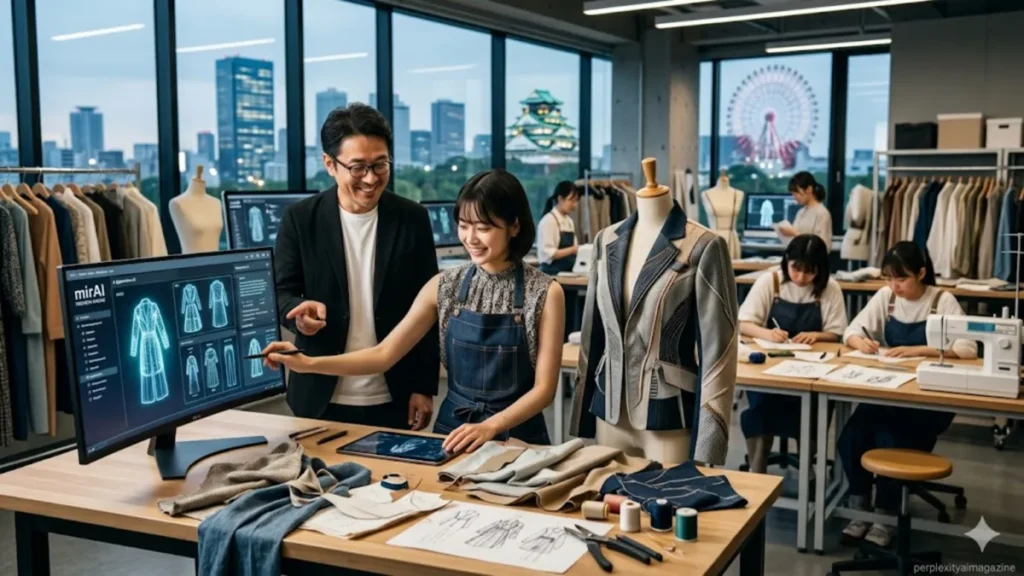
At Izuo Technical High School in Osaka, the rhythmic hum of sewing machines now competes with the soft tapping of tablet pens and the quiet whir of high-performance processors. This intersection of manual craft and digital innovation is led by Naoki Takata, a fashion engineering teacher who has become a pivotal figure in Japan’s “mirAI for Japan” initiative. The program, supported by Microsoft, aims to modernize the Japanese classroom by positioning Artificial Intelligence not as a replacement for the human spirit, but as a sophisticated “co-pilot.” For Takata’s students, this means using image-generating AI to visualize complex garments, design presentation slides for fashion shows, and edit video content with a speed that was previously unimaginable in a high school setting. 日本語学習 ドキュメンタリー 人工知能 オフィスファッション
The core intent of this pedagogical shift is to prepare students for a global fashion industry that is increasingly reliant on rapid prototyping and AI-driven ideation. By integrating these tools early, Takata is ensuring his students enter the workforce with both the tactile skills of a tailor and the digital literacy of a modern designer. Importantly, the curriculum dictates that AI enters the process only after manual brainstorming and sketching are complete. This ensures that the “imagination” remains human-centric. As Japan grapples with a labor shortage and a need for digital transformation (DX), the success of Izuo Technical High School serves as a documentary-style blueprint for how vocational education can adapt without losing its historical soul. – 日本語学習 ドキュメンタリー 人工知能 オフィスファッション.
The Architect of the New Atelier
Naoki Takata did not set out to revolutionize fashion education. Originally trained in electronics and information engineering, he transitioned into the fashion department due to a critical teacher shortage. This unique background allowed him to view the “needle and thread” through the lens of a systems engineer. After completing the mirAI for Japan training, Takata realized that the barriers to entry in high-end design were often technical rather than creative. “AI lowers the hurdles for students who have brilliant ideas but struggle with the precision of initial technical drawings,” says Takata. By using AI to refine their conceptual sketches, students gain the confidence to pursue more ambitious physical projects.
The impact has rippled beyond the fashion department. Students from unrelated disciplines, intrigued by the “AI art” projects and the high-tech video editing rooms, have begun joining the school’s IT clubs. This cross-pollination is a key goal of the mirAI program, which seeks to foster a generalized “AI fluency” across the Japanese youth population. The classroom has evolved from a traditional workshop into a hybrid laboratory where the ethics of data sources and copyright are discussed as frequently as fabric tension or hemline aesthetics. – 日本語学習 ドキュメンタリー 人工知能 オフィスファッション.
Comparison of Educational Paradigms
| Feature | Traditional Fashion Education | AI-Integrated Fashion Engineering |
| Primary Toolset | Sketchbooks, mannequins, shears | Generative AI, CAD, video editing software |
| Ideation Speed | Days to weeks for multiple iterations | Hours for high-fidelity visualizations |
| Core Philosophy | Mastering the physical medium first | AI as a “Co-pilot” for human imagination |
| Industry Readiness | Focused on artisanal craftsmanship | Hybrid focus on craft and digital workflow |
| Output | Physical garments and static portfolios | Garments, AI-aided media, and video lookbooks |
The “Co-Pilot” Philosophy in Practice
In Takata’s curriculum, the introduction of technology is carefully sequenced to avoid “creative atrophy.” Students begin each project with a “blank page” exercise—manual brainstorming and hand-drawn sketches. Only once the conceptual seed is planted do they turn to image-generating AI to explore variations in texture, color, and silhouette. This methodology mirrors the professional workflows of major fashion houses in Tokyo and Paris, where AI is used to simulate how a specific drape might look in silk versus wool before a single yard of fabric is cut. This efficiency is critical in a school environment where resources and time are finite. – 日本語学習 ドキュメンタリー 人工知能 オフィスファッション.
Expert voices in the field echo the necessity of this balance. “The danger of AI in education is the temptation to skip the struggle of creation,” notes Dr. Hiroshi Ishiguro, a prominent Japanese roboticist and social critic. “Takata’s approach of ‘human-first, AI-second’ is the only way to ensure that technology enhances rather than erases student identity.” By treating AI as a collaborative partner, the students learn to critique the machine’s output, checking for biases in the data or anatomical errors in generated figures, which hones their critical thinking and fact-checking skills.
Timeline of AI Integration at Izuo Technical
| Period | Milestone | Impact on Student Body |
| 2023 | Enrollment in mirAI for Japan | Teachers undergo intensive AI literacy training. |
| Early 2024 | Pilot Program Launch | Fashion students begin using AI for visualization. |
| July 2025 | “Stitching the Future” Report | National recognition of the school’s digital model. |
| Late 2025 | Cross-Departmental Clubs | Non-fashion students engage in AI-art and IT projects. |
| 2026 | Industry Partnership | Integration of AI video tools for professional lookbooks. |
Beyond the Runway: Ethics and Digital Literacy
The integration of AI is not merely about aesthetic output; it is a gateway to discussing the complex legal and ethical landscape of the 21st century. Takata devotes significant instructional time to the nuances of copyright law and the ethical implications of using Large Language Models (LLMs) and diffusion models. Students are taught to question where the training data comes from and how to navigate the murky waters of “AI-generated” versus “AI-assisted” work. This level of sophistication is rare in secondary education but essential given Japan’s recent legislative pushes regarding AI transparency and safety. – 日本語学習 ドキュメンタリー 人工知能 オフィスファッション
Furthermore, the time saved through AI-powered video editing and slide creation has allowed Takata to deepen the “fashion engineering” aspect of the course. With the “pre-production” phase streamlined, students spend more time in the “production” phase—the grueling but rewarding work of pattern making and garment construction. “Efficiency is the gift that AI gives back to the artisan,” says fashion technologist Syuzi Pakhchyan. At Izuo Technical, this gift is used to ensure that the “Technical” in their school name remains a badge of high-level proficiency in both the digital and physical realms.
Key Takeaways from the Izuo Model
- Human-Centric Design: AI is strictly a “co-pilot” used only after manual sketching and brainstorming are finalized.
- Efficiency Gains: Generative tools significantly reduce preparation time for fashion shows, slides, and video editing.
- Digital Literacy: Students are trained in AI ethics, copyright, and the identification of data bias.
- Interdisciplinary Interest: The fashion department’s AI success has attracted students from other disciplines to IT and art clubs.
- Professional Alignment: The curriculum mirrors the actual digital transformation currently occurring in the global fashion industry.
- Teacher as Facilitator: Takata’s background in engineering allows him to bridge the gap between vocational craft and modern tech.
- Scalable Framework: The mirAI for Japan program provides a replicable model for other technical schools across the country.
A Balanced Reflection on Educational Evolution
The story of Naoki Takata and his students is a microcosm of a larger debate happening across the globe: can technology and tradition coexist? In the context of Japanese education, which is often characterized by a rigorous adherence to established methods, the Izuo model is a radical but necessary departure. It acknowledges that the future of work will not involve choosing between a needle and a computer, but rather mastering the dialogue between the two. The students are not losing their ability to sew; they are gaining the ability to lead.
As we look toward the next decade, the “documentary” of AI in the classroom will likely show that the most successful students are those who can navigate this hybridity. Takata’s work suggests that the true value of AI in schools isn’t found in the images it generates, but in the time it frees up for human connection and deep work. At the end of the day, a garment designed by AI but stitched by a student’s hand represents a new kind of authenticity—one that is prepared for the challenges of a digital future while remaining firmly rooted in the physical present.
READ: DigitalEdge.org Guide: What Is Edge Computing in Cloud Computing
FAQs
What is the “mirAI for Japan” program?
Supported by Microsoft, mirAI for Japan is a comprehensive training initiative designed to equip Japanese educators with practical AI skills. The program focuses on integrating tools like generative AI into various subjects to enhance creativity and reduce administrative burdens, helping teachers transform their classrooms into hubs of modern digital literacy.
Does AI replace the need for students to learn how to draw or sew?
No. At Izuo Technical High School, teacher Naoki Takata emphasizes that students must master foundational skills like manual sketching, imagination, and critical thinking first. AI is used as a “co-pilot” to refine concepts and visualize ideas after the initial human creative work is done, ensuring students still value traditional craftsmanship.
What specific AI tools are used in the fashion engineering class?
While specific brand names are often kept general to focus on the pedagogy, the curriculum utilizes image-generating AI for design visualization, AI-powered presentation tools for slide creation, and AI video editing software to produce fashion show content efficiently.
How does the school handle the ethical concerns of AI?
Ethics is a core component of the curriculum. Students learn about copyright laws, the potential for data bias in AI models, and the importance of fact-checking. They are encouraged to be critical users of technology rather than passive consumers, understanding the limitations of large language models.
Has this program influenced students outside the fashion department?
Yes. The success of the AI integration in the fashion engineering department has sparked broad interest across the school. Many students from non-fashion backgrounds have started joining IT clubs and participating in AI-driven art projects, fostering a culture of innovation throughout the campus.
