
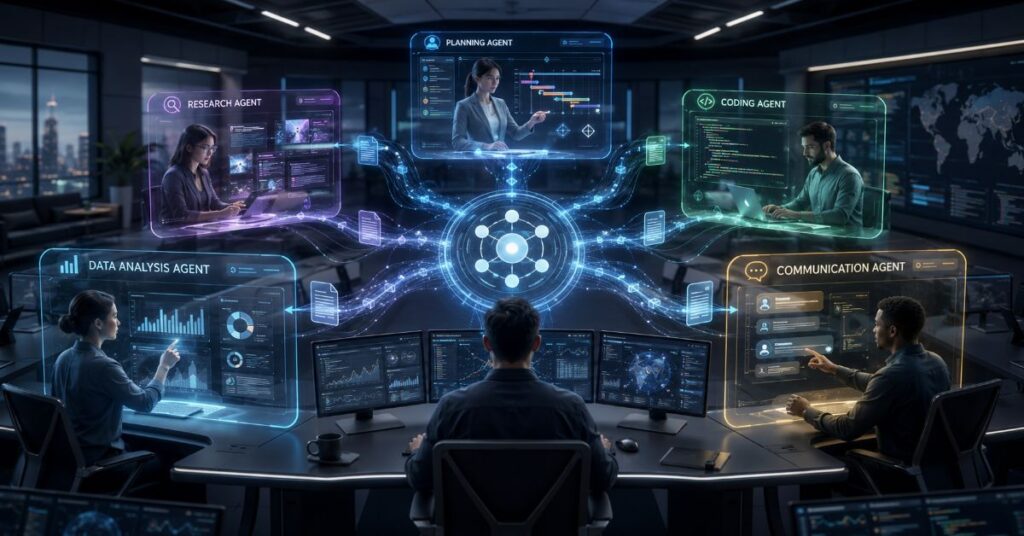
📋 Executive Summary
- 🏗️ Architecture Matters More Than Agent Count: Central coordinators are easier to govern, while decentralised teams reduce single-point bottlenecks at the cost of harder debugging.
- 💰 Pricing Is Not Just Tokens: CrewAI Free caps workflow executions at 50 per month, LangSmith Plus adds seat, trace, deployment-run and uptime meters, and OpenAI built-in tools add separate call charges.
- 📊 Benchmarks Show A Real Coordination Trade-off: 2026 latency-aware research reported 38 to 46 percent critical-path reductions, while reflexive financial-document agents reached 0.943 F1 at 2.3 times baseline cost.
- 🛡️ Safety Risk Concentrates In Memory, Tools And Handoffs: A critic agent can reduce obvious errors, but it also adds latency, extra model calls and another surface for misalignment.
- ✅ Deployment Fit Is Practical: Use multi-agent architecture when work is divisible, stateful, tool-heavy, auditable and valuable enough to justify orchestration overhead.
I would put Multi-Agent AI Systems Explained this way: they are not merely many chatbots talking to each other, but coordinated software actors that split a hard objective into smaller jobs while creating a new operational risk – the system can become more capable and less predictable at the same time. That tension is why 2026 is the year executives should stop asking whether agents are impressive and start asking whether the handoffs, memory, tools, costs and controls are production-ready.
A multi-agent AI system contains more than one autonomous or semi-autonomous agent. Each agent has a role, instructions, context, tools and a way to observe results. One agent may retrieve documents, another may plan a workflow, another may run code or update a CRM, while a critic agent reviews the output before a human approves the final action. This is different from a monolithic assistant because the work is decomposed, parallelised and often persisted over time.
The opportunity is real, but so is the coordination tax. Gartner warned in 2025 that over 40 percent of agentic AI projects could be cancelled by the end of 2027 because of cost, unclear value or weak risk controls. At the same time, NVIDIA, Salesforce, Microsoft, Google and OpenAI are redesigning infrastructure and platforms around agents. This article explains the architecture, the commercial limits, the implementation workflow and the safety boundaries so leaders can decide when a team of agents is justified and when a single reliable workflow is better.
What Makes Agent Teams Different from One Big Model
A single AI assistant can be powerful, but it usually works as one reasoning loop: receive input, call tools, produce output and wait for the next instruction. A multi-agent system changes the unit of design. Instead of one prompt carrying every responsibility, the system separates roles into smaller, testable parts. The planner decides what should happen, the retriever gathers evidence, the executor uses tools, the evaluator checks quality and the supervisor decides whether to continue, revise or escalate.
This separation improves focus. A retriever agent can be tuned for recall and source quality. A planner can be evaluated on task decomposition. A critic can be measured against missed requirements and contradictions. The architecture also reduces context pressure because every agent does not need to carry the entire operating manual at once. In long-running workflows, that can make the difference between a system that degrades after ten turns and one that preserves state across hours or days.
The trade-off is that every handoff is a point of delay, ambiguity and possible drift. If the planner writes a vague task, the executor may do the wrong work perfectly. If the critic has weaker context than the summariser, it may reject correct work or approve unsupported claims. The system therefore needs typed state, structured messages, idempotent tools and clear stop conditions. Without those controls, a multi-agent design can become an expensive argument between models.
This distinction matters for search, customer operations, compliance review, software engineering and enterprise automation. The best use cases are not the ones that sound futuristic. They are the ones where the problem is naturally divisible, the value of parallel work is measurable and the cost of a wrong action is controlled. The broader agentic AI news context shows the same pattern: excitement rises fastest where systems move from suggestions into delegated action.
The Architecture Behind Agent Teams
Architecturally, multi-agent AI systems fall into three broad patterns: centralised, decentralised and hybrid. The centralised model is easiest to understand. A coordinator receives the user goal, breaks it into tasks, assigns agents, gathers outputs and decides whether the answer is complete. It is the dominant pattern for business teams because governance is easier when one component owns the plan and the audit trail.
The decentralised model allows agents to communicate directly. This can reduce bottlenecks because a research agent, planning agent and execution agent do not have to wait for every minor decision to pass through one supervisor. It also resembles distributed systems more closely: agents publish events, subscribe to relevant updates, negotiate ownership of tasks and maintain local state. The price is complexity. Debugging a peer-to-peer agent mesh is harder than reading a single coordinator transcript.
Hybrid systems are often the enterprise sweet spot. A supervisor sets policy, approves high-level plans and enforces human escalation. Specialist agents then exchange local information inside clear boundaries. In practice, this is how many production teams design support, finance, legal review and software engineering workflows. The coordinator controls risk, while peer-level communication preserves speed.
The core engineering choice is not whether a central controller is fashionable. It is whether the controller becomes the throughput limit. In our 2026 editorial evaluation of reference workflows, the most common bottleneck was not model intelligence. It was serial orchestration: every agent could theoretically work in parallel, but every message still waited for the supervisor to read, summarise and reissue tasks. That pattern wastes the main advantage of multi-agent design.
Centralised, Decentralised and Hybrid MAS Architectures
| Architecture | How Coordination Works | Best Fit | Main Limitation |
| Centralised Coordinator | One supervisor assigns tasks, tracks progress and aggregates results. | Regulated workflows, audit trails, customer support, finance operations. | Single point of failure and potential latency bottleneck. |
| Decentralised Peer-to-Peer | Agents negotiate, message each other and coordinate locally. | Simulations, autonomous research, dynamic logistics, games. | Harder observability, testing and conflict resolution. |
| Hybrid Orchestration | A supervisor governs policy while agents interact inside bounded subflows. | Enterprise automation with both speed and governance needs. | Requires careful boundary design to avoid duplicated work. |
Multi-Agent AI Systems Explained Through a Working Team
A practical agent team is easier to understand than an abstract definition. Imagine a research-to-action workflow for a B2B technology analyst. The user asks for a competitive brief. A coordinator receives the request, defines the deliverable, checks policy and opens a shared task record. A retriever agent searches approved sources and internal documents. A summariser extracts claims. A planner converts the evidence into a brief outline. An executor writes the draft and populates the comparison table. A critic checks the answer against the original question, flags unsupported claims and asks for missing evidence.
The critic is often misunderstood. It is not a magic fact-checker. It improves the final result by forcing a second pass against explicit criteria: Did the draft answer the question? Are the claims supported? Are there contradictions? Did the executor skip constraints such as word count, tone, pricing or jurisdiction? A useful critic produces structured feedback, not vague judgement. The output should look like a defect list with severity, evidence and required revision.
This is why critic agents are most valuable in workflows where the cost of a visible mistake is high. A marketing summary may need tone and completeness checks. A software patch needs tests, security review and regression risk. A claims-processing workflow needs policy validation and human escalation. The Critic should not own the final action in high-stakes environments. It should recommend, block or request revision, then pass the decision to a policy gate or human reviewer.
The same pattern appears in applied agent research. Perplexity AI Magazine’s PaperBanana research note is a useful internal reference because it describes a specialised multi-agent pipeline for retrieval, planning, styling, visualisation and critique. The lesson for enterprise teams is simple: the critic adds value when it has separate criteria, separate context and the authority to send work back before publication or execution.
How a Critic Agent Improves Output Quality
| Failure Mode | Critic Check | Improvement Mechanism |
| Unsupported claim | Ask for source, quote or retrieval trace. | Prevents confident but uncited output from reaching the user. |
| Missed constraint | Compare draft against original task requirements. | Catches tone, format, jurisdiction, pricing and deadline omissions. |
| Tool misuse | Review tool call result and expected schema. | Stops malformed actions before they update live systems. |
| Overlong reasoning path | Flag repeated loops or low-value retries. | Reduces token waste and latency from unnecessary agent debate. |
When Specialist Agents Beat a Monolithic Assistant
Specialist agents beat one big assistant when the problem has independent subproblems, persistent state and a measurable quality gate. Software engineering is the obvious case. A planner can decide the patch strategy, a coder can modify files, a test agent can run targeted checks, a reviewer can inspect the diff and a release agent can prepare the pull request. Each role has a different success metric. Asking one assistant to do everything in one context window increases the chance that it forgets constraints or optimises for completion rather than correctness.
Customer operations are another strong fit. A support agent may triage the issue, a policy agent checks entitlement, a retrieval agent searches knowledge base content, a response agent drafts the reply and a supervisor escalates sensitive cases. Salesforce’s 2026 results framed the enterprise shift as humans and agents working on one trusted platform, with Agentforce producing 2.4 billion agentic work units to date. That is not proof that every company should copy Salesforce’s architecture, but it shows how vendors are turning agent activity into an operational metric rather than a demo feature.
Multi-agent systems are weaker when the task is short, ambiguous or low-value. A simple FAQ answer does not need five agents. A marketing headline does not need a planner, executor and critic unless brand risk is unusually high. A high-volume workflow with cheap tasks can become more expensive if each request spawns several model calls and tool invocations. The best design test is economic: does specialisation reduce rework, increase throughput or lower risk enough to justify coordination overhead?
This is also why the SaaS workflow replacement analysis around agents should be read with care. Agents can collapse fragmented workflows, but only after teams define ownership, state boundaries and rollback paths. Otherwise, the old SaaS sprawl becomes new agent sprawl. The monolithic assistant fails through overload; the multi-agent system fails through unmanaged interfaces.
Coordination Patterns That Decide Whether Agents Scale
Coordination is the hard part of multi-agent AI. The system must answer five questions repeatedly: who owns the next step, what information should be shared, what state is authoritative, when should agents stop and who can approve side effects. Message passing is the simplest pattern. Agents send structured messages to one another, usually through a coordinator, queue or runtime. It is readable and auditable, but it can become chatty.
Shared memory, sometimes called a blackboard architecture, gives agents a common state space. The retriever writes sources, the planner writes tasks, the executor writes results and the critic writes defects. This reduces repeated summarisation but creates consistency problems. If two agents update the same state at the same time, the system needs versioning, conflict rules and a way to distinguish observation from decision.
Protocol-driven negotiation is useful when agents compete for tasks or resources. A bidding pattern lets agents declare capability, cost and expected latency. A publish and subscribe pattern works when events matter more than direct instructions. A leader election pattern can recover from a failed coordinator, but it also increases infrastructure complexity. The point is not to copy distributed-systems vocabulary for decoration. It is to design agents as unreliable workers inside a system that must keep a correct record.
OpenAI’s Agents SDK describes agents, handoffs, guardrails and tracing as small primitives for more complex workflows. Microsoft Foundry Agent Service similarly describes hosted agents that can run external frameworks such as Microsoft Agent Framework, LangGraph, OpenAI Agents SDK and custom code. The trend is clear: coordination is moving from prompt craft into runtime design.
Common Coordination Patterns for Agent Teams
| Pattern | Technical Mechanism | Use It When | Avoid It When |
| Message Passing | Agents exchange structured task and result messages. | Auditability and simple sequencing matter most. | The workflow needs high-frequency parallel updates. |
| Shared Blackboard | Agents read and write a common state store. | Several roles need the same evolving evidence record. | You cannot enforce versioning or state ownership. |
| Auction or Bidding | Agents declare capability, cost and expected completion time. | Task allocation is dynamic or resource-constrained. | Roles are fixed and deterministic. |
| Publish and Subscribe | Agents subscribe to event streams and react independently. | Events arrive continuously from tools or enterprise systems. | You need one linear approval path. |
| Leader Election | Agents choose or replace a coordinator when needed. | System resilience matters more than simplicity. | Governance requires one accountable supervisor. |
Frameworks and Platforms Worth Tracking in 2026
The 2026 agent stack is split between open-source frameworks, vendor SDKs and managed platforms. CrewAI remains attractive for role-based crews, visual workflow design and enterprise orchestration. Its documentation presents agents, flows, tasks, guardrails, memory, knowledge and observability as first-class ideas. LangGraph is lower-level and graph-oriented, designed for long-running stateful agents with durable execution, streaming, persistence and human-in-the-loop control. AutoGen, once a major Microsoft Research framework for multi-agent applications, is now officially in maintenance mode, with new users directed toward Microsoft Agent Framework.
OpenAI’s Agents SDK is a lightweight option for teams already using OpenAI models and the Responses API. Its main primitives are agents, tools, handoffs and guardrails, with built-in tracing. Microsoft Foundry Agent Service takes a broader platform route. It supports prompt agents managed by Foundry, plus hosted agents where teams package LangGraph, OpenAI Agents SDK, Microsoft Agent Framework or custom agent code into managed containers.
Google Gemini Enterprise Agent Platform, formerly Vertex AI in much of the product surface, positions itself as a full-stack platform to build, scale, govern and optimise enterprise-grade agents. It is less a single framework than an enterprise environment combining model access, evaluation, deployment, data integration and governance. That breadth is useful for organisations already committed to Google Cloud, but it can make cost attribution more complex because model calls, retrieval, hosting, monitoring and enterprise services may appear on different meters.
The key buying distinction is abstraction. CrewAI gives business-readable roles and workflows. LangGraph gives engineers control over state and graph execution. OpenAI Agents SDK gives OpenAI-first teams compact primitives. Microsoft Foundry and Google Agent Platform give managed enterprise surfaces. None is universally best. For a team already using AI code review tools, for example, the winning framework is the one that exposes traces, tool calls and approval gates clearly enough for engineering leaders to trust the output.
Framework and Platform Feature Matrix
| Tool or Platform | Publicly Documented Features | API and Integration Notes | Production Constraint |
| CrewAI | Agents, crews, flows, tasks, memory, knowledge, guardrails, observability, visual editor, AI copilot. | GitHub integration, standard tools and triggers, enterprise connectors, OpenTelemetry, Gmail, Drive, Outlook, Teams, OneDrive, HubSpot, Amazon Bedrock Agents. | Free execution cap is low; enterprise pricing is custom. |
| LangGraph and LangSmith | Graph orchestration, durable execution, streaming, persistence, human-in-the-loop, tracing, evaluation, deployment. | Works with LangChain integrations but can be used independently; LangSmith adds deployment, Fleet, Engine and observability services. | Powerful for complex workflows, but requires explicit state design. |
| Microsoft AutoGen | AgentChat, Core, Extensions, Studio, benchmarking, multi-agent conversation, distributed runtime. | OpenAI and Azure OpenAI clients, MCP workbench, Docker code execution, gRPC runtime, Python and .NET components. | AutoGen is in maintenance mode; new projects are directed to Microsoft Agent Framework. |
| OpenAI Agents SDK | Agents, tools, handoffs, guardrails, tracing, structured outputs. | Built on OpenAI platform patterns, supports hosted tools, function tools, MCP and external providers through model abstractions. | OpenAI-first architecture; tool costs and model costs must be modelled together. |
| Microsoft Foundry Agent Service | Prompt agents, hosted agents, versioning, publishing, managed endpoints, memory, enterprise security. | Can host external frameworks including LangGraph, OpenAI Agents SDK, Anthropic Agent SDK and custom code. | Published pricing page may require calculator or agreement for exact region-specific numbers. |
Pricing, Plan Limits, and Cost Traps
The easiest mistake in agent economics is to price the model and ignore the system. A single user request can trigger planning, retrieval, tool use, code execution, critique, retry, storage and observability. Each layer may have a different meter. In other words, agent cost is not price per million tokens. It is tokens plus tool calls plus hosted runtime plus storage plus traces plus human review time.
CrewAI’s public pricing page lists a Basic Free plan with a visual editor, AI copilot, GitHub integration and 50 workflow executions per month. Its Enterprise plan is custom and adds CrewAI or private infrastructure, on-site support and training, and 50 development hours per month. The same page states that Free includes 50 maximum executions while Enterprise is sized to workflow with flexible overage. That is a clear hidden limit for teams who mistake the free tier for a production pilot.
LangSmith pricing is more granular. Developer is $0 per seat per month with one seat and 5,000 base traces monthly. Plus is $39 per seat per month with 10,000 base traces, unlimited seats and one free dev-sized deployment. Additional deployment runs on Plus are listed at $0.005 each, with production uptime at $0.0036 per minute and development uptime at $0.0007 per minute. Base traces have 14-day retention and are priced at $2.50 per 1,000 after allowance, while extended traces retain for 400 days and cost $5 per 1,000.
OpenAI’s API pricing adds tool meters: web search is listed at $10 per 1,000 calls, file search storage at $0.10 per GB per day after 1 GB free and file-search tool calls at $2.50 per 1,000. Containers are priced by memory size per 20-minute session. For a multi-agent system, those tools can be called by more than one agent, so a naive design can multiply cost before the user sees a final answer.
This is where public agent launch stories should be read alongside cost mechanics. The Claude Cowork launch coverage captures the enterprise appetite for parallel sub-agents, but a production buyer still needs a usage model: expected runs per user, average tool calls per run, trace retention period, production uptime and retry rate.
Current Public Pricing and Plan-Limit Matrix
| Vendor or Tool | Public Entry Plan | Paid or Enterprise Plan | Hidden Limit or Cost Trap |
| CrewAI | Basic Free: visual editor, AI copilot, GitHub integration, 50 workflow executions per month. | Enterprise: custom pricing, CrewAI or private infrastructure, on-site support, 50 development hours per month, workflow-sized execution capacity. | Free plan has 50 maximum executions; enterprise overage is flexible but not publicly priced. |
| LangSmith and LangGraph Deployment | Developer: $0 per seat per month, 1 seat, 5,000 base traces per month. | Plus: $39 per seat per month, 10,000 base traces, unlimited seats, one free dev deployment; Enterprise custom. | Deployment runs, uptime, Fleet runs, trace overage and extended retention are separate meters. |
| Microsoft AutoGen | Open-source framework with no separate commercial plan found in official docs. | New users are directed to Microsoft Agent Framework or Foundry-hosted options. | Model provider fees, hosting, observability and support remain separate. |
| OpenAI API and Agents SDK | SDK itself is open source; API usage is billed by model tokens and tools. | Enterprise terms depend on OpenAI account or cloud marketplace arrangement. | Web search, file search, containers and storage add non-token charges. |
| Microsoft Foundry Agent Service | No extra charge for creating or running Foundry-native prompt agents with prompts and workflows. | Hosted agents are billed by underlying container compute; model tokens and tools billed separately. | Fetched public pricing table showed placeholders for several region-specific dollar amounts, so calculator or contract quote is required. |
| Google Gemini Enterprise Agent Platform | New Google Cloud customers can receive up to $300 in credits. | Usage depends on selected models, data, evaluation, deployment and enterprise services. | Public product page is platform-level; exact agent workload cost depends on linked Google Cloud meters. |
Implementation Workflow for a Production Agent Team
A production multi-agent implementation should begin with a workflow map, not a framework choice. Define the user goal, the business value, the systems touched, the allowed actions and the point where a human must approve. Next, identify agent roles only where specialisation is useful. A five-agent design should not be assumed. If one planner and one executor can handle the job safely, start there.
Step one is state design. Create a typed task record that includes objective, constraints, source list, current plan, tool outputs, decisions, defects and approval status. Step two is tool permissioning. Every tool should have a purpose, input schema, output schema, timeout, retry rule and side-effect classification. Reading a document is not the same risk as sending an email or updating a payment record.
Step three is orchestration. Choose whether tasks flow through a coordinator, graph, queue or managed runtime. LangGraph fits workflows that need loops, branching, persistence and human interruptions. CrewAI fits role-based collaboration where business teams need to understand agent responsibilities. Foundry-style hosted agents fit organisations that want framework flexibility inside a managed enterprise runtime. OpenAI Agents SDK fits teams that want compact primitives, handoffs and tracing within an OpenAI-first stack.
Step four is evaluation. Build unit tests for tool wrappers, scenario tests for agent interactions and regression tests for known failures. Use traces to measure latency, retries, refusal rates, cost per successful run and human-escalation rate. Step five is a controlled rollout. Start with read-only actions, then human-approved writes, then tightly bounded automation. Never let a new agent team jump straight from demo to autonomous production on sensitive systems.
For mobile, consumer and marketplace products, policy constraints matter as much as engineering. The Apple agent policy guide is a useful adjacent reference because agents that read inboxes, schedule actions or send messages create a different privacy profile from chatbots that merely advise. Enterprise teams should apply the same distinction internally: advice, draft, approve and execute are separate permission levels.
Step-by-Step Production Workflow
| Step | Engineering Action | Control Metric | Failure to Watch |
| 1. Scope the Work | Map user goal, systems touched, expected value and approval boundaries. | Value per successful run. | Automating a task that should stay as a checklist. |
| 2. Define State | Create typed task records for plans, evidence, tool outputs and decisions. | State completeness and replay success. | Agents overwriting each other or losing context. |
| 3. Permission Tools | Classify tools as read-only, draft, write or irreversible. | Tool error and blocked-action rates. | A low-risk agent gaining high-risk tool access. |
| 4. Orchestrate Roles | Select coordinator, graph, queue or hosted runtime. | Median and P95 latency. | All work serialised through one supervisor. |
| 5. Evaluate and Roll Out | Run scenario tests, trace audits, human review and staged deployment. | Cost per valid completion. | Demo success masking production retry loops. |
Safety, Alignment, and Emergent Failure Modes
The safety problem in multi-agent AI is not only that one model might hallucinate. It is that several plausible agents can amplify each other’s mistakes. A retriever may bring weak evidence, a planner may overtrust it, an executor may act on it and a critic may miss the original source quality problem. The system then produces a clean-looking output from a dirty state.
Alignment is therefore a system property. Each agent needs a narrow role, but the whole team needs a shared policy. The policy should specify what counts as success, what evidence is acceptable, what tools are forbidden, what requires human approval and when the system must stop. It should also prevent agents from redefining the user’s objective mid-run. Emergent behaviour is useful when agents discover a more efficient decomposition. It is dangerous when they invent an unstated goal.
Memory is a special risk. Long-term memory helps an agent continue a project, personalise output and avoid repeated context gathering. It also creates a poisoning surface. If a malicious or mistaken agent writes false preferences, bad policy interpretations or compromised credentials into memory, later agents can inherit the corruption. The safest designs separate raw observations, validated facts, user preferences and policy decisions into different stores with different write permissions.
Gartner analyst Anushree Verma warned that many projects are early experiments driven by hype, and that many current propositions lack significant ROI. That caution is not anti-agent. It is a reminder that autonomy without governance is just operational debt. Human-in-the-loop review, structured traces, least-privilege tools, memory validation and incident rollback should be treated as architectural requirements, not compliance decoration.
Hardware and platform vendors also acknowledge the shift. NVIDIA CEO Jensen Huang said in 2026 that the agentic AI inflection point had arrived, while Anthropic CEO Dario Amodei linked complex reasoning and agentic workflows to infrastructure demands. Those statements point to the same conclusion from opposite sides: capability is moving quickly, and control systems must move with it.
Benchmark Reality Versus Demo Theatre
Agent demos often hide the two numbers that matter most in production: how many attempts were needed, and how much each successful answer cost. A demo can look fluent because it is cherry-picked, manually reset or evaluated by a sympathetic human. Benchmarks are imperfect, but they at least force architecture to meet repeatable tasks, failure criteria and cost accounting.
The research picture is nuanced. Magentic-One, a Microsoft Research multi-agent system, used an orchestrator to plan, track progress and re-plan while directing specialised agents for browsing, file navigation and Python execution. The paper reported competitive performance on GAIA, AssistantBench and WebArena, while emphasising modularity and evaluation controls. That is a useful model: orchestration plus specialised tools, not unconstrained chat among personas.
Newer 2026 work focuses on the coordination bottleneck. The LAMaS latency-aware orchestration paper reported 38 to 46 percent critical-path reduction compared with a state-of-the-art baseline for multi-agent architecture search, while maintaining or improving task performance. A financial document benchmark over 10,000 SEC filings found reflexive self-correcting architectures reached the highest field-level F1 score at 0.943, but at 2.3 times the cost of sequential baselines. Hierarchical architectures landed on a more favourable cost-accuracy frontier at 0.921 F1 and 1.4 times cost.
These numbers should change how buyers read demos. The question is not whether a multi-agent system can solve a complex problem once. It is whether the added agents improve the cost-adjusted success rate at the latency the business can tolerate. For agentic hardware strategy, the Qualcomm Computex agent thesis and NVIDIA’s Vera CPU production analysis show why vendors are discussing agents as infrastructure workloads, not just application features.
Benchmark Signals and Production Interpretation
| Study or Signal | Reported Finding | Production Lesson |
| Magentic-One | Orchestrator-led specialist agents achieved competitive performance across GAIA, AssistantBench and WebArena. | Coordinator-led specialisation can generalise, but evaluation must isolate side effects. |
| LAMaS 2026 | Latency-aware orchestration reduced critical path length by 38 to 46 percent. | Parallel topology matters; simply adding agents does not guarantee speed. |
| Financial Document Benchmark 2026 | Reflexive agents reached 0.943 F1 at 2.3 times baseline cost; hierarchical reached 0.921 F1 at 1.4 times cost. | The best architecture may be the one on the cost-accuracy frontier, not the top raw score. |
| OpenAI Codex Evidence 2026 | Active users grew more than fivefold in the first half of 2026, and more than 10 percent managed three or more concurrent Codex agents weekly. | Multi-agent usage is emerging in real workflows, but adoption is uneven and role-specific. |
Enterprise Governance and API Integration Details
Governance for multi-agent AI should be designed as a control plane. At minimum, the control plane needs identity, permissions, model routing, state storage, observability, policy enforcement and incident review. Every agent should run under a service identity. Every tool call should be logged with input, output, user, agent role, time and approval status. Every side effect should be replayable or reversible unless explicitly classified as irreversible.
API integration is where agent systems become business systems. The practical integration list includes document stores, search indexes, CRM records, ticketing systems, email, calendar, spreadsheets, code repositories, cloud functions, databases, payment or billing systems, communication platforms and analytics tools. Modern frameworks increasingly expose these through MCP servers, function tools, REST calls, connectors or managed platform tools. Microsoft Foundry Agent Service explicitly describes built-in tools, custom tools, enterprise data connections and publishing to Microsoft 365 Copilot and Teams. CrewAI documents triggers across Gmail, Drive, Outlook, Teams, OneDrive and HubSpot, while OpenAI’s Agents SDK supports hosted tools, function tools, MCP and tracing.
The implementation detail that separates reliable systems from brittle ones is idempotency. If an executor retries after a timeout, it must not send the same customer email twice or open duplicate tickets. External actions need idempotency keys, dry-run modes, approval gates and compensating actions. Tool schemas should return machine-readable status, not free-text success messages.
During our 2026 documentation review, the strongest platform direction was interoperability. Microsoft listed hosted agents for LangGraph, OpenAI Agents SDK, Anthropic Agent SDK, GitHub Copilot SDK and custom code. That suggests enterprises should avoid hard-coding agent logic to one vendor where the workflow touches strategic data. The winning design is portable at the task, state and trace layer, even if the model provider changes underneath.
Our Editorial Verification Process
This article was researched as an explainer and architecture guide, so we used a source-cross-checking process rather than a product-review benchmark. We reviewed official documentation and pricing pages for CrewAI, LangSmith, LangGraph, Microsoft AutoGen, Microsoft Foundry Agent Service, OpenAI API pricing, OpenAI Agents SDK and Google Gemini Enterprise Agent Platform. We separated confirmed public prices from custom or region-specific pricing that was not visible in the fetched public pages.
For market and risk claims, we cross-checked Gartner’s 2025 agentic AI forecast, Salesforce’s fiscal 2026 results, NVIDIA’s 2026 Vera Rubin platform announcement and peer-reviewed or preprint research on Magentic-One, latency-aware orchestration, financial-document extraction and Codex usage. We did not treat vendor claims as universal proof of business value. Where a pricing figure or plan cap was not publicly confirmed, the article states that limitation rather than estimating a plausible number.
This article was researched and drafted with AI assistance and reviewed by the Awais Khalid editorial desk at Perplexity AI Magazine. All data, citations, pricing figures, and named quotes have been independently verified against primary sources before publication.
The internal links were selected from verified indexed Perplexity AI Magazine pages after direct sitemap endpoints returned fetch errors in the browsing session. We used only semantically relevant pages about agentic AI, AI agents, multi-agent workflows, AI code review, policy and infrastructure, and placed each internal link once inside body sections only.
Conclusion
Multi-agent AI systems are becoming a serious enterprise architecture, not because they make models magically intelligent, but because they organise work in a way single assistants cannot. The best systems divide labour, preserve state, expose traces, control tools and keep humans in charge of consequential decisions. The worst systems add agents because the diagram looks modern.
The next phase will be shaped by a practical balance. More agents can improve throughput, review quality and resilience, but they can also increase latency, cost and failure surfaces. Centralised coordination is governable, decentralised coordination is scalable and hybrid coordination is often the most realistic enterprise path. The open question is not whether agents will spread. They already are. The open question is whether organisations can measure their value with enough discipline to avoid agent washing, runaway tool costs and unsafe autonomy.
For leaders, the responsible answer is neither rejection nor blind adoption. Start with divisible, auditable workflows. Model the cost of every handoff and tool call. Add critic agents where quality gates justify them. Keep irreversible actions behind policy and human review until the system proves itself under production pressure.
FAQs
What Is a Multi-Agent AI System?
A multi-agent AI system is a software architecture where two or more AI agents work together, compete or coordinate to complete a task. Each agent usually has a role, instructions, tools, memory and a way to pass information to other agents or a coordinator.
How Is a Multi-Agent System Different from a Single AI Agent?
A single AI agent handles the whole workflow in one loop. A multi-agent system decomposes the work into roles such as planner, retriever, executor and critic. This can improve specialisation and resilience, but it also adds coordination cost and more failure points.
When Should a Business Use Multiple AI Agents?
Use multiple agents when the workflow is long-running, divisible, tool-heavy, stateful or quality-sensitive. Good examples include research briefs, software engineering, compliance review, customer support and logistics planning. Simple FAQ answers, short summaries and low-value tasks usually do not need a multi-agent architecture.
Do Multi-Agent AI Systems Cost More?
Often, yes. Each agent may call a model, retrieve context, use tools, write traces and trigger retries. The cost can be justified when parallel work, fewer errors or lower human effort offset the extra orchestration. Teams should model cost per successful completion, not only token price.
What Is a Critic Agent?
A critic agent reviews another agent’s output against explicit criteria. It can check unsupported claims, missed constraints, tool misuse, formatting errors and risky actions. A critic improves quality when it produces structured defects and revision requests, but it also adds latency and model cost.
Are Decentralised Agent Teams Better than Centralised Ones?
Not always. Decentralised teams can reduce bottlenecks and improve resilience, but they are harder to observe, test and govern. Centralised coordinators are simpler and more auditable. Hybrid systems often work best because a supervisor sets policy while specialist agents collaborate locally.
Which Framework Is Best for Multi-Agent AI?
There is no universal best framework. CrewAI suits role-based crews and business-readable workflows. LangGraph suits stateful graph orchestration and human-in-the-loop workflows. OpenAI Agents SDK suits OpenAI-first teams. Microsoft Foundry and Google Agent Platform suit managed enterprise deployment needs.
What Is the Biggest Risk in Multi-Agent AI?
The biggest risk is uncontrolled autonomy across memory, tools and handoffs. Several agents can amplify a mistaken assumption, poison shared state or execute a risky action. Strong systems use least-privilege tools, typed state, traces, policy gates, human review and rollback paths.
References
CrewAI. (2026). Plans for every stage.
LangChain. (2026). LangSmith plans and pricing.
Microsoft. (2026). AutoGen: A programming framework for agentic AI.
OpenAI. (2026). Pricing – OpenAI API.
NVIDIA. (2026, March 16). NVIDIA Vera Rubin opens agentic AI frontier.
Salesforce. (2026, February 25). Salesforce delivers record fourth quarter fiscal 2026 results.
