
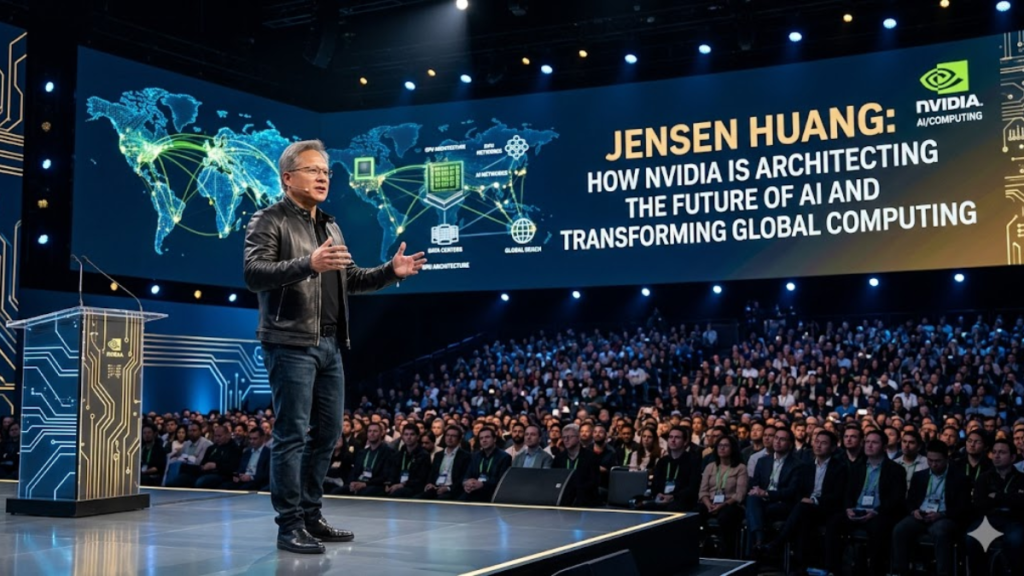
In a masterclass conversation on the Lex Fridman Podcast, NVIDIA CEO Jensen Huang demonstrates exactly what Jensen Huang NVIDIA AI scaling leadership looks like in practice — an unparalleled look into the engineering and leadership principles that have positioned NVIDIA at the center of the global AI revolution. Moving beyond standard corporate rhetoric, Huang details the technical complexities of “extreme co-design” and the counter-intuitive management philosophies required to scale a company in an age of exponential technological growth.
The New Computing Paradigm: From Accelerator to AI Factory
Jensen Huang describes a fundamental shift from general-purpose computing to the “AI Factory.” In this model, data centers are no longer just repositories of information but production facilities where the “output” is intelligence. This requires moving beyond simple acceleration to building integrated infrastructure that treats software, silicon, and networking as a single machine.
This is not an incremental evolution — it is a categorical redefinition of what a technology company builds and sells. NVIDIA no longer competes on chip speed alone; it competes on the quality and completeness of the intelligence-production system it delivers to the world. As Marc Andreessen has argued on AI productivity growth, the infrastructure layer is where the real compounding advantages are built.
The Engineering Philosophy: Extreme Co-Design
Huang argues that the era of general-purpose computing is yielding to a specialized “AI factory” model. He introduces the concept of extreme co-design — a strategy where software, silicon, networking, and systems are optimized as a single, unified entity.
- Breaking Amdahl’s Law: As computing problems outgrow a single GPU, engineers must shard data, models, and pipelines. Huang explains that simply adding more computers is insufficient; you must optimize the entire stack — power, cooling, and memory — to ensure that the system scales efficiently.
- The AI Factory: NVIDIA no longer views itself purely as a chipmaker, but as an architect of systems designed to produce “AI” as an output. This shift from “accelerator” to “infrastructure provider” is what allowed the company to move from gaming graphics to the foundation of modern Large Language Models (LLMs).
Exclusive Interview: Jensen Huang in His Own Words
In this conversation with Lex Fridman, Jensen Huang breaks down the engineering frameworks, leadership philosophy, and long-term thinking that has made NVIDIA the most important company in the AI era. These are his most consequential insights decoded for business and technology leaders.
In His Own Words
Jensen Huang on AI Infrastructure, Leadership Philosophy, and the Future of Intelligence
Leadership Under Pressure: The “No 1-on-1” Rule
Perhaps the most discussed aspect of Huang’s management is his unconventional organizational structure. Managing 60 direct reports without individual one-on-one meetings, Huang prioritizes radical transparency and context-sharing. This approach directly mirrors the principles OpenAI applies when building AI agents that think and act — context distribution at scale is the foundation of aligned execution.
- Context over Privacy: Huang argues that one-on-ones create bottlenecks and information silos. By keeping all discussions in group settings, he ensures every leader possesses the same foundational context, enabling faster, more aligned decision-making.
- Systematic Forgetting: To remain agile, Huang employs a mental model he calls “systematic forgetting” — the ability to deconstruct legacy assumptions, reason from first principles (the physics and logic of the problem), and immediately distribute those insights to his team. This prevents the organization from being anchored by outdated truths.
The Systematic Forgetting Framework
A three-step mental model used to deconstruct legacy assumptions and reason from first principles:
The AI Evolution: Scaling Laws and AGI
The interview explores the trajectory of AI, moving from basic pre-training to more sophisticated “agentic” scaling. Huang views AGI not as a singular mystical entity, but as a utility milestone — if an AI agent can reliably execute high-level tasks like running a company, it has achieved a critical level of functional intelligence.
- The “Unbridgeable Gap”: While AI excels at statistical consistency and rapid data processing, Huang emphasizes that it lacks the “noise” of human experience — intuition, anxiety, and moral nuance that are irreplaceable in high-stakes judgment calls.
- Future of Labor: He posits that AI will become an essential partner rather than a replacement, elevating human performance in fields like radiology and software engineering by handling the heavy lifting of data, leaving higher-level judgment to human experts.
This pragmatic view of AGI stands in sharp contrast to more alarmist perspectives. For a counterpoint that every technology leader should consider, Geoffrey Hinton’s urgent warning on superintelligence risk raises questions that Huang’s optimism does not fully resolve.
The “CUDA Bet” Legacy: Decade-Long Vision Over Quarterly Thinking
Jensen Huang’s success is a testament to the decade-long investment in an ecosystem that was initially taxing but ultimately created an unassailable moat for NVIDIA. The CUDA platform — launched in 2006 — was a multi-billion dollar bet on a computing paradigm that had no proven commercial market at the time.
The lesson for business leaders is not simply “invest for the long term.” It is more specific: invest in the infrastructure layer of whatever paradigm shift you believe is coming. NVIDIA did not invest in applications. It invested in the foundation that all applications would need. This is the same strategic logic explored in how high-performers use Claude AI for business efficiency — building systematic infrastructure rather than one-off solutions.
The Four Pillars of NVIDIA’s Competitive Moat
Key Takeaways for the Future
Conclusion
Jensen Huang’s roadmap for the next decade centers on the integration of human intuition and machine-scale intelligence. For leaders navigating this technological frontier, his message is clear: optimize for the entire stack, communicate with absolute transparency, and never stop reasoning from first principles.
The companies that will define the next era of AI are not the ones with the best models — they are the ones that build the best systems for producing intelligence at scale. Huang has been building that system for thirty years. The rest of the industry is only now beginning to understand what he was building.
