
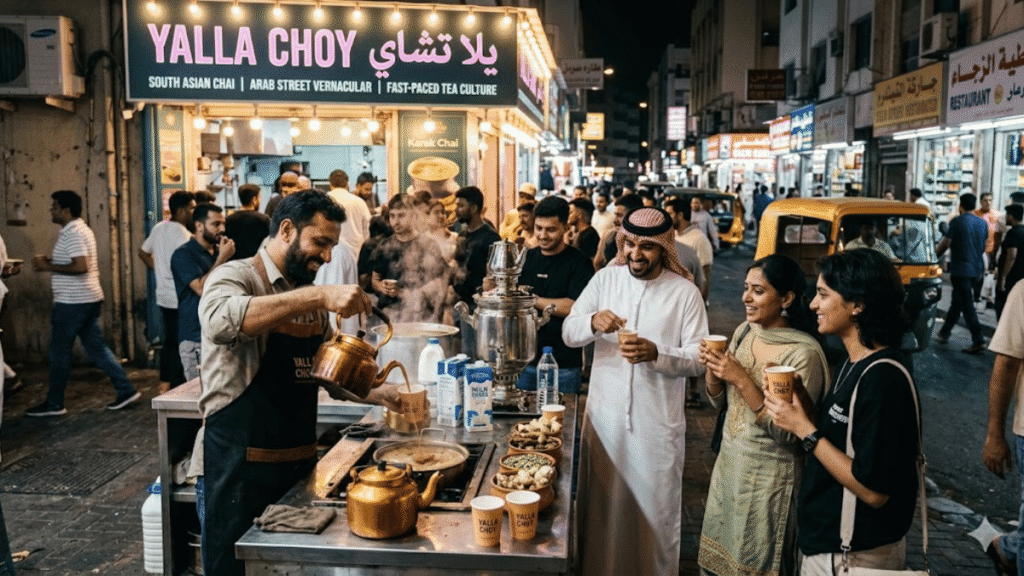
What is “yalla choy”? At first glance, the phrase sounds like casual slang—part Arabic urgency, part South Asian warmth. “Yalla,” meaning “let’s go” in colloquial Arabic, collides with “choy,” a phonetic variation of “chai,” the ubiquitous South Asian tea. Together, they form an expression that has begun circulating in diaspora-heavy urban spaces, street cafés, and informal food cultures. It is not simply a drink. It is a tempo, a social signal, and increasingly, a cultural identity marker.
In the first 100 words, the intent becomes clear: “yalla choy” represents a way of life where tea is not just consumed but mobilized. It is the drink of transit workers in Dubai, students in London, vendors in Karachi, and late-night taxi drivers across migration corridors. It is shorthand for immediacy—tea on the move, tea without ceremony, tea as fuel.
Unlike formal tea rituals documented in British, Chinese, or Japanese traditions, “yalla choy” exists in motion. It is not about stillness or ceremony but about continuity—between shifts, between borders, between identities. Its emergence reflects how globalization does not erase tradition but compresses and accelerates it.
To understand “yalla choy” is to understand how language, migration, and caffeine intersect in the everyday lives of millions.
The Origins of “Yalla Choy” as a Cultural Phrase
Linguistically, “yalla choy” is not a codified term in classical dictionaries. Instead, it emerges from colloquial blending—what linguists call code-switching in multilingual environments. In Gulf cities with large South Asian workforces, Arabic imperatives like “yalla” naturally merge with South Asian culinary vocabulary.
The term reflects lived multilingualism rather than formal language design. Workers moving between Pakistan, India, Egypt, Bangladesh, and the Levant often develop hybrid speech patterns. Tea becomes the anchor around which these linguistic blends form.
Historically, tea itself is a colonial and trade commodity. As historian Sidney W. Mintz argues in Sweetness and Power, global commodities like sugar and tea shaped modern labor and consumption systems. “Yalla choy” can be read as a late-stage cultural echo of these systems—where consumption is no longer elite or ceremonial but industrial and mobile.
In this context, “yalla choy” is less a drink name and more a labor rhythm.
Tea, Speed, and Urban Migration
Modern cities in the Middle East and South Asia are defined by speed. Labor migration has created dense networks of workers who rely on fast, accessible food and drink systems. Tea stalls—often open 24 hours—become infrastructural nodes.
| City | Common Tea Type | Consumption Context | Speed Factor |
|---|---|---|---|
| Dubai | Karak chai | Construction sites, transport hubs | Very high |
| Karachi | Doodh patti | Street stalls, offices | High |
| Doha | Spiced tea | Labor camps, roadside cafés | High |
| London | Masala chai | Cafés, student districts | Moderate |
These environments produce a shared behavioral pattern: tea consumed quickly, often standing, often between tasks. “Yalla choy” encapsulates this urgency.
Cultural historian Roy Moxham notes that tea has always been tied to labor systems. In colonial plantations and industrial factories alike, tea functioned as both stimulant and social glue.
Within this framework, “yalla choy” is not new behavior—it is newly named behavior.
The Anthropology of Fast Tea Culture
Anthropologists often examine food as a marker of identity, but “yalla choy” complicates this by emphasizing speed over ritual. Unlike Japanese tea ceremonies or Chinese gongfu tea traditions, the emphasis here is not precision but availability.
As anthropologist Alan Macfarlane notes in The Empire of Tea, tea became a globalizing force precisely because it adapted to multiple cultural contexts. It is one of the few beverages that can be ceremonial or utilitarian without contradiction.
“Yalla choy” sits firmly in the utilitarian category, yet it retains emotional depth. It is often shared among strangers, coworkers, and transit workers—creating micro-communities of shared caffeine dependency.
| Feature | Traditional Tea Ritual | “Yalla Choy” Culture |
|---|---|---|
| Preparation time | Long | Minimal |
| Social structure | Formal | Informal |
| Setting | Controlled | Street-based |
| Purpose | Ritual, reflection | Energy, mobility |
Despite its informality, “yalla choy” produces its own rituals: how sugar is added, how glasses are passed, how quickly it must be consumed before work resumes.
The Sociology of Urgency
“Yalla choy” is fundamentally a sociology of time. In high-mobility economies, time is fragmented into micro-units—commute time, shift time, waiting time. Tea becomes the interface between these fragments.
Sociologist Hartmut Rosa’s theory of social acceleration helps explain this phenomenon: modern life compresses experience into faster cycles of production and consumption. Tea stalls become acceleration points where people briefly stabilize before re-entering motion.
Three sociological insights define “yalla choy” culture:
- Temporal compression: Tea is consumed in under five minutes.
- Spatial fluidity: Consumption happens anywhere—streets, vehicles, construction sites.
- Social minimalism: Interaction is brief but meaningful.
This is not degradation of tradition; it is adaptation to economic rhythm.
Expert Perspectives on Tea and Globalization
Food historian Rachel Laudan has written extensively on how culinary traditions evolve through trade and necessity. She argues that “global cuisines are not diluted versions of tradition but entirely new systems of adaptation.”
Similarly, anthropologist Arjun Appadurai describes food as part of “global cultural flows,” where meaning is constantly reassembled across borders.
Tea scholar Jane Pettigrew emphasizes that tea’s adaptability is its greatest strength: “Tea survives because it fits everywhere—from ceremony to construction site.”
These insights help situate “yalla choy” not as a novelty but as a continuation of tea’s global evolution.
The Economics of Street Tea
Street tea economies operate on extremely low margins but high volume. A single vendor may serve hundreds of cups per day, often with minimal infrastructure.
| Cost Component | Average Value (USD equivalent) |
|---|---|
| Raw tea leaves | 0.02 per cup |
| Milk/sugar | 0.05 per cup |
| Labor input | 0.03 per cup |
| Selling price | 0.10–0.30 per cup |
The profitability lies in scale, not margin. “Yalla choy” thrives in these environments because it aligns with speed-based economics.
Tea stalls also function as informal employment hubs, especially for migrants who lack access to formal labor markets. In this sense, tea is not just consumption—it is economic infrastructure.
Cultural Identity in a Cup
“Yalla choy” is also an identity marker. It reflects hybrid identities formed in diaspora environments where language, food, and work intersect.
In cities like Dubai and Doha, workers from different linguistic backgrounds use shared food vocabulary to communicate. “Yalla choy” becomes a bridge phrase—understood even when grammar is not shared.
This mirrors broader patterns of cultural fusion seen in global street food cultures, where identity is expressed through hybrid consumption practices rather than formal heritage.
Tea, in this sense, becomes a neutral ground—neither fully Arabic nor fully South Asian, but something newly shared.
The Emotional Geography of Tea
Beyond economics and sociology, “yalla choy” carries emotional weight. It is associated with exhaustion, companionship, and endurance.
Workers describe tea breaks as moments of psychological reset. Even in high-pressure environments, a five-minute tea pause creates a sense of continuity.
This emotional dimension is crucial. Tea becomes a coping mechanism for fragmented urban life, offering predictability in otherwise unstable schedules.
As one cultural observer notes: “Tea is where labor pauses without stopping.”
Takeaways
- “Yalla choy” is a hybrid cultural expression combining Arabic urgency and South Asian tea culture.
- It reflects the realities of migrant labor and fast-paced urban economies.
- The term represents a broader shift toward speed-based consumption patterns.
- Tea stalls function as informal economic and social infrastructure.
- Anthropologically, it extends tea’s global history of adaptation and survival.
- Emotionally, it provides micro-moments of stability in fragmented time.
Conclusion
“Yalla choy” is not merely a phrase—it is a cultural compression. It captures the intersection of language, labor, and liquid ritual in a world defined by movement. While tea has historically been associated with stillness and reflection in many traditions, this iteration represents the opposite: motion, urgency, and survival within time constraints.
Yet even in its speed, “yalla choy” preserves something ancient. The act of sharing tea—no matter how brief—remains a gesture of connection. It suggests that even in accelerated environments, human beings continue to create rituals, however small, to anchor themselves.
In that sense, “yalla choy” is not a departure from tea’s history but its continuation—reshaped for a world that never stops moving.
Click Here to Check Out More Interesting Blogs!
FAQs
What does “yalla choy” mean?
It is a hybrid slang phrase combining Arabic “yalla” (let’s go) and “choy/chai” (tea), symbolizing fast-paced tea consumption culture.
Is “yalla choy” a real drink?
Not formally. It is a cultural expression rather than a standardized beverage, referring to quick, street-style tea.
Where is “yalla choy” commonly used?
It is most associated with migrant-heavy urban environments in the Middle East and South Asia.
Why is tea so central to this concept?
Tea is cheap, fast, and widely available, making it ideal for labor-driven and mobile populations.
Is “yalla choy” part of traditional tea culture?
It is a modern evolution influenced by migration, labor systems, and linguistic blending rather than traditional ceremonial tea practices.
