
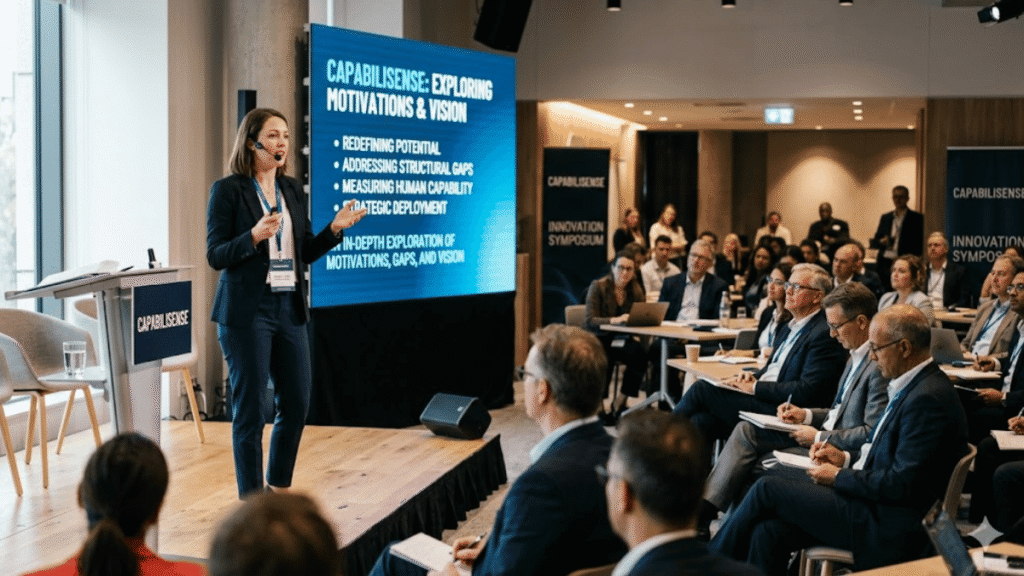
Why im building capabilisense medium? At its core, the answer is simple: because the world lacks a coherent system for understanding capability. Organizations measure performance, track outputs, and analyze outcomes, yet they remain fundamentally blind to the underlying capabilities that drive those results. Capabilisense is an attempt to correct that blindness—by building a framework that captures, interprets, and evolves capability as a measurable, actionable construct.
The idea emerged from a persistent observation: despite unprecedented advances in data science, artificial intelligence, and analytics, decision-makers still rely on fragmented signals—résumés, KPIs, test scores, and subjective evaluations. These proxies fail to capture the dynamic, contextual nature of capability. What people and systems can do is not static; it evolves with environment, learning, and opportunity.
Capabilisense is not just a platform. It is a thesis: that capability intelligence should sit at the center of modern decision-making. Whether in hiring, education, or organizational strategy, understanding capability at a granular level can unlock more equitable, efficient, and adaptive systems.
This article traces the reasoning behind that thesis—where the gaps exist, why they persist, and how Capabilisense seeks to address them.
The Problem: A World Measured by Proxies
Modern institutions are built on measurement, yet the metrics they rely on are often misaligned with reality. Academic degrees, standardized tests, and performance reviews serve as stand-ins for capability, but they frequently fail to capture nuance. – why im building capabilisense medium.
In 1973, psychologist David McClelland published a landmark paper, Testing for Competence Rather Than for Intelligence, arguing that traditional intelligence tests were poor predictors of job performance. His critique remains relevant today. Organizations continue to rely on credentials rather than demonstrated capability.
The problem is structural. Proxy metrics are easier to collect, standardize, and compare. Capability, by contrast, is complex—context-dependent, multidimensional, and evolving. As a result, systems default to what is measurable rather than what is meaningful.
This misalignment creates inefficiencies: talent is overlooked, potential is underestimated, and decisions are made on incomplete information. Capabilisense begins with the premise that these inefficiencies are not inevitable—they are artifacts of outdated measurement paradigms.
The Concept of Capability Intelligence
Capability intelligence reframes how we think about human and organizational potential. Instead of asking what someone has done, it asks what they can do—and under what conditions.
This shift aligns with broader developments in artificial intelligence and systems thinking. Researchers in Artificial Intelligence increasingly emphasize adaptive learning systems that evolve with data. Similarly, capability intelligence treats ability as dynamic rather than fixed. – why im building capabilisense medium.
Three core dimensions define this approach:
- Contextual Performance: Capability varies depending on environment and constraints.
- Learning Velocity: The rate at which new skills are acquired matters as much as existing skills.
- Transferability: The ability to apply knowledge across domains is a key indicator of adaptability.
As management scholar Peter Drucker once noted, “What gets measured gets managed.” Capabilisense extends this idea: what gets understood at the capability level can be optimized, scaled, and aligned with real-world needs.
Why Existing Systems Fall Short
Despite technological advances, most systems remain anchored in static models. Hiring platforms match keywords; educational systems grade standardized outputs; organizations track lagging indicators.
| System Type | Current Metric | Limitation | Capability Gap |
|---|---|---|---|
| Hiring | Résumés, degrees | Static snapshot | Ignores growth potential |
| Education | Test scores | Narrow evaluation | Misses applied skills |
| Performance | KPIs | Outcome-focused | Overlooks process capability |
| AI Models | Training data | Bias inheritance | Limited adaptability |
These limitations are not accidental—they are embedded in system design. Data pipelines are optimized for consistency, not depth. Algorithms prioritize pattern recognition over contextual understanding.
Capabilisense challenges this paradigm by proposing a system that captures capability as a living dataset—continuously updated, context-aware, and multidimensional. – why im building capabilisense medium.
A Timeline of Measurement Evolution
Understanding Capabilisense requires situating it within the broader history of measurement systems.
| Era | Dominant Model | Key Feature | Limitation |
|---|---|---|---|
| Early 20th Century | IQ Testing | Standardization | Narrow scope |
| Mid 20th Century | Credentialism | Institutional validation | Exclusionary |
| Late 20th Century | Performance Metrics | Quantification | Lagging indicators |
| Early 21st Century | Data Analytics | Scale and speed | Fragmentation |
| Emerging Era | Capability Intelligence | Dynamic modeling | Still evolving |
Each phase reflects an attempt to improve decision-making, yet each introduces new blind spots. Capabilisense positions itself as the next step—integrating insights from previous models while addressing their shortcomings. – why im building capabilisense medium.
The Role of AI in Capability Mapping
Artificial intelligence plays a central role in enabling capability intelligence, but it must be applied carefully. Traditional AI systems excel at classification and prediction, yet they often struggle with context and nuance.
Research by Geoffrey Hinton and others has advanced neural networks capable of learning complex patterns. However, these systems depend heavily on training data, which may encode biases and limitations.
Capabilisense approaches AI differently. Instead of treating models as static predictors, it uses them as adaptive interpreters—systems that evolve as new capability data is introduced. This requires continuous feedback loops, contextual inputs, and cross-domain integration.
“AI should augment human understanding, not replace it,” says Dr. Fei-Fei Li, a leading AI researcher. Her perspective underscores a key principle: capability intelligence must remain interpretable and aligned with human judgment.
Expert Perspectives on Capability and Measurement
Experts across disciplines have long questioned traditional measurement systems.
Economist Amartya Sen introduced the “capability approach,” emphasizing what individuals are able to do and be, rather than what they possess. His framework, developed in the late 20th century, directly informs the philosophical foundation of Capabilisense.
“The focus should be on expanding people’s capabilities,” Sen wrote, highlighting the importance of opportunity and agency.
Similarly, organizational psychologist Adam Grant has argued that potential is often overlooked in favor of past performance. “We need to get better at recognizing not just what people have achieved, but what they can achieve,” he notes.
These perspectives converge on a central insight: capability is a more meaningful unit of analysis than static metrics.
Building Capabilisense: From Idea to System
Turning the concept of capability intelligence into a functional system requires addressing several technical and philosophical challenges.
First, data collection must move beyond traditional inputs. Instead of relying solely on historical records, Capabilisense integrates real-time signals—behavioral data, learning interactions, and contextual performance indicators.
Second, modeling capability requires multidimensional frameworks. Linear scoring systems are insufficient; capability must be represented as a network of interrelated attributes.
Third, ethical considerations are paramount. Any system that measures capability risks reinforcing biases if not designed carefully. Transparency, fairness, and user control must be embedded at every level.
The result is not a single tool but an ecosystem—a platform that evolves with its users and adapts to diverse contexts.
The Broader Implications
If successful, Capabilisense could reshape multiple domains.
In education, it could enable personalized learning paths based on capability profiles rather than standardized curricula. In hiring, it could reduce reliance on credentials and open opportunities to overlooked talent. In organizational strategy, it could align roles with actual capability rather than assumed competence.
The implications extend beyond efficiency. By focusing on capability, systems can become more equitable, recognizing potential in individuals who may not fit traditional molds.
This shift reflects a broader societal trend: moving from static hierarchies to dynamic networks, where adaptability and learning define success.
Takeaways
- Capabilisense is built to address the gap between measurable outputs and underlying capability.
- Traditional systems rely on proxies that often misrepresent true potential.
- Capability intelligence reframes measurement as dynamic, contextual, and evolving.
- Advances in AI enable more nuanced capability mapping but require careful design.
- The concept draws on established theories from psychology, economics, and management.
- Successful implementation could transform education, hiring, and organizational decision-making.
Conclusion
Capabilisense emerges from a simple but profound question: what if we measured what truly matters? For decades, institutions have optimized around proxies—efficient, scalable, but ultimately incomplete. The result is a world where decisions are made with partial visibility, where potential is often hidden behind inadequate metrics.
Building Capabilisense is an attempt to move beyond that limitation. It is not a rejection of data, but a reimagining of it—toward systems that understand capability as fluid, contextual, and deeply human. The challenge is significant, requiring advances in technology, design, and ethics. Yet the opportunity is equally large.
In redefining how capability is understood, Capabilisense aims to shift the foundation of decision-making itself. Not toward perfection, but toward clarity—where individuals and organizations are seen not just for what they have done, but for what they are capable of becoming.
Click Here to Check Out More Interesting Blogs!
FAQs
What is Capabilisense?
Capabilisense is a conceptual and technological framework designed to measure and interpret capability as a dynamic, context-aware construct rather than relying on static metrics.
Why is capability intelligence important?
It provides a more accurate understanding of potential, enabling better decisions in hiring, education, and organizational strategy.
How does Capabilisense use AI?
It employs adaptive AI models to interpret capability data, focusing on context, learning, and transferability rather than static prediction.
What problem does Capabilisense solve?
It addresses the limitations of proxy-based measurement systems that fail to capture true capability and potential.
Can capability be measured objectively?
While challenging, capability can be modeled through multidimensional data and contextual analysis, improving accuracy over traditional metrics.
