
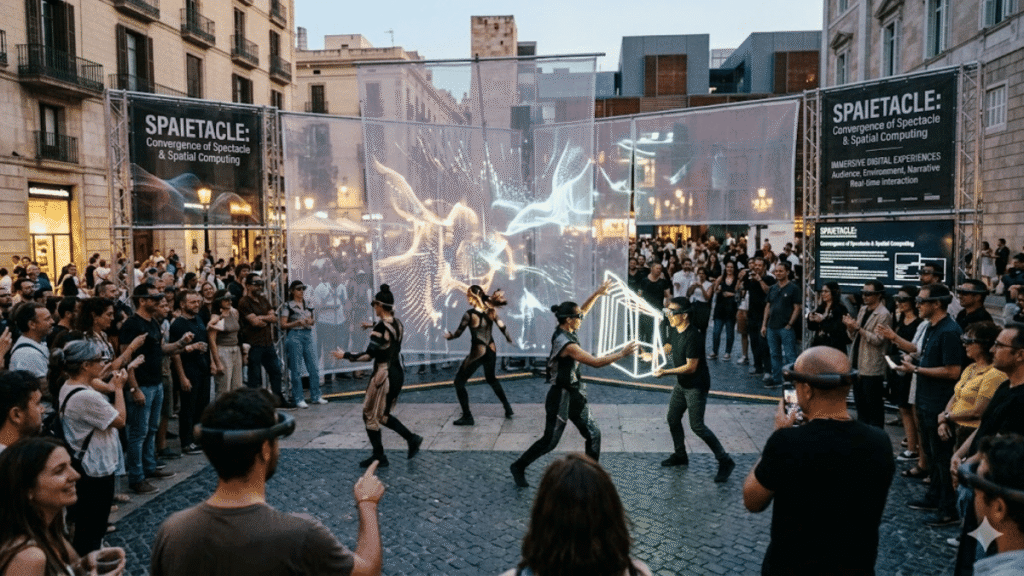
Spaietacle, an emerging conceptual term blending “space” and “spectacle,” refers to a new paradigm in immersive digital experience design where environments are not merely viewed but inhabited, navigated, and co-created. At its core, spaietacle describes the convergence of spatial computing, interactive media, and audience participation into a unified experiential framework. In practical terms, it signals a shift from passive consumption toward active engagement—where users become participants within digitally constructed realities.
The rise of spaietacle is closely tied to advancements in augmented reality (AR), virtual reality (VR), and mixed reality (MR). These technologies have matured rapidly over the past decade, enabling increasingly sophisticated simulations of physical space. Yet spaietacle goes beyond the technical layer. It represents a philosophical and design-oriented shift: the understanding that digital experiences must be spatially aware, narratively rich, and socially interactive.
This shift is not occurring in isolation. From immersive theater productions to virtual concerts and metaverse platforms, the boundaries between physical and digital environments are dissolving. Audiences no longer sit at a distance; they move through, influence, and even shape the experience itself. Spaietacle captures this transformation, offering a framework for understanding how spectacle evolves when it becomes spatial, interactive, and participatory.
The Evolution of Spectacle in the Digital Age
The concept of spectacle has long been central to media and culture, from ancient amphitheaters to modern cinema. Traditionally, spectacle has been defined by scale, visual impact, and emotional intensity. However, it has also been fundamentally one-directional: creators produce, audiences consume.
The digital age began to disrupt this model. The rise of the internet introduced interactivity, allowing users to engage with content in new ways. Social media platforms further blurred the line between creator and audience, enabling participatory culture.
Spaietacle represents the next stage in this evolution. By integrating spatial computing, it transforms spectacle into an environment rather than an event. This shift aligns with theories of media convergence and participatory culture, as described by scholar Henry Jenkins.
Media theorist Lev Manovich has argued that new media transforms traditional forms by adding layers of interactivity and variability. Spaietacle exemplifies this transformation, extending it into the spatial domain.
Core Components of Spaietacle
Spaietacle can be understood through three primary components: spatiality, interactivity, and narrative integration. Each plays a crucial role in shaping the overall experience.
| Component | Description | Function |
|---|---|---|
| Spatiality | Three-dimensional digital environments | Enables immersion |
| Interactivity | User engagement and control | Drives participation |
| Narrative Integration | Story embedded in environment | Creates meaning |
Spatiality ensures that the experience is not confined to a screen but extends into a navigable environment. Interactivity allows users to influence outcomes, creating a sense of agency. Narrative integration ties these elements together, providing context and emotional resonance.
This triadic structure distinguishes spaietacle from traditional media formats, which often emphasize one dimension at the expense of others.
Comparing Traditional Media and Spaietacle
| Feature | Traditional Spectacle | Spaietacle |
|---|---|---|
| Audience Role | Passive viewer | Active participant |
| Medium | Screen-based | Spatial environment |
| Interaction | Minimal | High |
| Narrative | Linear | Dynamic |
| Engagement | Observational | Experiential |
The transition from traditional spectacle to spaietacle reflects a broader cultural shift toward immersion and participation. Audiences increasingly expect experiences that are not only visually compelling but also interactive and personalized.
Digital experience designer Marco Alvarez explains:
“Spaietacle is not just about technology—it’s about rethinking the relationship between audience and environment. It turns spectators into participants.”
Applications Across Industries
Spaietacle has implications across a wide range of sectors. In entertainment, it is already reshaping how stories are told. Virtual concerts, for example, allow audiences to move through digital spaces, interact with performers, and engage with other attendees.
In education, spaietacle offers new possibilities for experiential learning. Students can explore historical events, scientific phenomena, and cultural environments in immersive ways that enhance understanding and retention.
Retail is another area of transformation. Brands are experimenting with virtual showrooms where customers can explore products in interactive environments, bridging the gap between online and physical shopping.
Dr. Karen Liu, an expert in immersive technologies, notes:
“The power of spaietacle lies in its ability to create presence. When users feel present in an environment, their engagement and emotional connection increase significantly.”
Timeline of Technological Influences
| Year | Development | Contribution to Spaietacle |
|---|---|---|
| 1990s | Early VR experiments | Foundation for immersive environments |
| 2007 | Smartphone revolution | Enabled mobile interactivity |
| 2012 | Consumer VR headsets | Brought immersion to mainstream |
| 2016 | AR platforms launched | Integrated digital with physical space |
| 2020s | Metaverse expansion | Unified spatial and social experiences |
This timeline highlights how spaietacle emerges from decades of technological progress, integrating multiple innovations into a cohesive framework.
Challenges and Limitations
Despite its potential, spaietacle faces several challenges. One of the most significant is accessibility. High-quality immersive experiences often require specialized hardware, limiting their reach.
Content creation is another barrier. Designing spatial, interactive narratives is complex and resource-intensive, requiring interdisciplinary expertise in technology, design, and storytelling.
There are also ethical considerations. As experiences become more immersive, questions about data privacy, user manipulation, and psychological impact become increasingly important.
Finally, there is the issue of standardization. Without common frameworks, experiences may remain fragmented across platforms, hindering widespread adoption.
Economic and Cultural Impact
The economic implications of spaietacle are substantial. By creating new forms of engagement, it opens opportunities for monetization through virtual goods, experiences, and services. Industries such as gaming, entertainment, and retail are already exploring these possibilities.
Culturally, spaietacle represents a shift in how people experience media. It blurs the boundaries between reality and simulation, creating hybrid spaces that combine elements of both.
This shift has implications for identity, social interaction, and creativity. Users are no longer just consumers; they are co-creators of the experience.
Cultural critic Sherry Turkle has noted that digital environments shape how individuals understand themselves and others. Spaietacle intensifies this dynamic by making those environments more immersive and interactive.
The Future of Spaietacle
Looking ahead, spaietacle is likely to evolve alongside advancements in artificial intelligence, haptic feedback, and network infrastructure. These technologies will enhance realism, responsiveness, and scalability.
The integration of AI could enable adaptive environments that respond to user behavior in real time, creating personalized experiences. Advances in connectivity, such as 5G and beyond, will support more complex and seamless interactions.
As these developments unfold, spaietacle may become a defining feature of digital culture, shaping how people work, learn, and interact.
Takeaways
- Spaietacle combines spatial computing and spectacle into immersive experiences.
- It transforms audiences from passive viewers into active participants.
- Core components include spatiality, interactivity, and narrative integration.
- Applications span entertainment, education, and retail.
- Challenges include accessibility, content complexity, and ethical concerns.
- Economic opportunities are significant across multiple industries.
- Cultural impacts involve new forms of identity and interaction.
Conclusion
Spaietacle represents a profound shift in the evolution of media and experience design. By merging space and spectacle, it creates environments that are not only seen but lived. This transformation reflects broader changes in technology and culture, where interactivity and immersion are becoming central to how people engage with the world.
Yet the path forward is not without obstacles. Technical, ethical, and economic challenges must be addressed to realize the full potential of spaietacle. Its success will depend on collaboration across disciplines and a careful balance between innovation and responsibility.
As digital and physical realities continue to converge, spaietacle offers a glimpse into a future where experiences are not just consumed but inhabited—where the boundaries between audience and environment dissolve, and new forms of storytelling and interaction emerge.
Click Here to Check Out More Interesting Blogs!
FAQs
What is spaietacle?
Spaietacle is a conceptual framework combining spatial computing and spectacle to create immersive, interactive digital experiences.
How is spaietacle different from virtual reality?
While VR is a technology, spaietacle is a broader concept that includes narrative, interactivity, and audience participation.
What industries use spaietacle?
Entertainment, education, retail, and gaming are key sectors exploring its applications.
What are the main challenges?
Accessibility, content creation complexity, ethical concerns, and lack of standardization.
What is the future of spaietacle?
It is expected to grow with advancements in AI, connectivity, and immersive technologies, becoming a central part of digital culture.
