
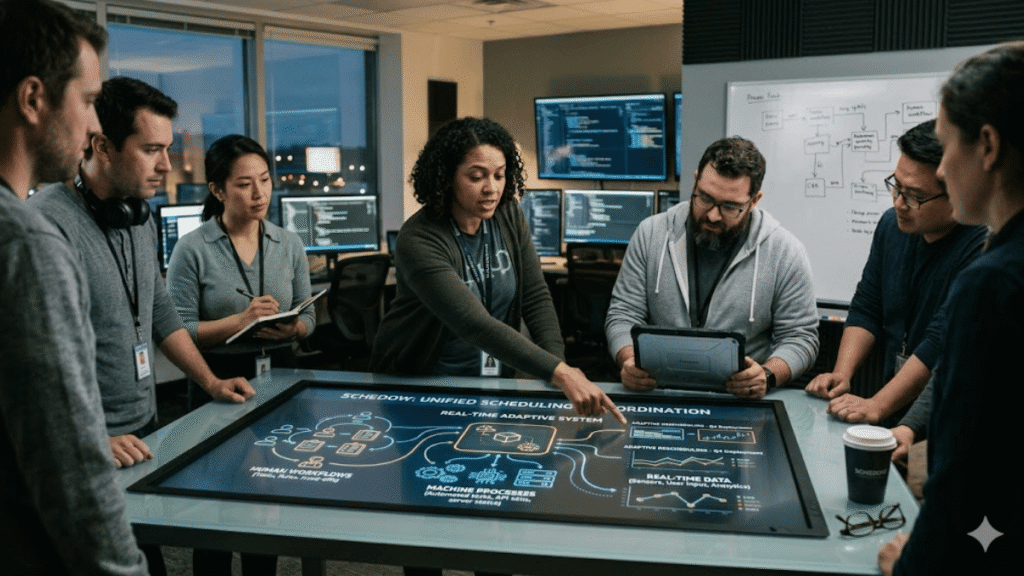
Schedow, though not yet a formalized platform or widely standardized protocol, is increasingly discussed as a conceptual framework for next-generation scheduling and coordination. At its most immediate level, schedow refers to an integrated system that synchronizes tasks, resources, and time across human and machine environments. In practical terms, it aims to eliminate the inefficiencies of fragmented calendars, siloed workflows, and disconnected automation tools by creating a unified coordination layer.
The modern digital landscape is defined by overload: meetings across time zones, asynchronous collaboration, automated systems running independently of human oversight. Schedow enters this complexity with a clear premise—coordination itself must become intelligent, adaptive, and system-wide. Rather than treating scheduling as a passive function, schedow reframes it as an active orchestration engine capable of optimizing decisions in real time.
This conceptual shift aligns with broader trends in artificial intelligence, distributed systems, and workflow automation. As organizations scale globally and systems grow more interconnected, the cost of poor coordination becomes increasingly visible. Missed dependencies, redundant processes, and inefficient resource allocation are no longer minor inconveniences; they are structural inefficiencies.
Schedow proposes a different model—one where time, tasks, and systems are dynamically aligned, enabling both humans and machines to operate with greater coherence and precision.
The Evolution of Scheduling Systems
Scheduling has historically evolved in incremental steps, from manual ledgers to digital calendars. Early systems were static, requiring users to manually input and adjust information. The introduction of digital calendars in the late 20th century marked a significant improvement, enabling easier updates and sharing.
However, these systems remained fundamentally reactive. Even modern tools, despite their sophistication, rely heavily on user input and lack contextual awareness. The rise of cloud computing and collaborative platforms in the 2010s introduced shared workspaces, but coordination remained fragmented across tools.
Schedow represents the next stage in this evolution. By integrating artificial intelligence and real-time data streams, it transforms scheduling from a passive record into an active system. This transition mirrors broader shifts in computing, where systems increasingly anticipate and respond to user needs.
As organizational theorist Henry Mintzberg has argued in his work on coordination mechanisms, effective systems depend not just on structure but on dynamic alignment. Schedow operationalizes this principle in a digital context.
Core Architecture of Schedow
Schedow’s conceptual architecture is built on three interdependent layers: temporal intelligence, task orchestration, and system integration. Together, these layers create a unified coordination framework.
| Layer | Description | Key Function |
|---|---|---|
| Temporal Intelligence | Real-time understanding of time constraints | Optimizes scheduling decisions |
| Task Orchestration | Coordination of workflows and dependencies | Ensures efficient execution |
| System Integration | Connectivity across platforms and tools | Enables seamless data flow |
Temporal intelligence allows schedow to interpret not just availability but context—priorities, deadlines, and constraints. Task orchestration ensures that activities are aligned with broader objectives, reducing inefficiencies. System integration connects disparate tools, creating a cohesive ecosystem.
This layered approach distinguishes schedow from traditional scheduling tools, which typically focus on a single dimension. By addressing time, tasks, and systems simultaneously, schedow offers a more holistic solution.
Comparing Traditional Scheduling to Schedow
| Feature | Traditional Scheduling Tools | Schedow Framework |
|---|---|---|
| Input Method | Manual | Automated and adaptive |
| Context Awareness | Limited | High |
| Integration | Fragmented | Unified |
| Decision-Making | User-driven | System-assisted |
| Scalability | Moderate | High |
The contrast highlights a fundamental shift from user-dependent systems to intelligent coordination engines. Traditional tools serve as repositories of information, while schedow acts as an active participant in decision-making.
Technology analyst Priya Natarajan notes:
“Scheduling has long been treated as an administrative task. Schedow reframes it as a strategic function, central to productivity and efficiency.”
Applications Across Industries
Schedow’s potential applications span a wide range of sectors. In healthcare, it could optimize patient scheduling, resource allocation, and staff coordination, reducing wait times and improving outcomes. Hospitals often struggle with inefficiencies caused by fragmented systems; schedow offers a unified approach.
In logistics, the framework could synchronize supply chains, aligning shipments, inventory, and transportation in real time. This level of coordination is critical in an era of globalized trade and just-in-time delivery.
Corporate environments also stand to benefit. By integrating calendars, project management tools, and communication platforms, schedow can streamline workflows and reduce cognitive load on employees.
Dr. Elena Martínez, a systems engineering expert, explains:
“Coordination is the hidden backbone of every organization. When it fails, everything else suffers. Schedow addresses this at a systemic level.”
Timeline of Influences
| Year | Development | Impact on Schedow Concept |
|---|---|---|
| 1980s | Digital calendars introduced | Foundation for electronic scheduling |
| 2000s | Cloud computing adoption | Enabled shared systems |
| 2010s | Workflow automation tools | Introduced task orchestration |
| 2020s | AI-driven analytics | Enabled predictive scheduling |
| Present | Emergence of schedow | Integration of all elements |
This progression illustrates how schedow builds on decades of technological advancement, integrating disparate innovations into a cohesive model.
Challenges and Limitations
Despite its promise, schedow faces several challenges. One of the most significant is data integration. Organizations often use multiple systems with incompatible formats, making seamless connectivity difficult.
Privacy concerns also arise. A system that integrates scheduling, tasks, and data must handle sensitive information responsibly. Ensuring compliance with regulations such as GDPR is essential.
Another challenge is user trust. For schedow to function effectively, users must be willing to delegate decision-making to automated systems. This requires confidence in the system’s accuracy and reliability.
Finally, implementation complexity cannot be overlooked. Transitioning from existing systems to a schedow-like framework requires significant investment and organizational change.
Economic and Organizational Impact
The adoption of schedow could have far-reaching economic implications. By improving efficiency, it has the potential to reduce operational costs and increase productivity. Organizations could allocate resources more effectively, minimizing waste.
At the same time, it may disrupt existing roles. Administrative tasks related to scheduling could become automated, shifting the focus toward strategic planning and oversight.
New opportunities will also emerge. Companies that develop schedow-compatible tools and services could create new markets, driving innovation.
As economist Michael Porter has emphasized, operational efficiency is a key driver of competitive advantage. Schedow directly addresses this by optimizing coordination, a critical yet often overlooked aspect of business performance.
Cultural and Behavioral Implications
Schedow’s impact extends beyond technology and economics into culture and behavior. By automating coordination, it changes how individuals interact with time and tasks. The traditional notion of managing one’s schedule may give way to a more collaborative, system-driven approach.
This shift raises questions about autonomy and control. While automation can reduce cognitive load, it may also limit individual flexibility. Balancing efficiency with personal agency will be a key consideration.
There is also a broader cultural dimension. As systems become more integrated, the boundaries between work and personal life may blur further. Schedow could either exacerbate this trend or help manage it more effectively, depending on its implementation.
Takeaways
- Schedow is a conceptual framework for intelligent scheduling and coordination.
- It integrates time, tasks, and systems into a unified model.
- The approach emphasizes automation, adaptability, and real-time decision-making.
- Applications span healthcare, logistics, and corporate environments.
- Challenges include data integration, privacy, and user trust.
- Economic impacts involve increased efficiency and potential disruption of roles.
- Cultural implications center on changing relationships with time and autonomy.
Conclusion
Schedow represents a significant rethinking of how coordination functions in the digital age. By transforming scheduling from a passive activity into an active, intelligent system, it addresses one of the most persistent inefficiencies in modern organizations.
Its strength lies in its holistic approach, integrating multiple dimensions of coordination into a single framework. Yet its success will depend on overcoming substantial challenges, from technical integration to cultural acceptance.
As digital systems continue to evolve, the need for effective coordination will only grow. Schedow offers a vision of how this might be achieved—through systems that not only manage time but understand it.
Whether it becomes a widely adopted framework or remains a conceptual reference, schedow highlights a critical truth: in a world of increasing complexity, coordination is not just a function—it is a foundation.
Click Here to Check Out More Interesting Blogs!
FAQs
What is schedow?
Schedow is a conceptual framework for integrating scheduling, task management, and system coordination into a unified, intelligent system.
Is schedow a real product?
Currently, it is a conceptual model rather than a specific commercial platform.
How does schedow differ from traditional scheduling tools?
It emphasizes automation, context awareness, and system-wide integration instead of manual input and isolated functionality.
What industries can benefit from schedow?
Healthcare, logistics, corporate environments, and any sector requiring complex coordination can benefit.
What are the main challenges?
Data integration, privacy concerns, user trust, and implementation complexity are key barriers.
