
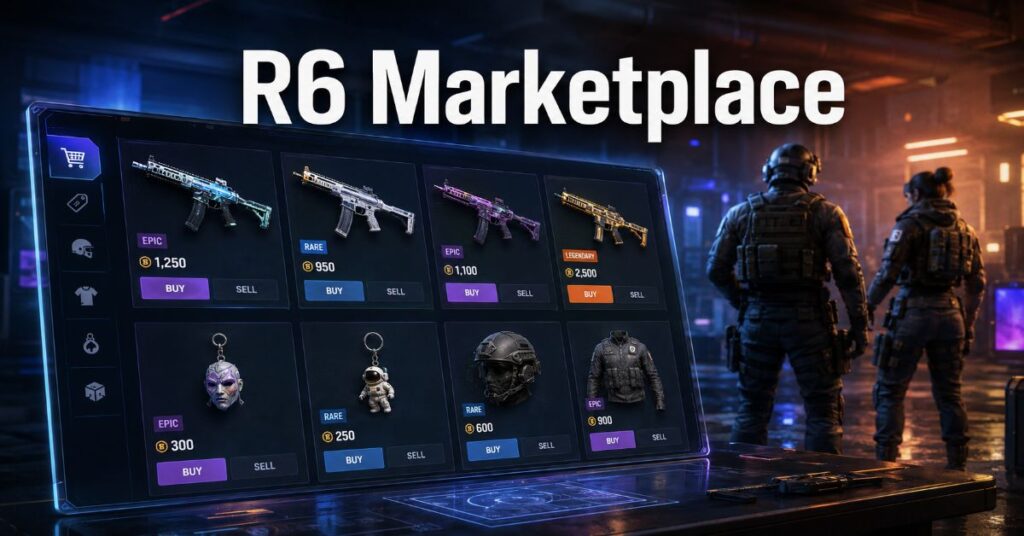
The r6 marketplace is the official Rainbow Six Siege trading hub where eligible players can buy and sell in-game cosmetic items using R6 Credits. It exists for one narrow purpose: letting the community exchange tradable Siege items without relying on unsafe third-party trading, account sharing or off-platform deals.
That sounds simple. In practice, the Marketplace has its own economy, rules and friction points. You can list weapon skins, attachment skins, uniforms, headgears, charms, operator portraits, card backgrounds and drone skins when Ubisoft marks them as tradable. You cannot sell every item in your inventory. You cannot cash out R6 Credits for real money. You cannot bypass Ubisoft’s fee. You also cannot treat a listing as instant liquidity, because every order depends on a matching buyer or seller.
The system matters because Rainbow Six Siege has spent years building value around cosmetics. Some players want old seasonal skins. Others want to convert unused inventory into credits for future purchases. Collectors track scarcity, nostalgia and visual status. Newer players see the Marketplace as a way to access older cosmetics without waiting for shop rotations.
This guide explains how the Marketplace works, who can use it, what items are tradable, how buying and selling orders match, where the 10% fee affects pricing, why some items do not appear and what practical strategy players should use before placing orders.
What the R6 Marketplace Actually Is
The R6 Marketplace is not a live auction house in the traditional sense. It is closer to an order-matching system.
A buyer sets the maximum number of R6 Credits they are willing to pay for an item. A seller sets the number of R6 Credits they want to receive before Ubisoft’s transaction fee. The system looks for compatible orders. When a match exists, the trade completes automatically.
That design matters because the buyer is not always paying exactly what they typed. If a buyer sets a maximum price and a seller is available at a lower matching price, the Marketplace can complete the purchase at the lower price. That makes buy orders less like shopping cart purchases and more like limit orders in a controlled cosmetic market.
For sellers, the logic is different. A listed item sits until a buyer accepts the price through a matching order. If no buyer appears, the listing can expire. The seller can cancel unfulfilled orders or adjust active pricing before a match happens.
The Marketplace keeps the exchange inside Ubisoft’s ecosystem. Players do not send items manually. They do not negotiate in chat. They do not trade account access. The transaction is automated, settled in R6 Credits and recorded in the user’s transaction history.
R6 Marketplace Rules at a Glance
| Marketplace Rule | Current Detail | Why It Matters |
| Currency | R6 Credits only | No real-money cashout or direct player payment |
| Ubisoft fee | 10% of sale amount | Sellers must price with the fee in mind |
| Active buy orders | 5 at once | Buyers must prioritize target items |
| Active sell orders | 5 at once | Sellers cannot list unlimited inventory |
| Order duration | 30 days | Expired orders must be reposted |
| Account level | Level 25 or higher | New accounts cannot trade immediately |
| Security requirement | 2FA and recovery email | Reduces account abuse and compromised-account trading |
| Age requirement | At least 13 years old | Access is restricted for younger accounts |
| Tradable inventory | Only eligible items | Some owned items will not appear in Sell |
| Current-season items | Not tradable until a later season | Prevents immediate resale of fresh seasonal content |
These rules create a slower, more controlled market than many players expect. Ubisoft is not trying to recreate an open skin economy with external wallets, speculative cash values or instant resale. The structure is tighter: limited orders, platform currency, delayed tradability and a mandatory transaction cut.
How Buying Works
Buying on the Marketplace starts in the Buy section. A player searches or browses for a tradable item, chooses the maximum price they are willing to pay and creates a purchase order.
The important phrase is maximum price. If you enter 1,000 R6 Credits, that does not always mean the final trade must cost exactly 1,000. It means you are willing to pay up to that amount. The Marketplace searches for the lowest compatible seller. If the system finds a seller below your cap, the order can complete at the lower matched amount.
That makes careful pricing important. A player who badly wants an item may place a high maximum order to improve the chance of matching quickly. A patient player may set a lower order and wait. The trade-off is speed versus savings.
Smart Buying Workflow
- Search the exact item name before placing an order.
- Check recent visible pricing where available.
- Decide your real maximum before entering a number.
- Avoid chasing sudden price spikes unless the item is time-sensitive to you.
- Keep one or two active buy slots open for better opportunities.
- Cancel stale orders if the market price moves far below your offer.
The biggest beginner mistake is treating a buy order like a shop purchase. It is not. You are entering a bid into a marketplace. Once it matches, the transaction completes.
How Selling Works
Selling starts in the Sell section. The Marketplace displays tradable items from your inventory. If an item does not appear, it is not currently eligible for sale, even if you own it.
The seller chooses an asking price and creates a listing. When the system finds a matching buyer, the item leaves the seller’s inventory and the seller receives R6 Credits after Ubisoft retains the 10% fee.
That fee changes the real return.
| Sale Price | Ubisoft 10% Fee | Seller Receives |
| 120 R6 Credits | 12 | 108 |
| 250 R6 Credits | 25 | 225 |
| 500 R6 Credits | 50 | 450 |
| 1,000 R6 Credits | 100 | 900 |
| 2,500 R6 Credits | 250 | 2,250 |
| 5,000 R6 Credits | 500 | 4,500 |
| 10,000 R6 Credits | 1,000 | 9,000 |
This is where many sellers miscalculate. A player who wants to end with 1,000 R6 Credits cannot list an item for 1,000 and expect to receive 1,000. The seller would receive 900 after the fee. To net roughly 1,000, the item would need to sell for about 1,112 credits, though Marketplace pricing may require whole-number increments depending on Ubisoft’s interface rules.
Smart Selling Workflow
- Open the Sell tab and review only the items Ubisoft marks as tradable.
- Compare similar listings or recent market movement where available.
- Calculate your expected net after the 10% fee.
- Use one active sell slot for a high-value item and the rest for realistic listings.
- Reprice items that sit too long without matching.
- Do not assume sentimental value equals market value.
A rare item is only valuable in the Marketplace if buyers are actively willing to spend credits on it. Scarcity helps, but demand closes the trade.
What Items Can Be Traded
The Marketplace is built around cosmetics. It does not let players sell operators, gameplay advantages or competitive performance upgrades.
Eligible item categories include:
• Weapon skins
• Attachment skins
• Uniforms
• Headgears
• Drone skins
• Charms
• Operator portraits
• Card backgrounds
This matters for game balance. Rainbow Six Siege is a tactical shooter where fair competition depends on keeping gameplay power separate from trading. The Marketplace monetizes appearance, nostalgia and collection status rather than weapon strength or operator access.
The most searched items are often older skins, visually distinctive cosmetics and recognizable collection pieces. Black Ice skins, event cosmetics and older seasonal items often attract attention because players associate them with status and account history. Still, availability depends on Ubisoft’s tradability rules. Owning a rare item does not guarantee it can be listed.
Why Some Inventory Items Are Missing
A missing item in the Sell tab usually means one of four things.
First, Ubisoft may not have marked the item as tradable. Marketplace eligibility is not universal.
Second, the item may come from the current season. Ubisoft’s Marketplace guidance states that current-season items are not tradable until the next season arrives.
Third, the item may be tied to a restriction, event, promotion or account-specific entitlement. Some cosmetics may remain locked to the account that earned or purchased them.
Fourth, Marketplace availability can change as Ubisoft adjusts the economy, resolves bugs or updates item eligibility.
This is one of the most important limits for players who search “why are my rare items missing from R6 Marketplace.” The answer is usually not a bug. The Marketplace only shows items that can be traded at that moment.
Buying Versus Selling: Which Side Has the Advantage?
| Player Goal | Best Marketplace Action | Main Advantage | Main Risk |
| Get an old cosmetic | Place a buy order | Access to past items | Overpaying during demand spikes |
| Convert unused skins | Create sell orders | Turns inventory into R6 Credits | 10% fee reduces return |
| Build a collection | Track multiple item prices | Better long-term planning | Five active buy-order limit |
| Sell high-demand skins | Price near current demand | Faster matching | Listing too low |
| Wait for bargains | Use lower buy orders | Potential savings | Order may never match |
| Clear inventory | List realistic prices | Faster credit recovery | Lower net after fee |
Buyers benefit when sellers underprice items or when demand is low. Sellers benefit when collectors compete for scarce cosmetics. Neither side has a permanent advantage because the system depends on item-specific supply, demand and timing.
The 10% Fee Is the Center of the Economy
The 10% transaction fee is not just a small deduction. It shapes trading behavior.
For sellers, it creates a spread between the listed price and the useful return. For buyers, it indirectly affects prices because sellers often raise asking prices to offset the fee. For Ubisoft, it removes credits from circulation, which helps control the in-game economy.
Without a fee, players could buy and resell the same cosmetics repeatedly with little friction. With a 10% fee, flipping becomes harder. A player who buys an item for 1,000 credits must sell it for more than 1,112 credits just to move near break-even after the fee. That makes speculative trading riskier.
This is an under-discussed feature of the Marketplace. The fee discourages rapid flipping, reduces artificial churn and pushes players toward intentional trades. It also means the Marketplace is not a clean profit system. It is a controlled exchange for cosmetics inside Ubisoft’s currency loop.
Order Limits: Why Five Buy and Five Sell Slots Matter
The Marketplace limit of five active purchases and five active sales forces players to prioritize. It prevents one account from flooding the market with hundreds of orders. It also makes users think carefully about opportunity cost.
A buyer with five active orders cannot place a sixth without canceling one. A seller with five active listings cannot unload an entire inventory in one sweep. That makes slot management part of the strategy.
A practical approach is to divide slots by confidence:
| Slot Type | Suggested Use |
| 1 high-priority buy slot | Your most wanted item |
| 2 value buy slots | Items you want only at good prices |
| 1 speculative buy slot | A low bid on a cosmetic you can wait for |
| 1 flexible slot | Kept open for sudden opportunities |
| 2 realistic sell slots | Items likely to move |
| 1 premium sell slot | Rare item priced higher |
| 1 test sell slot | Item used to learn demand |
| 1 rotating sell slot | Repriced or swapped frequently |
The players who use the Marketplace best are not always the richest in credits. They are often the most disciplined with slots.
What Happens When an Order Expires
Marketplace orders last for 30 days. If a match does not happen within that period, the order expires. It remains visible in transaction history, which helps players repost without rebuilding the order from scratch.
An expired order is not a punishment. It is a signal. Either the price was too low for a buy order, too high for a sell order or the item had too little market activity during the listing window.
Players should treat expiration as data. A buy order that expires below market may still be worth reposting if you are patient. A sell order that expires repeatedly may need a lower price unless you are waiting for a collector.
Are Black Ice Skins Restricted?
Black Ice skins are one of the most discussed cosmetic categories in Rainbow Six Siege because they carry long-running prestige in the community. Some Black Ice skins may appear when tradable. Others may not appear depending on Ubisoft’s current eligibility rules.
The safest rule is simple: if the item appears in your Sell tab, you can list it. If it does not appear, it cannot be sold at that moment.
Players should avoid third-party claims that all Black Ice skins are automatically sellable or that missing items can be forced into the Marketplace. Eligibility is controlled by Ubisoft’s system, not by account value, rarity claims or outside price lists.
Is the R6 Marketplace Safe?
The official Marketplace is safer than off-platform trading because it does not require password sharing, item gifting, third-party payment or manual trust between strangers. The transaction is handled through Ubisoft’s system.
That does not mean every Marketplace decision is risk-free. The main risks are economic, not mechanical.
Players can overpay. Sellers can underprice rare items. Accounts without proper security can be vulnerable. Users can misunderstand credit value. Market prices can move after a trade. A cosmetic that feels scarce today may become less desirable later.
The strongest safety practice is account security. Enable two-factor authentication, keep your recovery email updated and avoid any website or Discord user claiming they can unlock special Marketplace access.
The Real-World Impact of Player-to-Player Cosmetic Trading
The Marketplace changes how Siege players think about inventory. Before trading, unused cosmetics were mostly sunk value. A player either used a skin or ignored it. With Marketplace access, old inventory becomes a credit source.
That affects behavior in several ways.
Collectors become more strategic. They track old cosmetics, price movement and seasonal eligibility.
Casual players gain a way to turn unused items into credits for future cosmetics.
Long-time players may discover that forgotten inventory has demand.
New players gain access to items they missed, though often at prices set by community demand.
Ubisoft benefits by keeping trading inside its own ecosystem rather than letting gray-market sellers shape the experience. The 10% fee also returns value to Ubisoft’s controlled economy by removing credits from each completed sale.
The Marketplace therefore sits between community demand and publisher control. It gives players more freedom than a closed shop, but far less freedom than an external cash market.
Risks and Trade-Offs
The first trade-off is liquidity. An item is only useful as a credit source if someone wants to buy it. Rare does not always mean liquid.
The second trade-off is price opacity. Players may not always know whether a visible price reflects real demand, temporary hype or thin supply.
The third trade-off is account dependency. R6 Credits remain inside Ubisoft’s ecosystem. They are not cash, and they do not create real-world ownership.
The fourth trade-off is seasonal delay. Current-season items are held back from immediate trading, which protects new content cycles but frustrates players who want instant resale.
The fifth trade-off is security. A trading system increases the value of accounts with rare cosmetics. That makes account protection more important than ever.
Practical Strategy for New Users
New users should not start by buying the first famous skin they see. The better approach is slower.
First, browse the Marketplace without placing orders. Learn which items appear often and which items seem scarce. Second, check your Sell tab to see what your own inventory can actually list. Third, calculate how much you would receive after Ubisoft’s fee. Fourth, place one small buy order to understand how matching works. Fifth, sell a lower-value item before listing something rare.
The goal is to learn the system before committing meaningful credits.
For sellers, start with items you do not use. For buyers, start with a strict maximum. For collectors, keep a spreadsheet or note of target items, observed prices and preferred limits.
The Marketplace rewards patience more than impulse.
The Future of R6 Marketplace in 2027
By 2027, the Marketplace is likely to become more important to the Rainbow Six Siege cosmetic economy, but its growth depends on three constraints: security, item eligibility and player trust.
The first likely development is better price visibility. Players want clearer recent-sale ranges, not just active listings. Better pricing data would reduce confusion and help buyers avoid inflated orders.
The second likely development is wider item eligibility. As more seasons pass, more older cosmetics may become tradable. Ubisoft will still need to protect special promotions, current monetization plans and account-bound rewards.
The third likely development is stronger security enforcement. Any successful cosmetic marketplace increases the value of player accounts. That usually leads to more phishing attempts, fake trading sites and social engineering. Ubisoft’s access requirements already point in that direction by tying Marketplace participation to account maturity and security.
The uncertain question is whether Ubisoft will ever make the Marketplace more open. A more open market would please collectors, but it could also create speculation, price manipulation and more account theft. The safer prediction is controlled expansion, not full freedom.
Key Takeaways
• The Marketplace is an official Ubisoft trading system, not a cash marketplace or third-party item exchange.
• R6 Credits are the only supported currency, which keeps all value inside the Siege ecosystem.
• The 10% fee is central to pricing. Sellers should always calculate net credits before listing.
• Five active buy orders and five active sell orders make slot discipline important.
• Missing inventory items are usually not bugs. They are often not currently tradable.
• Current-season cosmetics are delayed from Marketplace trading until a later season.
• The safest strategy is patient buying, realistic selling and strong account security.
Conclusion
The r6 marketplace gives Rainbow Six Siege players something they wanted for years: a controlled way to exchange cosmetics with other players. It turns old inventory into usable credits, gives collectors access to past items and reduces the need for risky off-platform trading.
But it is not a free market in the broad sense. Ubisoft controls eligibility, currency, fees, order limits and account access. That structure protects the game economy, but it also limits what players can do with items they technically own inside their accounts.
For most players, the best approach is practical. Use the Marketplace to buy cosmetics you truly want. Sell items you no longer use. Respect the 10% fee. Do not chase hype pricing. Keep your account secure. The Marketplace is most useful when treated as a patient trading tool, not a shortcut to profit.
FAQ
What is the R6 Marketplace?
The R6 Marketplace is Ubisoft’s official Rainbow Six Siege trading hub. It lets eligible players buy and sell selected cosmetic items with R6 Credits. It supports items such as weapon skins, uniforms, headgears, charms, portraits and card backgrounds when Ubisoft marks them as tradable.
How do I access the R6 Marketplace?
You need an eligible Ubisoft account, account level 25 or higher, two-factor authentication enabled, a recovery email set up and an age of at least 13. Access can also depend on Ubisoft’s current Marketplace availability and account status.
Why are some of my skins missing from the Sell tab?
Only currently tradable items appear in the Sell section. If a skin is missing, Ubisoft has not made it tradable at that moment. Current-season items also do not become tradable until a later season.
Does Ubisoft take a fee from Marketplace sales?
Yes. Ubisoft retains a 10% transaction fee from completed sales. If you sell an item for 1,000 R6 Credits, you receive 900 R6 Credits after the fee.
Can I turn R6 Credits into real money?
No. The Marketplace uses R6 Credits only. Players can use credits inside the Rainbow Six Siege ecosystem, but the system does not support real-money cashout.
How long do Marketplace orders last?
Orders stay active for 30 days. If no matching buyer or seller appears, the order expires. You can use transaction history to repost expired orders more easily.
Are Black Ice skins tradable?
Some Black Ice skins may be tradable when Ubisoft marks them eligible. The rule is simple: if the item appears in your Sell tab, it can be listed. If it does not appear, it cannot currently be sold.
References
Ubisoft. (2026). Rainbow Six Siege Marketplace. Ubisoft. https://www.ubisoft.com/en-us/game/rainbow-six/siege/marketplace
Ubisoft. (2026). Rainbow Six Siege official website. Ubisoft. https://www.ubisoft.com/en-us/game/rainbow-six/siege
Editorial brief provided for PerplexityAIMagazine.com. (2026). Article Writing Prompt: R6 Marketplace.
