
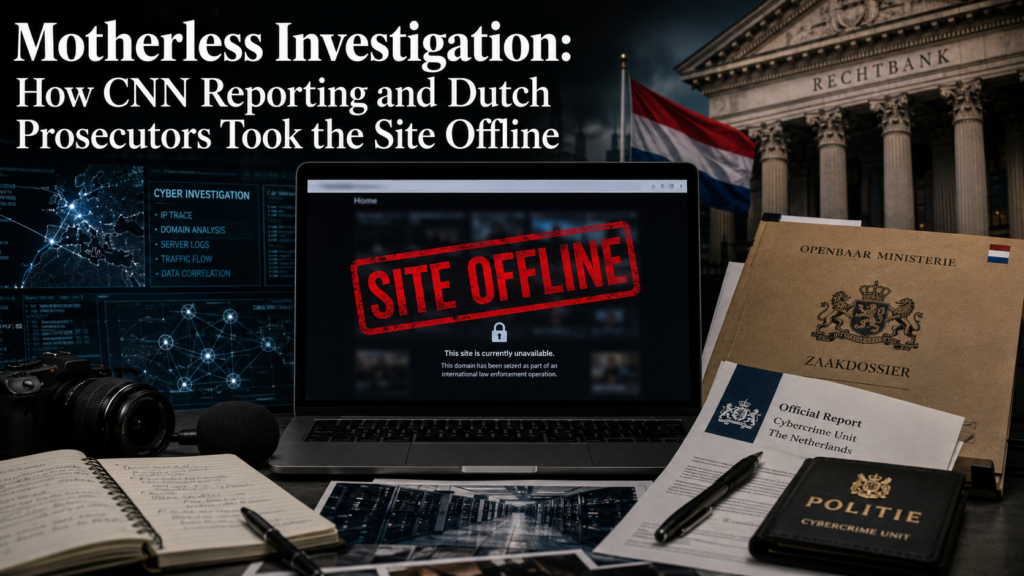
Motherless became the center of an international online abuse investigation after Dutch authorities took the pornography site offline in May 2026. The platform had been accused in investigative reporting of hosting videos that appeared to show non-consensual sexual abuse, including footage of women who were unconscious, drugged or unable to consent.
CNN’s investigation was central to the story. In a May 8, 2026 transcript, CNN described Motherless as a site it had investigated for hosting videos that appeared to show drugged women being sexually assaulted or raped. The same report said Dutch authorities had taken the site offline, prosecutors had opened a preliminary investigation into CNN’s findings and Motherless had been hosted on servers in the Netherlands by NFOrce.
Dutch reporting then added the local infrastructure layer. DutchNews reported that the Netherlands Public Prosecution Service, known as the OM, took the site offline after NOS and Nieuwsuur found that Motherless had been hosted on Dutch servers since 2024. The same report said the site drew roughly 62 million visitors a month and that an NOS analysis of 20,000 front-page videos found disturbing tags and categories linked to abuse concerns.
This is more than a takedown story. It is a test case for how governments, journalists, hosting companies, survivor advocates and regulators respond when alleged sexual abuse content is distributed through a large user-upload platform.
Why the Motherless Case Matters
Motherless was not treated by investigators as a small fringe website. The platform had large traffic, user-upload systems and search functions that reportedly helped users find categories of explicit content. That scale matters because platform responsibility changes when millions of people can access, upload, tag and redistribute videos.
The core issue is consent. Adult platforms can only operate lawfully and ethically if the people shown in content are adults who consented to filming and distribution. When a site is accused of hosting videos involving unconsciousness, intoxication, hidden recording or sexual assault, the problem is not just poor moderation. It becomes a possible criminal matter.
CNN’s coverage emphasized that the site had more than 60 million visits a month and thousands of videos featuring women who appeared unconscious during sex acts. CNN also reported that a hashtag described in the transcript as “ICheck” was used as a way to prove a woman was asleep.
That detail is important because tags and hashtags are not neutral labels. On user-generated platforms, tags are discovery tools. They help users search, sort and normalize categories of content. If a platform allows abuse-related tags to become popular, the issue is no longer only whether one video was removed after a complaint. The issue is whether the platform’s design made harmful material easier to find.
What CNN Found
CNN’s investigation placed Motherless within a wider online ecosystem linked to gender-based violence, sexual assault and drug-facilitated abuse content. In its May 8 broadcast transcript, CNN said Dutch authorities shut down the platform after its investigation sparked international condemnation. The report also said prosecutors had opened a preliminary investigation into CNN’s findings.
CNN Paris bureau chief Saskya Vandoorne reported that CNN had spent months investigating Motherless and Telegram groups linked to the site. The report said the investigation spread globally on social media and helped add momentum to calls for action.
This changed the story in three ways.
First, it shifted the case from a single-site moderation failure to a networked abuse concern. CNN did not describe only one website. It connected the site to linked groups and broader distribution patterns.
Second, it brought survivor reaction into the public record. CNN included survivor responses that framed the takedown as a moment of validation and accountability.
Third, it connected media evidence to state action. CNN reported that Dutch authorities acted because the servers had been physically located in the Netherlands for years, while NOS reporting on the Dutch connection added momentum.
What Dutch Prosecutors Did
Dutch authorities took Motherless offline in May 2026. According to DutchNews, the OM acted after NOS and Nieuwsuur found that the site had been hosted on Dutch servers since 2024. DutchNews also reported that a criminal investigation had been opened.
A criminal investigation is different from a platform safety review. Prosecutors can examine whether illegal material was distributed, whether evidence was preserved, whether operators knew about reported abuse, whether uploaders committed offences and whether the site’s systems enabled or profited from unlawful content.
A preliminary investigation does not automatically mean charges will follow. It means prosecutors considered the allegations serious enough to move beyond public criticism and into formal inquiry.
The Dutch minister of justice and security, David van Weel, was quoted in CNN’s transcript saying Dutch police and the public prosecution service had seen reason to take the site offline and that he considered it a good development.
Timeline of the Motherless Investigation
| Date | Event | Why It Matters |
| 2025 to early 2026 | CNN begins investigating Motherless and linked Telegram groups | The story develops from user complaints into a wider abuse-content investigation |
| March 2026 | CNN reporting draws international attention to alleged drug-facilitated sexual abuse content | Public pressure increases and the site becomes part of a global debate |
| Early May 2026 | NOS and Nieuwsuur investigate the Dutch hosting connection | The case becomes directly relevant to Dutch prosecutors and infrastructure providers |
| May 7, 2026 | NFOrce publishes a compliance escalation page about Motherless | The hosting provider requests urgent answers about moderation and abuse handling |
| May 8, 2026 | CNN reports that Dutch authorities took Motherless offline | The case moves from public exposure to state enforcement |
| May 2026 onward | Dutch prosecutors open a preliminary criminal investigation | Legal scrutiny turns toward evidence, operators, uploaders and hosting responsibilities |
NFOrce and the Hosting Provider Question
The hosting provider became a central part of the Motherless story because the site’s servers were reportedly in the Netherlands. CNN said Motherless was hosted on servers in the Netherlands by NFOrce, a company based in Steenbergen. CNN also reported that NFOrce launched an urgent compliance and abuse-handling review and gave Motherless 12 hours to respond. NFOrce later told CNN it did not operate, manage, moderate or control customer platforms or their content.
NFOrce also published a public compliance escalation page on May 7, 2026. It said the company had initiated an enhanced compliance and abuse-handling review after recent media publications and additional internal review. The provider requested confirmation on review and removal of high-risk content categories, moderation procedures, abuse handling and preventative compliance measures.
This matters because hosting providers are often not direct publishers of customer content. Still, they can become enforcement chokepoints when credible allegations involve unlawful or exploitative material. A host may not review every upload, but it can demand compliance answers, require remediation, preserve relevant records and suspend service where risk becomes unacceptable.
The Scale Problem
Scale is one of the most important parts of this case. CNN reported that Motherless received more than 60 million visits a month. DutchNews reported roughly 62 million monthly visitors and said an NOS analysis reviewed 20,000 videos posted on the front page in the first week of May.
A platform with that level of traffic cannot rely on the same moderation model as a small private forum. High-volume user-upload platforms need systems that can detect patterns, not just respond to individual complaints. That includes account-level review, repeated uploader detection, keyword monitoring, fast victim reporting, trusted flagger channels and evidence preservation.
DutchNews also reported that the online abuse expertise bureau Offlimits had received nearly 142 reports concerning roughly 12,000 videos on Motherless in 2026 alone and that 25 of those reports involved material concerning children.
That number is important because repeated reports can weaken the argument that a platform problem was isolated or unforeseeable. If a site receives many reports about similar harms, the moderation question becomes systemic.
Reactive Moderation vs Abuse-Content Enforcement
| Area | Reactive Platform Model | Stronger Abuse-Content Enforcement Model |
| Reports | Users submit individual URLs and wait for review | Victims, trusted flaggers and law enforcement get priority channels |
| Review | Moderators inspect one upload at a time | Teams analyze patterns across accounts, tags, uploads and mirrors |
| Evidence | Content may be removed without clear preservation | Relevant files, logs and account data are preserved for investigators |
| Uploader control | Minimal account barriers | Repeat-offender detection, identity signals and upload restrictions |
| Metadata | Tags are treated as user expression | High-risk tags become moderation signals |
| Hosting response | Host waits for formal legal notice | Host demands compliance proof and escalates high-risk customers |
| Public accountability | Platform publishes general policies | Platform documents response times, staffing and enforcement outcomes |
Why Tags, Search and Categories Matter
The Motherless investigation highlights an overlooked platform safety issue: metadata. Tags, search terms and categories can transform harmful uploads into searchable libraries.
A platform can remove one reported video but leave the discovery structure intact. That allows similar content to remain visible under related tags. When abuse-related tags become common, moderation must address the classification system as well as the files.
CNN reported that Motherless had thousands of videos featuring women who appeared unconscious during sex acts. It also reported that a popular hashtag was used as a way of proving a woman was asleep. DutchNews separately reported that an NOS analysis of front-page videos found highly viewed clips with disturbing tags, including tags associated with rape and incest.
The practical lesson is direct. Adult platforms cannot treat tags as harmless user labels when those tags signal incapacity, coercion, hidden recording or sexual assault. Metadata is part of the product. It must be part of the safety system.
Legal and Regulatory Context
The Motherless case sits at the intersection of criminal law and platform regulation.
The criminal-law question is whether unlawful material was uploaded, hosted, distributed or monetized and whether any operators, uploaders or facilitators can be held liable. Prosecutors will need to examine evidence, reporting history, platform controls and jurisdiction.
The regulatory question is broader. The European Union’s Digital Services Act, or DSA, applies to online intermediaries and platforms that connect users to content, products or services. The European Commission describes the DSA as a framework that creates responsibilities for digital services across the EU, including rules on illegal content, transparency and user protection.
The DSA does not replace criminal law. It adds duties around process, transparency and systemic risk. In abuse-content cases, those duties matter because slow review can mean ongoing harm for survivors.
The case also shows a difficult enforcement gap. Regulators need due process. Prosecutors need evidence. Victims need rapid removal. Platforms claim they need time to assess context. In cases involving alleged sexual abuse material, those timelines can collide.
Risks and Trade-Offs
The biggest risk is under-enforcement. If platforms ignore reports of non-consensual sexual abuse material, victims can be harmed again every time content is viewed, downloaded, reposted or mirrored. Sexual abuse material is not ordinary controversial speech. It can be an extension of the original abuse.
The second risk is over-enforcement. Broad takedowns can remove lawful adult content, push platforms offshore, reduce transparency and create private censorship without meaningful appeal. That concern is real and should be taken seriously.
The third risk is displacement. CNN reported that survivors and advocacy groups welcomed the takedown but warned that the site or similar networks could reappear on other servers. That warning is important. Takedown is not the same as dismantling an abuse network.
A strong enforcement model must balance all three risks. It should remove illegal material quickly, preserve evidence for investigators, protect lawful expression and make it harder for repeat uploaders to migrate without consequence.
Structured Insight Table
| Insight | Evidence Base | Why It Matters |
| CNN shifted the case from content scandal to network investigation | CNN reported months of investigation into Motherless and linked Telegram groups | Enforcement must examine distribution networks, not only single domains |
| Metadata became a core safety issue | CNN and Dutch reporting highlighted tags and categories linked to abuse concerns | Search tools can normalize harmful content if left unchecked |
| Hosting providers are now risk auditors | NFOrce requested answers on moderation, abuse handling and high-risk content categories | Infrastructure companies may face pressure to assess high-risk customers |
| Scale changed the accountability standard | CNN and DutchNews reported more than 60 million monthly visits | Large platforms need stronger systems than small communities |
| Takedown is only the first step | CNN reported warnings that similar networks could reappear elsewhere | Long-term enforcement requires evidence preservation and cross-border tracking |
Market, Cultural and Real-World Impact
The Motherless investigation affects more than one website. It sends a warning to adult-content platforms that consent verification, reporting channels and moderation architecture can become legal issues.
The market impact is likely to affect three groups first.
Adult platforms with user uploads will face stronger pressure to document abuse handling, especially for content involving intoxication, unconsciousness, hidden recording or disputed consent.
Hosting providers serving high-risk sites may need stronger review processes, clearer acceptable-use policies and faster escalation when credible allegations arise.
Moderation and compliance vendors may see increased demand from adult platforms that need evidence-preservation tools, keyword audits, trusted-flagger workflows and repeat-offender detection.
The cultural impact is more painful. The case shows how alleged abuse can be transformed into searchable entertainment through tags, comments, reposting and anonymous upload systems. CNN’s interview segment with Reem Alsalem, the UN special rapporteur on violence against women and girls, framed the issue as part of a wider problem of digital platforms hosting non-consensual sexual images and sexual abuse material.
That point should be handled carefully. Traffic figures do not prove that every visitor participated in abuse. The stronger conclusion is that a large platform allegedly hosted and surfaced content categories that created serious safety and legal concerns.
Practical Implications for Adult Platforms
The Motherless case points to a higher practical standard for adult platforms. A site that allows explicit user uploads should be able to answer basic safety questions before a crisis.
Those questions include:
- Who reviews reports involving non-consensual content?
- How fast are urgent reports escalated?
- Are victims given a direct reporting route?
- Are high-risk tags audited?
- Are repeat uploaders banned across accounts and devices?
- Are logs and files preserved when criminal conduct is alleged?
- Are older uploads reviewed when a new abuse pattern is discovered?
NFOrce’s escalation page asked similar questions about high-risk content review, moderation procedures, abuse handling and preventative compliance measures. That list may become a practical template for future hosting reviews.
The Future of Motherless in 2027
The future of Motherless in 2027 depends on three unresolved questions.
First, prosecutors must decide whether the evidence supports charges, seizures or further enforcement. The current investigation is preliminary, so any final legal outcome remains uncertain.
Second, hosting providers may tighten compliance standards for adult platforms. NFOrce’s public escalation asked for detailed answers about high-risk content, moderation and abuse-handling systems. Other providers may adopt similar checklists to reduce legal and reputational risk.
Third, regulators may focus more on system design than individual takedowns. Under the DSA environment, platforms can face scrutiny not only for what content appears online but for whether their notice, review, transparency and risk controls work in practice.
The uncertain part is migration. If one platform is taken offline, users can move to new domains, offshore hosts, encrypted channels or clone sites. That means 2027 enforcement will need to focus on repeat uploaders, cross-platform sharing paths, payment trails, data preservation and international cooperation.
The Motherless case may become a model for faster intervention, but only if authorities learn from its limits. Taking a site offline can stop immediate access. It does not automatically identify every uploader, remove every mirror or prevent the same networks from regrouping elsewhere.
Takeaways
- CNN’s investigation was central because it connected Motherless to alleged drug-facilitated sexual abuse content and linked online communities.
- Dutch prosecutors acted after CNN, NOS and Nieuwsuur reporting brought together survivor concerns, Dutch hosting infrastructure and platform-scale allegations.
- NFOrce’s compliance escalation shows that hosting providers may face stronger expectations when high-risk customers are accused of enabling abuse.
- Tags, search terms and categories can become safety risks when they make alleged abuse content discoverable.
- Large adult platforms need documented systems for victim reporting, high-risk metadata review, repeat-offender detection and evidence preservation.
- Takedowns must be paired with investigation and cross-border coordination, or harmful networks may simply relocate.
Conclusion
The Motherless investigation shows how a user-upload adult platform can become a criminal, regulatory and infrastructure problem when allegations involve non-consensual sexual abuse material. CNN’s reporting helped frame the case as part of a wider abuse-content ecosystem, while NOS and Nieuwsuur added the Dutch hosting connection that made local enforcement unavoidable.
The central lesson is that reactive moderation is no longer enough for high-risk platforms. If a site allows explicit uploads at scale, it must prove that it can detect abuse patterns, respond to victims, remove unlawful material, preserve evidence and stop repeat offenders.
The case also shows that hosting providers cannot ignore credible abuse allegations forever. They may not operate customer platforms, but they can demand compliance evidence and act when customers fail to meet basic safety expectations.
By 2027, the real measure will not be whether one website remains offline. It will be whether regulators, prosecutors, hosts and platforms can reduce the conditions that allowed alleged abuse material to circulate so widely in the first place.
FAQ
What is Motherless?
Motherless is an adult-content website that became the focus of major scrutiny after CNN and Dutch investigations alleged that it hosted videos involving non-consensual sexual abuse, including material involving unconscious or drugged women.
What did CNN report about Motherless?
CNN reported that Motherless hosted videos appearing to show drugged women being sexually assaulted or raped, also described as sleep content. CNN also said it had spent months investigating the site and Telegram groups linked to it.
Why did Dutch authorities take Motherless offline?
Dutch authorities took the site offline after CNN, NOS and Nieuwsuur investigations increased scrutiny. DutchNews reported that the OM acted after NOS and Nieuwsuur found the site had been hosted on Dutch servers since 2024.
Who hosted Motherless?
CNN reported that Motherless was hosted on servers in the Netherlands by NFOrce, a company based in Steenbergen. NFOrce said it launched an urgent compliance and abuse-handling review.
Did NFOrce control Motherless content?
NFOrce told CNN that it did not operate, manage, moderate or control customer platforms or their content. The company still initiated a compliance escalation and requested answers about moderation and abuse handling.
What happens next in the Motherless investigation?
Dutch prosecutors will need to determine whether evidence supports charges, seizures or further enforcement. The investigation is preliminary, so the final legal outcome remains uncertain.
Why does this case matter beyond one website?
The case shows how adult platforms, hosting providers and regulators may be judged by their systems, not only by whether they remove individual videos after public exposure.
Methodology
This article was prepared from the supplied production brief and revised to make CNN’s investigation central to the structure, headline and analysis. The user-provided brief specified the keyword, article requirements, source direction and editorial structure.
The factual review used CNN’s May 8, 2026 transcript, DutchNews reporting, NFOrce’s public compliance escalation and relevant Perplexity AI Magazine internal-link candidates. Claims about alleged abuse content are attributed to reporting, not independently verified by direct site review. The criminal investigation remains ongoing and no final charging decision has been cited in the available sources.
A human editor should verify all citations, confirm internal links are live, review legal wording and add the site’s author name before publication.
References
CNN. (2026, May 8). What We Know with Max Foster: Transcript. CNN Transcripts.
DutchNews.nl. (2026, May 8). Prosecutors take Dutch-hosted abuse site Motherless offline.
NFOrce. (2026, May 7). Case: Motherless.com, Abuse & Compliance Escalation.
Perplexity AI Magazine. (2026). Socialmediagirls forum analysis, safety and risks explained.
Perplexity AI Magazine. (2026). nhentai.nef: Mirror Domain Risks and Safety Guide.
Perplexity AI Magazine. (2026). Erothot Aesthetic Content Explained and Digital Trends.
