
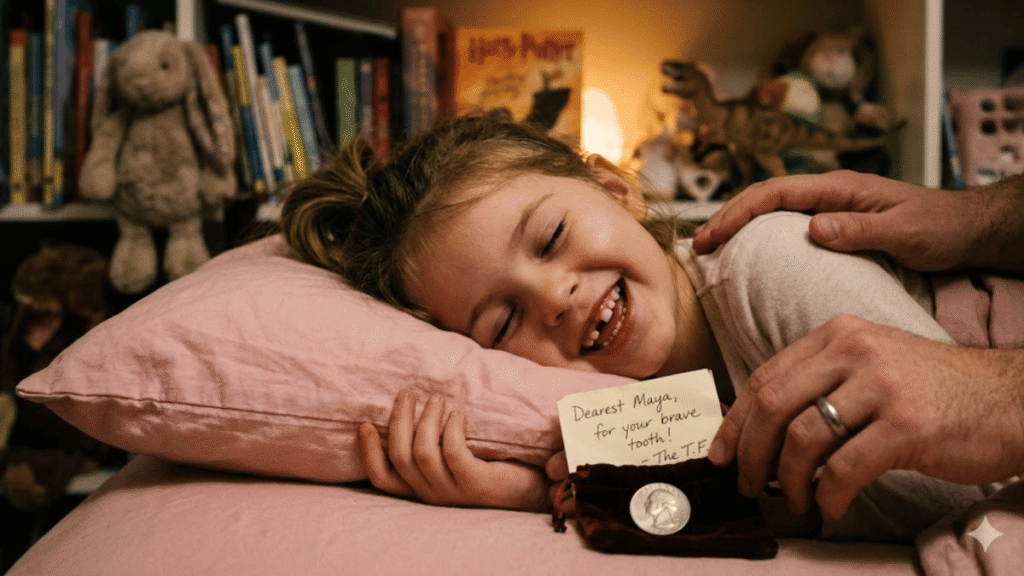
Is the Tooth Fairy real? In a literal sense, no credible scientific or historical evidence supports the existence of a magical being who exchanges lost teeth for money. Yet the persistence of the Tooth Fairy across generations suggests a deeper truth: it is “real” as a cultural construct, a psychological tool, and a shared myth that shapes childhood experience. Within the first moments a child places a tooth beneath a pillow, belief begins—not in biology or physics, but in storytelling and trust.
The Tooth Fairy exists in the same conceptual category as figures like Santa Claus—a symbolic character sustained by collective imagination. For children, this belief bridges fantasy and reality, softening anxieties around physical change and creating a sense of wonder. For parents, it becomes a ritualized opportunity to celebrate growth and reward milestones.
Across cultures, the tradition varies widely. In some countries, teeth are thrown onto rooftops or buried, yet the underlying purpose remains consistent: transforming a potentially unsettling biological process into something meaningful and even joyful. The question, then, shifts from whether the Tooth’s Fairy exists to why it continues to matter.
The Origins of the Tooth Fairy Tradition
The modern Tooth Fairy is a relatively recent invention, but its roots extend centuries into global folklore. Anthropologists trace early tooth-related rituals to medieval Europe, where fears of witches using body parts for spells led families to burn or bury children’s teeth. In Viking traditions, children received “tooth fees,” small payments for baby teeth believed to bring luck in battle.
The specific figure of a fairy exchanging money emerged in the early 20th century United States, gaining popularity after a 1927 play titled The Tooth Fairy‘s by Esther Watkins Arnold. Over time, commercialization and media reinforced the character’s image—small, winged, and benevolent.
Unlike older rituals rooted in superstition, the Tooth’s Fairy evolved into a benign cultural myth aligned with modern parenting values. It reframed tooth loss as a positive milestone rather than a moment of vulnerability. This transformation reflects broader societal shifts: from fear-based traditions to emotionally supportive narratives.
Today, the Tooth Fairy is less about mythology and more about meaning—a story intentionally maintained to support childhood development.
Why Children Believe: The Psychology of Magical Thinking
Children’s belief in the Tooth Fairy is not naïve—it is developmentally appropriate. Psychologists describe early childhood as a phase of “magical thinking,” where imagination and reality coexist fluidly. According to research by developmental psychologist Jean Piaget, children between ages 2 and 7 often interpret the world symbolically rather than logically.
This cognitive stage allows children to accept invisible agents like fairies or imaginary friends without skepticism. Rather than being misled, children are actively constructing understanding through narrative.
Three key psychological functions underpin Tooth Fairy belief:
- Coping Mechanism: Losing teeth can be unsettling; the fairy reframes it as a reward.
- Trust Development: Children learn to trust caregivers who reinforce the story.
- Imaginative Growth: Belief strengthens creativity and storytelling skills.
A 2016 study published in Frontiers in Psychology found that children who engage in imaginative play often demonstrate stronger problem-solving abilities later in life. The Tooth’s Fairy, in this sense, acts as a scaffold for cognitive development rather than a deception.
Cultural Variations Around the World
While the Tooth Fairy is dominant in Western cultures, tooth-loss rituals differ globally, revealing fascinating cultural diversity.
| Country/Region | Tradition | Symbolic Meaning |
|---|---|---|
| United States | Tooth under pillow for money | Reward and growth |
| Spain | Ratoncito Pérez (a mouse collects teeth) | Transformation and renewal |
| Japan | Teeth thrown onto roofs or under floors | Strength and alignment |
| Turkey | Teeth buried in meaningful locations | Future success |
| Egypt | Teeth thrown toward the sun | Protection and health |
In Spain and Latin America, children await Ratoncito Pérez, a small mouse rather than a fairy. The variation highlights how cultures adapt the same developmental milestone into locally meaningful narratives.
Despite differences, the underlying themes remain consistent: transition, growth, and reassurance.
The Economics of the Tooth Fairy
The Tooth Fairy has also evolved into an economic phenomenon. What began as a symbolic token has, in many households, become a small financial transaction.
| Year | Average Payment (U.S.) | Cultural Trend |
|---|---|---|
| 1950s | $0.25 | Symbolic gesture |
| 1990s | $1–$2 | Standardized reward |
| 2010s | $3–$5 | Inflation-adjusted norm |
| 2020s | $5+ | Competitive parenting culture |
According to surveys by organizations like Delta Dental, the average payout has steadily increased, reflecting broader economic and social pressures. Some parents report feeling compelled to match peer expectations, turning a simple ritual into a subtle competition.
This monetization raises questions: does higher payment enhance the experience, or dilute its symbolic meaning? Experts suggest that the value lies less in the amount and more in the ritual itself—the anticipation, the story, and the emotional exchange.
Ethical Questions: Is It a Lie?
One of the most debated aspects of the Tooth Fairy is whether it constitutes deception. Critics argue that encouraging belief in a fictional character undermines trust. Supporters counter that it is a form of “benevolent fiction,” similar to storytelling in literature.
Philosopher Immanuel Kant famously argued against lying under any circumstances, yet modern developmental psychology takes a more nuanced view. Research indicates that children do not interpret these myths as harmful lies when revealed; instead, they often reinterpret them as part of growing up.
Dr. Gail Heyman, a psychologist at the University of California, has found that most children transition out of belief gradually, without feelings of betrayal. They come to understand the Tooth Fairy as a shared social game rather than a literal truth.
The ethical dimension, therefore, depends largely on context. When presented gently and without coercion, the Tooth Fairy becomes less about deception and more about participation in a cultural narrative.
Expert Perspectives on the Tooth Fairy
Experts across disciplines agree that the Tooth Fairy serves meaningful developmental and social functions.
“Rituals like the Tooth Fairy help children make sense of change,” says Dr. Jacqueline Woolley, a developmental psychologist at the University of Texas. “They provide structure and reassurance during moments that might otherwise feel uncertain.”
Anthropologist Alan Dundes emphasized that folklore persists because it fulfills psychological needs. The Tooth Fairy, like other myths, survives not because it is factual, but because it is functional.
Meanwhile, pediatric dentists note practical benefits. Dr. Mary Hayes of the American Dental Association has observed that the tradition can encourage better oral hygiene by linking tooth loss with positive reinforcement.
These perspectives converge on a single insight: the Tooth Fairy is not random—it is purposeful.
Media, Marketing, and the Modern Fairy
The Tooth Fairy has been amplified through media, appearing in films, books, and advertisements. From children’s literature to Hollywood portrayals, the character has evolved visually and narratively.
In the 2010 film Tooth Fairy, starring Dwayne Johnson, the concept is reimagined humorously, demonstrating its flexibility as a cultural symbol. Such portrayals reinforce the fairy’s presence while adapting it to contemporary audiences.
Marketing has also played a role. Dental organizations, toy companies, and even financial institutions have used the Tooth Fairy as a branding tool, linking it to savings habits and health education.
This commercialization reflects a broader trend: myths do not remain static—they evolve alongside society.
The Moment of Disbelief
Eventually, every child confronts the question: is the Tooth Fairy real? This moment marks a cognitive transition from magical thinking to logical reasoning.
Studies suggest that children typically stop believing between ages 6 and 9. The shift often occurs not through direct revelation but through inference—comparing notes with peers, noticing inconsistencies, or questioning logistics.
Importantly, the loss of belief is rarely traumatic. Instead, it often brings a sense of maturity and inclusion in the “adult secret.” Many children take pride in becoming part of the tradition’s continuation, helping younger siblings maintain the illusion.
This transition illustrates a key developmental milestone: the ability to distinguish fantasy from reality while still appreciating both.
Takeaways
- The Tooth Fairy is not real in a literal sense but exists as a powerful cultural and psychological construct.
- Its origins blend ancient rituals with modern storytelling traditions.
- Belief in the Tooth Fairy supports emotional coping, imagination, and developmental growth.
- Cultural variations reveal universal themes of transformation and reassurance.
- The tradition has evolved economically and commercially over time.
- Ethical concerns are mitigated by the gentle, participatory nature of the myth.
- The eventual loss of belief represents a healthy developmental transition.
Conclusion
The question “Is the Tooth Fairy real?” ultimately depends on how one defines reality. In empirical terms, the answer is no—there is no evidence of a nocturnal visitor exchanging teeth for currency. Yet dismissing the Tooth Fairy entirely overlooks its enduring significance.
As a cultural artifact, it is profoundly real. It shapes childhood memories, fosters imagination, and provides comfort during moments of change. It connects generations through a shared ritual, quietly reinforcing values of growth, reward, and storytelling.
In a world increasingly driven by data and verification, the Tooth Fairy represents something different: the human capacity to create meaning beyond facts. It reminds us that not all truths are measurable—some are felt, remembered, and passed down.
And in that sense, the Tooth Fairy continues to exist—not under pillows, but in the collective imagination where stories become part of who we are.
Click Here to Check Out More Interesting Blogs!
FAQs
Is the Tooth Fairy based on a real person?
No, the Tooth Fairy is not based on a historical individual. It evolved from a combination of folklore, cultural rituals, and modern storytelling traditions.
At what age do children stop believing in the Tooth Fairy?
Most children stop believing between ages 6 and 9 as their cognitive development enables logical reasoning and skepticism.
Do all cultures have a Tooth Fairy?
No. Many cultures have different traditions, such as tooth-collecting mice or rituals involving throwing or burying teeth.
Is it harmful to let children believe in the Tooth Fairy?
Research suggests it is not harmful. It can support imagination and emotional development when handled appropriately.
How much money should the Tooth Fairy leave?
There is no standard amount. The value varies by culture and family preference, with emphasis on the ritual rather than the monetary reward.
