
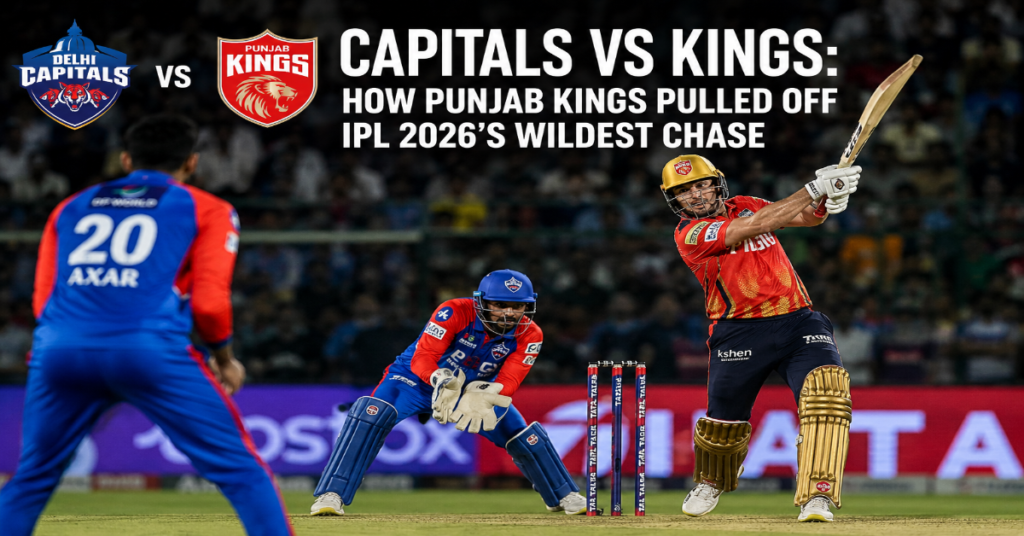
The Capitals vs Kings IPL 2026 match was not just another high-scoring league game. It became the night Punjab Kings completed the highest successful chase in IPL history, reaching 265/4 in 18.5 overs against Delhi Capitals at the Arun Jaitley Stadium in Delhi. Delhi had posted 264/2, powered by KL Rahul’s unbeaten 152 and Nitish Rana’s 91, but Punjab Kings won by six wickets with seven balls to spare.
The match had almost everything that defines modern IPL chaos: a 150-plus individual score, a 260-plus first-innings total, a 100-plus powerplay chase, multiple dropped catches and a scary head-injury incident involving Lungi Ngidi. The uploaded brief correctly frames the article around IPL 2026 Match 35, Delhi Capitals vs Punjab Kings, and the record chase angle.
What made the result so striking was not just the target. It was the rhythm of the chase. Punjab did not treat 265 as a miracle equation. They treated it as a rate-management problem. Prabhsimran Singh and Priyansh Arya attacked early, Shreyas Iyer controlled the middle and closing phase, and Delhi’s fielding errors turned pressure into panic.
Score Overview
| Team | Score | Overs | Main contributors | Result |
| Delhi Capitals | 264/2 | 20 | KL Rahul 152*, Nitish Rana 91 | Lost |
| Punjab Kings | 265/4 | 18.5 | Prabhsimran Singh 76, Priyansh Arya 43, Shreyas Iyer 71* | Won by 6 wickets |
Hindustan Times reported Punjab Kings at 265/4 in 18.5 overs, with Shreyas Iyer unbeaten on 71 off 36 balls. The Statesman also described the chase as completed with seven balls to spare at the Arun Jaitley Stadium.
Why This Capitals vs Kings Match Became Historic
This game broke the old logic of IPL batting. For years, 200 was treated as a winning total. Then 220 became chaseable. By 2024 and 2025, even 240-plus targets were no longer safe. But Delhi’s 264/2 should still have been enough in most conditions.
Punjab Kings changed that.
The chase was historic because it moved the IPL ceiling again. NDTV reported that Punjab bettered their own record for the highest successful IPL chase, having previously chased 262 against Kolkata Knight Riders in 2024. It also called the 265 chase the highest successful chase across T20 cricket.
The key was tempo. Punjab were not waiting for one batter to carry the innings deep from ball one to ball 115. They distributed violence across phases.
| Chase phase | Punjab approach | Impact |
| Overs 1–6 | All-out attack from Prabhsimran and Priyansh | Required rate fell from extreme to manageable |
| Overs 7–12 | Wickets came, but PBKS stayed ahead of the rate | Delhi could not create sustained pressure |
| Overs 13–18.5 | Shreyas Iyer controlled risk and punished errors | PBKS closed with seven balls left |
The most important strategic point: Punjab did not chase 265 in one burst. They made the target smaller every six balls.
Delhi’s Innings: KL Rahul’s 152* Should Have Been a Match-Winner
Delhi Capitals did almost everything right with the bat. KL Rahul’s 152* off 67 balls was a massive individual performance. Hindustan Times reported that Rahul struck 16 fours and nine sixes at a strike rate of 226.87, while Nitish Rana made 91 off 44 balls in a 220-run stand.
The innings had three layers.
First, Delhi did not lose early control. Even after Pathum Nissanka departed, Rahul and Rana stabilized without slowing the innings.
Second, Rana gave Delhi acceleration before the death overs. His 91 meant Punjab could not simply bowl around Rahul.
Third, Rahul’s finishing turned a very good total into a historic one. His 47-ball century and final acceleration pushed Delhi past 260. The Statesman described his score as the highest by an Indian in IPL history and the third-highest individual score overall in the league.
Yet the match exposed a cruel truth of current T20 cricket: a great individual innings can still lose if the opposition wins the powerplay by a massive margin.
Punjab’s Chase: The Powerplay That Changed Everything
The defining passage of the match came early in Punjab’s reply. Prabhsimran Singh and Priyansh Arya attacked so fast that Delhi’s 264 started to look less like a mountain and more like a steep but climbable road.
NDTV reported that Prabhsimran made 76 off 26 balls and Priyansh Arya made 43 off 17, adding 126 in just 6.5 overs. It also noted that Punjab recorded the season’s highest powerplay score at 105/0.
The Statesman gave an even sharper picture of the early assault, reporting 116 in the first six overs and an 18-ball fifty for Prabhsimran.
That opening stand changed the psychology of the game. Delhi were no longer defending 264. They were defending a shrinking equation.
| Batter | Runs | Balls | Role |
| Prabhsimran Singh | 76 | 26 | Powerplay destroyer |
| Priyansh Arya | 43 | 17 | Left-hand attacking partner |
| Shreyas Iyer | 71* | 36 | Anchor-finisher |
| Shashank Singh | 19* | Noted in reports | Support at the finish |
The chase also showed why powerplay hitting is now the most valuable currency in high-target T20 cricket. If a team chasing 265 scores around 100 in the first six overs without losing control, the target stops being absurd.
Shreyas Iyer’s Calm Finish
The early assault created the platform, but Shreyas Iyer made sure Punjab did not waste it. Hindustan Times reported that Iyer finished unbeaten on 71 off 36 balls, with three fours and seven sixes.
His innings mattered because the chase could easily have collapsed after the openers fell. Delhi did create openings. Kuldeep Yadav struck. Axar Patel also made an intervention. But Iyer’s value was in controlling volatility.
This was not a slow anchor innings. It was an innings built around choosing the right boundary options. He absorbed the brief wicket pressure, then attacked when Delhi missed their chances.
That is where the fielding story becomes central.
Dropped Catches: The Hidden Cost of Pressure
The Capitals vs Kings match will also be remembered for Delhi’s fielding collapse. The uploaded brief refers to around nine dropped catches across the game, while live coverage and match reports highlighted costly missed chances involving Shreyas Iyer and KL Rahul.
Hindustan Times reported that Karun Nair dropped Iyer in the 15th and 16th overs. Indian Express live coverage also noted Nair dropping Iyer at long-off when the Punjab captain was on 28.
Those misses were not just technical errors. They were scoreboard errors. In a chase this fast, every dropped catch costs more than the runs scored after it. It also costs fielding calm, bowler confidence and captaincy control.
Delhi had already benefited from Punjab dropping Rahul earlier. Hindustan Times reported that Shashank Singh dropped KL Rahul near the boundary when Rahul was on 12. Rahul finished on 152*.
That created a strange symmetry. Both teams made fielding mistakes, but Punjab survived theirs because their chase had more batting momentum.
The Lungi Ngidi Injury Scare
The most worrying moment of the match involved Lungi Ngidi. Hindustan Times reported that Ngidi hurt his head while trying to take a catch during the chase, fell backward and was taken away in an ambulance after physios and a stretcher came onto the field.
The Statesman also described it as a head injury suffered while attempting a catch, with Ngidi being stretchered off and play briefly halted.
This incident matters beyond the scorecard. T20 cricket often discusses player safety through workload, heat and fast bowling injuries, but high catches under lights create their own risks. Boundary and infield catching in modern T20 involves sprinting, backpedaling, diving and tracking a white ball at speed. A single misjudgment can turn dangerous.
Comparison With Other High IPL Chases
Punjab’s 265 chase did not happen in isolation. It extended a trend already visible in recent IPL seasons.
| Rank | Team | Target chased | Opponent | Year | Why it mattered |
| 1 | Punjab Kings | 265 | Delhi Capitals | 2026 | Highest successful IPL chase |
| 2 | Punjab Kings | 262 | Kolkata Knight Riders | 2024 | Previous IPL chase record |
| 3 | Sunrisers Hyderabad | 246 | Punjab Kings | 2025 | Abhishek Sharma’s 141 powered a massive chase |
| 4 | Mumbai Indians | 245 | Punjab Kings | 2023 | Showed Wankhede’s chase-friendly ceiling |
| 5 | Rajasthan Royals | 224 | Punjab Kings | 2020 | Earlier benchmark for IPL chasing |
Reuters reported Punjab’s 262 chase against Kolkata Knight Riders in 2024 as the highest IPL chase at the time, while Reuters also covered Sunrisers Hyderabad’s 2025 chase against Punjab, powered by Abhishek Sharma’s 141.
The difference in 2026 was the target size and the speed. Punjab did not scrape past 265. They got there with seven balls left.
Strategic Implications
This match should change how IPL teams think about defending giant totals.
A 260-plus score still gives a team a major advantage, but it no longer guarantees tactical comfort. Captains need wicket-taking plans even when they have runs in the bank. Defensive fields too early can be punished because elite T20 batters now treat singles as a bonus, not a necessity.
The bowling side must also protect the first six overs. If the chasing team reaches 90 or 100 in the powerplay, the match becomes a finishing contest rather than a chase.
For batting teams, the Punjab model offers a clear lesson. A huge chase does not always require one batter to score 130. It can be broken into roles:
| Role | Ideal output in 260 chase | Punjab example |
| Powerplay attacker | 60–80 at extreme strike rate | Prabhsimran Singh |
| Secondary opener | 35–50 fast runs | Priyansh Arya |
| Middle-order controller | 60–80 not out | Shreyas Iyer |
| Finishing partner | 15–25 calm runs | Shashank Singh |
Risks and Trade-Offs
The obvious risk is that this style can collapse quickly. If Punjab had lost two wickets inside the first three overs, the same attacking method would have looked reckless.
There is also a bowling-market implication. Franchises may now place even more value on bowlers who can take wickets in the powerplay rather than simply limit damage. Economy rate still matters, but wicket-taking under attack matters more.
Fielding depth is another trade-off. Teams often pick impact substitutes or specialist batting depth to stretch lineups. But when the match turns on high-pressure catches, a weaker fielder in the wrong position can become the difference between a win and a record defeat.
Real-World Impact: Why This Match Went Viral
The match became social-media fuel because it had a rare combination of shock and simplicity. Even casual fans understand the drama of 264 not being enough.
Reddit discussion, referenced in the uploaded brief, focused on the absurdity of a 150-plus score, a 260-plus innings, a scary injury and many dropped catches all occurring in one game.
That is why the match traveled beyond normal IPL highlights. It was not just Punjab fans celebrating. It was T20 fans processing a new scoring reality.
The Future of Capitals vs Kings in 2027
By 2027, matches like Capitals vs Kings may no longer feel like outliers. The IPL has already moved toward deeper batting lineups, flatter surfaces, aggressive powerplay batting and impact-player flexibility. The 2026 Delhi match showed how those forces combine.
The future question is not whether 260 can be chased. It already has been. The question is how teams adjust.
Expect three changes in 2027:
- More powerplay specialists: Teams will prioritize openers who can score 45 off 18 over traditional accumulators.
- More defensive fielding scrutiny: Dropped catches in high-scoring games will be reviewed as tactical failures, not just skill mistakes.
- More bowling variety: Captains will need wrist spin, cutters, hard lengths and boundary-size planning rather than pace-on predictability.
The uncertainty is pitch regulation. If venues remain extremely batting-friendly, record chases may become more common. If curators and match officials push for more balanced surfaces, 260 may return to being close to untouchable.
Takeaways
- Delhi’s 264/2 was a dominant batting performance, but Punjab’s powerplay made the chase structurally possible.
- KL Rahul’s 152* deserved to win most IPL matches, which makes the result even more remarkable.
- Prabhsimran Singh’s 76 off 26 was arguably the most important innings because it reset the required rate.
- Shreyas Iyer’s 71* showed the value of a middle-order batter who can finish without panic.
- Dropped catches shaped both innings, but Delhi paid the heavier price.
- Lungi Ngidi’s injury scare was a reminder that player safety matters even in batting-dominated spectacles.
- The match confirmed that modern IPL totals need to be judged by conditions, batting depth and powerplay intent, not by old score benchmarks.
Conclusion
The Capitals vs Kings IPL 2026 match was a record chase, but it was also a warning. Delhi Capitals produced an innings that would have won almost any T20 match in an earlier era. KL Rahul made 152*, Nitish Rana nearly made a century and the total reached 264. Yet Punjab Kings treated the target with clarity, aggression and nerve.
The result came from more than one heroic knock. Prabhsimran Singh broke the chase open, Priyansh Arya sustained the early assault and Shreyas Iyer finished the job after Delhi missed key chances. The dropped catches and Ngidi injury added drama, but the deeper story was tactical: in modern IPL cricket, even 260 is no longer safe unless the bowling and fielding match the batting standard.
This was not just a Punjab win. It was a glimpse of where T20 cricket is heading.
FAQ
What happened in the Capitals vs Kings IPL 2026 match?
Punjab Kings chased 265 against Delhi Capitals in Match 35 of IPL 2026 at the Arun Jaitley Stadium. Delhi made 264/2, but Punjab reached 265/4 in 18.5 overs and won by six wickets.
Who scored the most runs in Delhi Capitals vs Punjab Kings?
KL Rahul scored the most runs in the match with an unbeaten 152 for Delhi Capitals. For Punjab Kings, Prabhsimran Singh made 76 and Shreyas Iyer finished unbeaten on 71.
Is 265 the highest successful chase in IPL history?
Yes. Punjab Kings’ chase of 265 against Delhi Capitals in 2026 is reported as the highest successful chase in IPL history, beating Punjab’s own 262 chase against Kolkata Knight Riders in 2024.
Why did Delhi Capitals lose after scoring 264?
Delhi lost because Punjab’s openers scored at an extraordinary rate in the powerplay, Shreyas Iyer finished the chase and Delhi dropped key catches at crucial moments.
What was the scary injury in the match?
Lungi Ngidi suffered a head injury while attempting a catch during Punjab’s chase. Reports said he fell backward, received medical attention, was stretchered off and was taken away in an ambulance.
How many balls were left when Punjab Kings won?
Punjab Kings completed the chase with seven balls to spare, reaching 265/4 in 18.5 overs.
Methodology
This article was drafted from the supplied production brief and then checked against live match reports and score coverage. The core scoreline, venue, result, Rahul innings, Punjab batting details, dropped-catch context and Lungi Ngidi injury note were validated using Hindustan Times, NDTV Sports, The Statesman, Indian Express search snippets and Reuters coverage of related IPL chase records. The uploaded brief supplied the editorial structure, keyword rules and angle.
References
Hindustan Times. (2026, April 25). Delhi Capitals vs Punjab Kings highlights, IPL 2026: Rahul’s 152* goes in vain as Iyer’s brilliance leads PBKS to stunning victory.
NDTV Sports. (2026, April 25). Highest run-chase in IPL history: Punjab Kings shatter record as KL Rahul’s 152* for Delhi Capitals goes in vain.
The Statesman. (2026, April 25). IPL 2026: 264 falls short as Punjab Kings script record chase against Delhi Capitals.
Reuters. (2024, April 26). Punjab pull off IPL’s highest run chase in eight-wicket win over Kolkata.
Reuters. (2025, April 12). Sharma belts 141 as Hyderabad pull off IPL’s second-highest successful chase.
