
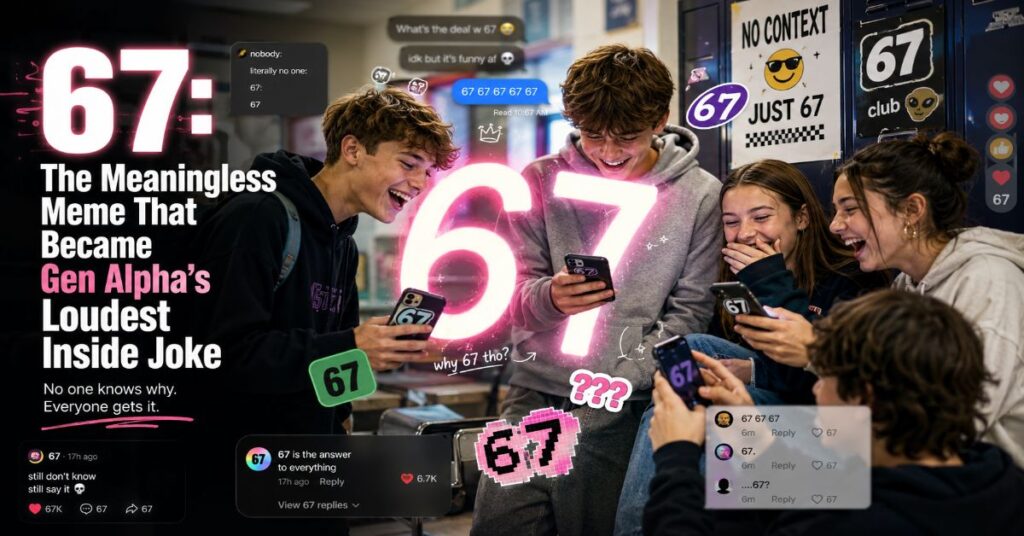
67 is a viral internet meme and slang term used mostly by kids, teens and Gen Alpha as a nonsense answer, chant or social cue. It does not have one stable meaning. That is the meaning. The phrase is often connected to rapper Skrilla’s 2024 and 2025 drill track “Doot Doot (6 7),” TikTok basketball edits, LaMelo Ball’s 6-foot-7 height and the up-and-down hand gesture now familiar in schools and short-form video culture.
For parents, teachers and adults trying to decode it, the frustrating part is also the most important part: the phrase is not designed to be decoded cleanly. It works because it is vague. A child can say it after almost any question. “How was lunch?” “Six-seven.” “Did you finish homework?” “Six-seven.” “Is this good or bad?” Hands move up and down, the room laughs and the adult is left asking why.
That is how modern youth slang often behaves online. It is not always a word with a dictionary definition. Sometimes it is a sound, a number, a rhythm, a gesture or a meme fragment that becomes funny because a community repeats it until repetition itself becomes the joke. By late 2025, the phrase had moved from TikTok and Instagram Reels into classrooms, basketball gyms, family dinner tables and mainstream language coverage.
This article explains what the meme means, where it came from, why children keep saying it, why schools have reacted so strongly and what the rise of six-seven says about language, attention and internet culture in 2026.
What Does 67 Mean?
The clean answer is simple: it means almost nothing.
The more useful answer is that six-seven is a flexible social signal. It can mean “maybe,” “so-so,” “I don’t know,” “that’s funny,” “I’m part of the joke” or “I want to annoy you in a way my friends understand.” In many uses, it is not a reply to the question being asked. It is a reply to the social situation around the question.
That is why it can feel impossible to translate. A normal slang word usually replaces another word. “Rizz” points toward charm. “Mid” points toward average quality. “Delulu” points toward unrealistic confidence. Six-seven does not point cleanly toward a concept. It points toward a mood.
The gesture matters too. Many kids say the phrase while moving both hands up and down, palms facing upward, as if weighing two options. That visual rhythm helps explain why some adults interpret it as “maybe this, maybe that” or “so-so.” But the gesture is not a formal definition. It is part of the performance.
A Practical Translation Table
| Use case | What a kid may be doing | Adult translation |
| Saying it after any question | Avoiding a serious answer | “I’m joking, not answering.” |
| Saying it with the hand gesture | Performing the meme | “Maybe, maybe not.” |
| Repeating it with friends | Joining the group rhythm | “We all know this joke.” |
| Saying it to annoy a teacher | Testing limits | “This is funny because you hate it.” |
| Posting it under sports clips | Referencing basketball edits | “This belongs to the meme.” |
| Using it around adults | Creating confusion | “You are not supposed to get it.” |
Where the Meme Came From
The strongest documented origin is Skrilla’s drill rap song “Doot Doot (6 7).” The track circulated online before its official 2025 release and included the repeated “6-7” lyric that became easy to clip, remix and attach to short videos.
From there, basketball culture accelerated the phrase. LaMelo Ball, the Charlotte Hornets guard, is listed at 6 feet 7 inches tall. That coincidence made him an ideal visual hook for edits using the lyric. Basketball highlight pages, TikTok accounts and short-form sports creators helped make the sound recognizable before many viewers understood anything about the song itself.
The meme spread again through youth basketball culture. Taylen “TK” Kinney, an Overtime Elite player, became associated with the phrase through repeated use in online clips. Then the “67 Kid,” widely identified in viral coverage as Maverick Trevillian, became a meme figure after a basketball-game clip showed him shouting the phrase with the now-recognizable gesture.
The result was a layered meme with several engines:
| Layer | What it added |
| Song lyric | The sound and rhythm |
| Basketball edits | A visual sports context |
| LaMelo Ball | A height-based coincidence |
| Youth athletes | Repetition and personality |
| Viral kid clip | A face, gesture and schoolyard energy |
| TikTok and Reels | Scale, remixing and algorithmic repetition |
| Classrooms | Offline spread and adult confusion |
This matters because the phrase did not spread through one official definition. It spread through repetition across contexts. Every new clip made it less tied to the original lyric and more useful as a general absurd response.
Why Kids Keep Saying It
Children and teens do not need a fixed meaning for a phrase to be useful. In some cases, fixed meaning would make it less useful.
Six-seven works because it gives young people four things at once.
First, it gives them a shared code. If one student says it and another student laughs, both have confirmed membership in the same online culture. The phrase becomes a quick test of who is inside the joke.
Second, it gives them low-risk rebellion. Saying a random number is not usually offensive. It is not profanity. It is not a direct insult. Yet it can still interrupt a lesson, derail a conversation or frustrate an adult. That makes it attractive in school settings where students want to push boundaries without crossing into obviously punishable speech.
Third, it gives them absurdity. Gen Alpha humor often prizes randomness, speed and anti-meaning. The joke is not “here is a clever punchline.” The joke is “why is everyone repeating this meaningless thing?” That type of humor fits short-form platforms where repetition can become funnier than explanation.
Fourth, it gives them control over adult attention. Once parents, teachers and media outlets begin asking “what does it mean,” the meme gains another layer. Children get to watch adults try to formalize something that was powerful partly because it resisted formalization.
The Role of “Brainrot” Culture
The phrase is often described as part of “brainrot” culture, a loose label for chaotic, repetitive, low-context online media that feels silly, overstimulating or intentionally pointless. The label can be dismissive, but it is useful if handled carefully.
Brainrot does not mean young people are unintelligent. It describes a style of media consumption and production shaped by short videos, fast remixing, sound repetition, inside jokes and algorithmic saturation. A phrase can become famous not because it is profound but because it is endlessly repeatable.
Six-seven fits that pattern perfectly. It is short. It sounds rhythmic. It has a gesture. It can be used in almost any situation. It is easy to spam in comments. It creates instant recognition among young users and instant confusion among outsiders.
That combination makes it ideal for algorithmic culture. The less specific the phrase is, the more places it can appear. A meme with a narrow meaning has limited use. A meme with no stable meaning can attach itself to sports videos, classroom jokes, family arguments, reaction edits and comment sections.
Why Teachers and Parents Got Frustrated
The classroom problem is not the phrase itself. The problem is repetition.
A student saying it once may be harmless. A room full of students repeating it during math, reading or announcements becomes disruptive. Reports from schools and teachers in 2025 described the phrase as a chant that could derail attention. Some classrooms responded with bans, jokes, reward systems or attempts to make the meme uncool by having adults use it.
The tension is familiar. Every generation has had phrases adults found irritating. The difference in 2026 is speed and scale. A schoolyard joke used to travel through neighborhoods. Now a meme can move across countries through TikTok, YouTube Shorts, Instagram Reels, sports edits and group chats before adults even notice it.
For parents, the better response is usually not panic. The phrase is not inherently dangerous. It is not a secret code for crime, drugs or self-harm. It is mostly absurd slang. But it can still become a behavior issue when it is used to ignore instructions, mock adults or disrupt learning.
Parent and Teacher Response Table
| Situation | Best response | What to avoid |
| Child says it casually at home | Ask once, then move on | Turning it into a major lecture |
| Student uses it during instruction | Set a clear behavior rule | Debating the meme’s meaning mid-class |
| Group repeats it to derail attention | Treat it like disruption, not slang | Banning every mention without context |
| Child uses it online | Discuss platform habits | Assuming the phrase itself is harmful |
| Adult wants to connect | Light humor can help | Overusing it until it becomes performative |
Is 67 Harmful?
Mostly, no. The phrase itself is not harmful in ordinary use. It is a nonsense meme.
The risks are indirect. The first risk is classroom disruption. Any repeated sound, joke or chant can become a problem if it prevents work from happening.
The second risk is adult overreaction. Treating the phrase as a crisis can make it more powerful. Youth memes often thrive on adult confusion. When adults act scandalized by a harmless phrase, they may accidentally extend its life.
The third risk is context collapse. A phrase that began in a drill rap lyric can become detached from the song’s original context. Many children using the meme may not know the track, the lyrics or any possible street references attached to the number. Adults should understand the origin without assuming every child using the phrase is endorsing the source material.
The fourth risk is attention habit formation. The phrase belongs to a wider media environment built around quick repetition, fast rewards and constant remixing. The concern is not that one meme ruins attention. The concern is that a steady diet of ultra-short, high-stimulation content may shape how children expect communication to feel.
Why a Number Became a “Word”
Dictionary.com naming “67” as a 2025 Word of the Year became controversial because the selection looked absurd at first glance. A number is not usually treated as a word. But that is exactly why the choice was culturally revealing.
Modern language is no longer limited to dictionary-style terms. Online expression includes emojis, sounds, clipped lyrics, gestures, acronyms, reaction images and numbers. A phrase can function like language even when it does not behave like a traditional word.
The selection also captured a bigger shift: meaning is increasingly contextual. Six-seven means little in isolation. It means something when said by a student in a classroom, posted under a LaMelo Ball edit, shouted at a basketball game or used by a child trying to make friends laugh.
That is why adults searching for a literal definition often leave disappointed. The better question is not “what does this number mean?” The better question is “what does this number do?”
It creates belonging. It interrupts seriousness. It marks generational distance. It makes adults ask for an explanation. It turns confusion into comedy.
Strategic and Cultural Implications
The rise of six-seven offers a useful case study for publishers, educators, parents and anyone studying internet culture.
For publishers, it shows why cultural explainers must move quickly but avoid pretending to have more certainty than the evidence allows. A meme’s origin can be traced, but its meaning can remain unstable.
For educators, it shows that banning a phrase may control behavior in the short term but can also give the meme forbidden energy. The more practical path is to separate language curiosity from classroom disruption. Students can be told, “I know the joke. It is not for instruction time.”
For parents, it shows the value of calm literacy. Asking children about their memes can open a conversation about platforms, humor and peer pressure. But demanding a perfect definition may miss the point.
For brands, it is a warning. Youth slang is tempting, but late adoption often looks forced. Once adults, companies and institutions begin using a meme, young people may abandon it or mock the attempt. The half-life of absurd slang is short because its coolness depends on freshness and in-group ownership.
Original Insights for Editorial Positioning
Insight 1: The phrase is more useful as a behavior marker than a vocabulary item.
Many explainers ask what the term means. A better editorial frame asks when, where and why it is used. Its practical value lies in group behavior, not definition.
Insight 2: The school backlash helped mainstream the meme.
Classroom bans and adult complaints gave the phrase a second audience. The original audience was children using it with each other. The second audience was adults trying to decode why children would not stop saying it.
Insight 3: The meme’s vagueness made it platform-portable.
A joke with one meaning fits one situation. A joke with no fixed meaning fits nearly every situation. That is why six-seven moved from song lyric to sports edit to classroom chant to dictionary controversy.
Insight 4: Adults should treat it as media literacy, not moral panic.
The phrase is a doorway into discussing short-form video habits, algorithmic repetition, peer belonging and the speed of online language. That conversation is more useful than arguing over whether the number “really” means something.
The Future of 67 in 2027
By 2027, the original phrase will probably no longer feel fresh to the children who made it famous. That does not mean it will disappear. It may survive as a nostalgic reference, a classroom memory, a parent joke or a shorthand example of Gen Alpha absurdism.
The more important future trend is not the phrase itself. It is the pattern behind it. Number-based memes, sound fragments and gesture-driven slang will keep emerging because short-form platforms reward repeatable units of culture. A two-syllable phrase with a built-in motion is easier to spread than a complex joke.
Schools will likely face similar waves again. One year it is six-seven. Another year it is a different number, sound or clipped lyric. The operational challenge will remain the same: protect attention without turning every youth meme into a disciplinary spectacle.
For publishers, the opportunity is to build explainers that recognize uncertainty. Meme coverage often fails when it overdefines what young users intentionally leave undefined. The strongest coverage in 2027 will explain origin, spread, function and cultural context without pretending every joke has a neat translation.
For parents, the best long-term habit is steady curiosity. A child’s slang will change. The underlying need for belonging, humor and identity will not.
Key Takeaways
• Six-seven is best understood as a social signal, not a traditional word.
• Its roots are tied to Skrilla’s “Doot Doot (6 7),” basketball edits, LaMelo Ball references and youth sports clips.
• The phrase became powerful because it is vague, rhythmic, easy to repeat and difficult for adults to pin down.
• Classroom disruption comes from repeated use, not from the phrase being inherently dangerous.
• Adult overreaction can extend the life of a meme by making it feel forbidden or mysterious.
• The meme shows how Gen Alpha language is shaped by short-form video, remix culture and in-group performance.
• By 2027, the phrase may fade, but similar absurd slang cycles will keep appearing.
Conclusion
Six-seven is not a puzzle with one hidden answer. It is a small piece of internet culture that became large because it was flexible, confusing and easy to perform. Its origin can be traced through a song, basketball edits, LaMelo Ball references, youth-athlete clips and viral schoolyard repetition. Its meaning, however, remains intentionally unstable.
That instability is the point. For children and teens, the phrase works as a joke, a signal and a mild act of rebellion. For adults, it works as a reminder that language online now moves through sound, gesture, rhythm and shared confusion as much as through formal definition.
Parents and teachers do not need to fear the phrase. They do need to manage behavior around it. The healthiest response is calm recognition: understand the meme, set boundaries when it becomes disruptive and use it as a small window into how young people build identity in a fast, absurd and endlessly remixable internet culture.
FAQ
What does 67 mean in slang?
It usually has no fixed meaning. Kids and teens use it as a nonsense phrase, joke, reaction or vague answer. Depending on context, it can suggest “maybe,” “so-so” or simply “I am part of this meme.”
Why do kids keep saying six-seven?
Kids repeat it because it is funny within their peer group, easy to say and confusing to adults. That combination gives it social value. It works like an inside joke more than a normal vocabulary word.
Is 67 a bad word?
No. The phrase itself is not a bad word or explicit term. The issue is context. If students repeat it during lessons or use it to ignore adults, it becomes a behavior problem rather than a language problem.
Where did the 67 meme start?
The phrase is strongly linked to Skrilla’s song “Doot Doot (6 7),” then spread through TikTok, Instagram Reels, basketball edits, LaMelo Ball references and viral youth basketball clips.
Why is LaMelo Ball connected to the meme?
LaMelo Ball is connected because he is listed at 6 feet 7 inches tall and appeared in many basketball edits using the sound. The height connection helped the phrase stick in sports meme culture.
What is the hand gesture for six-seven?
Many users move both hands up and down, palms upward, while saying the phrase. The gesture can look like weighing two options, which is why some people interpret the phrase as “so-so” or “maybe.”
Will the meme last?
Probably not in its current form. Like most youth slang, it may fade as soon as adults overuse it or a newer meme replaces it. Its bigger legacy is showing how fast absurd slang now travels.
Methodology
This article was prepared from a review of current public reporting, dictionary coverage, meme-origin explainers and cultural commentary published from 2025 to 2026. The analysis prioritizes documented origin points: Skrilla’s “Doot Doot (6 7),” short-form basketball edits, LaMelo Ball’s height association, Taylen Kinney’s role in spreading the phrase and the viral “67 Kid” clip.
The article avoids claiming one fixed definition because reliable coverage consistently describes the phrase as ambiguous, absurd or context-dependent. The school and parent guidance is based on the observed pattern of meme disruption, not on a claim that the phrase itself is harmful.
References
Andrew, S. (2025, October 18). The “6-7” meme can be annoying. But kids are shouting it for good reason. CNN.
Dictionary.com. (2025). Dictionary.com’s 2025 Word of the Year is 67. Dictionary.com.
Dator, J. (2025, September 24). Understanding the “6-7” meme and how LaMelo Ball is involved. SB Nation.
Good, A. (2025, February 4). Why do you keep seeing “6-7” on TikTok? The viral trend and LaMelo Ball meme, explained. AZCentral.
Kaur, D. (2025, August 13). What does “67” mean? Here’s what to know about new viral TikTok slang. USA Today.
Pierre, A. (2025, October 23). Let’s talk about “6 7.” Pitchfork.
Upton-Clark, E. (2025, October 10). Heard kids saying “6-7”? It’s so annoying that schools are banning it. The Guardian.
