
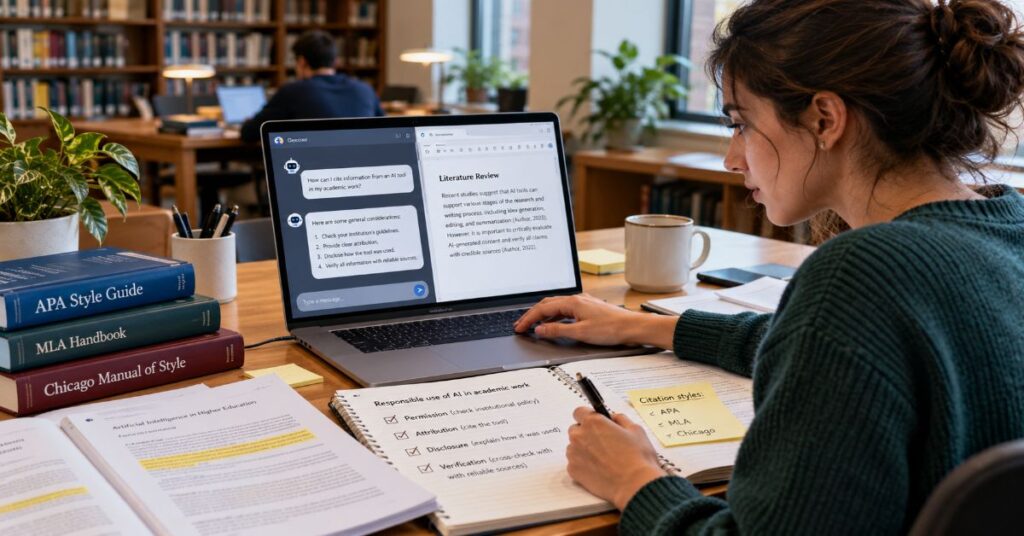
To Cite AI tools in academic work correctly, first check whether the AI use was permitted, then cite any AI-generated material in the style your course or publisher requires, disclose meaningful AI assistance separately, and verify the original sources behind every factual claim. How to cite AI tools in academic work correctly is therefore not a single formatting problem: it is a four-part integrity problem involving permission, attribution, transparency, and evidence.
That distinction matters because current guidance does not treat every interaction with ChatGPT, Claude, Gemini, Copilot, Perplexity, or another generative system in the same way. Quoting a generated sentence, using AI to brainstorm a structure, asking a model to translate a paragraph, relying on it to locate journal articles, and using it to analyse data can trigger different obligations. A reference-list entry may be necessary for one use, while a methods note, acknowledgement, appendix, or course-specific declaration may be required for another.
The first mistake many students make is assuming that “I cited the AI” settles the issue. It does not. Princeton’s scholarly-integrity guidance, for example, tells students to determine whether AI is allowed for the task and to disclose permitted use; Columbia Law School’s 2026–27 policy similarly requires students to remain fully responsible for the intellectual content and to verify AI-generated sources before citing them. Meanwhile, style bodies focus on documentation mechanics rather than granting permission to use AI.
This guide builds a decision system around those differences. It compares current APA, MLA, and Chicago guidance; shows what to do with ChatGPT, Claude, Gemini, Perplexity, Copilot, and AI-generated images or code; explains when an AI-use statement is more important than a bibliography entry; and gives a verification workflow designed to stop fabricated or misrepresented citations before they enter a paper.
The Four Questions to Answer Before You Format Anything
Most citation guides begin too late. They start with punctuation and reference-list order, even though the bigger academic-integrity decision happens before formatting. A reliable process begins with four questions.
First, was the AI use permitted? Course rules can differ not only between universities but between assignments in the same module. Princeton explicitly warns students that some instructors prohibit generative AI, others permit limited use, and some design assignments around it. Columbia Law School’s 2026–27 default policy likewise allows specified forms of AI assistance while requiring instructors to be consulted where doubt remains. A citation cannot convert a prohibited act into a permitted one.
Second, did AI-generated content enter the submitted work? If you quote, paraphrase, reproduce, or materially rely on generated wording, imagery, code, analysis, or a distinctive idea, formal citation may be required by the governing style or policy. MLA is especially clear that generated content incorporated into the work should be cited.
Third, did AI affect the process without becoming a citable source? Brainstorming, outlining, editing, translation, coding assistance, or search support may still need disclosure. The MLA’s separate guidance on describing AI use stresses that citation alone may not fully explain AI’s role. APA publishing policy also requires transparency about substantial use in drafting, analysis, code, and other research tasks.
Fourth, are the factual claims supported by original sources? This is the line that protects scholarship. If an AI system points you to a paper, read the paper and cite the paper. Do not cite the chatbot as evidence for what the paper says. For a broader workflow, our guide to academic writing with AI applies the same principle across literature review, drafting, editing, and verification.
Timothy McAdoo of the APA Style team put the transparency rationale succinctly in 2026: “Citing sources, including AI tools, helps make scholarly work transparent.” The important word is transparent. Correct citation should reveal what happened, not create a decorative reference that hides the actual contribution of the tool.
Citation, Disclosure, and Acknowledgement Are Not the Same Thing
A paper can be correctly cited and still be inadequately disclosed. It can also be fully disclosed without needing a conventional reference entry for every minor AI interaction. Treating these concepts as interchangeable creates both over-citation and under-reporting.
Citation is source-level attribution. It answers: where did this quoted, paraphrased, generated, or otherwise incorporated material come from? In MLA, that can mean a Works Cited entry built around the prompt or a description of what was generated. In Chicago, it can mean a note identifying the AI-generated text, tool, company, date, and share link. In APA-aligned contexts, the reference or attribution should be paired with an explanation of the tool’s role when it materially contributed.
Disclosure is process-level transparency. It answers: what did the AI do in producing this work? APA’s current publishing policy requires authors to disclose generative-AI use in manuscript drafting and places the disclosure in the section most relevant to the use, often the Introduction or Method section. Princeton tells students to disclose permitted AI assistance and even provides a template that identifies the tool and purpose.
Acknowledgement is a broader scholarly statement used when a course, institution, journal, or discipline prefers a concise description rather than a source-style citation. Some policies use “disclosure” and “acknowledgement” differently; others use them almost interchangeably. The governing local rule wins.
This is why a decision table is more useful than a universal slogan. If AI produced text that appears in your paper, citation is likely. If it reorganised your outline but no generated language appears, a disclosure may be enough. If it only corrected spelling in a way comparable to ordinary editing software, some policies may not require anything, while others still ask for an AI-use statement. If it found a journal article, cite the journal article after reading it, not the chatbot. Students comparing study workflows can also use our AI tools for students guide to distinguish research, drafting, tutoring, and editing functions before deciding what needs documenting.
| AI use | Likely citation? | Likely disclosure? | What to verify |
| Quoted generated text | Yes | Usually | Exact output, prompt context, permission |
| Paraphrased generated idea | Often | Usually | Whether idea is AI-derived or based on an original source |
| Brainstorming / outlining | Not always | Often | Assignment rules and how much structure survived |
| Grammar / spelling only | Usually no | Policy-dependent | Whether tool stayed mechanical or generated new prose |
| Source discovery | Cite original sources instead | Often | Existence, metadata, relevance, claim support |
| Code or data analysis | Policy/style-dependent | Usually | Correctness, reproducibility, model contribution |
| Generated image / figure | Usually credit required | Often | Prompt, tool, date, image policy and ethics |
A Practical Decision Matrix for AI Use
The correct documentation method depends on the function AI performed, not simply the brand name on the interface. ChatGPT used as a language editor is a different scholarly event from ChatGPT used to generate a paragraph that appears in the submitted paper.
The table below is a conservative cross-style workflow, not a substitute for your course or publisher rules. When local instructions are stricter, follow the stricter rule.
Low-Risk Assistance Still Needs Policy Checking
Mechanical support such as spelling correction or formatting may be treated differently from substantive generative assistance. APA’s publishing policy explicitly distinguishes generative AI from ordinary grammar-checking, citation software, and plagiarism detectors. But a generative tool can cross the line from mechanics into content generation quickly: “fix punctuation” and “rewrite this argument so it is more persuasive” are not the same task.
Substantive Support Should Leave an Audit Trail
If AI helped build an argument, generated text, translated substantive content, analysed data, produced code, or shaped a literature search, preserve the prompt and output. This is useful even when the final rules require only a short statement. A retained record lets you explain what the model did and what you changed.
Steve Baule’s 2026 student framework makes the same conceptual move: transparency should reflect the extent of AI involvement rather than treating all uses as identical. Nicholas Micallef and Olga Petrovska put the problem sharply in their 2026 disclosure-framework paper: “generic, binary declarations” fail to capture nuanced AI use across academic tasks. That makes task-specific documentation a better long-term habit than a generic sentence added at the end.
How APA Handles Generative AI in 2026
APA guidance is often misrepresented online because many pages still repeat the earliest 2023 ChatGPT format without recognising that APA expanded its generative-AI guidance in 2025. The current practical lesson is not to memorise one frozen ChatGPT template. It is to identify what you are citing, explain how the system was used, and preserve enough detail for readers to understand the role of AI.
APA Publishing Policies state that when a generative-AI model is used in drafting a manuscript for an APA publication, the use must be disclosed and cited. AI cannot be listed as an author, and human authors remain responsible for verifying information and citations supplied by the model. APA’s additional guidance goes further: AI used to generate resource lists should be described in the Introduction; AI used to create or refine code should be described in Methods; substantial copyediting or translation can belong in an author note; and AI-generated or edited figures should be disclosed where the figure appears.
What an APA-Style Record Should Capture
For student work, the exact reference format should follow the latest APA Style guidance provided by the instructor or institutional style resource. APA’s September 2025 update distinguishes between citing a specific AI chat and describing broader use. A current specific-chat pattern is: OpenAI. (2025, August 21). High school grammar concepts [Generative AI chat]. ChatGPT. [stable share URL]. Replace the title, date, product and URL with the record you actually used. If a shareable chat is not available or the output is central and non-retrievable, preserve the conversation transcript and consider an appendix or supplementary file where your rules permit it.
The deeper rule is human accountability. APA’s Chelsea Lee described testing a model for peer-reviewed sources and finding that the apparently credible references were not real. That is why APA policy tells authors to verify AI-provided citations against original sources. If you use an AI research assistant, our AI citation tool comparison evaluates tools by whether linked evidence actually supports the claim rather than by citation count alone.
A safe APA workflow is therefore: disclose the purpose, cite the AI-generated material when required, save the interaction, and replace AI-provided factual references with verified original sources that you have actually read.
How MLA Handles Generative AI
MLA currently offers the clearest source-style mechanics for generative AI. Its August 2025 revised guidance says not to treat the AI tool as an author. Instead, the citation describes what was generated, names the AI tool as the container, identifies the specific model where possible, names the company, gives the generation date, and uses a stable shareable conversation URL when available.
MLA Template for Generated Text
A typical Works Cited pattern is:
“Description of prompt or generated content” prompt. AI Tool, model name or number, Company, Day Month Year, stable share URL.
For example, if a student asked ChatGPT to produce a counterargument and then quoted part of the response, the first element could be a concise description of that prompt rather than an entire multi-sentence instruction. The in-text citation usually points to the shortened first element of the Works Cited entry.
The 2025 revision matters because older pages often direct readers to the general tool homepage and use outdated model-version language. MLA now prefers a stable shareable link to the specific conversation when the platform provides one. If no stable link exists, the general tool URL can be used.
MLA also separates generated content from functional use. Its “Beyond Citation” guidance explains that AI may influence research, ideation, drafting, and learning in ways that a Works Cited entry does not fully communicate. Those uses may need to be described in a note or another appropriate part of the work.
Most importantly, MLA tells writers to open and directly consult sources cited by an AI system rather than treating the AI summary as the evidence. That principle aligns with our guide on how to make Perplexity cite more academic sources: source steering and source verification are separate tasks. A model can point toward scholarship; only the original paper can establish what the scholarship actually says.
| Style / Context | What to record | Where it usually appears | Critical caveat |
| APA | Provider/tool, date or version context, generated item or chat details as current guidance requires | Reference/attribution plus relevant disclosure section | APA publishing policy also requires human verification and disclosure |
| MLA | Prompt or generated-content description, tool, model, company, date, share URL | Works Cited and in-text reference to first element | Stable share URL is preferred when available; AI is not treated as author |
| Chicago | Generated text or prompt, tool, company, date, share URL | Footnote or endnote for formal citation | Broader AI use may still require separate disclosure |
| Institutional AI policy | Tool, task, scope, location of use, verification steps | AI-use statement, acknowledgement, methods note or course declaration | Local policy can be stricter than the style guide |
How Chicago Handles AI-Generated Content
Chicago’s current public guidance takes a pragmatic approach. It says AI-generated text should be credited when used and allows a numbered footnote or endnote for formal academic work. A current example identifies the generated text, ChatGPT, OpenAI, the date, and the share URL. If the prompt is not already described in the prose, Chicago says it can be included in the note.
A simplified note pattern is:
1. Text generated by [AI tool], [company], [date], [share URL].
Or, when the prompt must be identified:
1. [AI tool], response to “[prompt or concise prompt description],” [company], [date], [share URL].
Chicago also says that if you edited AI-generated text, you can note that the output was edited for style and content. For generated images, the source should be credited like other images, with a description of the prompt, the tool, and the date.
Why Notes Often Fit AI Better Than Bibliographies
A note can document a one-off generated response without pretending that the chatbot is a conventional scholarly author. That is useful when the exchange is non-repeatable or specific to a particular prompt. It also lets a student explain modifications or context without forcing every detail into a bibliography entry.
The weakness of a note-only approach is that readers may still not understand how deeply AI shaped the work. If the system helped design the research question, analyse a dataset, or repeatedly rewrite prose, a separate disclosure remains valuable. The citation records a particular output; the disclosure records the wider process.
The safest interpretation is therefore not “Chicago only wants a footnote.” It is: use the Chicago note to credit generated content, then follow the assignment, institutional, or publisher policy for broader AI disclosure. This matters especially for students working across disciplines, because humanities instructors may use Chicago notes while departments impose their own AI declarations.
The Tool Name Does Not Change the Core Logic
Students often search separately for “how to cite ChatGPT,” “how to cite Claude,” “how to cite Gemini,” or “how to cite Perplexity.” The brand can affect the details you record, but it does not change the four-part logic: permission, citation, disclosure, and verification.
For ChatGPT, preserve the conversation date, model where visible or required, provider, prompt context, and share link if you are creating a source-style reference. For Claude, record Anthropic as the provider and preserve the specific conversation or artifact information available to you. For Gemini, record Google as the provider and the relevant model or product context. For Microsoft Copilot, distinguish between the consumer product, an enterprise environment, and an AI feature embedded in Microsoft 365 if that matters to reproducibility. For Perplexity, distinguish the AI-generated synthesis from the underlying sources it cites.
Research Engines Require a Two-Layer Citation Habit
Perplexity and other citation-forward systems can create a false sense of safety because references are visible beside the answer. A visible citation proves only that the system attached a source; it does not prove the source supports the exact sentence, that the source is peer reviewed, or that the bibliographic metadata is accurate. Our Perplexity for academic research guide recommends opening the DOI, publisher page, PubMed record, arXiv page, or other authoritative record before a source enters your bibliography.
The same applies to AI tools that summarise uploaded papers. If you quote the paper’s claim, cite the paper. If you quote the model’s interpretation of the paper, then you may need to document both the model interaction and the original paper, depending on your style and purpose. This two-layer habit prevents a common category error: citing the intermediary instead of the evidence.
The best research assistant comparison therefore depends on the task. A tool that is excellent for discovery may still be unsuitable as the final authority in a scholarly argument.
When You Should Cite the Original Source, Not the AI
If an AI system tells you that a study found a 23% effect, the scholarly source is the study, not the chatbot. If the model summarises a Supreme Court judgment, the source is the judgment. If it explains a theory from a textbook, the source should be the textbook or another authoritative scholarly source you actually consulted.
This rule is easy to state and surprisingly easy to violate because AI interfaces compress search, reading, and synthesis into one screen. The result feels like a source even when it is only an intermediary.
MLA’s 2025 guidance directly addresses this problem: when an AI tool cites secondary sources, writers should click through and consult those sources directly. APA’s publishing policy similarly requires authors to verify information and citations supplied by AI by reading original sources. Columbia Law School’s 2026–27 policy requires students to independently verify AI-generated sources and authorities before citing them.
The Five-Check Source Test
Before any AI-suggested source enters a bibliography, verify five things: existence, identity, relevance, support, and status. Existence means the paper or book is real. Identity means the title, authors, year, journal, volume, pages, DOI, or publisher record match. Relevance means the source actually addresses your question. Support means the passage supports the claim you plan to make. Status means you have checked for retraction, correction, preprint-only status, or other limits.
This is where human judgement cannot be outsourced. An AI system can produce a perfectly formatted citation to a nonexistent article, attach the wrong DOI to a plausible title, or cite a real paper that does not support the sentence. The core verification habit is the same whether you use ChatGPT, Gemini, Claude, Copilot, Perplexity, Elicit, Consensus, or another assistant.
For citation-forward search tools, our review of AI citation reliability shows why “has citations” and “is correctly supported” are different questions.
| Check | Question | Failure to catch |
| Existence | Can the source be found in an authoritative catalogue, DOI registry, publisher, database, or official site? | Fabricated reference |
| Identity | Do author, title, year, venue, volume, pages and DOI match? | Mismatched metadata or wrong DOI |
| Relevance | Does the source actually address the topic? | Plausible but irrelevant citation |
| Support | Does the original passage support the claim you make? | Citation that exists but does not substantiate the sentence |
| Status | Is it retracted, corrected, a preprint, superseded, or otherwise limited? | Using unreliable or outdated evidence |
How to Write an AI-Use Disclosure That Actually Helps
A useful disclosure tells the reader what the tool did, where it affected the work, and what the human author verified. A weak disclosure says only “AI was used.” That statement may technically reveal something, but it does not show the extent of assistance.
A stronger student disclosure can use four elements: tool, task, scope, and verification. For example: “I used ChatGPT to generate alternative search terms and to identify unclear sentences in a draft. I did not use generated prose in the submitted text. All cited sources were located and checked independently.” If the tool generated content that appears in the work, add the required citation and, where appropriate, preserve the transcript.
Princeton’s template similarly asks students to identify the AI tool and the purpose for which it was used. The University of Bologna recommends that substantial GenAI use be declared with the tool, version, purpose, and other contextual details when no stricter publisher or funder rule applies. The shared principle is inspectability: a reader should be able to understand the AI contribution without guessing.
Disclosure Should Match the Assignment, Not Your Comfort Level
Students sometimes avoid disclosure because they fear that admitting any AI use will make their work look less authentic. A 2026 Frontiers in Education study by Daniel H. Chang and colleagues found that disclosure behaviour is shaped by disciplinary culture, perceived consequences, and student background. Their analysis warns that AI disclosure rules cannot be treated as discipline-neutral. Damola Usman Onaolapo’s 2026 perspective identifies a wider problem: institutions can mandate transparency without protecting people from the social cost of honesty. In his words, “The evidence says it does not” automatically follow that mandatory disclosure produces real transparency.
That does not mean students should hide permitted use. It means institutions need clearer rules, and students need more specific records. Our guide on whether to tell your teacher you used AI makes the practical point: document what happened first, then map that activity to the rule governing the assessment.
A disclosure is strongest when it is factual and boring. It should not sound like a defence speech. State the tool, state the task, state the scope, and state what you checked yourself.
Worked Examples Across Common Academic Scenarios
Correct AI citation becomes easier when you classify the scenario before choosing the format.
Scenario 1: You Quote a ChatGPT Sentence
If the assignment permits this, treat the generated sentence as AI-generated content. In MLA, create the appropriate Works Cited entry describing the prompt or generated content, with the model, OpenAI, date, and stable share link where available. In Chicago, use a note identifying the generated text, ChatGPT, OpenAI, date, and share URL. In APA-aligned work, follow the latest APA Style instructions and also explain the use if it materially contributed to the paper.
Scenario 2: You Use Claude to Improve an Outline
If none of Claude’s generated wording enters the paper, a conventional source citation may not be the main requirement. A disclosure or acknowledgement may be more appropriate, depending on local rules. Preserve the prompt and the outline changes in case the instructor asks how the tool was used.
Scenario 3: Gemini Finds Three Journal Articles
Open all three articles, verify their metadata, read the relevant sections, and cite the articles directly. If your course requires disclosure of AI-assisted research, note that Gemini was used for source discovery. Do not cite Gemini as the evidence for the articles’ findings.
Scenario 4: Perplexity Summarises a Paper You Cite
Do not copy the summary into your literature review without checking the paper. Open the original publication and compare the claim with the methods, results, and limitations. Cite the original paper. If you rely on Perplexity’s wording or interpretation, document that separately as required.
Scenario 5: Copilot Rewrites Your Paragraph
If the rewritten wording substantially survives into the submission, this is closer to generated content than simple spell-checking. The safest approach is to disclose the use and follow your institution’s citation rule. If the assignment prohibits AI-generated prose, no citation format can cure the underlying policy breach.
Scenario 6: An AI Tool Generates Code for Analysis
Verify the code, test it, document the model and prompts, and disclose the tool in the methodology if the code materially affects the analysis. APA’s publishing guidance explicitly treats code creation or refinement as a method-level disclosure. Cite software, datasets, packages, and scholarly methods separately from the AI interaction.
Scenario 7: AI Generates an Image or Figure
Credit the generated image under the relevant style and include the prompt or descriptive information your style requires. Also consider copyright, licensing, research ethics, and whether synthetic imagery is allowed in your field. A citation answers who or what generated the image; it does not answer whether the image is an acceptable research artefact.
What the Top-Ranking Guides Commonly Miss
The current SERP is useful but repetitive. The first ten materially relevant results reviewed for this article were dominated by citation-format explainers from student-help sites, academic-writing services, citation platforms, and education publishers. Their most common structure was: define when to cite AI, show APA, MLA, and Chicago templates, then add a short FAQ.
That structure answers the formatting question but often underplays the policy question. Several ranking pages imply that “cite whenever you use AI” is a complete rule. It is not. A course may prohibit generative AI entirely. Another may permit brainstorming but prohibit generated prose. A journal may require a methods disclosure even if no generated text is quoted. A university may tell students to disclose AI rather than treat it as a conventional source.
A second gap is update lag. Current MLA guidance changed in August 2025 to prefer stable shareable links and specify the model where possible, yet many pages still reproduce older 2023 examples. APA also expanded its generative-AI guidance in 2025, while secondary pages often reduce it to a single software-style reference.
A third gap is evidence hygiene. Many guides say “verify sources” in one sentence but do not give a repeatable procedure for checking whether a DOI, title, author list, journal, and claim actually match. That is the most consequential failure mode in academic use.
A fourth gap is process transparency. Citing one generated sentence does not reveal that AI also designed the outline, generated search terms, rewrote the conclusion, and suggested references. The citation can be correct while the disclosure remains incomplete.
The information gain in this guide is therefore procedural: separate permission from citation, separate citation from disclosure, and separate AI output from original evidence. That framework is more durable than memorising one model-specific reference string, because model names, URLs, and style-body examples will continue to change.
| Recurring SERP pattern | What ranking pages do well | Gap this article addresses |
| APA / MLA / Chicago template sequence | Fast lookup | Often starts after the permission decision has already been made |
| “When to cite AI” checklist | Simple user intent match | Frequently merges citation with disclosure |
| ChatGPT-first examples | Familiar examples | Can become outdated as model names, URLs and style guidance change |
| Short warning about hallucinations | Acknowledges risk | Rarely provides a repeatable source-verification workflow |
| FAQ ending | Covers PAA-style questions | Often omits audit-trail and process-transparency guidance |
A Verification Workflow Before Submission
The safest citation workflow is a chain of custody for ideas and evidence. It should let you answer three questions after the paper is finished: What did the AI do? Which claims came from original sources? Can another reader inspect the evidence trail?
Start by saving the assignment policy or publisher rule that governed your AI use. Then keep a simple log of substantive AI interactions: date, tool, model if available, purpose, and whether generated material entered the final work. You do not need to archive every spelling correction unless the policy requires it; focus on interactions that changed content, reasoning, analysis, source selection, or wording.
Next, export or preserve share links for any conversations you need to cite. If the platform does not provide a stable public link, retain a transcript or screenshot according to course or journal rules. Do not publish private or confidential prompts merely to create retrievability.
Then verify every source suggested by AI. Use DOI registries, publisher pages, library databases, PubMed, Crossref, arXiv, court databases, official reports, or other authoritative records appropriate to the discipline. Read the original passage that supports your claim. Check publication status, corrections, and retractions.
Finally, perform a two-column audit. In the first column, list every place AI materially affected the work. In the second, write where that use is documented: in-text citation, note, reference entry, method statement, acknowledgement, appendix, figure caption, code repository, or nowhere because the policy does not require it. Any blank cell for a substantive use is a prompt to re-check the governing rule.
Kari D. Weaver’s 2026 work on AI transparency argues for structured disclosure across learning, research, and publication. Ben Haj Rhouma Mohamed and Akram Temimi frame the assessment stakes even more broadly: “Generative AI has unsettled a core assumption of higher education assessment.” The operational lesson is straightforward: transparency is strongest when it is built into the workflow rather than reconstructed from memory five minutes before submission.
Common Mistakes That Can Still Trigger Academic-Integrity Problems
The most dangerous mistakes are not punctuation errors. They are mismatches between what happened and what the paper tells the reader happened.
One mistake is citing AI when the use itself was prohibited. Another is citing the chatbot instead of the original scholarly source. A third is copying a model-generated bibliography without verifying that the sources exist. A fourth is giving a generic AI disclosure that conceals extensive drafting or analysis. A fifth is using a citation generator’s polished output as proof that the underlying source is real.
A sixth mistake is treating a share link as a guarantee of reproducibility. It improves retrievability, but AI systems can change, links can be access-controlled, and model outputs can depend on hidden system settings. Preserve the record you actually used when the interaction is important.
A seventh is uploading confidential, unpublished, or sensitive research material into a public generative-AI system. APA explicitly warns authors about confidentiality and prohibits journal editors and reviewers from entering submitted manuscript content into generative AI because doing so would breach peer-review confidentiality.
An eighth is assuming AI-detection scores determine whether citation or disclosure is needed. They do not. Your obligations come from the actual use of the tool and the applicable policy, not from whether a detector can identify that use.
A ninth is over-disclosing trivial mechanics while under-disclosing substantive intellectual assistance. A 500-word appendix listing every grammar correction can create noise if it obscures the fact that the model generated the paper’s central argument. Disclosure should be proportionate but complete.
The final mistake is relying on a static blog post when the style body or institution has newer rules. MLA’s 2025 revision is a reminder that AI citation standards are still moving. Before a high-stakes submission, check the live guidance from the style body, university, journal, or publisher that actually governs your work.
Our Editorial Verification Process
This article was researched on 6 October 2026 as a current explainer for the question “how to cite AI tools in academic work correctly.” We reviewed the first ten materially relevant results returned for the exact keyword and close variants, including recent guides from the Princeton Journal of Pre-Collegiate Research, Scribbr, ReadWonders, ResearchProspect, CiteGood, Grammarly, Working Educators, CASRAI, HowManyWords and related citation-guide publishers. Their recurring structure was a short “when to cite” section followed by APA, MLA and Chicago templates and FAQs. The recurring gaps were weak separation of permission from citation, limited distinction between citation and disclosure, inconsistent treatment of 2025 style-guide updates, and insufficient source-verification workflows.
Primary verification relied on the Modern Language Association’s August 2025 revised generative-AI guidance, the Chicago Manual of Style’s current AI documentation FAQ, APA Publishing Policies and APA’s 2026 academic-writing guidance, Princeton University’s scholarly-integrity guidance, Columbia Law School’s 2026–27 student AI policy, and 2026 peer-reviewed or scholarly work on AI disclosure and academic integrity. We treated university rules as examples rather than universal standards because course and assignment policies differ.
The specified Perplexity AI Magazine sitemap.xml endpoint did not return parseable XML through the available browsing layer. To avoid fabricating a sitemap inventory, internal links were selected from live indexed Perplexity AI Magazine pages with direct semantic relevance to academic writing, AI citation, student research, source reliability, AI disclosure and research assistants. Eight internal links are used once each in body sections only.
Commercial pricing was not included because this is a citation and academic-integrity guide, not a product comparison; plan price does not determine whether AI use is academically permissible. Where style guidance has changed since 2023, the article prioritises the latest primary guidance found during this research pass.
This article was researched and drafted with AI assistance and reviewed by the Sami Ullah Khan editorial desk at Perplexity AI Magazine. All data, citations, pricing figures, and named quotes have been independently verified against primary sources before publication.
Conclusion
Correctly citing AI in academic work is less about memorising one ChatGPT reference and more about preserving the integrity of the scholarly record. The durable sequence is permission first, disclosure second, citation where generated material is incorporated, and original-source verification before factual claims enter the paper.
That sequence also resolves many apparent contradictions between institutions and style guides. Princeton may frame permitted AI use primarily as something to disclose. MLA gives detailed Works Cited mechanics for generated content. Chicago offers a practical note format. APA publishing policy combines citation, disclosure, and human responsibility for accuracy. None of these rules removes the need to follow the specific assignment, department, journal, or publisher policy that governs your work.
The standards will continue to evolve as AI tools gain stable share links, embedded research modes, file analysis, coding agents, and institution-specific deployments. The best defence against future changes is not a frozen template. It is a transparent research record: what tool you used, what task it performed, what generated material survived into the final work, and which original sources you personally verified.
If that record is clear, citation becomes the final formatting layer rather than a last-minute attempt to explain an opaque writing process.
FAQs
How do I cite AI tools in academic work correctly?
First check whether the AI use is permitted, then cite any AI-generated material under the required style, disclose meaningful AI assistance, and verify original sources behind factual claims. The exact format differs by APA, MLA, Chicago, discipline, institution, and publisher, so current local guidance takes priority.
Do I need to cite ChatGPT if I only used it for brainstorming?
Not always as a conventional source, but you may still need to disclose the use. Many institutions distinguish between generated content that appears in the paper and process assistance such as brainstorming or outlining. Check the assignment rule and preserve a brief record of what ChatGPT did.
Should I cite ChatGPT or the source that ChatGPT found?
Cite the original source if your claim comes from that source. Open it, verify the bibliographic details, read the relevant passage, and cite it directly. If you also quote or rely on ChatGPT’s own generated interpretation, document that AI output separately if your style or policy requires it.
How does MLA cite generative AI?
MLA’s August 2025 guidance describes the generated content or prompt, names the AI tool as the container, includes the model where possible, gives the company and generation date, and prefers a stable shareable conversation URL when available. MLA does not recommend treating the AI tool as an author.
How does Chicago cite ChatGPT?
Chicago allows a formal footnote or endnote identifying AI-generated text, ChatGPT, OpenAI, the date, and a share URL. If the prompt is not already described in the prose, include it in the note. Broader AI use may still need a separate disclosure under local policy.
Does APA require AI disclosure?
APA Publishing Policies require generative-AI use in manuscript drafting to be disclosed and cited for APA publications. Authors remain responsible for accuracy and must verify information and citations supplied by AI. Coursework requirements can differ, so students should follow instructor and institutional rules.
Can I cite an AI-generated reference without opening the source?
No. A plausible citation can be fabricated, mismatched, or unsupported. Verify that the source exists, that its metadata are correct, and that the original text supports your claim. Then cite the original source rather than relying on the AI-generated bibliography.
Should I include my AI prompts in an appendix?
Sometimes. If the AI output is central, non-retrievable, or required by your instructor or publisher, preserving prompts and responses in an appendix or supplementary file can improve transparency. If a stable share link is accepted, that may reduce the need for a full transcript, but local rules control.
References
- American Psychological Association. (2026). APA Publishing Policies: Policy on the use of generative artificial intelligence in scholarly materials.
- American Psychological Association. (2026). Teaching academic writing in the age of AI. Monitor on Psychology, April/May 2026.
- Modern Language Association. (2025, August 13). How do I cite generative AI in MLA style? (Updated and revised). MLA Style Center.
- Modern Language Association. (2025, August 13). Beyond citation: Describing AI use in your work. MLA Style Center.
- The Chicago Manual of Style. (2026). Citation, documentation of sources: How do you recommend citing content developed or generated by artificial intelligence, such as ChatGPT? Q&A.
- Princeton University. (2026). Disclosing generative AI. Scholarly Integrity.
- Columbia Law School. (2026). 2026–2027 default academic policy on student use of artificial intelligence.
- Chang, D. H., Lin, M. P.-C., Huang, J.-Y., & Ryoo, J. (2026). “Should I tell my teacher?” Student AI disclosure practices, stigma, and self-regulated learning in higher education. Frontiers in Education, 11, 1826174.
- Weaver, K. D. (2026). Artificial intelligence and transparency: Toward a framework for disclosure of AI use in learning, research, and publication. Information Services & Use, 46(1–2), 5–11.
- Micallef, N., & Petrovska, O. (2026). Structuring transparency: Developing domain-specific generative AI declaration frameworks in higher education. arXiv:2606.13389.
- Mohamed, B. H. R., & Temimi, A. (2026). Assessment design under imperfect information: Generative AI, disclosure, and student response in higher education. Assessment & Evaluation in Higher Education.
