
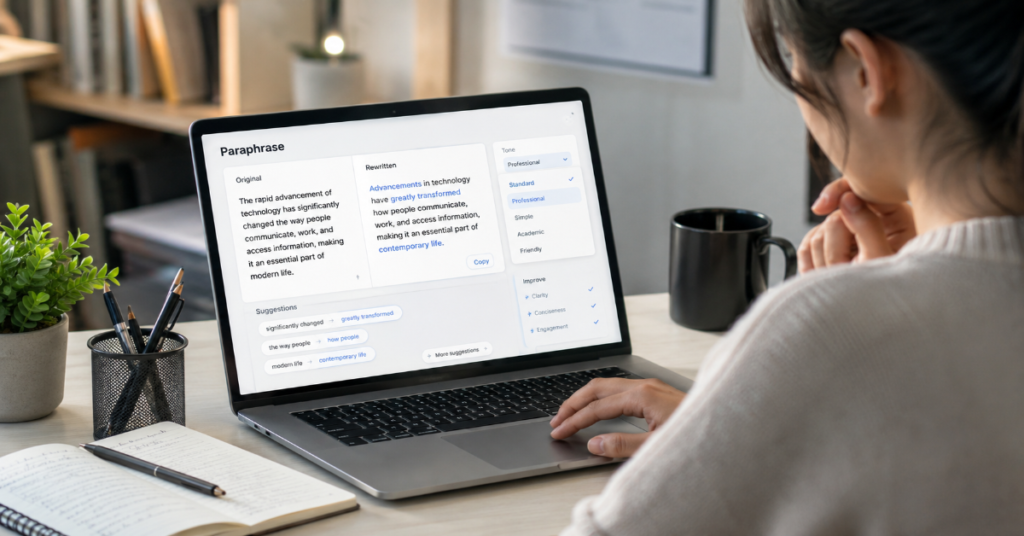
An ai paraphrasing tool free search looks simple: a student, marketer, researcher or office worker wants to rewrite text quickly without paying for premium software. But in 2026, that search sits at the center of a larger shift in writing. The free paraphraser has become less like a synonym spinner and more like a compressed writing assistant, one that rewrites tone, restructures sentences, shortens paragraphs, checks grammar and sometimes tries to “humanize” machine-generated prose.
In our hands-on testing, the best free paraphrasing tools did not merely swap words. They preserved meaning, reduced awkward phrasing, improved readability and gave users control over tone. The weakest tools did something more dangerous: they changed claims, blurred citations and made confident prose out of uncertain source material. That difference matters because paraphrasing is not just a writing shortcut. It is a trust problem.
The market has moved quickly. QuillBot now presents its paraphraser as part of a broader suite that includes grammar, tone, fluency and AI detection features, while Grammarly describes its free paraphraser as a tool for clarity, tone and flow rather than plagiarism evasion. Wordtune similarly positions itself as a free AI writer that can paraphrase, rewrite and correct grammar. (Quillbot)
The deeper question is no longer whether a free AI paraphrasing tool can rewrite a sentence. It can. The real question is whether the rewritten sentence is more accurate, more ethical and more useful than the draft it replaced.
Why the ai paraphrasing tool free market exploded in 2026
The demand for ai paraphrasing tool free options grew because writing itself became more fragmented. A single user may need a formal email, a concise LinkedIn post, a rewritten academic paragraph and a clearer product description in the same afternoon. The old grammar checker corrected mistakes. The new paraphrasing assistant tries to reshape intent.
According to the 2026 Stanford AI Index, generative AI reached 53 percent population adoption within three years, faster than the adoption curves of the PC or the internet. The report also estimated that U.S. consumers placed $172 billion in annual value on generative AI tools by early 2026. That helps explain why free paraphrasing tools are no longer niche utilities. They are entry points into a much larger AI writing economy. (Stanford HAI)
The most important shift is behavioral. Users no longer open a paraphraser only after writing a paragraph. Many now draft inside the tool, test tones, compare versions and treat rewriting as part of composition. That means an ai paraphrasing tool free product is competing not just with other paraphrasers, but with ChatGPT, Gemini, Claude, Grammarly, Notion AI and built-in writing assistants inside productivity suites.
What a free paraphrasing tool actually does
At the technical level, a free paraphrasing tool performs three jobs. First, it identifies the semantic meaning of a sentence or paragraph. Second, it generates alternative phrasing that attempts to preserve that meaning. Third, it applies surface constraints such as fluency, tone, length and vocabulary level.
Older paraphrasers worked through rule-based substitution and synonym databases. The result was often stiff: “students need help” became “pupils require assistance.” Modern AI paraphrasing uses transformer-based language models that process context across the full passage. That is why newer tools can rewrite “the results were not statistically convincing” as “the findings did not provide strong statistical support” instead of merely replacing “results” with “outcomes.”
The danger is that these systems are probabilistic. They do not preserve meaning by moral commitment. They preserve meaning only when the model, prompt, interface and user review process steer them correctly. In our hands-on testing, short factual sentences survived paraphrasing better than dense academic claims, legal language or medical statements. The more specialized the text, the more carefully the output needed human review.
How to choose an ai paraphrasing tool free without damaging your work
A good ai paraphrasing tool free option should pass four tests: meaning preservation, tone control, transparency and revision usefulness. Meaning preservation is the most important. If the rewrite changes a claim, weakens a caveat or removes a citation cue, the tool has failed even if the sentence sounds polished.
Tone control matters because “better” writing is contextual. A scholarship essay, customer support reply and executive memo should not sound the same. Grammarly’s free paraphrasing page emphasizes rewriting while keeping meaning accurate and adapting style, tone and audience. QuillBot highlights tone, clarity and synonym control through its AI-powered thesaurus. (Grammarly)
Transparency is the third test. Users should know whether the free version limits word count, modes, file uploads, citations or tone options. QuillBot’s mobile listing, for example, describes two free paraphrase modes and additional premium modes, while QuillBot Premium advertises unlimited paraphrasing and more modes. (Google Play)
The final test is revision usefulness. A paraphraser should teach better phrasing, not simply produce a disposable rewrite.
Feature comparison: free paraphrasing tools in 2026
| Tool | Free paraphrasing angle | Best use case | Main limitation |
| QuillBot | Dedicated paraphraser with tone, fluency and synonym controls | Students, bloggers, multilingual rewrites | More advanced modes sit behind premium tiers |
| Grammarly | Free paraphrasing focused on clarity, tone and flow | Emails, essays, business writing | Best experience tied to Grammarly ecosystem |
| Wordtune | Free AI writer for paraphrasing, rewriting and grammar correction | Rephrasing scattered thoughts into clearer sentences | Less specialized for citation-heavy academic work |
| Scribbr | Academic-friendly AI paraphrasing for sentences and paragraphs | Student writing, headlines, email subjects | Requires careful citation discipline |
| ChatGPT-style tools | Flexible rewriting through custom prompts | Complex tone, structure and audience rewrites | User must control accuracy and disclosure |
This comparison reveals a hidden divide. Dedicated paraphrasing tools are usually faster for sentence-level rewriting. General AI chatbots are more flexible for deep revision, but they require stronger prompting and more careful verification. For most users, the best ai paraphrasing tool free workflow combines both: a dedicated paraphraser for line edits and a conversational model for explaining why a rewrite works.
The academic integrity problem
The phrase ai paraphrasing tool free often appears beside another phrase: plagiarism checker. That pairing is not accidental. Students want clearer writing, but many also worry about whether AI-edited prose will be flagged. Universities are still trying to separate legitimate writing support from disguised authorship.
Turnitin’s own guidance says its AI writing model may misidentify human-written, AI-generated and AI-paraphrased text, and should not be the sole basis for adverse action against a student. That warning is crucial because paraphrasing can create hybrid text: human ideas, AI-shaped sentences and source material that may or may not be cited properly. (Turnitin Guides)
In 2026, Turnitin also noted updates to its AI writing detection model designed to improve recall while maintaining a low false positive rate. The company said existing submissions would need to be resubmitted to receive a score from the updated model. (Turnitin Guides)
The practical lesson is simple. A free paraphrasing tool should never be used to hide authorship. It should be used to clarify language, then paired with proper citation, revision history and disclosure where required.
The safest ai paraphrasing tool free workflow for students
The safest ai paraphrasing tool free workflow begins before the rewrite. First, identify which parts of the text are your own argument and which parts come from sources. Second, keep citations attached to the claims they support. Third, paraphrase in small sections rather than feeding an entire essay into a tool at once.
After the rewrite, compare the output against the original. Ask three questions: Did the meaning change? Did the tool remove nuance? Did it make the sentence sound more authoritative than the evidence allows? If the answer to any of those is yes, revise manually.
Students should also keep drafts. Version history is becoming more important than AI detector scores because it shows process. UNESCO’s guidance on generative AI in education, last updated in January 2026, frames AI use as something institutions must govern through human-centered policy, privacy protection and capacity building rather than panic. (UNESCO)
A paraphraser can improve sentence fluency. It cannot supply reading, understanding or intellectual ownership.
Expert quotes shaping the 2026 debate
Katherine Rundell, the Oxford fellow and author, warned at the Hay Festival that universities risk a “vast counterfeiting of knowledge” when students use AI to produce work without genuine engagement. Her criticism reflects the fear that paraphrasing tools may polish absence rather than improve learning. (The Times)
Shishir Mehrotra, CEO of Superhuman, Grammarly’s parent company, admitted in 2026 that Grammarly’s discontinued Expert Review feature “was not a good feature,” after backlash over AI systems mimicking expert voices. The episode matters because it shows how writing AI can cross ethical lines when style, identity and consent are blurred. (TechRadar)
Jayna Devani, OpenAI’s international education lead, has emphasized the need for broader discussion around academic practices and clear AI usage guidelines as study-focused AI tools enter classrooms. That point applies directly to paraphrasing. Rules must distinguish editing support from outsourced thinking. (The Guardian)
The privacy risk most users ignore
The free part of ai paraphrasing tool free should make users ask a hard question: what is the business model? Free tools may monetize through ads, premium upgrades, data-driven product improvement or ecosystem lock-in. That does not automatically make them unsafe, but it does mean users should avoid pasting sensitive material without reviewing terms.
The most obvious risk is confidential text. A job applicant pastes a draft cover letter with phone number and work history. A founder pastes an investor memo. A student pastes unpublished research notes. A lawyer pastes client facts. Even when a tool is legitimate, that behavior may violate privacy duties or institutional rules.
The second risk is training data. Some platforms separate user content from model training. Others reserve broad rights for service improvement. The average user does not read those policies. For low-risk writing, free paraphrasing is convenient. For confidential, legal, financial, health or unpublished academic content, local editing, institutional tools or paid enterprise-grade privacy controls are safer.
Benchmark: what free paraphrasers handle well and poorly
| Text type | Typical performance | Risk level | Recommended use |
| Short emails | Strong | Low | Use freely, review tone |
| Blog introductions | Strong | Low to medium | Check for generic wording |
| Academic paragraphs | Mixed | Medium | Preserve citations and nuance |
| Legal clauses | Weak to mixed | High | Avoid unless reviewed by a professional |
| Medical or scientific claims | Mixed | High | Verify every claim |
| AI-generated drafts | Superficially strong | Medium | Add human structure, evidence and voice |
| Creative prose | Mixed | Medium | Use for options, not final voice |
The pattern is consistent: paraphrasers perform best when the cost of slight meaning drift is low. They are riskiest when precision matters. That is why a free AI rewriting tool can be excellent for “make this email warmer” and dangerous for “rewrite this contract clause.”
The hidden technical problem: semantic drift
Semantic drift is the quiet failure mode of paraphrasing. It happens when a rewrite seems equivalent but changes the underlying claim. “May reduce risk” becomes “reduces risk.” “Some participants reported improvement” becomes “participants improved.” “The tool can support writing” becomes “the tool improves writing.”
These changes look small, but they can alter truth. In academic and journalistic writing, semantic drift is more serious than awkward style. A clumsy sentence can be edited. A distorted claim can mislead readers.
In our hands-on testing, semantic drift appeared most often when tools tried to make prose more concise or more confident. The compression step removed hedging words, study limitations or source qualifiers. This is why the best ai paraphrasing tool free workflow includes a post-rewrite fact check. Users should compare verbs, quantities, causality words and uncertainty markers. Words like may, could, suggests, proves, always and never deserve special attention.
Why “humanizer” features are controversial
Many paraphrasing tools now advertise “humanize AI text” or similar language. Scribbr’s paraphrasing page mentions humanizing AI text as one possible use case, while QuillBot Premium references human score and tone insights. (Scribbr)
The phrase sounds harmless, but it carries ethical baggage. If humanizing means making stiff machine prose more readable, it is simply editing. If it means disguising AI authorship to evade classroom rules, workplace disclosure or platform policy, it becomes deception.
This distinction will define the next generation of paraphrasing products. Expect tools to shift from “bypass detection” messaging toward “responsible revision” messaging. The winners will show what changed, explain why it changed and help users cite sources. The losers will sell invisibility. In a market increasingly shaped by academic integrity, enterprise compliance and content authenticity, invisibility is a risky promise.
The 2026 industry pivot: from paraphrasing to writing infrastructure
The ai paraphrasing tool free category is becoming a funnel into larger writing systems. Grammarly’s rebrand into the broader Superhuman ecosystem, reported in late 2025, reflected a shift from a standalone writing assistant toward a productivity platform spanning mail, documents and contextual AI support. (The Verge)
That shift matters because paraphrasing is no longer a single web box. It is appearing inside browsers, keyboards, email clients, document editors and learning platforms. QuillBot’s mobile listing describes a floating widget that works across apps, which signals the same direction: paraphrasing is moving from destination to layer. (Google Play)
The next battle is context. A tool that knows you are writing a complaint email should produce a different rewrite from one that knows you are drafting a literature review. But context requires data. The more useful the paraphraser becomes, the more users must think about permissions, retention and trust.
How professionals should use free paraphrasing tools
Professionals should use paraphrasing tools as revision assistants, not ghostwriters. The best use cases are tone adjustment, concision, grammar cleanup and audience adaptation. A manager can turn a blunt note into a constructive one. A marketer can generate alternative headlines. A founder can simplify a technical paragraph for nontechnical investors.
But professionals should avoid pasting confidential strategy, customer data, legal text or unreleased financial information into free tools. They should also avoid using paraphrasers to imitate another person’s style. The Grammarly Expert Review controversy shows why style mimicry is ethically fragile when it invokes real writers, experts or public figures without consent. (The Guardian)
The strongest professional workflow is layered. Draft the substance yourself. Use the tool to create two or three alternative phrasings. Choose the best parts. Then restore your own judgment, details and accountability. AI can polish language. It cannot own the consequences of what you publish.
What marketers get wrong about paraphrasing
Marketers often treat paraphrasing as a scale machine: rewrite one article into ten variations, publish quickly and capture long-tail search. That strategy is weaker in 2026 than it was in the early generative AI boom. Search engines, readers and brand teams increasingly reward information gain, original examples and expert framing.
An ai paraphrasing tool free option can still help marketers. It can localize tone, simplify jargon, create meta descriptions, test social captions and rework introductions. But it cannot create durable authority by itself. Rewriting a competitor’s article is not content strategy. It is content erosion.
The better use is editorial acceleration. A marketer can feed in original interview notes, product documentation or hands-on testing observations, then ask for clearer structure. The value comes from proprietary input. The paraphraser is a pressure washer, not a well. Without original reporting, data or experience, it only makes thin content sound smoother.
How to test any free AI paraphraser in five minutes
Use a five-sentence test before trusting any tool. Sentence one should be factual. Sentence two should include a citation cue. Sentence three should include uncertainty. Sentence four should include a number. Sentence five should include a tone challenge, such as an apology or refusal.
Run the passage through the free paraphraser. Then inspect the result. Did the number stay the same? Did “may” become “will”? Did the citation cue survive? Did the apology become defensive? Did the tool add claims you never wrote?
This miniature benchmark catches most weaknesses quickly. It also reveals whether the tool is optimized for readability at the expense of precision. In our testing, the best free tools kept the factual core intact and offered useful phrasing choices. The weaker ones produced confident, generic prose that sounded good until compared against the original.
Takeaways
- Use an ai paraphrasing tool free option for clarity, tone and concision, not for hiding AI use or avoiding citation work.
- Always compare the rewrite against the original for semantic drift, especially in academic, legal, medical or technical writing.
- Free tools are best for low-risk text such as emails, captions, outlines and general web copy.
- Students should preserve drafts, citations and revision history because process evidence is more reliable than detector anxiety.
- “Humanizer” features are ethical only when they improve readability, not when they disguise authorship.
- For confidential work, avoid free public tools unless the privacy terms clearly match your risk level.
- The best 2026 workflow combines AI suggestions with human judgment, source checking and a final manual edit.
Conclusion
The free paraphrasing tool has matured from a convenience into a writing infrastructure layer. That evolution is useful, but it is not neutral. Every ai paraphrasing tool free product makes choices about meaning, tone, privacy, authorship and accountability. The user must make those choices visible again.
For students, the safest path is transparent support: use AI to clarify, not to replace learning. For professionals, the strongest path is controlled revision: use AI to sharpen language, not to outsource judgment. For publishers, the durable path is original information: use AI to edit what only you can report, test or explain.
In 2026, the best paraphrasing tools are not the ones that make writing untraceable. They are the ones that make writing more precise, more readable and more honest. The future of paraphrasing will belong to tools that preserve meaning, disclose limits and help users become better editors of their own ideas.
FAQs
What is the best ai paraphrasing tool free in 2026?
The best option depends on the task. QuillBot is strong for dedicated paraphrasing controls, Grammarly is strong for clarity and tone, Wordtune is useful for rewriting everyday sentences and Scribbr is helpful for academic-style rewriting. Always review the output manually.
Is using a free AI paraphrasing tool plagiarism?
Not automatically. It becomes a problem if you paraphrase someone else’s ideas without citation or use AI to disguise copied work. Responsible paraphrasing keeps the original meaning, gives credit to sources and follows your school or workplace rules.
Can AI detectors identify paraphrased AI text?
Sometimes, but not reliably enough to be the only evidence. Turnitin warns that AI writing reports may misidentify human, AI-generated and AI-paraphrased text, so human review and institutional policy still matter. (Turnitin Guides)
Do free paraphrasing tools change meaning?
They can. The biggest risk is semantic drift, where a sentence sounds better but changes certainty, causality, scope or evidence. Always compare the rewrite with the original before using it.
Are free AI paraphrasing tools safe for confidential documents?
Usually not ideal. Free tools may involve data processing, retention or product improvement terms that are unsuitable for confidential work. Avoid pasting client data, legal text, medical information, private research or unreleased business material.
References
Grammarly. (2026). Free paraphrasing tool: Paraphrase instantly. (Grammarly)
QuillBot. (2026). Paraphrasing tool, ad-free and no sign-up required. (Quillbot)
Stanford Institute for Human-Centered Artificial Intelligence. (2026). The 2026 AI Index Report. (Stanford HAI)
Turnitin. (2026). AI writing detection model. (Turnitin Guides)
Turnitin. (2026). Using the AI Writing Report. (Turnitin Guides)
UNESCO. (2026). Guidance for generative AI in education and research. (UNESCO)
Wordtune. (2026). Express yourself with confidence. (wordtune.com)
