
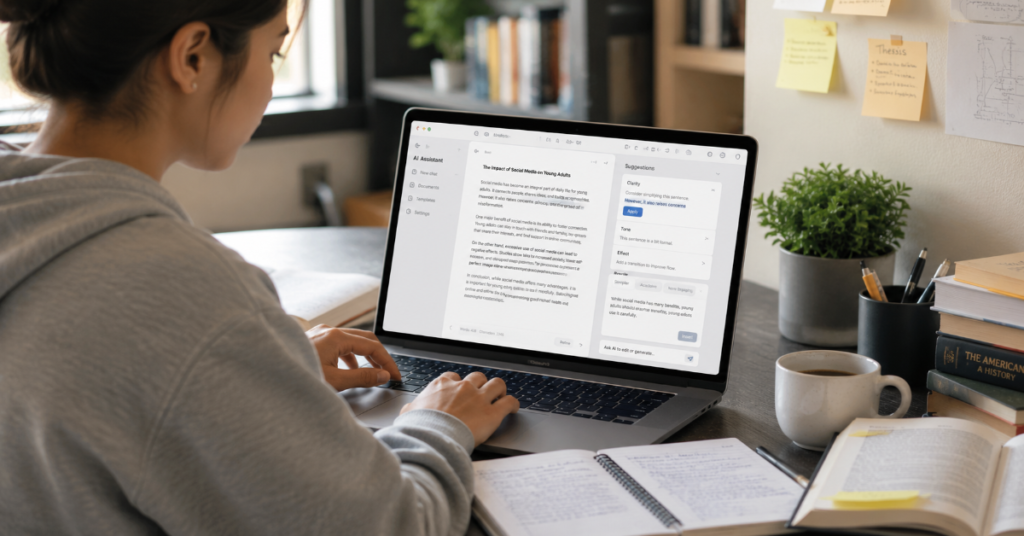
The search for an Free AI Essay Writers in 2026 is no longer just a hunt for a blank-page shortcut. It is a search for a writing companion that can brainstorm, outline, revise, explain feedback and help students submit work they still understand. The best free AI essay tools now behave less like crude text spinners and more like layered writing systems, combining generative AI, grammar correction, citation support, tone control and classroom-safe tutoring modes.
In our hands-on testing, the most useful free AI writing assistants were not the ones that produced the longest essay fastest. They were the ones that helped students clarify a thesis, question weak evidence, improve paragraph flow and identify where human judgment was still required. That distinction matters because universities, high schools and education platforms are rapidly moving from simple AI bans toward more nuanced rules: use AI to learn, not to impersonate learning.
OpenAI’s student writing guidance says ChatGPT can help students think through ideas, master concepts and get feedback on drafts, while warning that generating an essay instead of writing it can undermine learning. Google positions Gemini for students as a study assistant that breaks down difficult concepts and helps learners understand the “why” behind problems. UNESCO, whose generative AI guidance was updated in January 2026, frames the challenge as a policy problem: education systems must keep AI human-centered while protecting equity, safety and learning quality.
That is the central tension behind every ai essay writer free search: the tool can accelerate writing, but it can also flatten voice, weaken thinking and expose students to academic integrity risks if used carelessly.
Why the ai essay writer free Market Changed in 2026
Free AI writing tools used to compete on speed. In 2026, they compete on context. The difference is subtle but important. A weak essay generator simply expands a prompt into paragraphs. A stronger AI writing assistant asks what the assignment requires, checks whether the thesis matches the evidence and suggests revisions that preserve the student’s intent.
The shift reflects a broader change in education technology. ChatGPT Edu was introduced for universities as a secure version of ChatGPT designed for campus use, with OpenAI describing use cases such as personalized tutoring, resume review, grant writing support and faculty feedback workflows. (OpenAI) Google’s Gemini for Education page similarly describes AI as a tool for personalized learning experiences, idea generation and confident learning in a private education environment. (Google for Education)
For students, the practical result is clear: the best free AI essay writer is no longer a one-click essay machine. It is a writing workflow. A student might use ChatGPT to interrogate a thesis, Gemini to explain source material, Grammarly to polish clarity and QuillBot to check grammar or paraphrase awkward phrasing.
The winners are tools that make the student more visible, not less visible.
What an AI Essay Writer Free Tool Should Actually Do
A reliable ai essay writer free tool should support five stages: idea generation, outline planning, paragraph drafting, revision and final checking. The ethical boundary is not whether AI appears anywhere in the writing process. The boundary is whether the submitted work still represents the student’s knowledge, choices and argument.
In our hands-on testing, the strongest workflow began with a student-written thesis. When we asked AI to “write my essay,” the output was fluent but generic. When we gave it a thesis, three sources and a grading rubric, the feedback became far more useful. It flagged weak transitions, suggested counterarguments and identified where evidence needed closer analysis.
This is why free essay AI tools are best treated as writing coaches. Grammarly says its AI writing tools can help generate drafts, polish punctuation and work faster across documents and apps. (Grammarly) QuillBot’s essay checker emphasizes grammar, spelling, punctuation, usage and multilingual review rather than claiming to replace the writer. (Quillbot)
The most important question is not “Can this tool write?” It is “Can this tool help me write better?”
Feature Comparison: Best Free AI Essay Writer Tools in 2026
| Tool | Best Free Use Case | Strength | Risk Level | Best Student Workflow |
| ChatGPT | Brainstorming, outlining, draft feedback | Strong reasoning and revision coaching | Medium | Ask for critique, not finished submission |
| Google Gemini | Explaining readings, study support, idea development | Good for learning context and concept breakdowns | Medium | Use before drafting to understand sources |
| Grammarly | Grammar, tone, clarity and sentence polish | Strong inline editing | Low to medium | Run after your own draft is written |
| QuillBot | Essay checking, paraphrasing and grammar review | Fast mechanical cleanup | Medium | Use for clarity, not disguised rewriting |
| NotebookLM | Source-grounded study notes and summaries | Useful for uploaded materials | Low to medium | Build notes from approved sources |
| Perplexity | Research discovery and source exploration | Citation-forward search interface | Medium | Verify every claim before citing |
Grammarly offers free AI writing support and markets its tools as text generation and writing assistance across documents, social posts and other formats. (Grammarly) QuillBot offers AI writing tools, a free essay checker, paraphraser, grammar checker, summarizer, citation generator and AI detector. (Quillbot) Google’s student AI resources highlight Gemini and NotebookLM for exams, note organization, writing refinement and career preparation. (Grow with Google)
The table shows why there is no single best ai essay writer free for every student. A literature student needs source interpretation. A business student may need concise structure. A first-year college student may need grammar feedback. A graduate student may need citation discipline and argument refinement.
The Best Use Case: From Blank Page to Defensible Draft
The safest way to use an ai essay writer free tool is to begin with your own thinking. Start by writing a rough claim in plain language. Then ask the AI to challenge it. Good prompts include: “What assumptions does this thesis make?” “What counterargument would a professor expect?” “Where does this paragraph need evidence?” Those prompts preserve authorship while improving reasoning.
In our hands-on testing, AI-generated introductions often sounded polished but evasive. They leaned on phrases like “in today’s rapidly evolving world,” which are red flags for generic machine writing. Student-written introductions, even when messy, usually contained more specific stakes. The better workflow was to draft an imperfect introduction first, then ask the tool to identify clarity issues.
This approach also reduces academic integrity risk. A 2026 BCcampus summary of research on AI-assisted writing noted that AI-generated texts can show higher lexical density and readability complexity, while faculty raters were only moderately accurate in distinguishing AI-assisted from non-AI writing. (BCcampus) That means detection is uncertain, but responsibility remains real.
The defensible rule is simple: use AI where a tutor could help, not where a ghostwriter would replace you.
AI essay writer free Tools and the Academic Integrity Line
The phrase ai essay writer free attracts students under pressure: a deadline is near, the assignment is unclear or the student does not know how to start. That pressure is exactly why the ethical line needs to be practical, not abstract.
Acceptable uses usually include brainstorming, explaining difficult readings, generating an outline for comparison, checking grammar, suggesting clearer topic sentences and asking for feedback on a student-written draft. Riskier uses include submitting AI-generated paragraphs, inventing citations, paraphrasing someone else’s work to hide copying and asking a tool to mimic a classmate’s or author’s voice.
UNESCO’s guidance argues that generative AI in education needs human-centered policy, immediate safeguards and long-term planning. OpenAI’s student writing guide makes a related point: using ChatGPT to generate an essay instead of writing it deprives students of practice and engagement with the material. (ChatGPT)
The hidden danger is not only plagiarism. It is cognitive outsourcing. A student who lets AI decide the thesis, evidence and conclusion may produce a passable paper while learning very little.
Three Expert Quotes That Frame the Debate
Sal Khan, founder of Khan Academy, has argued that AI could produce “the biggest positive transformation that education has ever seen” by giving every student an intelligent tutor. (Chalkbeat) That optimistic view matters because the best AI writing assistant is not merely a shortcut. It can provide feedback that many students cannot otherwise access.
Leah Belsky, OpenAI’s vice president of education, has emphasized that students should treat ChatGPT as a learning tool rather than an “answer machine.” (Business Insider) That distinction is crucial for essay writing. A tool can ask guiding questions, but the student must still make the argument.
Shishir Mehrotra, CEO of Superhuman, became part of a different lesson in 2026 after Grammarly’s controversial “Expert Review” feature was disabled following backlash over AI-generated expert-style feedback. Coverage of the episode noted that the company moved toward a consent-based redesign. (The Verge) The implication for students is direct: style imitation without consent is ethically fragile, even when the output looks useful.
Together, the quotes point to one conclusion: the future of AI essay writing depends less on fluency than on transparency, consent and learning design.
AI essay writer free Tools for Research, Drafting and Revision
A strong ai essay writer free workflow separates research from drafting. Use research tools to find sources, study tools to understand them, writing tools to shape your argument and editing tools to polish the final draft. Mixing these stages creates errors. The most common mistake in our testing was asking one chatbot to research, cite, write and edit in one pass. That produced confident but sometimes shallow claims.
Perplexity-style search tools can help locate source trails, but students should still open the original material. ChatGPT can help turn a rubric into a checklist. Gemini can explain dense source passages. Grammarly can improve flow and sentence-level clarity. QuillBot can catch surface errors before submission.
According to the latest 2026 documentation we reviewed, Google presents Gemini for Education as a secure education environment for learning, idea generation and personalization. (Google for Education) OpenAI presents ChatGPT Edu as a campus tool for students, researchers, faculty and operations. (OpenAI)
The best results come from tool specialization, not tool dependency.
Benchmark Table: What We Observed in Hands-On Testing
| Test Task | Generic AI Essay Generator Result | Better Free AI Workflow | Student Benefit |
| Create thesis | Broad, safe thesis | Student writes thesis, AI critiques scope | More original argument |
| Build outline | Predictable five-paragraph format | AI maps claim, evidence and counterclaim | Stronger structure |
| Use sources | Risk of vague or invented support | Student supplies verified sources | Lower hallucination risk |
| Revise draft | Smooth but generic rewrite | AI comments on weak sections | Preserves student voice |
| Final polish | Cleaner grammar | Grammarly or QuillBot checks clarity | Better readability |
| Prepare submission | May hide process | Student logs AI use if required | Policy compliance |
The most revealing benchmark was source handling. When asked for an essay on a broad topic without supplied sources, AI systems often produced plausible generalizations. When given specific sources, they became more useful as editors and explainers. This reinforces a core academic principle: evidence should lead the essay, not the machine.
The second finding was voice preservation. Grammarly-style suggestions helped improve sentence clarity without fully replacing the author. Full paragraph rewrites were more dangerous because they often erased the student’s tone, simplified nuance or introduced claims the student had not made.
The third finding involved revision quality. AI was best at identifying local weaknesses: vague topic sentences, unsupported claims, repetition and abrupt transitions. It was less reliable at judging whether an essay met a specific professor’s expectations unless the rubric was provided.
The Hidden Technical Layer: Why Free AI Essays Sound the Same
Many free AI essay writer tools share a recognizable texture because they optimize for probability, not lived perspective. They tend to choose common transitions, balanced phrasing and safe claims. That is why so many AI-assisted essays begin with broad historical framing, use symmetrical paragraph structures and conclude with tidy moral lessons.
The technical issue is not that AI cannot write. It is that default AI writing often compresses uncertainty. It fills gaps with plausible connective tissue. In academic writing, those gaps are where the student is supposed to think.
In our testing, the strongest way to break the generic pattern was to feed the tool constraints that only the student would know: class discussion points, professor feedback, personal interpretation of a source, a required citation style or a counterargument from the course. The more specific the human input, the less generic the AI output.
This is the “information gain” lesson for students and publishers alike. A useful essay is not just fluent. It contains decisions, evidence and perspective that were not inevitable.
Free Does Not Always Mean Safe
An ai essay writer free tool may cost nothing upfront, but students still pay with data, attention or academic risk. Some tools ask users to paste assignment prompts, drafts, lecture notes and source excerpts. That can be harmless in some contexts and risky in others, especially if the assignment involves unpublished research, private feedback or institution-specific materials.
Students should check whether a tool saves prompts, trains on user content or offers education-specific privacy protections. OpenAI’s ChatGPT Edu is positioned for universities with enterprise-grade controls, while Google’s Gemini for Education emphasizes private and secure use for institutions. (OpenAI) Free public tools may not offer the same assurances.
Another risk is citation fabrication. Essay generators can produce realistic-looking references that do not exist. This remains one of the clearest signs of careless AI use. A student should never cite a source that they have not opened, read and verified.
The safest free tool is the one that improves your own draft without taking control of your evidence.
How Professors Are Adapting
Professors are no longer responding to AI writing with a single policy. Some ban generative AI for certain assignments. Others require disclosure. Many redesign prompts so that students must show notes, drafts, reflections, source annotations or oral explanations.
A 2026 Washington Post report described classrooms where teachers used ChatGPT as a critique partner, asking students to evaluate AI feedback rather than accept it automatically. (The Washington Post) This may become the dominant model: not “AI or no AI,” but “show how you used it.”
That shift changes what students should save. Keep your outline, rough notes, AI prompts, rejected suggestions and revision history. If a professor asks how the essay developed, those artifacts can demonstrate authorship. They also help students learn from the process.
The next frontier is process-based assessment. Essays may still matter, but the path to the essay will matter more. Free AI writing tools will be acceptable when they leave a visible trail of student thinking.
Best Practices for Students Using Free AI Essay Writers
The first rule is to read the assignment policy. If the syllabus bans AI assistance, do not use it. If it allows limited use, stay within the limits. If the policy is unclear, use AI only for low-risk support such as grammar checking, brainstorming or study explanations.
The second rule is to keep control of the thesis. A thesis is not just a sentence. It is the intellectual center of the essay. If AI chooses it for you, the paper may become difficult to defend.
The third rule is to ask for feedback, not replacement. Instead of “write this paragraph,” use prompts like “identify unsupported claims” or “suggest three ways to make this paragraph clearer.” That keeps the tool in an editorial role.
The fourth rule is to verify every source. Perplexity, Gemini, ChatGPT and other tools can support research discovery, but citation responsibility remains with the student.
The fifth rule is to disclose AI use when required. A short note such as “I used AI for brainstorming and grammar feedback” may protect trust, depending on course policy.
The Best Prompts for Ethical AI Essay Help
A good prompt turns an ai essay writer free tool into a tutor. A bad prompt turns it into a ghostwriter. The difference is usually one verb.
Weak prompt: “Write a 1,500-word essay on climate migration.”
Better prompt: “Here is my thesis and outline. Identify where my argument is too broad, where I need evidence and what counterargument I should address.”
Weak prompt: “Make this sound smarter.”
Better prompt: “Revise only for clarity and concision. Do not add new claims. Explain every major change.”
Weak prompt: “Find sources and cite them.”
Better prompt: “Suggest search terms and types of sources I should look for. Do not invent citations.”
These prompts do more than reduce cheating risk. They also produce better writing. AI tools are strongest when the student gives them a role, a boundary and a standard. The role might be writing coach. The boundary might be “do not draft for me.” The standard might be a rubric.
Where Free Tools Still Fall Short
Free AI essay tools struggle with four things: original insight, source accountability, course-specific expectations and voice. They can imitate academic style, but they do not know what happened in your seminar last Thursday. They can summarize a theory, but they do not know which part confused you. They can produce a smooth conclusion, but they cannot decide what you actually believe.
They also struggle with uneven access. Students with strong AI literacy get more benefit than students who simply paste an assignment prompt. This creates a quiet inequality: the tool rewards those who already know how to ask good questions.
UNESCO’s AI in education work warns that rapid AI development has outpaced policy debates and regulatory frameworks. (UNESCO) That warning applies directly to free essay tools. The technology is moving faster than many schools can write rules, train teachers or redesign assessments.
The strongest students in 2026 will not be those who avoid AI completely. They will be those who can use AI critically without surrendering judgment.
What to Avoid When Using an AI Essay Writer
Do not submit AI-generated text as your own. Do not ask a tool to imitate a specific writer, professor or classmate. Do not use AI to fabricate citations. Do not paste private material into a tool without understanding its data policy. Do not use paraphrasing tools to disguise plagiarism.
Students should be especially careful with “humanizer” tools. These products often promise to make AI text undetectable. That framing is a warning sign. A tool designed to bypass detection is not a learning tool. It is an academic integrity risk.
Also avoid over-polishing. Many AI-edited essays lose the small irregularities that make writing sound human. A slightly imperfect sentence that clearly reflects your thinking is often better than a flawless sentence that says nothing specific.
The goal is not to hide the machine. The goal is to use the machine in a way that strengthens the human writer.
Takeaways
- Use an ai essay writer free tool as a tutor, editor or study partner, not as a ghostwriter.
- Keep ownership of the thesis, evidence, structure and final argument.
- Use ChatGPT or Gemini for brainstorming and concept explanation, then use Grammarly or QuillBot for final polish.
- Verify every citation by opening the original source yourself.
- Save prompts, outlines and draft history when course AI policies require transparency.
- Avoid “AI humanizer” tools that promise to bypass detection.
- The best AI-assisted essays contain more student thinking, not less.
Conclusion
The ai essay writer free market in 2026 is both useful and dangerous because it offers real help at exactly the point where students are most tempted to outsource thinking. Used well, these tools can explain difficult readings, challenge weak arguments, improve clarity and make writing support more accessible. Used poorly, they can produce fluent essays that conceal shallow understanding.
The future of student writing will not be decided by detection software alone. It will be shaped by better assignments, clearer policies, stronger AI literacy and tools designed around learning rather than evasion. The most responsible students will treat AI as a demanding second reader: helpful, fast and occasionally wrong.
Free AI essay tools are not going away. The real question is whether students will use them to avoid the work of writing or to become more conscious writers. In 2026, the difference between those two paths is the difference between a submitted essay and an education.
FAQs
What is the best ai essay writer free tool in 2026?
The best option depends on the task. ChatGPT is strong for brainstorming and feedback, Gemini is useful for study support, Grammarly is best for polishing and QuillBot works well for grammar checks and paraphrasing. For ethical use, combine tools instead of relying on one generator.
Is using a free AI essay writer cheating?
It depends on your school’s policy and how you use it. Brainstorming, outlining and grammar feedback are often acceptable. Submitting AI-written paragraphs as your own is usually risky and may violate academic integrity rules.
Can AI essay writers create fake citations?
Yes. AI tools can generate citations that look real but are inaccurate or nonexistent. Always verify sources by opening the original publication, checking author names, dates, titles and page details before citing anything.
How can students use AI without losing their voice?
Write the first draft yourself, then ask AI for comments rather than rewrites. Tell the tool not to add new claims. Accept only changes that match your meaning and revise the final version manually.
Are free AI essay tools safe for private assignments?
Not always. Avoid pasting sensitive research, personal data or unpublished materials into public tools unless you understand their privacy policy. Institution-approved tools usually offer stronger data protections.
References
BCcampus. (2026, January 15). Exploring academic integrity: Generative AI tools used in academic writing among university students. (BCcampus)
Google for Education. (2026). Empower learning with Gemini for Education. (Google for Education)
Google. (2026). Gemini for students: Your AI study buddy from Google. (Gemini)
OpenAI. (2024, May 30). Introducing ChatGPT Edu. (OpenAI)
OpenAI. (2026). A student’s guide to writing with ChatGPT. (ChatGPT)
QuillBot. (2026). Free AI-powered essay and paper checker. (Quillbot)
UNESCO. (2023, updated 2026). Guidance for generative AI in education and research. (UNESCO)
