
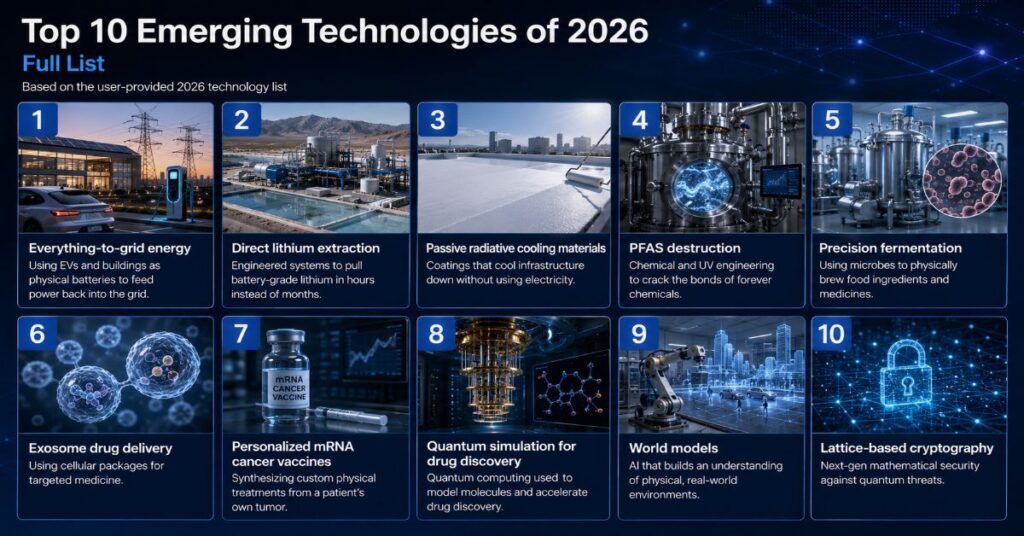
The World Economic Forum has been publishing its annual list of the ten technologies most likely to reshape the world within five years for over a decade. For most of that time, the list leaned heavily on software — machine learning, synthetic biology, augmented reality, digital platforms. This year’s edition, released Monday in Dalian during the Annual Meeting of the New Champions, reads differently. Seven of the ten technologies are fundamentally about physical matter: extracting minerals faster, cooling buildings without electricity, destroying chemicals that nature cannot, delivering medicine directly to diseased cells. The list is a signal that the frontier of commercially relevant innovation has moved, at least partly, off the screen.
The 2026 report was developed by the World Economic Forum in collaboration with Frontiers publishing and the Dubai Future Foundation, drawing on nominations from more than 250 experts and evaluated against three criteria: novelty, breadth of impact, and ecosystem readiness. The resulting list spans energy infrastructure, biotechnology, materials science, AI, and cryptography — and almost every entry connects, directly or indirectly, to the same set of underlying pressures: constrained energy and water systems, climate stress, aging or inadequate digital infrastructure, and the cost and inequality of access to advanced medicine.
Key Developments
- WEF released its Top 10 Emerging Technologies of 2026 report on June 23 during the Annual Meeting of the New Champions in Dalian, China, developed with Frontiers and the Dubai Future Foundation.
- The 2026 list pivots strongly toward physical infrastructure: 7 of 10 technologies operate on matter, energy, or biological systems rather than software.
- Only two entries are primarily digital: world models (AI building internal representations of physical environments) and lattice-based cryptography (post-quantum security).
- Technologies are evaluated for large-scale commercial or societal impact within the next 3–5 years, making the 2026 list a forward view to roughly 2028–2031.
The 10 Technologies at a Glance
| # | Technology | Category | Core Idea |
| 1 | Everything-to-Grid (E2G) Energy | Energy & Infrastructure | EVs, buildings and data centers feed surplus power back to the grid |
| 2 | Direct Lithium Extraction | Critical Minerals | Pulls battery-grade lithium from brine in hours, not months |
| 3 | Passive Radiative Cooling Materials | Materials Science | Coatings that cool surfaces by emitting heat to space — no electricity |
| 4 | PFAS Destruction | Environmental Chemistry | Chemical/UV methods that break the bonds of ‘forever chemicals’ |
| 5 | Precision Fermentation | Biotechnology | Engineered microbes brew food ingredients, proteins and medicines |
| 6 | Exosome Drug Delivery | Medicine | Cell-derived nanoparticles deliver therapies across biological barriers |
| 7 | Personalised mRNA Cancer Vaccines | Medicine | Custom vaccines synthesised from a patient’s own tumour mutations |
| 8 | Quantum Simulation for Drug Discovery | Quantum Computing | Quantum computers model molecular interactions beyond classical reach |
| 9 | World Models | Artificial Intelligence | AI that builds internal representations of physical environments |
| 10 | Lattice-Based Cryptography | Cybersecurity | Post-quantum encryption resistant to quantum computer attacks |
What the Report Says
According to coverage in The National and the report’s own published framing, the ten technologies identified are: everything-to-grid (E2G) energy systems; direct lithium extraction; passive radiative cooling materials; PFAS destruction; precision fermentation; exosome drug delivery; personalized mRNA cancer vaccines; quantum simulation for drug discovery; world models; and lattice-based cryptography. The report frames all ten as approaching a “critical inflection point” where scientific advances are beginning to translate into real-world deployment, rather than remaining laboratory-stage research.
WEF managing director Stephan Mergenthaler said the technologies “could challenge long-held assumptions about how we use technology to address some of the world’s most pressing challenges, such as food insecurity, climate change and untreatable diseases.” Frontiers chief editor Frederick Fenter, in comments carried by ANI’s wire service, noted that open scientific research was essential to identifying which technologies were genuinely approaching the inflection point the report describes.
The Physical Infrastructure Technologies
Everything-to-grid energy, or E2G, extends vehicle-to-grid technology to cover buildings, factories, and data centers as well as electric vehicles — treating any asset with significant battery or thermal storage as a potential contributor to grid stability during periods of peak demand. The concept has direct relevance to the AI data center energy crisis: a hyperscale facility with substantial on-site storage could offload excess power during off-peak AI workloads and draw from storage during demand peaks, reducing its net grid burden. The same pressure driving interest in E2G is what has led hardware makers like Microsoft to design custom silicon like the Maia 200 chip specifically for inference efficiency — reducing energy per computation is now as commercially significant as reducing cost per computation.
Direct lithium extraction targets one of the most consequential bottlenecks in the clean energy transition: the speed at which battery-grade lithium can be extracted from brine deposits. Conventional lithium extraction evaporates brines in open ponds over 12 to 18 months, consuming enormous amounts of water, and is geographically concentrated in the South American lithium triangle. Direct extraction uses engineered adsorbent or membrane materials to pull lithium from the same brine in hours rather than months, with substantially lower water consumption.
Passive radiative cooling materials are perhaps the most immediately relevant of the seven physical technologies to the AI infrastructure challenge. These are coatings or materials that cool surfaces by emitting heat as infrared radiation into outer space through the atmospheric window, without consuming any electricity — a thermodynamic property that naturally occurs but has historically been difficult to engineer into durable, scalable coatings. Applied to data center roofs or building exteriors, passive radiative cooling can reduce the cooling load on active refrigeration systems, addressing one of the most energy-intensive components of data center operation. PFAS destruction rounds out the materials science entries, offering for the first time a credible path to breaking the chemical bonds that make per- and polyfluoroalkyl substances — used in everything from semiconductor manufacturing to nonstick cookware — effectively permanent in water systems and biological tissue.
The Biotechnology Technologies
Precision fermentation uses microorganisms as programmable biological factories to produce specific compounds on demand — proteins, flavors, enzymes, pharmaceuticals — without requiring the agricultural land or supply chain of conventional production. The WEF highlights its applications across food proteins, animal-free dairy ingredients, and pharmaceutical production.
Exosome drug delivery and personalized mRNA cancer vaccines represent the two medical entries. Exosomes are nanoscale particles naturally secreted by cells that carry molecular cargo between cells, with the ability to cross biological barriers including the blood-brain barrier more effectively than many conventional drug formulations — with lower immune response than some earlier synthetic delivery systems. Personalized mRNA cancer vaccines synthesize a custom immunological treatment from a patient’s own tumor sequencing data, directing the immune system to recognize and attack cancer-specific mutations. The concept has moved from largely theoretical to Phase 3 clinical reality in the past two years, with Moderna and BioNTech both reporting significant efficacy improvements in personalized mRNA vaccine trials. Quantum simulation for drug discovery rounds out the biotech cluster: quantum computers can model the quantum-mechanical behavior of molecules with a fidelity that classical computers cannot match at comparable scale, potentially enabling the simulation of complex molecular interactions central to drug discovery without the synthesis and wet-lab testing cycles those interactions currently require.
The Digital Technologies: World Models and Lattice Cryptography
World models are the one technology on the list that sits squarely within the AI conversation rather than adjacent to it. A world model is an AI system that builds an internal representation of a physical environment — not just patterns in language or image data, but an understanding of how objects move, interact, and respond to forces in the real world. World models are foundational to the next generation of robotics and autonomous systems, and their inclusion in a list dominated by physical infrastructure technologies signals that the convergence between AI and physical systems is the defining theme of the 2026 technology landscape. The same frontier AI models that are transforming text and code generation are now — through world modeling — beginning to reshape how machines understand and navigate the physical world, making the security implications of frontier AI capabilities that much more consequential.
Lattice-based cryptography addresses the eventual threat that sufficiently powerful quantum computers will break the RSA and elliptic-curve encryption that secures most of the world’s digital infrastructure. The US National Institute of Standards and Technology finalized its first set of post-quantum cryptographic standards in 2024; what remains is the far larger and slower challenge of migrating the world’s actual encryption infrastructure to the new standards before a quantum computer capable of breaking current encryption arrives.
The Dispute: Emerging vs. Arrived
The WEF list’s selection criteria emphasize technologies approaching “a critical inflection point” rather than technologies that have already achieved mass deployment — a distinction that matters more for some entries than others. Personalized mRNA cancer vaccines and lattice-based cryptography are already in advanced clinical or standardization phases respectively; they are not emerging in the sense of being unproven. Other entries, particularly passive radiative cooling materials at scale and exosome drug delivery, remain significantly earlier in the commercialization pipeline despite years of research attention. Critics of annual technology lists of this kind have noted that the same technologies tend to appear across multiple years’ editions as “emerging” while the commercialization gap between scientific achievement and market deployment remains stubbornly wide. The pattern mirrors what CEOs report about AI itself — widespread adoption of capability with limited financial return — suggesting that naming a technology as emerging is often the easiest part of the innovation challenge.
What Happens Next
The report examines conditions shaping adoption through 2031, making it a five-year forward view rather than a one-year prediction. The critical variables the WEF identifies for most entries are consistent: infrastructure readiness, regulatory frameworks, manufacturing scale-up, public trust, and long-term investment. For energy technologies like E2G and direct lithium extraction, the rate-limiting factor is infrastructure and permitting rather than scientific uncertainty. For biotech entries like exosome delivery and personalized mRNA vaccines, regulatory pathway clarity and manufacturing cost at scale are the primary constraints. For lattice-based cryptography, the binding constraint is the pace of migration across incumbent systems, which will take years of coordinated institutional effort even with political will behind it.
Why It Matters
The WEF’s 2026 list is significant not just for what it includes but for the argument its composition makes. Seven physical technologies, two digital ones, and the specific framing of the physical technologies around resource constraints and infrastructure bottlenecks — energy, water, mineral supply chains, heat management — reflects the same set of tensions now shaping AI governance as well. The dominant constraint on technological progress in the second half of the 2020s is increasingly physical and infrastructural rather than computational, a pattern visible across the AI industry in everything from data center power shortages to the push for AI board governance frameworks at the world’s largest banks. The WEF list is that argument made concrete: the companies and governments that solve energy storage, lithium supply, heat management, and post-quantum security will be at least as consequential to the next five years of technological development as those building the most powerful AI models.
Sources
World Economic Forum / Frontiers (Top 10 Emerging Technologies Report 2026); The National; ANI; New Kerala; Sustainability Magazine.
