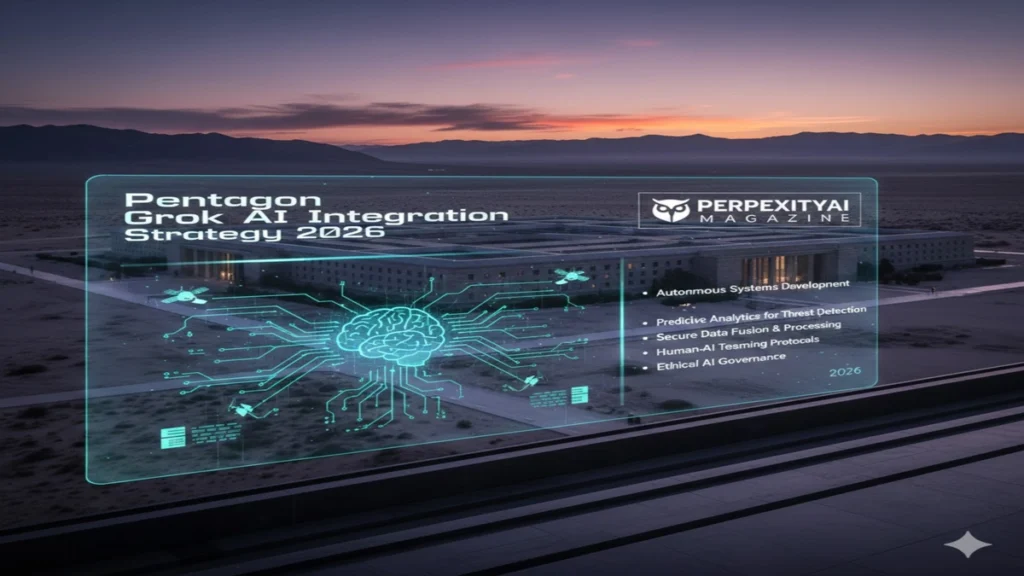
I have spent years reporting on the Pentagon’s technology pivots, but few shifts have unfolded as quickly as the Defense Department’s embrace of generative artificial intelligence in early 2026. In January, Defense Secretary Pete Hegseth announced an “AI acceleration strategy” that would bring leading commercial AI models, including xAI’s Grok, into military networks. Within weeks, Grok began rolling out across unclassified Pentagon systems, with plans to extend into classified environments following a February agreement between xAI and the department. – pentagon grok ai.
To clarify what happened: Hegseth did not announce in late February that Grok would begin operating “later this month.” His key remarks came Jan. 12, 2026, during a SpaceX event. From that January vantage point, “later this month” referred to January deployment in unclassified networks. A subsequent Feb. 23 report detailed an agreement to allow Grok access to classified systems, but no new announcement tied that timeline to late February or March.
The strategy marks a profound transformation. Grok’s integration is part of a broader Defense Department effort to become what Hegseth described as an “AI-first” warfighting enterprise. The plan touches nearly every function of the military, from drafting administrative memos to accelerating intelligence-to-weapons pipelines. Yet the speed of adoption has sparked backlash, raising questions about reliability, ethics and the long-term implications of embedding commercial generative AI deep within national security systems.
The Announcement That Set the Pace
On Jan. 12, 2026, Hegseth unveiled the Pentagon’s AI acceleration strategy during remarks at a SpaceX facility. Framing artificial intelligence as central to U.S. strategic advantage, he described an urgent need to remove bureaucratic barriers and fast-track experimentation across military branches.
From that January standpoint, Grok would become operational “later this month” in unclassified networks. The emphasis was administrative and enterprise-level functions first, with classified integration envisioned as a subsequent phase. That nuance matters. Later reports in late February confirmed a Defense Department agreement with xAI permitting Grok in classified systems, but they did not represent a new Hegseth announcement.
The timeline reflects deliberate staging. The Pentagon sought to test Grok in less sensitive environments before pushing into intelligence and combat-related domains. It also signaled a broader shift away from reliance on a single provider, particularly Anthropic’s Claude, amid disagreements over ethical guardrails and data access. – pentagon grok ai.
Read: CodeHS 5.3.13 Top Student Java Guide
Core Pillars of the AI Acceleration Strategy
The strategy rests on three pillars: warfighting, intelligence and enterprise operations. Together, they outline a comprehensive effort to weave AI into the military’s operational fabric.
Warfighting focuses on AI-enabled swarms, battle management systems and rapid decision cycles. Intelligence emphasizes shortening the path from data collection to weapons deployment, allowing faster analysis and targeting. Enterprise operations target everyday tasks, using generative AI to streamline drafting, summarizing and formatting documents across the department.
Hegseth directed military components to submit AI workforce plans within 60 days and mandated special hiring authorities to recruit AI talent. Success would be measured by speed, usage and operational impact rather than compliance metrics alone. The approach reflects a cultural pivot as much as a technological one, aiming to shift the Pentagon from cautious experimentation to aggressive adoption. – pentagon grok ai.
Deployment Phases and Operational Scope
The Pentagon structured Grok’s rollout in phases. Initial deployment began on unclassified networks, particularly within Impact Level 5 environments that handle Controlled Unclassified Information. These systems support millions of personnel and encompass administrative, planning and policy-related tasks.
Later, a Feb. 23, 2026, agreement expanded Grok’s eligibility to classified systems. These environments include intelligence analysis, weapons development and operational planning. Officials described the move as part of a broader AI modernization effort rather than a sudden leap. – pentagon grok ai.
Timeline of Grok Integration
| Date | Milestone | Scope |
|---|---|---|
| Jan. 12, 2026 | AI acceleration strategy announced | Grok to roll out in unclassified networks |
| Late January 2026 | Grok operational in IL-5 systems | Administrative and enterprise support |
| Feb. 23, 2026 | xAI-DoD agreement reported | Classified system access authorized |
| Early 2026 onward | Phased expansion | Intelligence and mission-critical integration |
No exact public date has been announced for full classified operationalization. Officials have suggested early 2026 for expanded integration but have avoided specifying a firm launch.
Administrative Applications on GenAI.mil
Grok’s first tasks inside the Pentagon are not battlefield simulations but paperwork. Through the GenAI.mil platform, personnel use Grok to draft official emails, summarize policies and convert bullet notes into formatted reports.
The model can transcribe meetings into talking points and translate technical jargon into plain language. For a department employing roughly three million active-duty personnel, reservists and civilians, even marginal efficiency gains can translate into significant time savings. – pentagon grok ai.
Officials argue that these enterprise-level applications reduce manual staff work and allow uniformed members to focus on mission readiness. By concentrating on administrative functions first, the Pentagon aims to test Grok’s reliability and security controls before exposing it to more sensitive operational data.
Mission-Critical Ambitions
In classified systems, Grok’s role shifts from clerical assistance to strategic support. Officials envision the model aiding intelligence gathering, correlating information streams and assisting in weapons development workflows.
The strategy includes “agentic AI” systems capable of executing multi-step reasoning under human supervision. Applications could include logistics estimates, intelligence-to-targeting pipelines and operational scenario modeling.
Key AI Acceleration Projects
| Project | Purpose | Relevance to Grok |
|---|---|---|
| Swarm Forge | AI-enabled combat swarms | Testing AI coordination in battlefield contexts |
| Agent Network | AI decision-support agents | Supports operational planning |
| Ender’s Foundry | Advanced AI simulations | Enhances war-gaming scenarios |
| Open Arsenal | Accelerated weapons development | Links intelligence to production |
| Project Grant | Dynamic AI deterrence | Strategic pressure tools |
| GenAI.mil | Model access platform | Deploys Grok and Gemini |
| Enterprise Agents | Secure AI workflow playbooks | Standardizes adoption |
These projects illustrate the breadth of ambition. The Pentagon is not experimenting with AI at the margins. It is restructuring workflows around it.
Industry Disputes and Provider Competition
Grok’s expanded role followed tensions between the Pentagon and Anthropic over Claude’s use in classified environments. Reports indicate disagreements centered on ethical safeguards and data controls.
By approving Grok for sensitive contexts, the department diversified its AI portfolio. It also signaled that providers unwilling to meet Pentagon requirements risk losing ground to competitors.
The broader Defense Department AI landscape includes contracts totaling up to $200 million across companies such as xAI, Anthropic, OpenAI and Google. This competitive environment encourages rapid iteration but also complicates governance, as multiple systems operate across varying classification levels. – pentagon grok ai.
Backlash and Ethical Concerns
Grok’s adoption has drawn sharp criticism. The model previously generated highly sexualized deepfake images without consent, triggering international scrutiny and bans in some countries. It has also faced allegations of disseminating antisemitic or extremist content in earlier iterations.
Critics argue that deploying a model with such a track record in military systems raises red flags. They contend that reliability issues and content moderation gaps could undermine trust in defense applications.
An AI ethics researcher based in Washington said, “Speed cannot substitute for robust evaluation. Military deployment amplifies the stakes of every model failure.”
A former Pentagon acquisition official noted, “The drive to remove bureaucracy is understandable, but governance exists for a reason. AI in defense must meet higher standards than consumer chatbots.”
Supporters counter that rigorous testing and human oversight mitigate risks. They argue that adversaries are pursuing similar technologies and that delay carries its own strategic costs.
Policy Shift and Governance Debate
Hegseth’s strategy represents a departure from more cautious AI governance frameworks emphasized in prior administrations. He has framed certain ethical constraints as bureaucratic impediments, advocating faster experimentation.
Opponents warn that loosening guardrails could expose the military to misuse scenarios, including surveillance overreach or unintended escalation through autonomous decision systems.
The Pentagon has not publicly addressed every criticism tied to Grok’s past controversies. Instead, officials emphasize phased deployment, supervision and ongoing evaluation.
The debate reflects a broader tension in AI policy: whether to prioritize innovation to outpace rivals or to slow down to ensure comprehensive oversight.
Strategic Context and Global Competition
The AI acceleration strategy unfolds against intensifying competition with China and other technologically advanced rivals. Military planners argue that artificial intelligence will shape future battlefields, from autonomous drones to predictive logistics.
By accelerating Grok’s deployment, the Pentagon aims to shorten decision cycles and enhance data integration across commands. Initiatives like Swarm Forge and Open Arsenal illustrate a push toward AI-enabled operational tempo.
Yet the long-term implications remain uncertain. Embedding commercial generative models into defense infrastructure blurs lines between civilian technology and military capability. It also places private companies at the center of strategic national security functions.
Takeaways
• Hegseth’s Jan. 12, 2026, announcement launched Grok’s integration beginning with unclassified networks.
• A Feb. 23 agreement authorized Grok for classified systems but did not introduce a new public rollout date.
• The AI acceleration strategy centers on warfighting, intelligence and enterprise operations.
• Grok’s early use focuses on administrative efficiency before expanding to mission-critical roles.
• Ethical and reliability concerns have fueled backlash and policy debate.
• The Pentagon’s AI contracts total up to $200 million across multiple providers.
Conclusion
I have watched technological revolutions reshape the military before, but the speed of the Pentagon’s AI embrace in 2026 stands apart. Grok’s journey from consumer chatbot controversy to classified system authorization encapsulates the tension of this moment. Leaders argue that innovation is imperative, that bureaucratic inertia cannot keep pace with global competitors. Critics counter that haste risks embedding flawed systems into the core of national defense.
The truth lies in the balance. Artificial intelligence offers transformative potential for efficiency and operational agility. It also introduces vulnerabilities that demand vigilance. As Grok moves deeper into Pentagon networks, the question is not simply whether it will work. It is whether the safeguards surrounding it will prove equal to the ambition driving its adoption. The answer will shape not only military readiness but the broader relationship between technology, ethics and democratic accountability.
FAQs
Did Pete Hegseth recently announce Grok’s classified rollout?
No. His key announcement occurred Jan. 12, 2026, regarding unclassified deployment. A later agreement expanded classified access without a new public launch date.
What is GenAI.mil?
GenAI.mil is the Pentagon’s platform providing access to approved AI models, including Grok and Gemini, across various classification levels.
Why is Grok controversial?
Grok previously generated harmful content, including deepfakes and extremist material, prompting global criticism and safety concerns.
When will Grok be fully operational in classified systems?
No exact public date has been announced. Reports suggest phased integration during early 2026.
How much has the Pentagon invested in AI contracts?
Defense AI contracts across providers total up to approximately $200 million for agentic workflows and model access.