
On paper, the Oracle Defence Tech Summit is a conference. In practice, the most consequential thing it announced this year was something that already happened in the North Atlantic: an AI system running offline on physical edge hardware, helping Royal Navy commanders capture and apply battlefield lessons while operating in waters with no reliable communications link to the outside world.
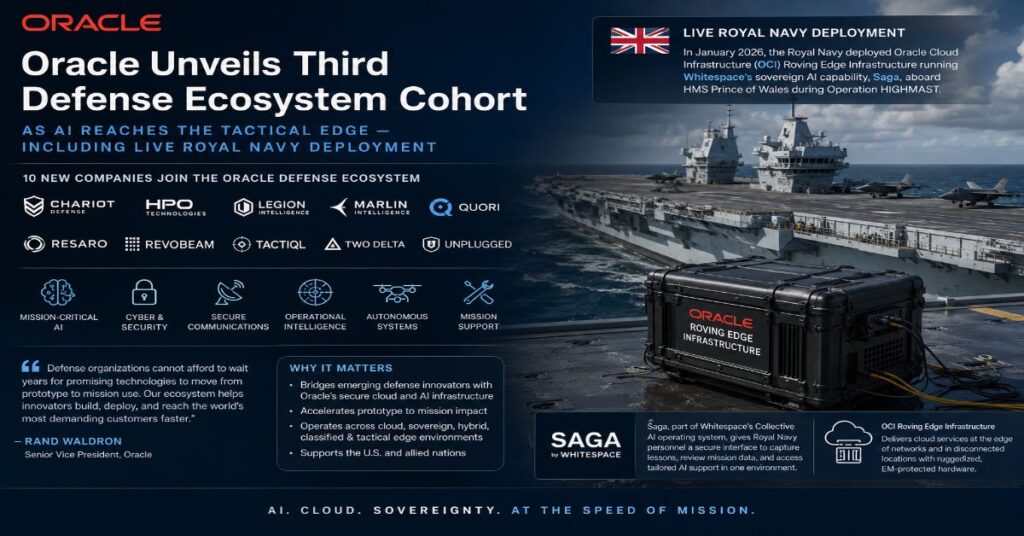
At its annual Defense Tech Summit in Brussels on June 25, Oracle announced the third cohort of the Oracle Defense Ecosystem, adding 10 new emerging technology companies covering mission-critical AI, cyber capabilities, secure satellite communications, operational intelligence, and autonomous systems for the US and allied militaries. The announcement formalizes a programme that now functions as Oracle’s primary mechanism for channelling cloud, AI, and edge infrastructure capability into the defence sector at a speed that traditional defence procurement cannot match.
The centrepiece is not the list of new companies but the live deployment already underway. Ecosystem member Whitespace deployed its Saga operational learning system on Oracle Roving Edge Devices to support classified workloads for the Royal Navy during Operation HIGHMAST — running AI models offline, aboard ship, in an environment with disrupted, disconnected, intermittent, and limited connectivity, enabling commanders to capture critical lessons learned and apply them in real time rather than waiting until the vessel returned to port to sync with shore-based systems.
Key Developments
- Oracle announced the third cohort of the Oracle Defense Ecosystem at its Defence Tech Summit in Brussels on June 25, 2026, adding 10 new emerging defence technology companies.
- Existing member Whitespace deployed its Saga AI system on Oracle Roving Edge Devices during Operation HIGHMAST, supporting Royal Navy classified workloads completely offline at sea.
- The third cohort expands focus areas to include AI for operational intelligence, secure satellite communications, autonomous underwater systems, and tactical edge computing.
- The ecosystem connects defence tech startups to Oracle’s sovereign cloud infrastructure across 25+ countries, covering FedRAMP High, DISA IL5, Secret/Top Secret environments.
What Happened
According to Oracle’s press release, the ten companies joining the third cohort are: Chariot Defense (ruggedized power and energy systems for drones and tactical edge); Legion Intelligence (AI tools for defence teams); Marlin Intelligence (underwater robotics technology); Quori (AI-powered operational intelligence systems); and six additional companies spanning cyber, secure communications, mission support, and autonomous systems for the US and allied nations. The ecosystem provides members with access to Oracle’s distributed cloud infrastructure in 25-plus countries, covering the full spectrum of security classifications from FedRAMP High through DISA Impact Level 5 and IL6 to Secret and Top Secret environments.
Rand Waldron, Oracle’s senior vice president, framed the programme’s core purpose as collapsing the timeline between prototype and operational deployment: “Defense organizations cannot afford to wait years for promising technologies to move from prototype to mission use. The Oracle Defense Ecosystem gives emerging defense and dual-use companies a faster path to build with Oracle, deploy on sovereign cloud and AI infrastructure, and reach customers operating at the mission edge.” The programme complements a separate enablement structure through the Defence Holdings accelerator and partnerships with Shield Reply and Red Reply for cloud and edge environment integration. To attend the Oracle Defence Tech Summit 2026’s full agenda, Oracle brought together mission owners, technologists, investors, and integrators from across the NATO-aligned defence community.
The Mechanism: From Prototype to Mission Edge
The Whitespace Saga deployment aboard Royal Navy vessels during Operation HIGHMAST is the most concrete illustration of what Oracle’s edge infrastructure is actually designed to do. Saga is an operational learning capability — a system that captures experience and lessons from live operations, structures them for retrieval, and makes them actionable for commanders in real time rather than post-mission. The challenge in deploying any AI system at sea, particularly for classified workloads, is that naval vessels regularly operate in denied or degraded communications environments where connectivity to shore-based data centers is unavailable or unacceptable from a security standpoint. Running AI models that are genuinely useful in that context requires the compute to come with the vessel, not to stay in a cloud data center waiting for the ship to come within range.
Oracle Roving Edge Devices are hardened compute units designed for exactly this scenario: full OCI compute capability, portable and deployable in physically harsh and communications-denied environments, running AI workloads from a local instance of Oracle’s cloud infrastructure without any connectivity requirement. Whitespace’s deployment demonstrates a full operational loop: lessons captured from active naval operations, structured by AI into accessible knowledge, available to the next watch on the same vessel without any data leaving the ship. That is a meaningfully different capability than AI delivered via a shore-connected API, and it is the use case that Oracle’s sovereign, distributed cloud architecture is specifically built to serve at classified levels.
The Backstory
Oracle’s defence infrastructure push is the technology-company side of a broader pattern visible across the AI industry in 2026: the major cloud providers competing to become the default infrastructure layer for military AI, sovereign AI, and edge AI simultaneously, with the understanding that whoever wins that infrastructure relationship at the start of the agentic AI era will be very difficult to displace later. That same dynamic is visible in Nvidia’s sweeping infrastructure partnerships across Asia, in the US government’s push to have all major AI labs submit to pre-release national security reviews, and in the Five Eyes’ joint cybersecurity warning about frontier AI capabilities — all reflecting the same underlying reality that AI has crossed from a commercial product category into a national security infrastructure layer.
Oracle’s position in this competition is distinctive. Unlike AWS, Azure, and Google Cloud, which built their defence credentials primarily through FedRAMP-certified versions of their existing commercial cloud products, Oracle has structured its entire distributed cloud architecture around sovereign and disconnected deployment from the beginning, including classified cloud environments that can run in airGapped or physically isolated configurations. That architecture makes Oracle a natural fit for the edge and disconnected use cases — aboard ships, at forward operating bases, on satellites, in denied-communications environments — that are structurally harder to serve from a hyperscaler’s primary commercial cloud infrastructure. The Whitespace deployment is a proof point for that positioning that Oracle can now point to publicly as a completed operational deployment rather than a pilot.
Reactions
Paul Jenkinson, CEO and co-founder of Whitespace, has described the deployment as demonstrating that sovereign AI at the tactical edge is no longer aspirational: the system ran, it worked on classified workloads, and it did so in the denied-communications environment that had historically made shipboard AI impractical for anything beyond pre-loaded, static models. The Royal Navy’s willingness to let that deployment be disclosed publicly suggests it is being treated as a demonstration case rather than a sensitive capability that needs to remain undisclosed — a signal that the deployment was considered successful enough to advertise.
The Dispute: Prototype Speed vs. Procurement Accountability
The core promise of Oracle’s Defense Ecosystem — moving technologies from prototype to mission deployment faster than traditional procurement — is also the core criticism that defence acquisition specialists direct at commercial-off-the-shelf AI in operational environments. Procurement timelines exist in part because operational deployment of technology in classified or mission-critical contexts requires security vetting, interoperability testing, failure-mode analysis, and legal frameworks around liability and data ownership that take time to establish properly. Bypassing procurement timelines to deploy faster introduces real risk: a system that works in a controlled demonstration environment may fail in ways that matter when the communications are genuinely disrupted, the data is genuinely classified, and the humans relying on it are making decisions with operational consequences.
There is also a structural tension in Oracle’s model: the Defence Ecosystem provides startups with infrastructure access, cloud credits, and a path to defence customers, but the ecosystem’s commercial interests align with faster deployment and more technology adoption, not with the conservative risk management that characterizes how militaries have traditionally made technology decisions. That tension is not unique to Oracle — it characterises most commercial-cloud defence initiatives — but it becomes more pointed as the systems in question move from administrative tools to AI that shapes operational decisions at sea. The accountability frameworks for AI acting on classified military workloads in a disconnected environment remain less mature than the technology itself, a gap that regulatory frameworks like Ireland’s new AI Office are beginning to address on the civilian side but that has no equivalent in defence policy yet.
What Happens Next
The third cohort’s focus on tactical edge computing and sovereign cloud suggests Oracle is deliberately positioning future ecosystem companies around the use cases where its architecture has the clearest competitive differentiation from hyperscale competitors: offline, classified, physically distributed deployments where the compute must travel with the operator rather than sitting in a cloud data center. Watch for whether subsequent cohorts deepen into specific domain verticals — autonomous underwater systems (Marlin Intelligence), satellite communications, and space-based edge compute are the clearest growth areas given the companies now in the ecosystem — and for whether the Royal Navy’s Operation HIGHMAST deployment produces publicly disclosed performance metrics that establish a baseline for what AI-assisted operational learning actually delivers in a denied-communications naval environment.
Why It Matters
The Oracle Defense Ecosystem announcement matters less for the list of ten new companies than for what the Whitespace deployment demonstrates: that sovereign AI running on physically deployable edge compute, processing classified workloads without any cloud connectivity, is no longer a capability that defence organisations need to wait for. It is operational now, on Royal Navy vessels, during active operations. The implications for how allied militaries integrate AI into disconnected and denied-environment operations — the exact scenarios where AI is potentially most valuable and where traditional cloud architectures are most constrained — are significant. Oracle is betting that winning the edge infrastructure layer now, before standards and procurement processes have fully hardened, is worth more than waiting for the defence market to move at its own pace. The Miasma worm attack on AI coding tools earlier this month underscored how rapidly adversaries are probing for vulnerabilities in AI infrastructure — making the security architecture of edge-deployed military AI systems not just a procurement checkbox but a live operational concern.
Sources
Oracle PRNewswire; Oracle Defence Tech Summit Agenda; Investing.com; StockTitan; Oracle defense alliances page.
