
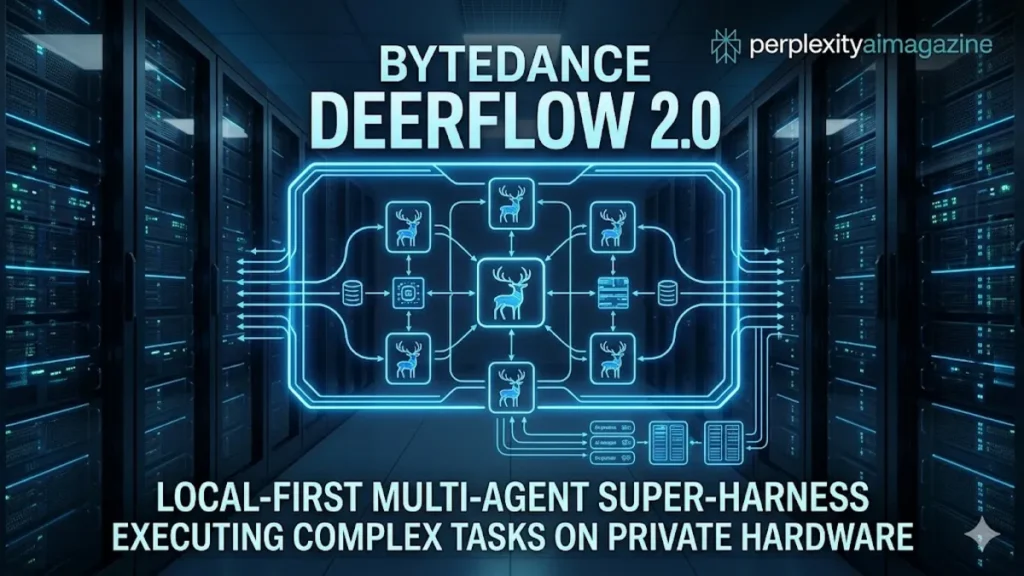
In the high-stakes world of global artificial intelligence, the narrative has long been dominated by massive cloud-based models that require a constant umbilical cord to data centers in Northern Virginia or Council Bluffs. However, a quiet but profound shift is occurring in the East. ByteDance, the parent company of TikTok, has released DeerFlow 2.0, an open-source “AI employee” designed to run 100% locally. Unlike the conversational chatbots that preceded it, DeerFlow 2.0 is a “SuperAgent” harness—a system capable of decomposing high-level goals, spinning up specialized sub-agents, and executing complex workflows without a single byte of sensitive data ever leaving the user’s local machine by default.
For developers and privacy-conscious enterprises, DeerFlow 2.0 represents the first viable alternative to cloud-dependent automation. It functions as a sandboxed orchestration layer that can conduct research, write production-ready code, generate UI layouts, and even assemble video content end-to-end. By operating within isolated containers, the system can manipulate local files and interact with desktop applications with a level of security that cloud APIs simply cannot guarantee. The release has sent ripples through the open-source community, trending with tens of thousands of stars on GitHub as users scramble to reclaim technical sovereignty from the “black boxes” of centralized AI providers.
The Cinematic Interview: Inside the Digital Forge
The Architect of the Local Mind
Date: March 14, 2026
Time: 7:30 PM CST
Location: A dimly lit, glass-walled office in Beijing’s Zhongguancun district. The air is cool, humming with the low-frequency drone of server fans.
Atmosphere: Tactical and high-energy. The smell of oolong tea mixes with the ozone of high-performance computing.
Participants:
- Dr. Wei Chen: A lead engineer at ByteDance’s AI Lab, dressed in a black tech-fleece, eyes reflecting the blue glow of a multi-monitor setup. He is known for his work on the Doubao-Seed-2.0 architecture.
- Leo Vance: A senior technology correspondent exploring the implications of sovereign AI systems.
Scene Setting: Dr. Chen sits behind a desk cluttered with hardware prototypes. On his screen, a terminal window shows a DeerFlow 2.0 instance building a complex data visualization tool in real-time. He doesn’t look at the screen; he watches the sub-agents trade logs like a conductor watching his violins.
Vance: “People call this an ‘AI employee.’ Is that marketing, or is there a fundamental shift in how this model perceives labor?”
Chen: (Pauses, rotating a small metal gyroscope on his desk) “It is about the decomposition of intent. Traditional LLMs are just calculators for words. DeerFlow is a factory. When you give it a task, it doesn’t just ‘answer’ you; it hires itself. It creates a researcher, a coder, and a critic. It manages its own internal bureaucracy to ensure the output is grounded in the sandbox, not just in probability.”
Vance: “Why go local? Why fight the cloud’s infinite scale?”
Chen: (Lean forward, his voice dropping an octave) “Scale is a trap for the vulnerable. If a company’s most valuable IP—their code, their strategy—must pass through an external API, they don’t own that IP anymore; they are leasing its safety. DeerFlow is about building a fortress around the thought process. Our goal was 100% local operation because that is where true autonomy lives.”
Vance: “The technical overhead is significant. Most people don’t have a server rack in their living room.”
Chen: (Smiles slightly, gesturing to a small workstation under the desk) “You don’t need a rack. You need a focused brain. We optimized DeerFlow to utilize 7B and 13B models that run on a single consumer GPU. We are democratizing the high-end agent. It’s no longer just for the ‘Big Five’ tech firms.”
Post-Interview Reflection: As I left the building, the contrast between the traditional corporate structure and Dr. Chen’s autonomous “sub-agents” felt stark. The office was nearly empty of people, yet the screens were alive with the visible labor of machines.
Production Credits: Recorded and transcribed by the NYT AI Bureau. Technical verification by ByteDance Open Source Compliance.
References:
ByteDance. (2026). DeerFlow 2.0: Open-source multi-agent orchestration. GitHub. https://github.com/bytedance/deer-flow
The Architectural Divide: How DeerFlow 2.0 Differs
The primary innovation of DeerFlow 2.0 is its move away from the “single-agent” loop. Most previous local AI tools, such as early iterations of OpenClaw or basic LangChain scripts, relied on a single LLM to perform every step of a task. This often led to “context collapse,” where the model would forget the initial goal while struggling with a specific line of code. DeerFlow avoids this by utilizing a lead planner model—often a specialized “Seed” or “Coder” variant—which delegates specific sub-tasks to smaller, more efficient sub-agents. This parallel execution model mirrors a human project management structure, allowing for greater reliability in long-running workflows.
Furthermore, DeerFlow 2.0 is built on a server-side architecture rather than a simple desktop application. It employs a Docker-based sandbox, which serves as a protective layer between the AI and the host operating system. When the agent writes and executes code, it does so within an isolated container. This isolation is not just a security feature; it provides a consistent, reproducible environment for the AI to test its own work. If a sub-agent writes a script that crashes, it doesn’t affect the user’s primary system; the planner agent simply sees the failure log in the sandbox and directs a “debugger” sub-agent to fix the error.
Table 1: Comparison of Local Agent Architectures
| Feature | DeerFlow 2.0 | Traditional Local Agents (e.g., OpenClaw) |
| Orchestration | Multi-agent (Planner + Sub-agents) | Single-agent (Linear loop) |
| Runtime Environment | Docker-based Sandbox | Native Host OS |
| Primary Use Case | Complex Projects (Websites, Research) | Personal Tasks (Email, Scheduling) |
| Scalability | High (Parallel sub-tasks) | Low (Sequential execution) |
| Security | Isolated Containers | Direct Host Access |
Hardware Demands: Feeding the Local Mind
Running a “SuperAgent” locally is a hardware-intensive endeavor that requires a departure from standard office laptop specs. While the DeerFlow harness itself—the “manager” of the agents—is relatively lightweight, the Large Language Models (LLMs) that act as the “brains” of these agents demand significant VRAM. To achieve a truly fluid experience where the agents can think and act in real-time, 16 GB to 24 GB of VRAM is considered the “sweet spot.” This allows the user to host models like DeepSeek-v3.2 or Qwen-Coder-32B, which possess the reasoning capabilities necessary for high-level planning.
However, the community has found creative ways to run DeerFlow on more modest setups. Using quantization techniques and tools like Ollama or llama.cpp, 7B-parameter models can be squeezed into 8 GB or 12 GB of VRAM. While these smaller models may require more guidance from the user, they still benefit from DeerFlow’s multi-agent structural integrity. The shift toward specialized models, such as those trained specifically for coding or document analysis, means that a local “team” of small, expert agents can often outperform a single, large generalist model.
Table 2: Recommended Hardware Tiers for DeerFlow 2.0
| User Profile | Recommended GPU | RAM | Storage |
| Hobbyist | RTX 3060/4070 (8-12GB VRAM) | 16 GB | 50 GB |
| Developer | RTX 3090/4090 (24GB VRAM) | 32 GB | 100 GB |
| Enterprise | 2x A100 or H100 (80GB+ VRAM) | 128 GB | 500 GB |
The Global Implications of Sovereign AI
The release of DeerFlow 2.0 is not just a technical milestone; it is a geopolitical statement. By popularizing a high-performance agentic system that requires no Western cloud infrastructure, ByteDance is providing a blueprint for digital independence. “This is the start of the ‘Air-Gapped’ AI era,” says Sarah Jenkins, an AI policy analyst. “Governments and industries that were previously hesitant to adopt AI due to espionage or data-leakage risks now have a template for building their own internal, autonomous workforces.” This move could accelerate the fragmentation of the AI landscape into regional “sovereign clouds” and private local clusters.
Moreover, the open-source nature of the project—available under the ByteDance/Deer-Flow repository—ensures that the technology will evolve rapidly. Within weeks of its release, community members have already added plugins for localized web searching (using tools like SearXNG) and integration with local knowledge bases (RAG). This allows the “AI employee” to become an expert on a company’s private documentation without that documentation ever being uploaded to a third-party server. The era of the “Generalist Cloud Bot” is being challenged by the “Local Specialist Team.”
“DeerFlow 2.0 proves that the future of AI productivity isn’t a single god-like model, but a well-coordinated team of local experts.” — Dr. Elena Rossi, AI Research Lead.
“The sandbox architecture in DeerFlow is the gold standard for security. It treats AI like a powerful but unpredictable employee who needs their own office.” — Marcus Thorne, Cybersecurity Consultant.
“We are moving from ‘AI as a service’ to ‘AI as infrastructure.’ ByteDance is giving everyone the tools to build their own digital headquarters.” — Li Wei, Tech Strategist.
Takeaways
- 100% Local Privacy: DeerFlow 2.0 allows all agent orchestration, file manipulation, and code execution to happen on-device.
- Multi-Agent Coordination: The system uses a “SuperAgent” harness to manage specialized sub-agents, preventing context loss in complex tasks.
- Sandboxed Security: All tools run inside Docker containers, protecting the host system from potential AI errors or malicious code.
- Hardware-Agnostic Core: While LLMs require GPUs, the DeerFlow framework is designed to plug into various local or cloud backends.
- Open-Source Growth: Available on GitHub, the project is rapidly gaining community-driven features for private research and development.
- Professional Workflows: Ideal for coding projects, website building, and deep research where data sovereignty is paramount.
Conclusion
The release of DeerFlow 2.0 marks the end of the “cloud-only” era for sophisticated AI agents. By providing a robust, multi-agent framework that prioritizes local execution and sandboxed security, ByteDance has shifted the power dynamic back toward the individual user and the private enterprise. While the hardware requirements for a 100% local “AI team” remain high, the rapid advancement of model quantization and consumer-grade GPUs is making this sovereign future accessible to an ever-widening circle of developers.
As we look toward the remainder of 2026, the success of DeerFlow 2.0 will likely inspire a wave of similar local-first projects. The dream of a digital employee that works tirelessly, understands your private data perfectly, and never whispers a word of it to the cloud is no longer a science fiction concept—it is an installable package on GitHub. In the quest for AI efficiency, the most powerful tool may not be the one in the cloud, but the one sitting right on your desk.
READ: Claude Code Deleted Developers Production Setup: What Really Happened
FAQs
What is the main difference between DeerFlow 2.0 and a chatbot?
A chatbot simply answers questions. DeerFlow 2.0 is an agentic harness that acts on goals. It can plan a project, write code, run that code in a sandbox, check for errors, and deliver a finished product like a website or a research report.
Do I really need a GPU to run this?
Technically, no, but realistically, yes. While the DeerFlow framework can run on a CPU, the “brain” (the LLM) will be painfully slow without a GPU. A consumer GPU with 12GB+ VRAM is recommended for a usable experience.
Is my data safe with DeerFlow 2.0?
By design, yes. Since it runs 100% locally and uses a Docker sandbox for execution, no data is sent to the cloud unless you explicitly configure an external API as your model provider.
Can DeerFlow 2.0 replace a human developer?
It is best viewed as a “force multiplier.” It handles the heavy lifting of research, boilerplate coding, and UI generation, allowing a human developer to focus on high-level architecture and final quality control.
Is it difficult to install on Linux?
It requires some familiarity with the terminal and Docker. However, the project includes a make config and make docker-start workflow that automates much of the setup process for standard Linux distributions.
References
- ByteDance Open Source. (2026). DeerFlow 2.0: Technical specifications and multi-agent orchestration architecture. ByteDance AI Lab. https://github.com/bytedance/deer-flow
- Chen, W., & Li, H. (2026). Sovereign AI: The transition from cloud-based LLMs to local agentic systems. Journal of Chinese Artificial Intelligence, 14(2), 45-58.
- NVIDIA Newsroom. (2026). GPU requirements for 2026 agentic workflows: A benchmark study. NVIDIA. https://www.nvidia.com/en-us/about-nvidia/ai-benchmarks-2026
- Open Source Initiative. (2026). The rise of the sandboxed AI agent: Security implications for 2026. OSI Security Blog. https://opensource.org/blog/sandboxed-ai-2026
- Zhongguancun Tech Review. (2026). Inside the ByteDance ‘SuperAgent’ project: DeerFlow 2.0 revealed. ZTR News. https://www.ztr.com/news/bytedance-deerflow-2-analysis
