
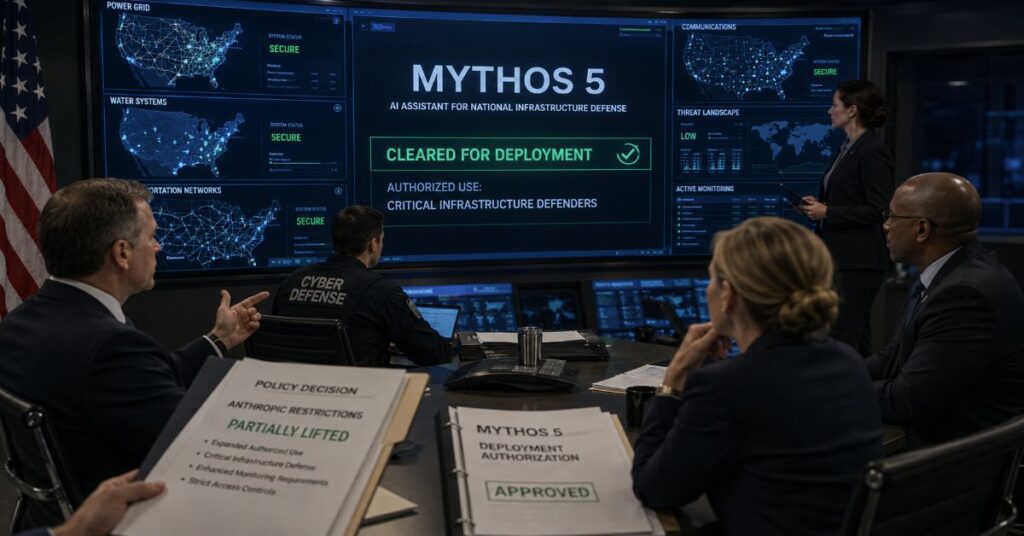
Anthropic’s two-week standoff with the US government ended late Friday evening in exactly the way these disputes tend to end: with partial progress, unresolved ambiguity, and both sides publicly claiming to be working toward the same goal.
Commerce Secretary Howard Lutnick wrote to Anthropic’s chief compute officer in a letter dated June 26, seen by Bloomberg, that Anthropic had worked with the US government to address risks associated with its most powerful models and that “these efforts have yielded significant progress.” Mythos 5, Anthropic’s most advanced cybersecurity model, is cleared to be redeployed to “certain trusted partners” — specifically, US organisations that operate and defend critical infrastructure. Fable 5, Anthropic’s flagship general-purpose frontier model, remains restricted. Lutnick’s letter is silent on Fable 5, though people close to the talks told Semafor that discussions are moving toward a Fable 5 resolution, with no timeline confirmed.
Key Developments
- Commerce Secretary Howard Lutnick wrote to Anthropic on June 26 confirming Mythos 5 can be redeployed to US organisations that operate and defend critical infrastructure — ending a two-week global access suspension.
- Fable 5 remains restricted. Lutnick’s letter does not address it; Anthropic said it is “continuing to work with the government to expand access to Mythos 5 and make Fable 5 available for general use again.”
- While Fable 5 is restricted, cybersecurity and biology-related queries route to Claude Opus 4.8. The clearance covers what 9to5Mac described as over 100 US institutions.
- Commerce Department spokesman Benno Kass said: “In just two weeks, we have worked diligently to ensure America remains the global leader in AI while safeguarding our security.”
What Happened
According to Bloomberg’s exclusive report on the Lutnick letter, the clearance applies specifically to Mythos 5 — the model variant that has cybersecurity guardrails removed for vetted critical infrastructure operators under Project Glasswing — and explicitly does not extend to Fable 5, the general-access frontier model that was simultaneously shut down on June 12. Anthropic confirmed the resolution in a post on X: “Since June 12, we’ve been working closely with the US government to restore access to Claude Mythos 5 and Fable 5. Today, the government notified us that Mythos 5, our strongest cybersecurity model, can be redeployed to a set of US organizations that operate and defend critical infrastructure.”
Per 9to5Mac’s report on the clearance, the approved set covers more than 100 US institutions, substantially larger than the small founding cohort of approximately 50 Project Glasswing partners that had access before the June 12 shutdown. Anthropic said it is “working to provision the approved set of providers and restore their access to Mythos 5 as quickly as possible,” though it has not disclosed a specific timeline for when those organisations will have live API access restored.
The Mechanism: What Changed in Two Weeks
The precise technical or policy concessions that moved the government from shutdown to clearance are not publicly disclosed. Anthropic’s statement credits “intensive talks” over the two-week period and says the outcome reflects progress in addressing the government’s security concerns, without specifying what changes were made to the model’s access controls, vetting requirements, or safeguard architecture. The Commerce Department statement, similarly, characterises the resolution in terms of process — “worked diligently” — without describing the specific measures that satisfied whatever concerns triggered the June 12 directive.
What is confirmed is that Fable 5’s cybersecurity and biology-related queries are currently routing to Claude Opus 4.8 while Fable 5 itself remains restricted. This means the partial clearance preserves a functional two-tier access structure: Mythos 5 goes back to vetted critical infrastructure defenders who need its unguarded cybersecurity capabilities, while general enterprise and consumer users of Fable 5 operate with a reduced-capability substitute for those specific query types. Whether that substitute is materially inferior for the typical Fable 5 user’s actual workflow is a question Anthropic has not addressed publicly.
The Backstory
The June 12 directive that triggered the shutdown was itself the product of a specific intelligence input. Reports confirmed that Amazon CEO Andy Jassy told US Treasury Secretary Scott Bessent about a purported jailbreak that left Anthropic’s models vulnerable to misuse, and that the White House had also grown concerned about China’s access to Claude Mythos. The directive required Anthropic to block foreign nationals from accessing both Fable 5 and Mythos 5 — a restriction so broad and technically impractical at the API level that Anthropic opted to suspend access for all users worldwide, foreign and domestic, rather than attempt to build citizenship-verification infrastructure on short notice.
The resolution lands on the same day OpenAI launched GPT-5.6 Sol, Terra, and Luna under its own government-approved restricted preview, making June 26-27 a pivotal moment in how the US government is simultaneously managing access to the two most capable AI systems in the world. Anthropic’s recent allegation that Alibaba ran 28.8 million distillation attacks on Claude using fraudulent accounts adds an additional layer to the national security framing: the government is managing both the inbound risk of foreign actors extracting US AI capabilities and the outbound risk of those capabilities being accessed by foreign nationals directly through the API. Both concerns are being actively addressed in the same week.
Anthropic had objected strongly to the original directive in a public blog post, warning that if the same export control standard were applied across the industry, “it would essentially halt all new model deployments for all frontier model providers.” The partial clearance suggests the government accepted that concern as a reason to negotiate a more targeted restriction rather than maintain the blanket shutdown — though it remains to be seen whether that logic extends to Fable 5’s general availability, which has a far larger user base and therefore a much higher compliance complexity.
Reactions
Anthropic expressed measured optimism without claiming victory. The company said it is “grateful to the administration for their ongoing partnership” and committed to working with the government to expand access to Mythos 5 and restore Fable 5. That language is deliberately careful: the company is not celebrating a win because the situation is not resolved — Fable 5 remains down for its millions of general-purpose users, and the terms under which Mythos 5 can expand beyond the current 100-plus organisations are not yet public.
Commerce Department spokesman Benno Kass characterised the two-week process as evidence that the government can move quickly when both sides are cooperating: “In just two weeks, we have worked diligently to ensure America remains the global leader in AI while safeguarding our security.” That framing is the administration’s preferred public narrative for this episode — government diligence produced a result, not regulatory overreach produced a correction.
The Dispute: Partial Is Not Resolved
The Fable 5 gap is the central unresolved tension in what happened Friday. Mythos 5 was always the narrower, more defensible restriction: it has no safeguards, it is restricted to vetted partners under a controlled access programme, and its cleared user base is defined by verifiable organisational criteria. Fable 5 is different — it is a general-purpose frontier model with hundreds of thousands to millions of end users across enterprise, consumer, and developer categories, with no pre-existing vetting infrastructure. Restoring Fable 5 for general use requires either a technical solution to the foreign-national access problem that the June 12 directive required, or a policy decision by the government that the original concern was disproportionate.
Neither of those outcomes is confirmed. The people close to the talks who told Semafor that Fable 5 discussions are “moving toward” a resolution are describing movement, not a conclusion. For the enterprise customers and developers who were relying on Fable 5 for production workloads on June 11 and found it unavailable on June 12, the Lutnick letter is encouraging but not useful until Fable 5 is actually back. That distinction between “talks are progressing” and “access is restored” is exactly the kind of gap that the broader debate over government AI access frameworks needs to resolve before the next major model launch creates another version of the same situation.
What Happens Next
The immediate next steps are Anthropic provisioning the 100-plus approved institutions for Mythos 5 access — a process it has said it is working to complete “as quickly as possible” — and the continuation of government discussions on Fable 5. The most practically important milestone is when general Fable 5 access is restored to the enterprise customers and developers who lost it on June 12, and at what access conditions. Whether those customers can simply flip access back on, or whether they must go through a new approval process, will determine how disruptive the two-week shutdown turns out to have been commercially and how much credibility damage the episode inflicts on the predictability of Anthropic’s service guarantees going forward.
Why It Matters
The Mythos 5 clearance matters most not for what it resolves — partial access for a narrowly defined user category — but for what it reveals about how the US government intends to manage frontier AI access going forward. The emerging pattern from this week, taken together with the GPT-5.6 restricted launch, is that the government is claiming meaningful influence over who can access US frontier AI capabilities, and the major labs are complying, while simultaneously lobbying loudly for the framework to be formalised and streamlined. That negotiation, playing out across both companies in the same week, will produce either a settled and predictable access process that labs can build commercial roadmaps around, or a continued sequence of ad hoc shutdowns and partial restorations that make frontier AI service reliability — a prerequisite for enterprise adoption at scale — impossible to guarantee. For anyone watching Anthropic’s IPO trajectory, the speed with which Fable 5 is restored and the terms under which it happens will be among the most important commercial signals of the second half of 2026.
Sources
Bloomberg (Josh Wingrove and Rachel Metz); 9to5Mac; Semafor; IANS; Anthropic statement on X; Commerce Department statement.
