
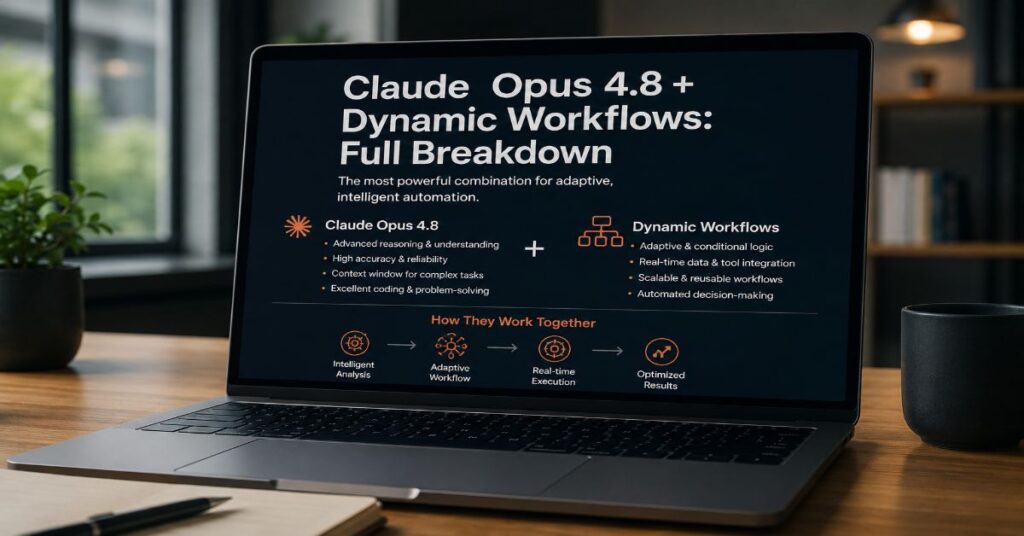
Summary of Major Developments
- Claude Opus 4.8 released May 28, now fully deployed: Anthropic released Claude Opus 4.8 on May 28, 2026 — 41 days after Opus 4.7 — across claude.ai, the Claude API, and Claude Code. The model uses the identifier claude-opus-4-8 and maintains the same pricing structure as Opus 4.7: $5 per million input tokens and $25 per million output tokens for standard mode. Fast mode — operating at 2.5x the speed — is now priced at $10/$50 per million tokens, three times cheaper than fast mode was for previous models.
- Dynamic Workflows launches in research preview: Alongside Opus 4.8, Anthropic launched Dynamic Workflows for Claude Code — a new orchestration capability that allows Claude to plan and execute very large-scale software tasks by deploying hundreds of parallel subagents in a single session. Dynamic Workflows breaks complex engineering jobs into specialised sub-tasks, assigns them to parallel agents operating on a shared filesystem, verifies outputs, and reports results back to the user. The feature is available in research preview for Enterprise, Team, and Max plan users. On Max and Team plans it is on by default; Enterprise plan administrators must enable it explicitly.
- Reliability and honesty improvements headline the model: Opus 4.8 moves from 64.3% to 69.2% on SWE-bench Pro for coding performance. More significantly for enterprise adoption, Anthropic reports the model is approximately four times less likely than Opus 4.7 to pass coding flaws without flagging them — a reliability improvement that addresses the core enterprise concern about agentic AI introducing undetected errors into production code. Early testers described it as ‘more likely to flag uncertainties and less likely to make unsupported claims.’
Technical Breakdown: Dynamic Workflows Architecture and What It Delivers
Dynamic Workflows is architecturally distinct from conventional agentic AI frameworks in one critical respect: it allows a lead agent — Claude Opus 4.8 — to dynamically spawn, direct, and coordinate hundreds of specialised subagents within a single Claude Code session, all operating on a shared filesystem with a unified progress state. This is not sequential task chaining, where one agent completes a task before the next begins. It is parallel orchestration, where multiple specialised agents execute simultaneously on different components of a complex engineering problem and report results back to the lead agent for synthesis and verification.
Anthropic’s stated test case for Dynamic Workflows is repository-scale codebase migration across approximately 750,000 lines of Rust — a task that would take weeks of sequential agentic execution to complete but can be compressed significantly through parallelisation. The lead agent plans the migration strategy, identifies the interdependencies across the codebase, assigns logical segments to parallel subagents, monitors their progress, handles conflicts that arise when two subagents modify interdependent code sections, and runs the existing test suite as its quality bar before reporting completion to the human engineer.
The resumable runs capability in Dynamic Workflows addresses one of the most persistent pain points in production agentic AI deployment: interrupted long-running tasks. When a Dynamic Workflow session is interrupted — by a network error, a rate limit, a user pause, or a system restart — the session saves its progress state to a persistent checkpoint. The session can be resumed from that checkpoint without restarting the entire workflow from scratch, which is operationally critical for tasks that span hours or days.
The Opus 4.8 model reliability improvement — four times fewer undetected coding flaws versus Opus 4.7 — is the metric that will determine enterprise adoption velocity. Agentic coding at the scale that Dynamic Workflows enables introduces a qualitatively different risk profile than single-prompt code generation: an agent operating across 750,000 lines of code in a production codebase can introduce subtle errors at a scale that human review cannot catch without systematic automated testing. Anthropic’s decision to lead the Opus 4.8 announcement with the honesty and reliability metrics rather than the benchmark scores reflects an understanding that enterprise engineering teams are more concerned with what the model gets wrong than with what it gets right on abstract benchmarks.
| Capability | Claude Opus 4.7 | Claude Opus 4.8 | Change |
| SWE-bench Pro | 64.3% | 69.2% | +4.9 percentage points |
| Undetected code flaws | Baseline | ~4x less likely to pass flaws | Major reliability improvement |
| Standard mode pricing | $5/$25 per M tokens | $5/$25 per M tokens | Unchanged |
| Fast mode pricing | 3x higher than current | $10/$50 per M tokens | 3x cheaper |
| Fast mode speed | N/A | 2.5x base model speed | New tier |
| Dynamic Workflows | Not available | Research preview (Enterprise/Team/Max) | New capability |
| Parallel subagents | Not supported | Hundreds per session | New architecture |
| Resumable runs | Not supported | Supported via checkpoint | New capability |
| Mid-task system updates | Not supported | Supported via Messages API | New API feature |
| Safety vs Opus 4.7 | Baseline | Lower deception, better refusal | Improved |
Commercial and Enterprise Market Impact
Dynamic Workflows arriving in research preview — rather than general availability — is a deliberate product positioning decision with commercial logic. Research preview status means the feature is functional and available to paying Enterprise, Team, and Max plan customers, but that Anthropic reserves the right to modify the architecture, pricing, and access terms based on what it learns from production usage at scale. For enterprises evaluating whether to build workflows on top of Dynamic Workflows, research preview status is a signal to treat it as a pilot platform rather than a production dependency until it reaches general availability.
The competitive context matters. OpenAI’s Codex platform serves over 4 million weekly users and was cited as generating over $1 billion in ARR from agentic coding. Google’s Gemini Code Assist and GitHub Copilot Workspace both compete in the enterprise agentic coding segment. Anthropic’s Dynamic Workflows is a direct response to this competitive pressure — specifically targeted at the enterprise use case where tasks are too large, too complex, and too risk-sensitive for single-agent sequential execution. The 750,000-line Rust migration benchmark is not an arbitrary number: it is sized to represent the scale of codebase maintenance work that represents the highest-value enterprise engineering workflows.
“The four-times improvement in undetected coding flaw rate is the number that matters for enterprise risk sign-off. A model that misses coding flaws at the previous rate is not deployable in production agentic pipelines without comprehensive human review that defeats the purpose of automation. A model that misses flaws at one-quarter the rate is moving toward a risk threshold where selective human review on outputs is operationally viable.” — Principal Software Engineering Manager, enterprise technology firm, June 2026
“Dynamic Workflows in research preview means Anthropic gets production-scale stress testing at enterprise workloads before committing to a GA service level agreement. That is smart product development. The enterprises getting access to it now are building the evaluation data that will shape the GA version. Build on it but do not make it a hard dependency until GA.” — Enterprise AI Platform Architect, Fortune 500 financial services, June 2026
Frequently Asked Questions
What is Claude Opus 4.8 Dynamic Workflows and which plans can access it?
Dynamic Workflows is a new Claude Code orchestration capability that allows Claude Opus 4.8 to deploy hundreds of parallel subagents in a single session to tackle very large-scale software engineering tasks. It supports parallel execution, resumable runs via checkpoint saves, and shared filesystem access across subagents. Dynamic Workflows is currently in research preview for Claude Code users on Enterprise, Team, and Max plans. On Max and Team plans it is enabled by default. On Enterprise plans, administrators must enable it in Claude Code settings. It is not available on Plus, Pro, or Free plans.
How does Claude Opus 4.8 pricing compare to Opus 4.7?
Standard mode pricing is unchanged from Opus 4.7: $5 per million input tokens and $25 per million output tokens. The new Fast mode — which operates at 2.5x the base model speed — is priced at $10 per million input tokens and $50 per million output tokens. This represents a three-times cost reduction versus what fast mode pricing was for previous Opus models. The model ID is claude-opus-4-8 and it is available on claude.ai, the Claude API, and Claude Code.
What is the Mythos timeline mentioned alongside Opus 4.8?
Anthropic confirmed alongside the Opus 4.8 release that Mythos-class models — the most capable models in its portfolio, currently available only to a small number of organisations through Project Glasswing — will be made available to all customers ‘in the coming weeks.’ Anthropic stated that models of this capability level require stronger cybersecurity safeguards before general release and that those safeguards are being completed. No specific date has been given. Mythos-class models are described as operating at a higher capability level than Opus 4.8.
Sources
Anthropic. (2026, May 28). Introducing Claude Opus 4.8. https://www.anthropic.com/news/claude-opus-4-8
TechCrunch. (2026, May 28). Anthropic releases Opus 4.8 with new ‘dynamic workflow’ tool. https://techcrunch.com/2026/05/28/anthropic-releases-opus-4-8-with-new-dynamic-workflow-tool/
WinBuzzer. (2026, June 1). Anthropic Ships Opus 4.8 with Dynamic Workflows. https://winbuzzer.com/2026/05/29/anthropic-ships-opus-48-with-dynamic-workflows-xcxwbn/
gHacks Tech News. (2026, May 30). Anthropic Releases Claude Opus 4.8 With Effort Controls and Dynamic Workflows. https://www.ghacks.net/2026/05/30/anthropic-releases-claude-opus-4-8-with-effort-controls-and-dynamic-workflows-for-claude-code/
ETIH EdTech. (2026, June 2). Anthropic releases Claude Opus 4.8 for coding agents. https://www.edtechinnovationhub.com/news/anthropic-pushes-claude-opus-48-beyond-code-completion-with-dynamic-workflows
Decode The Future. (2026, June 2). Claude Opus 4.8: 7 Changes + Dynamic Workflows. https://decodethefuture.org/en/claude-opus-4-8-explained/
Releasebot / Anthropic. (2026, June 4). Claude Updates — Dynamic Workflows rollout notes. https://releasebot.io/updates/anthropic/claude
