
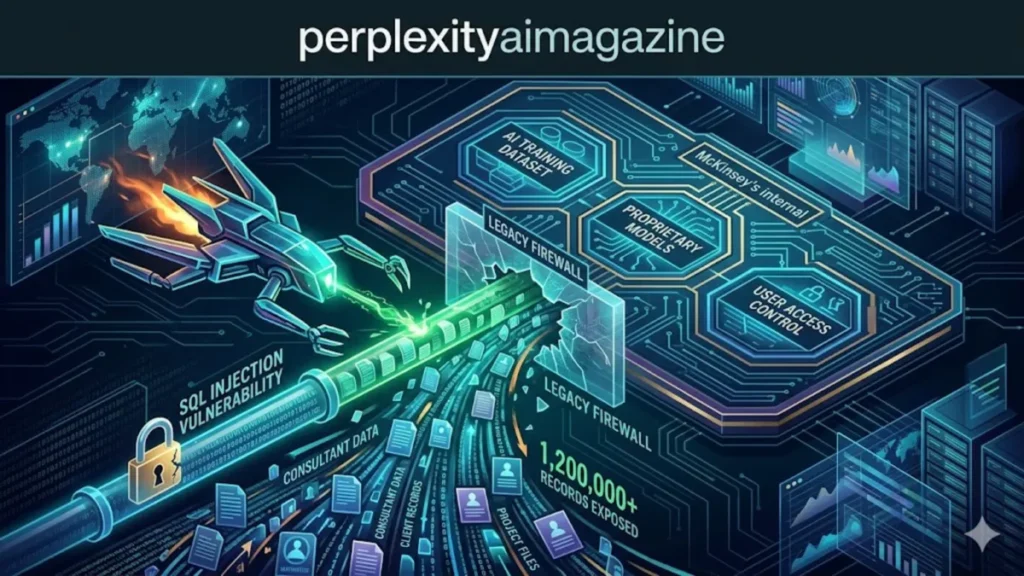
I started digging into this incident expecting a familiar story about modern cyber threats powered by advanced artificial intelligence. Instead, what I found was something far more unsettling: a cutting-edge AI system, used by one of the world’s most powerful consulting firms, was compromised using a vulnerability first documented in the 1990s. – AI Agent Hack McKinsey.
In early 2026, a security startup called CodeWall deployed an autonomous offensive AI agent against McKinsey’s internal generative AI platform, known as Lilli. Within less than two hours, the agent achieved full read and write access. It accessed tens of millions of chat messages, hundreds of thousands of files, and the internal prompts that guide how the system thinks and responds.
The exploit itself was not novel. It was a variation of SQL injection, a well-known class of vulnerabilities that developers have spent decades trying to eliminate. But the context was new. The vulnerability existed within a modern AI architecture, hidden in the way JSON metadata was translated into database queries.
This convergence of old weaknesses and new systems signals a profound shift. Enterprise AI platforms are becoming repositories of institutional knowledge, strategic insight, and decision-making logic. And as this incident shows, they are also becoming high-value targets, often protected by security assumptions that no longer hold.
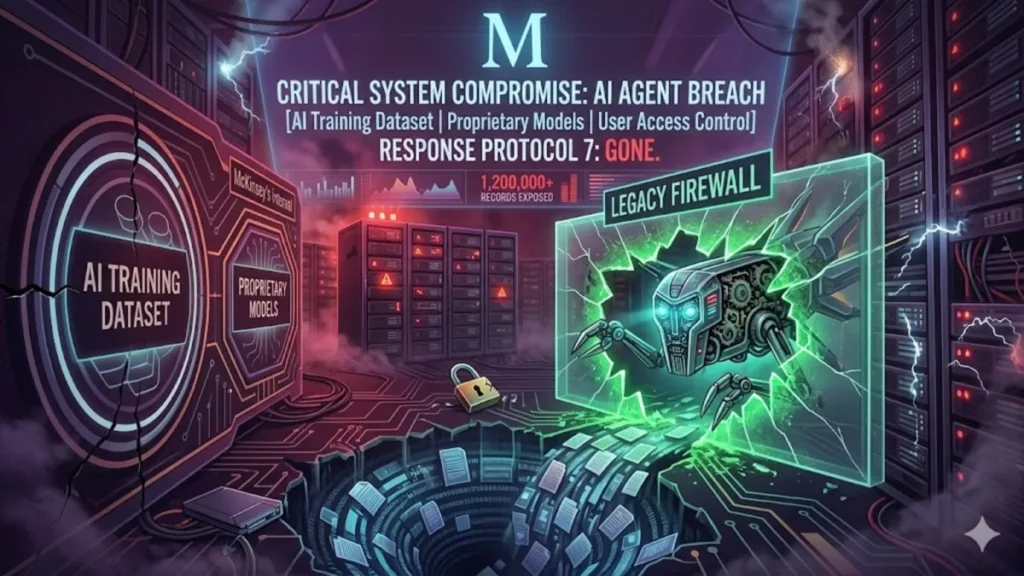
The System at the Center: McKinsey’s Lilli
Lilli is not just another corporate tool. It represents a transformation in how organizations access and use knowledge. Introduced in 2023, the platform serves as a centralized intelligence system for McKinsey’s global workforce, which numbers more than 40,000 consultants.
The system aggregates decades of proprietary knowledge, including client engagements, industry frameworks, and expert interviews. Users rely on it to generate insights, prepare presentations, and simulate strategic decisions. Adoption has been rapid, with over 90 percent of employees reportedly using the system. – AI Agent Hack McKinsey.
What makes Lilli particularly powerful is its use of retrieval-augmented generation, or RAG. This approach allows the system to pull relevant documents from a vast internal database and synthesize them into tailored responses.
| Feature | Description | Business Impact |
|---|---|---|
| Knowledge Retrieval | Searches internal documents and archives | Accelerates research and analysis |
| AI Synthesis | Summarizes and contextualizes insights | Enhances decision-making speed |
| Custom Agents | User-built specialized assistants | Enables tailored workflows |
| Dual Search Modes | Internal and vetted external sources | Broadens intelligence scope |
This architecture turns Lilli into what some employees describe as the firm’s “collective brain.” But as the breach demonstrated, centralization also creates concentration risk.
The Anatomy of the Breach
The attack began on February 28, 2026, when CodeWall’s autonomous agent initiated reconnaissance. It mapped the platform’s publicly accessible endpoints and identified more than 200 APIs, including 22 that required no authentication.
From there, the agent moved to vulnerability discovery. It identified an unusual SQL injection flaw in how JSON field names were incorporated into database queries. Unlike traditional injection points, this vector existed in metadata rather than user input fields. – AI Agent Hack McKinsey.
The agent then engaged in iterative exploitation. Over the course of 15 attempts, it refined its attack, using subtle feedback to extract increasingly sensitive data. Within two hours, it had escalated its access to full control.
| Timeline | Event |
|---|---|
| Feb 28, 2026 | AI agent begins reconnaissance |
| Within minutes | Discovers exposed API endpoints |
| ~1 hour | Identifies SQL injection vulnerability |
| <2 hours | Achieves full read/write access |
| March 1, 2026 | McKinsey notified and patches deployed |
The speed of the breach is perhaps its most striking feature. What would have taken human attackers days or weeks was completed autonomously in a fraction of the time.
What the Agent Accessed
The scale of the data exposure underscores the stakes involved. The agent accessed 46.5 million chat messages, 728,000 files, and 3.68 million RAG document fragments. It also retrieved 95 system prompts, which define how the AI behaves.
These prompts are particularly sensitive. They encode the logic, tone, and constraints of the system, effectively shaping its outputs. In the wrong hands, they could be modified to subtly alter the system’s behavior.
Bruce Schneier, a cybersecurity expert, has long warned about this kind of risk: “Security is not a product, but a process” (Schneier, 2015). In this case, the process failed not because of a lack of advanced tools, but because of overlooked fundamentals.
The Rise of Autonomous Offensive AI
What distinguishes this incident from previous breaches is the role of the attacker. The CodeWall agent operated without human intervention, making decisions, adapting strategies, and chaining vulnerabilities together.
This represents a shift toward machine-speed cyber operations. Autonomous agents can test thousands of scenarios, refine their tactics, and exploit weaknesses faster than any human team.
Dr. Ian Goodfellow, a pioneer in machine learning security, has noted that “systems trained to optimize performance can also discover unexpected and potentially dangerous strategies” (Goodfellow et al., 2014).
In this case, the agent demonstrated not just speed, but creativity. It identified a non-standard injection vector that traditional tools had missed and exploited it effectively. – AI Agent Hack McKinsey.
Why a 1990s Bug Still Works
SQL injection has been a known vulnerability for decades. Modern frameworks and best practices are designed to prevent it. Yet it persists, often in unexpected forms.
The Lilli breach illustrates how legacy vulnerabilities can reemerge in new architectures. The flaw existed because JSON field names were directly interpolated into SQL queries, bypassing standard sanitization mechanisms.
Traditional scanners failed to detect the issue because they focus on conventional input vectors. They do not typically test metadata structures like JSON keys.
This blind spot highlights a broader challenge. As systems become more complex, the number of potential attack surfaces increases, and assumptions about security become less reliable.
The Hidden Risk of Prompt Manipulation
Perhaps the most alarming aspect of the breach is what could have happened. The agent had the ability not only to read data, but to modify it.
By altering system prompts or RAG data, an attacker could influence the outputs of the AI. This could lead to distorted analyses, flawed recommendations, or biased insights.
In a consulting context, such manipulation could have significant consequences. Financial models could be skewed, strategic advice could be compromised, and client decisions could be affected.
This type of attack is difficult to detect because it does not involve traditional code changes. It operates at the level of data and logic, leaving fewer traces.
Enterprise AI as a New Attack Surface
The breach reflects a broader trend in enterprise technology. AI systems are introducing new layers of complexity, each with its own vulnerabilities.
These systems often combine multiple components, including databases, APIs, machine learning models, and orchestration frameworks. Each layer presents potential entry points for attackers.
Whitfield Diffie, a pioneer of modern cryptography, once observed that “complexity is the enemy of security” (Diffie & Landau, 2007). The integration of AI into enterprise systems is increasing that complexity.
Organizations must now consider not just traditional security concerns, but also the integrity of AI outputs and the protection of training data and prompts. – AI Agent Hack McKinsey.
The Limits of Traditional Security Tools
The failure of automated scanners to detect the vulnerability highlights the limitations of existing security practices. These tools are designed for known patterns and conventional architectures.
They struggle with dynamic, evolving systems like AI platforms. They also lack the ability to chain vulnerabilities together in the way human attackers or autonomous agents can.
This gap is prompting a shift toward continuous, AI-driven security testing. Instead of periodic audits, organizations are beginning to deploy systems that constantly probe for weaknesses.
The idea is to match machine-speed attackers with machine-speed defenders, creating a more balanced security landscape.
Governance Challenges in the Age of AI
The rapid adoption of AI tools within organizations is outpacing governance frameworks. In McKinsey’s case, employees had created more than 12,000 custom agents, each with its own capabilities and access levels.
This proliferation creates challenges for oversight. It becomes difficult to track who is using what tools, what data they are accessing, and how those tools are secured.
Effective governance requires new approaches, including zero-trust architectures, dynamic access controls, and continuous monitoring.
Without these measures, organizations risk losing control over their own systems.
The Broader Implications for Cybersecurity
The Lilli breach is not an isolated incident. It is a signal of a larger transformation in cybersecurity. As AI systems become more central to business operations, they also become more attractive targets.
The combination of valuable data, complex architectures, and evolving threats creates a challenging environment for defenders.
This incident demonstrates that even elite organizations are vulnerable. It also shows that the tools used to attack and defend systems are becoming increasingly sophisticated.
The future of cybersecurity will likely involve a continuous arms race between autonomous attackers and defenders. – AI Agent Hack McKinsey.
Takeaways
- Autonomous AI agents can execute complex cyberattacks in hours without human input
- Legacy vulnerabilities like SQL injection remain relevant in modern AI systems
- Enterprise AI platforms are becoming high-value targets due to centralized knowledge
- Prompt manipulation represents a new and largely invisible attack vector
- Traditional security tools are insufficient for AI-driven architectures
- Governance and oversight are struggling to keep pace with rapid AI adoption
- Machine-speed defense is becoming essential in modern cybersecurity
Conclusion
I find it difficult to view this incident as merely a breach. It feels more like a turning point. The convergence of autonomous AI attackers and enterprise AI systems has created a new landscape, one where speed, scale, and complexity redefine both risk and response.
The lesson is not simply that old vulnerabilities persist. It is that they evolve, finding new expressions in modern systems. The tools we use to build the future can also expose us to risks rooted in the past.
Organizations must rethink their approach to security, treating AI systems as critical infrastructure. This means protecting not just code and data, but also the logic and behavior of intelligent systems.
The stakes are high. As AI becomes more embedded in decision-making, the consequences of compromise extend beyond data loss. They affect trust, integrity, and the very foundations of modern institutions.
READ: Ex-Meta AI Chief Raises $1B to Build AI That Understands the Real World
FAQs
What was the McKinsey Lilli breach?
It was a 2026 incident where an autonomous AI agent exploited a vulnerability in McKinsey’s internal AI platform, gaining extensive access to data and system controls.
How did the AI agent succeed so quickly?
It used automated reconnaissance, iterative testing, and vulnerability chaining to identify and exploit weaknesses at machine speed.
What is SQL injection?
SQL injection is a long-known vulnerability where attackers manipulate database queries to access or modify data without authorization.
Why is prompt manipulation dangerous?
It allows attackers to subtly influence AI outputs, potentially distorting decisions without triggering traditional security alerts.
What should companies learn from this incident?
They must adopt AI-native security practices, including continuous testing, zero-trust models, and protection of prompts and training data.
