
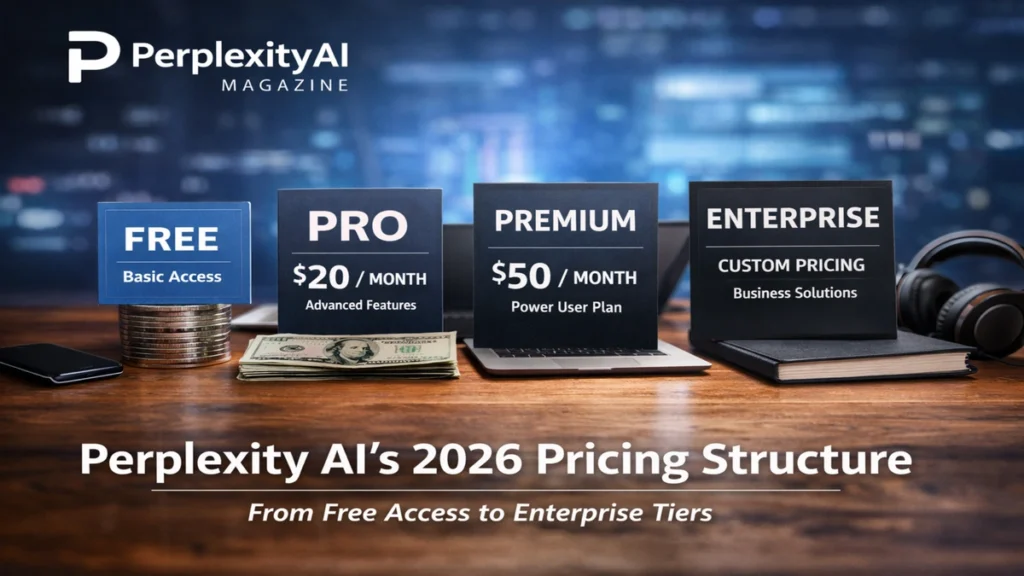
Perplexity AI’s pricing in 2026 is not merely a list of numbers; it is a map of how artificial intelligence is being transformed from a novelty into an economic utility. The company’s tiered model — free, Pro, Max, Enterprise Pro, and Enterprise Max — reflects an emerging reality: intelligence itself is becoming a metered resource. As AI systems grow more capable, more autonomous, and more integrated into daily work, the question is no longer whether to use them, but how much of them one can afford. – perplexity pricing.
For individuals, this means choosing between light, exploratory use and deep, continuous reliance. For organizations, it means deciding whether AI is a helpful supplement or a foundational layer of operations. Perplexity’s pricing tiers make these choices explicit, aligning levels of access with levels of dependence.
The structure also reveals something deeper about the AI economy. Free access still exists, but only at the margins. The most powerful capabilities — unlimited research, frontier models, automation, and collaboration — are increasingly concentrated behind paywalls. This mirrors earlier transitions in computing, from personal software to cloud services, where capacity and convenience came to be sold as subscriptions.
This article examines Perplexity’s pricing not just as a consumer guide, but as a cultural signal. It explores what each tier offers, who it is for, and what it suggests about the future relationship between humans and intelligent systems.
The Free Tier and the Politics of Access
Perplexity’s free tier provides a limited entry point into its ecosystem. Users can perform basic searches, receive conversational answers, and experiment with the platform’s interface. But meaningful constraints remain. Advanced models are restricted. Deep research workflows are capped. File uploads and integrations are limited.
The free tier functions less as a full product and more as an on-ramp. It invites curiosity, but not reliance. It allows users to taste the system without committing to it.
This design is deliberate. It reflects a broader pattern in AI platforms: openness is preserved symbolically, but depth is monetized. The free tier offers visibility; paid tiers offer capability.
In this sense, the free tier is not about access to intelligence but access to the idea of intelligence.
Read: Perplexity News: When AI Agents Start Running the Web
Pro as the Cognitive Middle Class
The Pro tier, priced at $20 per month or $200 per year, represents the platform’s center of gravity. It is designed for individuals who use AI regularly but not exhaustively: researchers, writers, students, consultants, and analysts.
Pro offers expanded Deep Research queries, access to advanced models, file uploads, integrations with tools like Google Drive and Dropbox, and a modest number of Labs projects for structured outputs such as reports and dashboards. – perplexity pricing.
This tier corresponds to what might be called the cognitive middle class: people whose work increasingly depends on synthesis, analysis, and generation, but who do not require constant automation or infinite throughput.
Pro is not unlimited, but it is sufficient. It supports depth without excess, iteration without saturation.
This balance makes Pro the most attractive option for most users and the most revealing tier about how AI is being normalized into professional life.
Max and the Industrialization of Thinking
The Max tier, at $200 per month or $2,000 per year, removes most constraints. Unlimited research, unlimited Labs projects, access to frontier models, early access to experimental tools like the Comet browser, and priority support transform AI from a tool into a continuous environment.
Max is designed for power users: startups building AI-driven products, analysts running constant pipelines, creators producing at scale, and teams whose workflows are inseparable from AI.
This tier marks the point at which AI stops being a helper and becomes infrastructure. It is no longer consulted occasionally; it is embedded everywhere. – perplexity pricing.
The existence of Max reflects a shift in how thinking itself is commodified. Reasoning, synthesis, and generation become scalable processes, available in industrial quantities for those who can pay.
Enterprise Tiers and the Governance of Intelligence
Enterprise Pro and Enterprise Max extend this logic into organizational contexts. These tiers emphasize collaboration, governance, security, compliance, and administrative control.
Enterprise Pro provides shared workspaces, seat management, and compliance features suitable for regulated environments. Enterprise Max adds unlimited capacity, advanced integrations, enhanced media generation, and top-tier support.
These tiers are not about individual productivity but institutional transformation. They position AI as a shared resource within organizations, governed like any other strategic asset.
The language of these tiers is telling: seats, governance, compliance, audits, integration. Intelligence is no longer personal. It is organizational. – perplexity pricing.
Feature Comparison
| Feature | Pro | Max | Enterprise Pro | Enterprise Max |
|---|---|---|---|---|
| Monthly Cost | $20 | $200 | $40/seat | $325/seat |
| Research Limits | Capped | Unlimited | High | Unlimited |
| Model Access | Advanced | Frontier | Advanced | Frontier |
| Collaboration | Limited | Moderate | Full | Full |
| Governance | None | None | Yes | Yes |
| Early Features | No | Yes | No | Yes |
This table illustrates how the tiers map onto increasing intensity, scale, and institutionalization.
Why Pro Fits Academic Work
Academic research values depth, rigor, and traceability more than volume. Pro aligns well with these priorities.
It offers enough Deep Research queries to iterate through literature, enough Labs projects to generate tables and summaries, and enough file handling to manage PDFs and datasets. – perplexity pricing.
For most academics, Max’s unlimited capacity is unnecessary. Their bottleneck is not volume but interpretation. Pro provides the right balance.
Pro Versus Alternatives
| Plan | Strength | Limitation |
|---|---|---|
| Free | Cost-free exploration | Too restrictive |
| Pro | Balanced depth and tools | Capped volume |
| Max | Unlimited power | Expensive, often excessive |
This comparison highlights that Max is not “better” in a universal sense. It is better for a specific mode of work.
API Pricing and Programmable Intelligence
Perplexity’s API pricing introduces another dimension: intelligence as a service. Developers can integrate search, retrieval, and reasoning into their own systems, paying per request or per token.
This model reflects the shift from human-facing AI to machine-facing AI. Intelligence becomes something that other systems consume. – perplexity pricing.
This is perhaps the most profound transformation: AI stops being a user interface and becomes a protocol.
Takeaways
- Perplexity’s pricing tiers reflect increasing dependence on AI rather than increasing prestige
- The free tier offers visibility, not depth
- Pro represents normalized professional use
- Max represents infrastructural use
- Enterprise tiers represent organizational intelligence
- API access represents machine-to-machine intelligence
Conclusion
Perplexity’s pricing in 2026 is a story about how intelligence itself is being reorganized as a service. What was once a human monopoly — research, synthesis, reasoning — is now something that can be provisioned, throttled, upgraded, and billed.
This does not make intelligence less human, but it changes how humans relate to it. We no longer only think. We subscribe to thinking.
The danger is not that machines will replace us, but that we will forget how much of ourselves we have outsourced.
Perplexity’s pricing makes that outsourcing visible. It draws a line between curiosity and reliance, between assistance and infrastructure.
Where each person or organization chooses to stand on that line will shape not only their productivity, but their relationship to knowledge itself.
FAQs
Is Perplexity free?
Yes, but with limited capabilities and usage.
What is the best plan for most users?
Pro, because it balances cost and capability.
Who should use Max?
Power users and teams who rely on AI continuously.
What are Enterprise plans for?
For organizations needing governance and collaboration.
Does Pro include API access?
It may include limited credits, but significant use is billed separately.
