
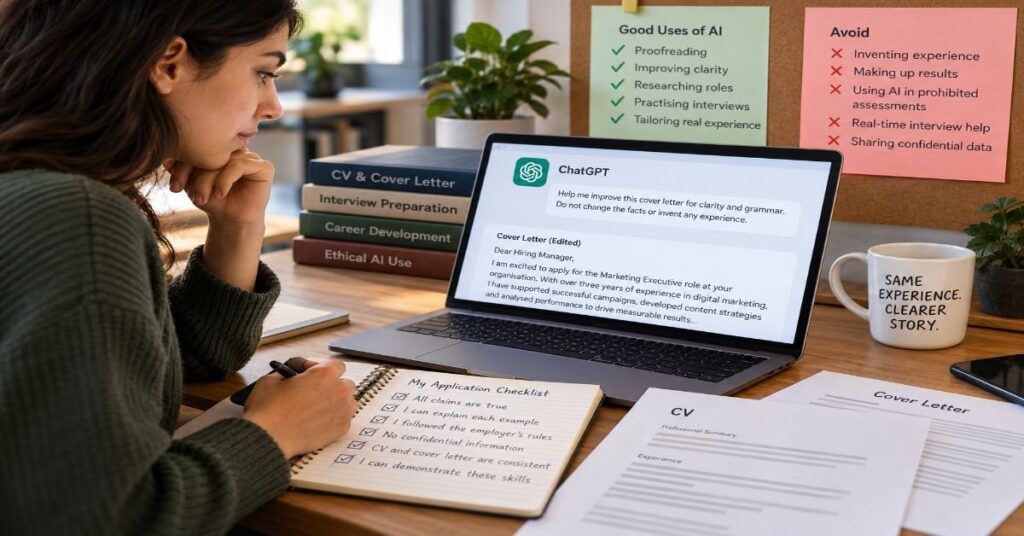
No, it is not inherently dishonest to use AI for job applications: it becomes dishonest when the tool changes the truth of your experience, conceals who did assessed work or breaks the employer’s stated rules. The distinction matters because a spotless CV can now be generated in seconds, but the employer still needs to know whether the applicant can do the job. AI may write the words; it must not write the person.
The practical question is not whether ChatGPT touched your cover letter. It is whether the result represents a real human who can explain each claim and perform the promised work. That standard accommodates an applicant with excellent experience but weak writing confidence. It also reveals why a beautifully drafted application can be deceptive when it attributes team results to a sole leader or supplies unfamiliar skills simply because they appear in a vacancy.
Current employer guidance is not uniform. The British Council explicitly allows AI for proofreading, public research and interview preparation, but not during interviews or assessments. Harvard’s career advice similarly supports considered editing while warning against invented or inflated qualifications. Oxford University encourages candidates to consider whether they could comfortably explain their AI use to an employer. Those differences are important: honesty is both about factual representation and about the conditions of a particular assessment.
This guide sets out an evidence-based three-part test, a stage-by-stage risk map, a workflow for producing defensible applications, and concrete examples of where assistance becomes misrepresentation. It also explains the less obvious problem: an application can be factually accurate yet still conceal the independent reasoning an employer is trying to evaluate.
Is It Dishonest to Use AI for Job Applications?
AI assistance is generally acceptable when it improves the expression of real experience and complies with the relevant hiring process. Proofreading, identifying unclear wording, comparing a vacancy with a genuine CV and practising interview questions normally leave the candidate’s identity and qualifications intact. The same software becomes ethically problematic when it invents a certificate, presents AI-created work as a completed client project or supplies prohibited answers in a live assessment.
A useful distinction separates representation from performance. A CV is mostly a representation: it tells an employer what a person has previously done. A skills test is often a performance: it asks the person to demonstrate ability under specified conditions. Tools permitted for the first purpose may be forbidden for the second. Treating both as ordinary writing tasks misses the employer’s underlying reason for asking.
Neither manual writing nor AI authorship guarantees honesty. People exaggerated achievements long before language models existed. Conversely, an applicant who has dyslexia, uses English as an additional language or struggles to condense complex experience may rely on editorial tools without misrepresenting a thing. The ethical issue is whether the application produces a reliable hiring signal, not whether every sentence was typed without assistance.
A Short Rule Worth Remembering
Use AI to improve how the employer understands you, not to create someone more impressive than you really are. If a tool makes an untrue claim sound credible, its polish increases rather than decreases the problem.
What Employers Mean When They Say “Do Not Use AI”
The phrase can mean several distinct things. Some employers object to generated answers because they want to judge unaided written communication. Others accept text editing but forbid real-time prompts in interviews or coding tests. Still others focus on privacy, asking candidates not to upload confidential data or proprietary assessment questions. An absolute ban and a narrow test-stage restriction should not be treated as interchangeable.
The British Council publishes a particularly clear example: it accepts proofreading, CV structuring, role research and practice, while prohibiting AI-generated scripts or real-time help during interviews and assessments. It also says candidates may be asked about their AI use. The UK Secret Intelligence Service provides a similar distinction between preparation and prohibited AI assistance during online tests or interviews. These are employer-specific policies, not universal law.
An employer’s decision to use AI for its own recruitment does not automatically authorise candidates to use it in every setting. The symmetry argument—“the company uses AI, so I can”—raises a legitimate concern about fairness, but it does not override a disclosed assessment rule. Applicants can challenge unfair processes or choose not to participate; secretly violating clear conditions is different from disputing their fairness.
Read the Scope Before Drawing Conclusions
Look for language about drafting materials, authenticity declarations, online tests, interviews, use of outside resources, confidentiality and permitted assistive technologies. When the instruction is ambiguous, ask whether AI may be used for brainstorming, editing, research or the specific task. Preserve the written answer.
The Three-Part Honesty Test: Truth, Ownership and Permission
The most reliable way to judge an AI-assisted application is to test it along three separate dimensions. Each catches a failure that the others may miss. A fully truthful answer can still breach a no-AI exam condition. A permitted tool can still introduce a false claim. And a truthful, permitted draft can still make the applicant appear capable of reasoning they did not actually do.
These checks are a practical editorial framework, not a statutory test or a validated psychometric instrument. They are valuable because they turn a vague moral debate into decisions candidates can make before submitting work.
Truth: Does the Application State Only What You Can Support?
Check employment dates, titles, qualifications, metrics, software exposure, project ownership and the scale of outcomes. Distinguish a team result from your individual contribution. Replace invented percentages with observable, accurately described outcomes rather than false precision.
Ownership: Can You Explain and Defend the Work?
Imagine a hiring manager pointing to any sentence and asking what you personally did, why you made that decision and what changed afterwards. If you cannot answer, remove or revise the claim. For assessments, ownership also asks whether the solution demonstrates your independent reasoning under the task rules.
Permission: Was This Assistance Allowed at This Stage?
Read the exact instructions. A policy may allow editing of an application but prohibit any outside assistance during an assessment. Silence is not reliable consent for high-stakes tests. If a permissible scope is stated, keep within it and disclose when expressly requested.
| Use of AI | Likely ethical status | Decisive question |
| Correcting grammar in your own CV | Usually acceptable | Are the underlying claims unchanged? |
| Tailoring real achievements to a vacancy | Usually acceptable | Can you prove every achievement? |
| Drafting a letter from your own notes | Conditional | Does the final letter express your actual reasons? |
| Making up revenue figures | Dishonest | Are the numbers supported by evidence? |
| Completing a prohibited skills test | Prohibited | Did the employer authorise assistance? |
| Preparing with mock interviews | Usually acceptable | Is the tool used only before the live interview? |
| Using real-time interview prompts | Often prohibited | Does the employer specifically permit this? |
A Stage-by-Stage Map of Acceptable AI Help
Applicants encounter different kinds of evidence requests as they move through recruitment. Treating the entire process as one uniform permission zone invites avoidable mistakes. A simple map helps separate low-risk preparation from activities where the employer is explicitly assessing an individual.
At the research stage, summarising public information, comparing role requirements and identifying questions for a recruiter are generally uncontroversial. At the document stage, AI can act as an editor or structured interviewer. At the assessment stage, its use depends on task instructions, and at the live interview stage, undisclosed answer generation can undermine the meaning of the interview itself.
Some real workplaces expect professionals to use AI in their daily tasks. An employer may deliberately construct an open-tool exercise to test that ability. In that case, using AI as permitted is not dishonest; concealing the workflow or presenting unverified outputs as independently checked remains poor practice. Always judge the task that was actually set.
| Stage | Constructive uses | High-risk boundary |
| Role search | Public research; comparing qualifications | Inventing knowledge of a company |
| CV and cover letter | Editing; arranging genuine evidence | Fabricating roles or metrics |
| Application questions | Clarifying the candidate’s own examples | Generic invented motivations |
| Take-home exercise | AI use if task explicitly allows it | Concealing unauthorised generation |
| Live interview | Advance preparation and rehearsals | Undisclosed answer feeds |
| After an offer | Checking documents and onboarding guidance | False professional licences or references |
Why a Perfectly Written Application Can Still Fail
Language models are good at producing the appearance of a polished professional narrative. They can also flatten the distinctive details that make a candidate memorable. A recruiter may see dozens of letters referring to collaboration, passion and strategic impact without learning what any applicant actually built, sold, fixed or changed.
The problem is not that phrases such as “results-driven professional” are automatically lies. They are weak evidence. An applicant who writes “supported a cross-functional transformation programme” may be describing anything from sending meeting invitations to redesigning a process. AI can create an impressive surface while removing the ordinary details that would allow an interviewer to evaluate the work.
In a June 2025 Nature Careers discussion, careers coach Fatimah Williams suggested using AI as a thinking partner. That approach differs from asking it to invent a polished professional identity. More recent June 2026 Harvard Business Review analysis by Shraddha Sunil and Mudit Saraf argues that generative AI is weakening conventional hiring signals because polished resumes and interview performance can be manufactured more cheaply. The two observations point to the same solution: stronger evidence of actual competence.
One overlooked failure mode is consistency drift. An applicant may begin with a true achievement, then request a stronger version, then a more senior version, and finally a version containing outcome metrics. Each rewrite seems minor, but the final paragraph can represent something materially different from the first. Comparing the final document with an independent fact file helps catch this drift.
Replace Adjectives With Verifiable Detail
Instead of “spearheaded strategic operational improvements”, specify the task, scope and result: “Built a weekly reporting sheet used by four support agents to track unresolved tickets.” Add a quantified improvement only when it can be substantiated.
How to Build a Truth File Before You Open an AI Tool
Create a private record of your work history before generating any application content. Include employer names, accurate dates, job titles, reporting lines, actual responsibilities, project constraints, tools you genuinely used and results you can discuss. Preserve distinctions among leading, supporting, observing and approving a project. Those verbs describe different contributions.
For each achievement, collect a short story: the initial problem, your actions, your level of autonomy, the measurable or observable outcome, and the evidence that supports your account. Evidence may include a portfolio artefact, a public project page, a performance review or a reference who can confirm your role. It does not have to be a confidential document; often a clear account of the decision is more useful than a sensitive screenshot.
The best evidence file also records uncertainty. Maybe a team improved conversion, but you do not know the final percentage. Say what you know and avoid asking AI to estimate a flattering number. Maybe you supported software deployment but were not the project owner. Preserve that distinction. A modest and precise achievement is more credible than an exaggerated one.
Do not automatically paste this full file into a public chatbot. Remove names, contact details, confidential client information, internal code and non-public documents. Yale’s career guidance warns users to protect identifying information when asking AI tools for feedback. Work from anonymised notes wherever practical.
The Six Fields to Record for Every Example
Record context; responsibility; personal action; tools actually used; observed result; and proof or credible explanation. If one field is missing, ask yourself what you can safely say without filling the gap with a generated guess.
A Safer Workflow for CVs, Cover Letters and Application Questions
Begin by writing a rough description of the experience yourself. This can be untidy. The goal is to preserve factual material before optimisation. Next, ask AI to identify unclear statements and missing evidence, rather than to manufacture stronger achievements. Only after the underlying content is sound should you request a concise edit.
For a CV, work one bullet at a time. Ask for shorter alternatives that retain the exact responsibility and result. Compare each alternative with the truth file. Reject lines that introduce leadership, numerical outcomes or technical expertise absent from your account. For a cover letter, start with three personal answers: why this role, why this organisation, and which real example best supports the fit.
For written questions, identify whether the prompt evaluates a factual example, a motivation or a specific judgement. AI can ask follow-up questions and challenge vague explanations. It should not supply motivations you do not hold or experiences you never had. If a question asks for independent writing, follow the employer’s policy even if the output would be more elegant with assistance.
Finish with a manual audit and an out-loud rehearsal. Read each paragraph and ask whether you could expand on it naturally under interview pressure. Check that dates match across the CV, profile and application. Review every proper noun, certification, link and number. Human review remains essential because a plausible-sounding AI error can survive several rounds of editing.
Prompt 1: Interview Me Before Drafting
“Ask me targeted questions about my genuine work on this project. Do not invent responsibilities, numbers or qualifications. Distinguish my contribution from the team’s. After I answer, suggest two concise CV bullets and identify anything that needs verification.”
Prompt 2: Audit My Evidence
“Review these anonymised CV claims against the evidence notes below. Flag exaggeration, unsupported metrics, ambiguous ownership and vague terminology. Do not add facts or rewrite until I confirm the corrections.”
Prompt 3: Rehearse a Recruiter Challenge
“Act as an interviewer. Question my submitted achievement statements one at a time. Ask what I personally did, what trade-offs I made and how I know the outcome. Tell me where my answers need clearer evidence.”
Four Realistic Scenarios That Change the Ethical Answer
Consider a support analyst who helped a five-person team improve ticket tracking. AI changes “contributed to weekly reporting” into “led a company-wide service transformation”. The original activity may be valuable, but the new claim changes scope and authority. The honest revision names the analyst’s personal contribution and avoids pretending to have led the project.
Now consider an applicant with strong experience but an awkward first draft in English. They ask for grammar corrections and clearer paragraph structure without changing facts. That is substantially different from using AI to invent a job history. Some employers may still restrict the level of assistance allowed; candidates should respect the applicable instructions, particularly where language proficiency itself is being assessed.
A marketing candidate receives a take-home brief requesting original strategic reasoning without external assistance. They use AI to produce the entire campaign and conceal that choice. Even when the campaign happens to be plausible, the submission fails the permission and ownership tests. If the exercise explicitly permits AI, a more defensible approach is to document which ideas came from tools, explain which were rejected and justify the final choices.
Finally, a candidate practises difficult interview questions the night before a video call. That preparation is legitimate under many policies. Secretly displaying AI-generated answers during the actual interview is a different action. The British Council and SIS explicitly prohibit such assistance. The decisive change is not the software but the conditions under which the employer is evaluating the candidate.
The Boundary Can Move With the Task
One employer may assess whether a candidate can write unaided; another may assess whether a candidate can supervise AI responsibly. Identical tool use can therefore be authorised in one exercise and a rule violation in another. Read the task before deciding.
Should You Disclose Using ChatGPT or Another AI Assistant?
There is no single disclosure rule covering every employer, occupation and country. Routine editorial help may not require a separate statement when instructions are silent, but that is not permission to conceal material assistance in a restricted task. If an application asks whether AI was used, answer accurately and describe the scope. If an integrity declaration says the work must be unaided, respect it.
The useful distinction is between disclosure and impression management. Saying “I used AI to shorten my genuine CV bullets and check grammar” is precise. Saying “AI wrote none of this” when it substantially generated the text is false if asked directly. Equally, a candidate need not portray ordinary spellchecking as equivalent to an AI-completed technical assessment.
Policies can be more restrictive than general career advice. A university admissions statement may forbid translation or content generation even when an ordinary employer allows proofreading. Do not copy a policy from a different organisation and assume it applies. If access needs or disability accommodations matter, ask the recruiting team how assistive technology is treated within the process rather than making unsupported assumptions.
Where the rules are unclear, a short question is usually sufficient: “May applicants use AI for proofreading or brainstorming, and are there any restrictions for the assessment?” A clear written answer is more useful than debating abstract definitions of cheating after submission.
| Situation | Practical disclosure approach | Reason |
| Ordinary CV proofreading; no policy stated | Usually no special declaration unless asked | The applicant remains the source of facts |
| Application asks about tool use | Describe the actual scope truthfully | A misleading answer creates a separate honesty issue |
| Assessment says no outside tools | Do not use AI | Permission is explicitly absent |
| Assessment explicitly allows AI | Follow documentation instructions | Evaluation may include responsible tool use |
| Policy unclear | Request clarification in writing | Avoids relying on assumptions |
Privacy, Fairness and Other Risks Beyond Cheating
Honesty is only one dimension of responsible AI use. A candidate may produce an accurate application while exposing private data from former clients or employers. Public chatbot prompts should not contain proprietary business plans, confidential customer records, passwords, personal identification details or restricted interview questions. Sanitising examples is especially important for cybersecurity, healthcare, finance and legal roles.
AI may also embed bias or inaccurate assumptions. It can suggest traits based on a stereotyped job description, inflate seniority or advise hiding career gaps when an honest explanation would be better. Its apparent confidence is not evidence of correct professional guidance. Verify employer details on the employer’s own website and treat generated salary estimates or legal claims as unverified until independently supported.
There is a fairness question too. Applicants with good AI tools and prompting skills can produce more polished documents than equally qualified candidates without them. But banning all writing support can disadvantage people who benefit from editing assistance. A fairer approach is for employers to define what they need to measure, communicate permissible tools and evaluate evidence of genuine competence. The UK government’s responsible AI recruitment guidance discusses transparency, fairness and safeguards in employer AI deployment.
Applicants cannot solve recruitment-system design alone. They can, however, make their applications auditable: accurate claims, clear contributions, evidence on request and faithful compliance with disclosed conditions. These practices help protect credibility regardless of whether an employer uses automated screening.
What Research Actually Shows—and What It Does Not
Evidence is more mixed than simplistic headlines suggest. Prospects reported results from the 2025 Luminate Early Career Survey: 43% of respondents used AI to edit CVs or cover letters, 35% used it to write them from scratch and 26% used it for application questions. These figures describe reported use among the surveyed early-career population; they do not prove that applicants who use AI receive more offers.
A 2025 research paper linked by Harvard Kennedy School, by Benjamin Lira and colleagues, reported that participants practising cover-letter writing with AI later performed better on a writing test than a comparison group practising without it. That study suggests AI assistance can sometimes support learning rather than simply substitute for it. It does not establish that any employer must accept AI during independently assessed writing tasks.
Nature Careers’ 2025 reporting includes recruiters’ concerns about generic AI text and the potential mismatch between written applications and interview performance. A 2026 Harvard Business Review analysis makes the broader point that polished documents are becoming cheaper to manufacture. Together these sources caution against equating the sophistication of application language with job competence.
No sound universal percentage can tell an individual whether their AI-assisted application is dishonest. Policies, roles and assessment designs vary. Similarly, there is no reliable basis for promising that an “AI-proof” writing style will defeat detection software. Focus on accurate documents and the ability to defend them rather than trying to fool a detector.
The Stronger Hiring Signal
A specific, verifiable example and a candidate who can explain it provide better evidence than a perfectly polished but ungrounded narrative. This is an inference from the combined guidance, not a claim that any particular writing style guarantees interview success.
A Final Pre-Submission Audit
Before pressing submit, compare your finished application with your evidence notes. Check each employment date, qualification, metric, client outcome and claimed tool. Mark sentences you could not explain without looking up their meaning. These are the first to revise or remove.
Next read the employer instructions again, looking for rules that apply to the specific stage. If the assessment has a ban on outside assistance, do not treat earlier permission to proofread a CV as permission to generate test answers. Remove confidential information from any remaining AI conversations and check that attachments contain no sensitive internal data.
Finally, rehearse two questions for every major achievement: “What exactly did you do?” and “How do you know that was the result?” A truthful answer need not be theatrical. It needs to make your contribution clear. If your application survives those questions, AI has probably served as an editor rather than a substitute applicant.
- Every claim matches my genuine experience.
- I can explain each achievement and its evidence.
- I followed the employer’s current AI-use rules.
- I did not expose private or confidential information.
- My CV, cover letter and professional profile are consistent.
- I can reproduce the relevant skills under the conditions of the role.
Our Editorial Verification Process
This explainer cross-checked career-service guidance from Harvard, Yale and UC Davis against specific employer policies published by the British Council and the UK Secret Intelligence Service. It also examined Oxford University’s assessment guidance, the 2025 Luminate figures reported by Prospects, the 2025 Lira and colleagues study, and reporting or analysis from Nature Careers and Harvard Business Review. The three-part honesty test and illustrative scenarios are editorial frameworks, not empirical hiring experiments.
No application was submitted, no employer was interviewed for this article, and no proprietary AI-detector accuracy study was performed. Examples are hypothetical and are labelled as such. Source statements should be rechecked before publication because recruitment guidance can change. As of 22 October 2026, the publication’s sitemap could not be retrieved, so internal link destinations remain unverified and are not fabricated.
This article was researched and drafted with AI assistance. Independent final review and fact-checking by the Awais Khalid editorial desk at Perplexity AI Magazine remain to be completed before publication.
Conclusion
Using artificial intelligence to make a truthful application clearer is not automatically dishonest. What matters is whether an employer still receives a faithful account of the applicant’s experience and an authentic demonstration of the skills being assessed. A tool that corrects grammar does something fundamentally different from a tool that invents achievements or secretly answers interview questions.
The safest practical standard has three parts: preserve the truth of every claim, retain ownership of every relevant decision and comply with the conditions of each recruitment stage. None of these safeguards requires applicants to reject useful technology. They require candidates to choose when the technology is genuinely helping, rather than pretending to be the applicant.
Important questions remain unresolved. Employers do not share one policy, and tests designed before ubiquitous generative AI may no longer measure the abilities recruiters think they measure. Candidates also face unequal access to coaching, assistive technology and application resources. Greater clarity about permitted tools would make recruitment fairer for both sides.
For now, the strongest application is not the one that sounds least like AI. It is the one in which every important statement can be supported by the human whose name appears at the top.
Frequently Asked Questions
Is It Dishonest to Use AI for Job Applications?
Not by default. Editing and structuring genuine experience is usually defensible, while fabricated qualifications and prohibited live assistance are not. Check the individual employer’s published application and assessment guidance.
Is Using ChatGPT to Write a CV Cheating?
It depends on how it is used and what the employer permits. Rewriting truthful bullet points for clarity is different from inventing achievements or submitting claims you cannot explain.
Can Employers Tell if a Cover Letter Used AI?
Some employers attempt to detect AI-like language or compare writing with interview responses, but no detection method should be treated as infallible. The safer priority is specificity, accuracy and a voice you can defend.
Is It Cheating to Use AI During an Interview?
Where the employer prohibits live AI assistance, yes: it violates the stated assessment conditions. Prepare with mock interviews beforehand instead. If the employer expressly permits a tool, follow its defined scope.
Must I Tell a Recruiter I Used AI?
Follow the employer’s disclosure requirements and answer honestly when asked. Routine editing without an explicit disclosure rule is not necessarily equivalent to submitting prohibited AI-generated assessed work.
Can I Use AI for Take-Home Assignments?
Only within the task’s instructions. Some exercises deliberately permit AI and evaluate how it is supervised; others require independent work. Ask before using the tool if permission is unclear.
Can AI Invent Skills or Employment Results on My CV?
A model can generate convincing but unsupported claims. Never submit invented skills, employment history, certifications, responsibilities or metrics. Validate every line against your own evidence.
How Can I Keep AI-Written Text From Sounding Robotic?
Start with your own facts and examples. Replace generic praise and abstract claims with specific decisions, constraints and outcomes. Read the final application aloud and remove phrasing you would never use.
References
British Council. (n.d.). AI in the British Council application process. https://www.britishcouncil.org/work/jobs/application-process/ai
Harvard FAS Mignone Center for Career Success. (n.d.). AI for resumes and cover letters. https://careerservices.fas.harvard.edu/ai-resumes-and-cover-letters/
Lira, B., Rogers, T., Goldstein, D. G., Ungar, L., & Duckworth, A. L. (2025). Learning not cheating: AI assistance can enhance rather than hinder skill development. Harvard Kennedy School. https://www.hks.harvard.edu/publications/learning-not-cheating-ai-assistance-can-enhance-rather-hinder-skill-development
Nathan, D. (2025). Using generative AI in job applications. Prospects. https://www.prospects.ac.uk/careers-advice/getting-a-job/using-generative-ai-in-job-applications/
Gould, J. (2025, June 5). Should I use AI to help draft my science job application? Nature. https://www.nature.com/articles/d41586-025-01759-9
Sunil, S., & Saraf, M. (2026, June 8). AI has broken hiring. Here’s how to fix it. Harvard Business Review. https://hbr.org/2026/06/ai-has-broken-hiring-heres-how-to-fix-it\
Secret Intelligence Service. (n.d.). Using AI in applications. https://www.sis.gov.uk/careers/using-ai-in-applications/
University of Oxford. (n.d.). Use of AI in job applications and assessments. https://www.ox.ac.uk/careers/careers-guidance/job-search-and-applications/use-of-ai-in-job-applications-and-assessments
Yale Office of Career Strategy. (n.d.). Using AI in your job search. https://ocs.yale.edu/channels/using-ai-job-search/