
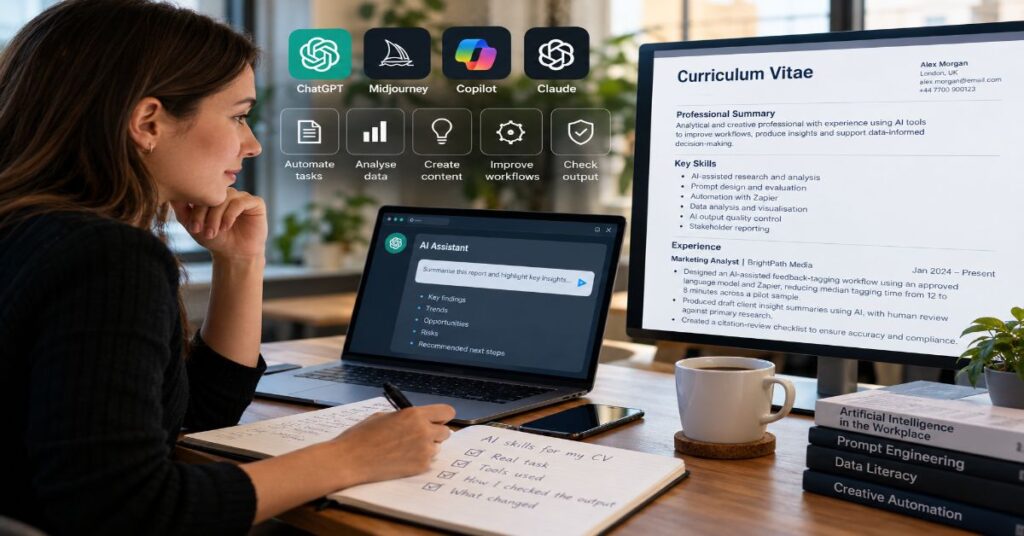
To understand how to list AI skills on a CV in 2026, describe a real task you performed with AI, precisely what you did, how you checked the output and what changed; a string of model names cannot establish the same credibility. This distinction matters because employers can ask for a demonstration, not just search for a keyword. A candidate who says “ChatGPT expert” may be less convincing than one who can explain a modest, verified process improvement.
AI skills on a CV are specific, verifiable abilities to use artificial intelligence tools or systems to complete tasks, improve workflows or evaluate machine-generated output. The skills section helps employers scan for relevant abilities; experience and project bullets establish whether those abilities were applied responsibly. Both matter, but they do different jobs.
The demand signal is real, although its meaning is often distorted. LinkedIn’s 2026 labour-market report described 70% year-on-year growth in US jobs requiring AI literacy skills. That is growth in advertised requirements, not proof that every candidate needs advanced machine-learning expertise. Microsoft’s 2026 Work Trend Index surveyed 20,000 AI-using workers in ten countries; 50% selected AI-output quality control and 46% selected critical thinking as increasingly important skills. Those are worker perceptions rather than a universal ranking of recruitment criteria.
This guide offers an original T.R.U.S.T. writing framework, a four-level capability ladder, career-specific examples, an evidence audit, and a format recruiters can read. All example achievements and numbers are illustrative unless explicitly attributed to published research. Replace them with your own substantiated facts before sending a CV.
What AI Skills Actually Signal to Employers
AI Literacy Is Not the Same as AI Engineering
In a non-technical role, applied AI literacy can include specifying an accurate brief, reviewing generated material against primary evidence, protecting client information and deciding when automation is inappropriate. An engineer may additionally need data pipelines, model evaluation, API integration, software testing and monitoring. The same phrase “AI proficient” obscures these distinctions. A useful starting point is to distinguish capability from exposure: watching a demonstration, using an assistant occasionally, and owning a deployed workflow are different achievements.
Our companion analysis of what employers want from AI skills explores that divide between applied literacy, specialist development and governance. It is an important distinction when translating a job advert into a CV. An applicant for a marketing role need not claim to train models. An applicant for a machine-learning engineering role should not use a list of consumer chatbot subscriptions as evidence of production engineering.
Job Demand Does Not Prove Individual Hiring Advantage
LinkedIn’s January 2026 survey reported that 66% of recruiters said finding qualified talent had become harder; 59% reported that AI was helping them discover candidates whose skills they might otherwise have missed. These percentages describe surveyed recruiter responses, not a prediction that adding “AI” to a CV improves any individual application. A credible applicant meets the job requirements first and then uses AI evidence to strengthen that case.
The practical inference is that relevance beats breadth. If a role requires stakeholder reporting, evidence about faster, quality-controlled reporting is more useful than knowledge of ten unrelated image generators. If the vacancy mentions governance, evidence of review gates and approved data handling is stronger than a prompt collection.
How to List AI Skills on a CV Using T.R.U.S.T.
Use T.R.U.S.T. as a drafting checklist, not as five words that must all be squeezed into every bullet. It produces longer notes first; you then compress them into a clear achievement statement. A final CV bullet usually needs one or two lines, while your interview notes can preserve the full explanation.
| Element | Question to Answer | Evidence to Keep |
| Task | What real problem was being solved? | Brief or workflow input |
| Role | Did you use, configure, build or govern? | Steps you personally owned |
| Utility | Which approved tool or integration? | Tool name and purpose |
| Safeguard | How were errors and data risks controlled? | Quality checklist or review gate |
| Tangible result | What improved, over what baseline? | Before-and-after records |
A Weak Claim and a Defensible Claim
Weak: “Expert in prompt engineering and artificial intelligence.” Better illustrative example: “Designed an AI-assisted feedback-tagging workflow using an approved language model and Zapier; routed uncertain classifications to manual review and reduced median tagging time from 12 to 8 minutes across a defined pilot sample.” The second sentence identifies the work, ownership, control and measurement. It still needs evidence: sample size, pilot dates, error-rate method and a clear explanation of whether review time was included.
Do not borrow the sample metric. A smaller, accurate claim such as “standardised a weekly research brief and introduced a citation-review checklist” is preferable to an invented 40% improvement. The standard is what you can defend under questioning, not what sounds most dramatic.
An Interview-Ready Formula
A compact pattern is: action verb + specific business task + AI method/tool + human check + evidenced outcome. For example: “Produced draft client insight summaries using an approved AI assistant, checked quotations against interview transcripts and reduced the number of editing rounds.” Without measured counts, avoid asserting a numeric reduction. You can still show responsibility through the review method, decision owner and deliverable.
The Four Levels of AI Capability
Select the level that reflects what you actually did, rather than the maturity implied by the newest vocabulary. Candidates may occupy different levels across different activities; a skilled user of research assistants can remain a beginner at deploying AI agents. The distinction is particularly useful when a vacancy uses the broad term “AI experience”.
| Level | What You Can Claim | Suitable CV Evidence |
| 1. Assisted user | Used approved AI to support a work task | Verified research brief or edited report |
| 2. Workflow operator | Ran or configured a repeatable process | Documented hand-off, exception and review |
| 3. AI builder | Designed integrations, prompts, applications or evaluations | Code, tests, deployment scope and metrics |
| 4. Governance owner | Set policy or managed AI-related controls | Approval procedure, audit record, risk review |
Why the Verb Matters
“Used”, “configured”, “prototyped”, “integrated”, “deployed” and “governed” communicate different responsibilities. Use them deliberately. A tutorial project on synthetic data should say “prototyped”; it should not imply production ownership. An internal prompt library is a real contribution but is not, on its own, evidence of model fine-tuning or machine-learning research.
The UK employment context is worth checking separately from global AI headlines. Our overview of AI roles hiring in the UK explains how advertised demand differs among technical, AI-user and adjacent jobs. An accurate level statement helps recruiters compare candidates without assuming every applicant belongs to the same talent pool.
Where to Put AI Skills on a CV
Professional Summary: Only If AI Is Role-Relevant
Use a single sentence connecting AI to the role’s core responsibility: “Operations analyst focused on reporting quality, process improvement and carefully reviewed AI-assisted analysis.” Avoid making “AI enthusiast” the centre of a summary for an unrelated vacancy. Your core occupation and results should remain identifiable even if the fashionable tool name disappears.
Skills Section: Short, Searchable and Honest
A plain-text line works well: “AI and automation: AI-assisted research; output verification; prompt design; Power Automate; documented human review.” Include branded tools only where they match both the vacancy and your experience. “ChatGPT” is a product name, not an account of competence. Pair it with an application such as drafting, summarisation, data analysis or structured quality assurance.
Experience: Show the Work and the Control
Recent experience bullets carry the strongest evidence because they identify context and accountability. In most generalist roles, one well-supported AI bullet may be enough. For an AI-centric role, multiple bullets are appropriate when they demonstrate distinct responsibilities rather than repeating tools. For a stronger view of how technology changes responsibilities, see our analysis of career exposure to AI change.
Projects, Education and Certifications
A project section is appropriate for career changers, graduates and workers who cannot use AI in their current workplace. Describe the dataset as public, synthetic or permissioned; name the deliverable and its limitations. A certificate proves participation in an educational activity, not independent mastery. If the course involved a practical project, record its result and assessment method, rather than listing badges without context.
AI Skills to List by Career Stage
Junior applicants should prioritise careful execution and verifiable learning. Mid-career professionals can emphasise repeatability, hand-offs and process ownership. Senior candidates should explain how they established decisions, review responsibilities and controls. The right hierarchy depends on the actual job, but it gives a more disciplined answer than a generic “top 20 AI skills” inventory.
| Career Stage | Stronger Claims | Avoid |
| Graduate | AI-assisted document analysis with source checks | Unqualified “AI expert” |
| Mid-career contributor | Repeatable workflow, QA and measurable cycle time | Tool list without task context |
| Manager | Team policy, exception process, training and governance | Claiming engineering tasks done by others |
| Technical specialist | API integration, tests, evaluation and operations | Equating a demo with deployment |
The highest-value transferable capabilities include task decomposition, versioned instructions, output validation, permission awareness, documented escalation and cost-aware evaluation. None should be asserted without an example. “Prompt engineering” becomes persuasive when you can explain input constraints, prompt revisions, test cases, failure patterns and evidence of improved output quality.
For roles under pressure from automation, demonstrate control over non-routine exceptions and relationships, not only faster production. Our analysis of occupations exposed to AI disruption distinguishes technical exposure from employer decisions about staffing. That caution matters: a CV should describe your contribution to a process, not claim that any single skill guarantees job security.
Copy-Ready AI CV Examples by Profession
The examples below are writing templates, not facts about a real candidate. Replace every tool, outcome, approval process and metric with what you actually did. If a suggested workflow was prohibited by your employer, do not claim it or reproduce confidential material in a portfolio.
Marketing and SEO
“Researched competitor topics with an approved AI research assistant, validated sources and search intent manually, then prepared editorial briefs with documented claim checks.” A stronger evidence pack includes the final brief, a redacted verification log and a record of corrections. For editorial practice, our guide to AI-supported blog drafting workflows explains why draft generation and publishing quality assurance are distinct steps.
Customer Support and Success
“Configured AI-assisted triage suggestions for routine tickets, checked proposed tags against a sampled set of cases and escalated sensitive or ambiguous issues to agents.” If you have actual measurement, add the sample period, first-response time and change in wrong-route rate. A shorter first response is not necessarily a better customer outcome if misclassification increases.
Recruitment and Human Resources
“Used an approved internal assistant to draft interview question outlines and summarise anonymised feedback; applied recruiter review before circulation.” This does not imply the AI screened candidates or made employment decisions. Describe the data handling truthfully, especially where employee or applicant information is sensitive.
Finance and Operations
“Prepared first-pass monthly variance commentary from approved reporting extracts, reconciled all figures to source ledgers and documented outstanding exceptions for manager sign-off.” Such wording shows the reviewer owns the figures. A spreadsheet generated by AI is not a controlled financial process until calculations and source mappings have been checked.
Software Engineering
“Used GitHub Copilot to propose unit tests and refactoring changes; reviewed diffs, ran automated tests and security checks before merging approved code.” If you built an API-backed feature, state what you integrated, how failures were observed and whether the system reached production. “Built an AI agent” is too broad without permission boundaries, testing and actual deployment scope.
Education and Training
“Developed differentiated classroom exercises using approved AI drafting tools, reviewed factual accuracy and age suitability, and adapted materials to the curriculum.” Training institutions may prohibit some types of generative use. An educator’s skill includes knowing when to avoid AI, how to disclose its use and how to preserve direct assessment of learner ability.
Healthcare Administration
“Prepared appointment-information drafts from approved templates with an authorised AI tool; required staff review before patient distribution.” Do not imply diagnosis or independent clinical decisions. Health data, access permissions and supervision requirements are more important than a flashy model name.
Researchers and Analysts
“Used AI tools to organise source discovery and synthesise candidate themes; inspected original sources, rejected unsupported claims and recorded citation decisions.” Our comparison of research AI tools describes why source discovery, evidence extraction and verification should be treated separately. A research assistant’s bibliography is not a substitute for opening the underlying papers.
The Evidence Ledger: Prove a Result Without Inventing Numbers
Measure the Whole Workflow
A frequent CV failure is to compare minutes taken to generate a draft with hours previously taken to finish a deliverable. A credible comparison includes preparation, prompting, manual review, error correction and approval. If a process previously took 90 minutes and AI drafting takes 15 but checking takes 70, the net time saving is five minutes before setup and maintenance. An unqualified “83% faster” claim would misrepresent the real result.
Create a private evidence ledger with five columns: baseline period; task volume; time including checking; quality or error measure; and documented assumptions. A candidate who cannot share the underlying employer records can still explain the methodology and offer a synthetic demonstration. Avoid exposing internal data, prompts that contain trade secrets or client documents without permission.
Use a Failure Case to Demonstrate Judgement
Keep an example where the tool missed a qualification, hallucinated a reference, assigned the wrong customer category or proposed an unsafe action. Explain how you detected it and changed the workflow. A limitation with an effective countermeasure is stronger evidence of professional judgement than a portfolio claiming flawless AI output. Document the change without turning the error into a boast.
Safeguards and Governance Skills Recruiters Can Test
Quality control is not simply proofreading. It is a procedure appropriate to the consequence of a mistake. In public-facing marketing, fact-checking and editorial review may be enough. In finance, source reconciliation and access restrictions are central. In HR, privacy, fairness and human accountability matter. For autonomous software, access scope, approvals, logging and reversibility become essential.
Five Useful Control Skills
- Output validation: check facts, calculations, code, summaries and citations against the authoritative source.
- Data boundaries: use approved tools and remove or protect personally identifiable and proprietary material.
- Escalation judgement: define when a person must override, reject or approve an AI suggestion.
- Versioning and evaluations: maintain reproducible instructions and test representative cases after changes.
- Disclosure and documentation: record material AI assistance when policy, clients or professional rules require it.
The NIST AI Risk Management Framework and its generative-AI profile offer a useful reference for risk-aware practice, although they are not a CV-writing rubric. Mention “AI governance” only when your work involved actual responsibilities such as drafting a policy, evaluating a system, running an approval process or maintaining an auditable control. Reading a guideline alone is learning, not owning governance.
ATS-Friendly Formatting and Keyword Matching
Keep the Important Terms as Ordinary Text
Use conventional sections—Professional Summary, Skills, Work Experience, Projects, Education—and clean bullet text rather than graphics, complex multi-column templates or skill-rating bars. Applicant tracking systems vary, so there is no universal parsing guarantee. Test by copying your exported CV text into a plain-text document and checking whether labels, dates and bullets remain in a logical sequence.
Match the Vacancy Without Keyword Stuffing
Where the job advertisement asks for “generative AI”, “AI literacy”, “workflow automation” or “output evaluation”, use the precise term if it truthfully describes your work. Do not sprinkle all four into every section. Spelling out a term once alongside an abbreviation can improve clarity, but repeated phrases cannot replace the missing evidence. Never list a product you cannot use or discuss during an interview.
An ATS match does not prove technical competence or guarantee that a human recruiter will read the document. Send the format requested by the employer and preserve an editable original. For international applications, adapt “CV” and “résumé” terminology to the region and the employer’s requirements, not to an imagined algorithm.
Common AI CV Red Flags and How to Fix Them
| Red Flag | Why It Fails | Credible Alternative |
| “AI expert” | Level is undefined | Describe exact task and ownership |
| “ChatGPT, Claude, Gemini” | Product names without outcomes | Connect each relevant tool to a workflow |
| “Saved 70% time” | Unknown denominator and checks | Include baseline, sample and review time |
| “Built production AI” | Possible scope inflation | Say “prototyped” if that is true |
| “Responsible AI” | Unclear control responsibility | Describe a review or data-handling procedure |
Overclaiming is not only a reputational risk. It can cause a candidate to be hired into a role for which their real skill level is mismatched. Vague metrics make that worse. If you cannot substantiate a saving, use a truthful process statement. If you did not own model deployment, do not borrow the engineer’s result. If your employer forbade a tool, do not describe unauthorised use as innovation.
The Eight-Question Interview-Proof Test
- Can I identify the original business task and why AI was appropriate?
- Can I describe which steps I performed personally?
- Can I name the exact tool or approved system and its purpose?
- Can I explain input permissions, privacy limits and human approval?
- Can I show or reconstruct the workflow without exposing secrets?
- Can I define a before-and-after measure and its sample?
- Can I describe one failure and the safeguard introduced?
- Would my wording still be accurate if an interviewer requested a demonstration?
If you fail the first two questions, the claim is probably too vague. If you fail on safeguards, narrow the claim until it reflects what you responsibly managed. If you fail on measurement, remove the metric and preserve the observable work. If you fail on demonstration, move the item into a learning project or delete it. This is a self-audit instrument proposed for readers, not a validated employer screening test.
A Seven-Day Plan to Build One Credible AI Bullet
Days One and Two: Select a Permitted Task
Choose a small, repeatable task that resembles work in the desired role and uses information you are entitled to process. Capture the manual baseline and success criteria first. Suitable examples include summarising public industry updates, organising synthetic support tickets or creating lesson-plan drafts from public curriculum material. If policy is uncertain, choose public or synthetic data.
Days Three to Five: Run and Evaluate
Introduce one AI assistance step, not a stack of unfamiliar products. Record instructions, exceptions, error categories and review time. Repeat the task with varied cases. Do not hide failures or cherry-pick the best result. A controlled small trial can show competent judgement; it cannot establish large-scale operational performance.
Days Six and Seven: Write and Rehearse
Draft the T.R.U.S.T. record, then compress it to one honest CV bullet. Prepare a brief walkthrough including one error. Have someone ask which actions were yours and which belonged to the model. If a metric survives this scrutiny, use it. Otherwise keep the workflow achievement and leave the percentage out.
Frequently Asked Questions
How do I list AI skills on a CV in 2026?
List the specific tool or method, the work task, your personal role, how outputs were checked and an outcome you can verify. Put the tool and capability in a concise Skills section and put the strongest proof in Experience or Projects.
Should I put ChatGPT on my CV?
Yes, if you used ChatGPT in a role-relevant activity and can explain what you did. Avoid listing the product name by itself; identify the task, verification procedure and contribution.
Is prompt engineering a skill for a CV?
It can be when you can demonstrate deliberate task specification, tested prompt revisions and reliable evaluation. Simply writing a few requests in a chatbot does not prove advanced prompt engineering.
Which AI skills are best for a non-technical CV?
Useful examples include AI-assisted research, source validation, document summarisation, workflow automation, data privacy awareness and human quality checks. Select skills actually required by the target role.
Can I list AI skills without professional experience?
Yes. Use a clearly labelled project or coursework section and describe the data, workflow, tools, evaluation and limitations. Do not present a practice exercise as a commercial deployment.
How many AI tools should I list?
There is no universal optimum. List only tools relevant to the vacancy that you can discuss confidently; a few well-evidenced capabilities beat a long unsubstantiated catalogue.
Will listing AI skills help me pass applicant tracking systems?
Relevant plain-text terms may make capabilities easier to find or parse, but hiring systems differ. Accurate experience, role fit and a readable CV matter more than repeating keywords.
Should AI use be disclosed on a CV?
A CV should truthfully describe your role and achievements. Follow applicable workplace, professional and client disclosure rules for specific work; do not imply fully independent authorship where that would materially mislead.
Our Editorial Verification Process
This guide distinguishes reported labour-market findings from original editorial advice. The demand figures are from LinkedIn’s 2026 labour-market and recruiter reports; worker priorities are from Microsoft’s 2026 Work Trend Index. The four-level ladder, T.R.U.S.T. checklist, evidence ledger and seven-day exercise are editorial frameworks rather than externally validated scoring instruments. Vendor plan prices and feature limits are omitted because subscriptions are not necessary to explain CV wording, and no current price comparison was performed.
The current top-page comparison reviewed search results including Indeed, Leland, Resume.co, LoopCV, ClaudeCV, Oxford AI School, and other indexed guides. The article deliberately emphasises the scope of responsibility, safeguards and defensible evidence rather than presenting another generic tool list. The magazine sitemap and fallback sitemap endpoints were inaccessible to retrieval; internal links were instead selected from individually indexed magazine articles and must be checked in WordPress before publication.
This article was researched and drafted with AI assistance. Independent editorial review, the verification of every named quotation and the final publication checks must be completed by the Awais Khalid editorial desk at Perplexity AI Magazine before publication. No human review or hands-on testing is claimed to have taken place when it has not.
Conclusion
The strongest AI CV in 2026 is not the one with the most model names. It is the one that helps an employer see what work was done, what the applicant truly owned and what checks separated a plausible AI answer from a reliable outcome. The T.R.U.S.T. method offers a simple way to organise that evidence, while the four-level ladder reduces the temptation to turn ordinary tool use into inflated technical expertise.
That standard also accommodates different careers. A graduate can describe a careful public-data project; a support manager can explain an escalation process; a software engineer can show testing and deployment scope; a governance lead can document accountability. The strength of each example depends on whether it corresponds to the actual vacancy and can survive questions about errors, permissions and measurable results.
Labour-market research indicates that AI literacy and human judgement are changing the skills discussion, but neither a certificate nor a CV phrase guarantees a job. Employers vary in how they assess AI use, and emerging tools will keep changing. A precise account of your decisions, limitations and results is therefore more durable than an attempt to sound current. It is also a more useful foundation for the interview that follows.
References
LinkedIn. (2026). Building a future of work that works. View original source
LinkedIn. (2026, January 7). LinkedIn research: Talent in 2026. View original source
LinkedIn. (2026, February 24). Skills on the rise. View original source
Microsoft. (2026, May 5). 2026 Work Trend Index annual report. View original source
International Labour Organization. (2026, August 13). Changing landscape of skills in the age of AI. View original source
Indeed Editorial Team. (2026, June 15). How to include artificial intelligence skills on your resume. View original source
Leland. (2026, July 27). How to list AI skills on your resume. View original source
National Institute of Standards and Technology. (2024). AI Risk Management Framework: Generative AI profile. View original source