
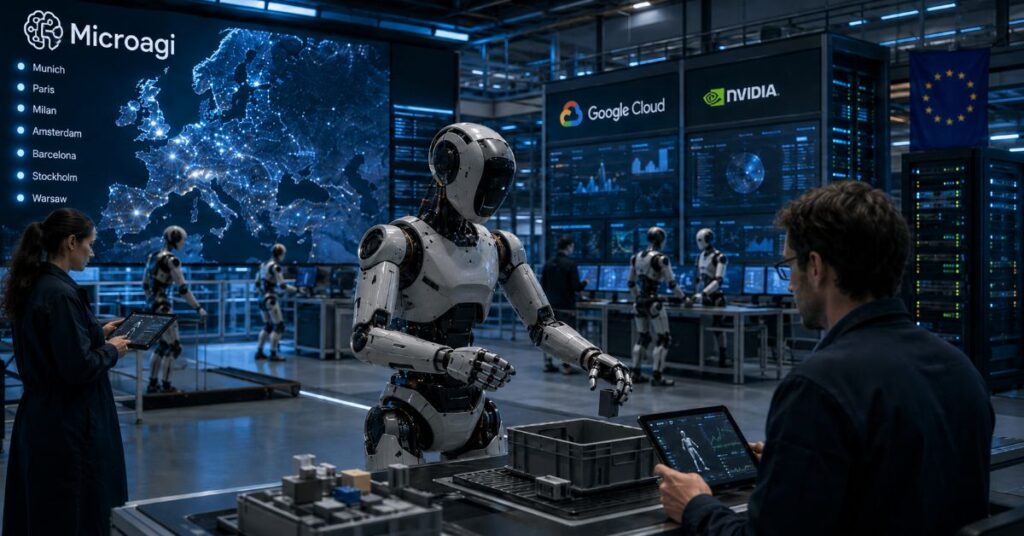
Teaching a robot to pour a glass of water is harder than teaching a large language model to describe the process. The robot has to perceive a physical environment in three dimensions, understand where the glass is, plan a sequence of motor actions to grasp and tilt the bottle, and execute that plan in real time while receiving continuous feedback from sensors. The training data required for that learning is not text on the internet — it is physical footage of the action, captured in real-world environments, at scale across dozens of variation conditions. Getting enough of it is the central bottleneck in embodied AI development. Microagi was built to solve that bottleneck. Google Cloud and NVIDIA are now backing it to do so at scale.
On July 22, 2026, the Munich-based AI startup announced a strategic collaboration with Google Cloud, using NVIDIA Blackwell platform GPU infrastructure to accelerate the training of task-specific embodied AI models for humanoid and commercial robotic platforms. The deal follows a $55 million seed funding round that positioned Microagi as one of Europe’s fastest-growing AI startups, and confirms a model for how European robotics AI companies are beginning to access the compute density previously available only to US-headquartered AI labs.
Key Developments
- Munich-based Microagi announced a strategic collaboration with Google Cloud on July 22, 2026, to accelerate the development of embodied AI models for humanoid and commercial robots using NVIDIA Blackwell platform GPUs.
- Microagi collects real-world training footage across more than a dozen countries and trains task-specific AI models for individual robotic platforms. Its technology already supports industry leaders including Unitree and UBTECH.
- The deal follows Microagi’s $55 million seed funding round. Google Cloud is not receiving Microagi’s training data or customer data in return for the compute access — the arrangement is compute-for-infrastructure, not data-for-compute.
- Google Cloud VP Marianne Janik described the partnership as an “ecosystem play,” with Google positioning itself as the infrastructure backbone for the European embodied AI and robotics sector rather than a direct participant in robot development.
What Was Announced
Microagi and Google Cloud jointly released the announcement via a PRNewswire press release from Sunnyvale and Munich simultaneously on July 22, 2026. Under the collaboration, Microagi will access Google Cloud’s advanced AI stack and NVIDIA Blackwell platform GPUs to scale its model training workloads — the compute-intensive process of converting real-world robot footage into trained task models. Bercan Kilic, Microagi’s founder, described the compute requirement as a ‘massive model inference pipeline’ that demanded a partner capable of supporting it at scale. Itxaso Araque, Director for Digital Natives and Startups in EMEA North at Google Cloud, confirmed that Google Cloud’s AI stack was designed to power complex, multimodal data pipelines like Microagi’s. Marianne Janik, Google Cloud’s VP for northern Europe, told Semafor in a separate interview that the partnership is an ‘ecosystem play’ — Google is not building robots or training models itself, but positioning its infrastructure as the backbone the European robotics AI ecosystem runs on.
One element of the deal that Semafor reported and that distinguishes it from some other cloud AI partnerships: Google Cloud is not receiving Microagi’s training data or its customers’ data in return for compute access. The arrangement is infrastructure-for-fee rather than data-for-compute, a distinction that matters both commercially and under EU data sovereignty and GDPR frameworks that apply to how a European company’s training data can be processed and shared.
What Microagi Does
The Physical Data Collection Problem
Embodied AI models — AI systems that control physical agents like robots in real-world environments — require a fundamentally different training data pipeline than language or image models. Language models learn from text; image models learn from photographs and videos. Embodied AI models learn from physical interaction data: footage of objects being manipulated, environments being navigated, and tasks being completed by humans or earlier-generation robots in real conditions. That data is expensive to generate, slow to collect, highly variable across environments and task types, and not available on the internet in anything like the quantity that text or image data is. Building a large, diverse, high-quality physical interaction dataset is an engineering and logistics challenge as much as a machine learning challenge. Microagi’s business model is built around solving that challenge as a service: the company collects real-world training footage across more than a dozen countries, curates and annotates it, and uses it to train task-specific models for individual robotic platforms.
Task-Specific Rather Than Generalist
Microagi’s approach is deliberate about scope. Rather than attempting to train a single generalist robot model that can handle any task in any environment — the ambition of several US-headquartered robotics AI companies — Microagi trains task-specific models: a model that is optimised for sorting parts on a manufacturing line, or placing items on a retail shelf, or navigating a specific type of facility layout. Task-specific models train faster, require less compute, fail more predictably, and can be validated against a tighter set of performance criteria than generalist models. They are also easier to certify for industrial use under EU machinery and safety regulations, which impose requirements on industrial robots that are stricter than those that apply to consumer devices. Microagi’s existing customers Unitree and UBTECH — two of the most commercially active humanoid robot manufacturers globally — validate that there is real demand for this task-specific model supply even from companies building general-purpose robotic hardware.
Why Google Cloud and NVIDIA Are Backing European Robotics
The Ecosystem Strategy
Google Cloud’s ‘ecosystem play’ framing from VP Janik is the key to understanding why this partnership works the way it does. Google is not attempting to compete with Microagi in embodied AI model development, and Microagi is not attempting to compete with Google Cloud in infrastructure. The arrangement is complementary: Microagi has the physical data, the task model expertise, and the robotics industry relationships; Google has the compute infrastructure, the GPU supply chain relationships through its partnership with NVIDIA, and the cloud platform that allows Microagi to scale training workloads without building and managing its own GPU clusters. Backing an emerging European robotics AI company with compute access is also a customer acquisition strategy for Google Cloud’s European enterprise business: the factory operators and logistics companies that deploy Microagi-trained robot models are Google Cloud potential customers for the broader AI and cloud services those operations require. The context is directly relevant to the broader pattern of NVIDIA’s infrastructure partnerships across Asian and European manufacturing hubs, where the same logic applies: NVIDIA and its cloud partners are positioning their hardware as the essential compute layer beneath the AI applications being built in each region’s industrial sector.
NVIDIA Blackwell as the Backbone
The NVIDIA Blackwell platform underpinning the Google Cloud deployment is the specific hardware generation that makes large-scale embodied AI model training economically feasible for a company of Microagi’s size. Blackwell’s GB200 and GB300 configurations deliver dramatically higher compute density than the prior Hopper generation, particularly for the multi-modal training workloads that embodied AI requires — processing camera feeds, depth sensor data, force-torque sensor readings, and proprioceptive feedback simultaneously during training. Google Cloud’s plan to be among the first cloud providers to offer NVIDIA Vera Rubin NVL72 rack-scale systems in the second half of 2026 positions Microagi for a further hardware upgrade as that generation becomes available through the partnership.
The Broader Embodied AI Landscape
Microagi’s partnership announcement arrives alongside a broad surge in physical AI investment and deployment globally. NVIDIA held a dedicated robotics press conference in Tokyo on July 16, 2026, where Jensen Huang appeared alongside the CEOs of FANUC, Yaskawa Electric, and Kawasaki Heavy Industries to announce deepened physical AI partnerships across Japan’s industrial robotics sector. Figure AI, Apptronik, Boston Dynamics, and 1X Technologies have each raised significant capital in 2025 and 2026 for humanoid robot development in the United States. The European robotics sector, while home to strong industrial robot manufacturers, has historically lagged in AI-native robotics development. Microagi’s $55 million seed round and now its Google Cloud partnership represent a meaningful step toward closing that gap. The intersection of embodied AI with agentic AI on mobile and edge devices is also worth noting: the perception, reasoning, and action loops that agentic AI on edge devices requires share architectural principles with the embodied AI models Microagi is training, and progress in one domain tends to accelerate the other as tooling, model architectures, and training frameworks mature.
The Data Sovereignty Dimension
For a European AI company training models on physical footage collected across more than a dozen countries and processed on US cloud infrastructure, the data governance architecture of the partnership matters commercially and legally. The confirmed structure — Google Cloud provides compute, Microagi retains its data and the data of its robot manufacturer customers — is directly relevant to EU AI Act and GDPR compliance. Under GDPR, training data involving footage collected in European environments and potentially capturing individuals in the frame must meet specific handling and processing standards. Under the EU AI Act, AI systems used to control robots in industrial environments are likely to be classified as high-risk, imposing documentation, audit, and human oversight requirements on the models Microagi trains. Building the partnership architecture so that Microagi retains data control reduces the legal complexity of demonstrating compliance with both frameworks, compared to an arrangement where training data flowed to Google’s infrastructure without contractual restrictions on use.
What Happens Next
The immediate operational next step is deploying the Google Cloud and NVIDIA Blackwell infrastructure for Microagi’s training pipelines. The company has not published a timeline for the next model release or for expanding its manufacturer customer base beyond Unitree and UBTECH, but the access to large-scale Blackwell compute through Google Cloud is a significant acceleration of its training capacity relative to what a $55 million seed-stage company could acquire independently. The partnership will be most consequential if it allows Microagi to expand its physical data collection programme across more task types and more geographies, generating the breadth of training data that task-specific model quality ultimately depends on.
Why It Matters
The Microagi-Google Cloud-NVIDIA partnership matters for the European AI ecosystem at least as much as for the robotics sector specifically. It demonstrates that a European AI startup working on a computationally demanding frontier AI application can access tier-one US cloud infrastructure on terms that preserve European data sovereignty, without relocating to the United States or structuring the business around US-centric partnerships. Google’s ‘ecosystem play’ framing, if successful across multiple European AI verticals, positions Google Cloud as the preferred infrastructure partner for the European AI industry — a commercially significant outcome that is distinct from and complementary to the European Commission’s own AI infrastructure investments through the AI Factories programme. For Microagi specifically, the partnership is a credibility signal as much as a compute contract: Google Cloud and NVIDIA don’t make ecosystem investments in companies they don’t believe will reach significant scale.
Sources
PRNewswire (Microagi/Google Cloud joint press release), July 22, 2026. Semafor, July 21, 2026 (Marianne Janik interview). Google Cloud blog, NVIDIA GTC 2026 partnership update, March 2026.
