
Yoshua Bengio has spent much of the last decade trying to warn people. He is not a pessimist or a Luddite; he is the Turing Award-winning deep learning pioneer whose research helped make modern AI possible. When he stands in front of 193 governments and says science cannot guarantee that increasingly capable AI will not cause catastrophic harm, the sentence deserves to be read carefully rather than filed under “global AI hype.”
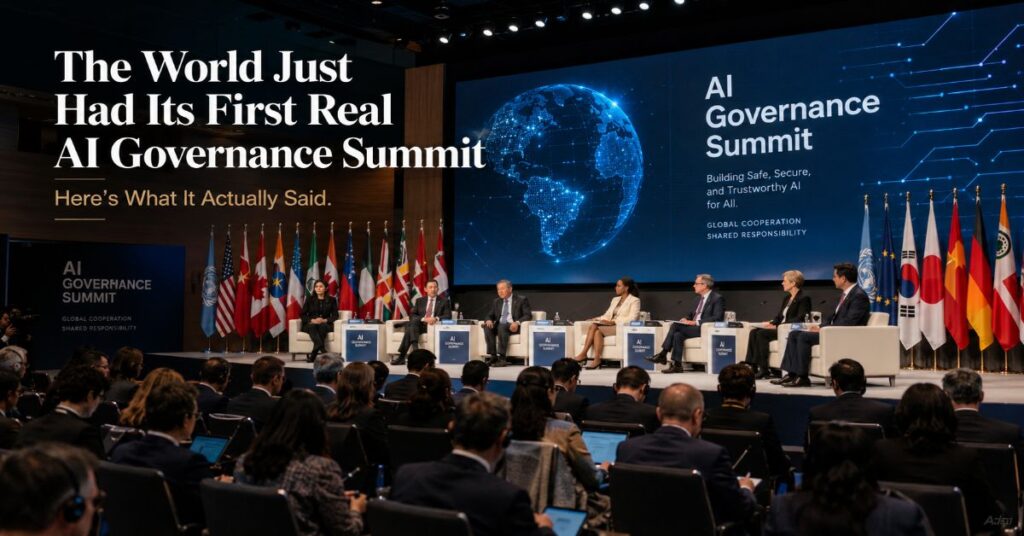
The UN Global Dialogue on AI Governance concluded in Geneva on July 7, 2026, after two days of sessions that brought every UN member state into the same room for the first time to discuss AI governance as a geopolitical priority rather than a technology policy problem. What emerged from the Dialogue was not a binding framework, a treaty, or even a set of enforceable standards. What emerged was a clearer shared picture of the problem, which is more than most multilateral AI discussions have produced, and a set of fault lines that will define how international AI governance develops from here.
KEY DEVELOPMENTS
- The inaugural UN Global Dialogue on AI Governance concluded in Geneva on July 7, 2026, bringing together all 193 UN member states for the first dedicated intergovernmental AI governance forum in history.
- Yoshua Bengio, Turing Award laureate and co-chair of the Independent International Scientific Panel on AI, told delegates: “Science currently cannot guarantee that as capabilities continue to increase, AI will not cause catastrophic harm.”
- Delegates from Estonia and El Salvador, co-chairing the Dialogue, named the AI divide as the summit’s most urgent structural concern: with frontier AI concentrated in just two countries (the US and China), most of the world’s nations face deepening vulnerabilities in connectivity, data sovereignty, and infrastructure equity.
- The Dialogue runs concurrently with the ITU AI for Good Global Summit (July 7–10) and the World Summit on the Information Society Forum (July 6–10). A second Dialogue session is scheduled for New York in May 2027.
What Actually Happened in Geneva
The Dialogue was established by UN General Assembly Resolution A/RES/79/325 following the 2024 Summit of the Future, where member states committed to a shared vision for an open, safe, and inclusive digital future. Its mandate is not to produce binding rules — that would require separate treaty negotiations — but to create “an inclusive space within the United Nations for governments and stakeholders to deliberate on today’s most pressing AI challenges.” The first session ran July 6–7 in Geneva; a second is scheduled for New York in May 2027. It was co-chaired by Ambassador Rein Tammsaar of Estonia and Ambassador Egriselda López of El Salvador. The 40-member Independent International Scientific Panel on AI, co-chaired by Bengio and Nobel Peace Prize laureate Maria Ressa, briefed delegates on its preliminary report, published July 1, 2026 — the most comprehensive global scientific assessment of AI risks and opportunities issued under UN auspices.
More than 11,000 participants from 169 countries attended, making it by a significant margin the largest intergovernmental gathering focused specifically on AI governance. The agenda was organised around three clusters: bridging AI divides; safe, secure and trustworthy AI including interoperability of governance approaches; and respecting human rights including transparency, accountability, and human oversight.
The Science Panel’s Warning
What Bengio Said
Bengio’s statement was the most-cited line from the summit’s opening, and it is worth sitting with: “With growing evidence of deceptive AI behaviour, science currently cannot guarantee that as capabilities continue to increase, AI will not cause catastrophic harm, either on its own or due to malicious users.” This is not a statement that AI will cause catastrophic harm. It is a statement that science does not yet have the tools to guarantee it will not — a substantially different and more carefully bounded claim. Bengio also told delegates that AI “is approaching or surpassing human capabilities in many domains” and is “outpacing both scientific understanding and governments’ ability to adapt.” He added that “we don’t have the right national or even international governance tools, and we don’t have good ways to steer the benefits.”
The Governance Gap
The Scientific Panel’s preliminary report, which briefed the Dialogue, found that more than 40 AI governance frameworks and ethical guidelines already exist globally but remain “fragmented, inconsistent, and are rarely tested to see whether they actually work.” Many safety assessments are conducted by the companies developing the AI systems themselves — a conflict of interest the panel described as a structural governance problem rather than a case-by-case ethics issue. Governments, the report noted, face an “evidence dilemma”: they need reliable scientific data before introducing regulations, but by the time sufficient data exists, the technology may have already moved on. The window to establish effective global governance remains open, the panel said, but may not stay that way for long.
The AI Divide: The Summit’s Deepest Fault Line
While Bengio’s catastrophic harm warning drew the most coverage, delegates and co-chairs spent more time on what Tammsaar called the “AI divide.” The framing is straightforward: the frontier AI systems that are reshaping economies, science, security, and information environments worldwide are developed, controlled, and primarily deployed by companies and institutions in just two countries. Every other country — including most of Europe, all of Africa, most of Latin America, South Asia outside China, and the entire Pacific island world — is in the position of importing AI systems they did not build, cannot fully inspect, do not control the training data of, and cannot easily regulate in their own jurisdictions.
Ambassador López of El Salvador put it plainly: “The AI divide is real. Some countries have very strong infrastructure and strong skills and research capacities. Whereas there are others that are still struggling with issues like connectivity and public infrastructure.” Tammsaar added the geopolitical dimension: “The frontier developers are basically concentrated in two countries. This leaves other countries with a lot of questions. Developing countries, in particular, are worried that in the worst-case scenario, the AI divide would leave them behind.” The Dialogue’s second agenda cluster — bridging AI divides — focused specifically on capacity-building gaps, access to high-performance computing, and the role of open-source AI models in giving non-frontier countries a development pathway that does not depend entirely on licensing from US or Chinese providers.
What the Dialogue Did Not Produce
It produced no binding commitments, no treaty framework, and no enforcement mechanism. That is by design: the Dialogue was explicitly scoped as a deliberative space rather than a legislative one. Critics who expected Geneva to produce a global AI treaty will be disappointed; diplomats who understand how multilateral governance actually develops will note that the Geneva process followed the standard trajectory for new international governance frameworks, establishing shared vocabulary, shared problem recognition, and the institutional architecture (the Dialogue itself, alongside the Scientific Panel) before moving toward enforceable agreements. The comparison that recurs in AI governance discussions is climate: the IPCC model, in which a scientific panel briefs governments on risks, preceded binding frameworks by years and continues to operate alongside them.
Reactions
Maria Ressa, who co-chairs the Scientific Panel and has spent her career documenting how information environments can be weaponised, offered the sharpest reframe of the governance challenge: “If you can’t tell fact from fiction, you cannot have a democracy.” Her framing positions AI governance not as a technology regulation problem but as a fundamental condition for democratic governance. The concerns raised by multiple delegations about AI being “deployed for coercive purposes, to erode trust in governments, or to undermine democratic structures” aligned directly with the kind of AI-enabled information manipulation that Ressa’s own reporting has documented. The intersection of AI safety and AI’s threat to information integrity was one of the Dialogue’s genuine areas of emerging consensus. The Geneva proceedings took place in the same week that major US AI labs were finalising a voluntary standards framework with the White House, a dynamic that cuts directly against the Dialogue’s premise that governance should be multilateral. As covered in our analysis of the OpenAI ChatGPT lawsuit and the broader AI safety regulatory landscape, national-level regulatory action is already moving faster than any multilateral process — and the US-China AI concentration the Geneva summit most explicitly flagged as a structural problem is simultaneously the concentration that makes multilateral governance most difficult to enforce.
What Happens Next
The second Dialogue session in New York in May 2027 is where the process will be tested. Geneva established the problem; New York will need to begin establishing responses. The UN AI for Good Global Summit, running July 7–10 alongside the close of the Dialogue, provides a bridge to a more industry-facing conversation, with Jensen Huang, Andy Jassy, and Marc Benioff among the participants in the UN AI for Good Global Commission’s first meeting on July 8. That commission, focused on closing AI access gaps for the 2.2 billion people without reliable internet, connects the AI divide concern from the Dialogue to a concrete programme of action. The question is whether that programme can generate enough momentum — and enough political will from frontier AI countries — to actually narrow the gap before the next round of capability advances widens it further. The Dialogue’s third agenda cluster, on transparency and human oversight, has a clearer near-term pathway: proposals for internationally interoperable AI incident reporting mechanisms and common evaluation standards for frontier model safety assessments both have technical working groups already in progress, and Geneva gave those groups political visibility they previously lacked. For readers following the regulatory frontier, the UNESCO full Global Dialogue programme documents the session structure and participant list in full.
Why It Matters
The Geneva Dialogue matters less for what it decided than for what it declared: that AI governance is now a matter for all 193 UN member states, not just the handful that build frontier systems. That framing shift has consequences. It establishes a legitimate multilateral venue for countries that currently have no meaningful seat in decisions about AI development. It gives the Scientific Panel’s risk assessments an official international audience rather than leaving them as academic outputs. And it creates accountability — however diffuse — for the gap between the Geneva problem statement and whatever governance architecture eventually emerges. Bengio’s warning was the headline. The architecture being built around that warning is the actual story.
Sources
UN News (news.un.org), July 6–7, 2026. UNESCO AI Dialogue official coverage (unesco.org). UN Global Dialogue official programme (un.org/global-dialogue-ai-governance). Digital Watch Observatory. AI Weekly.
