
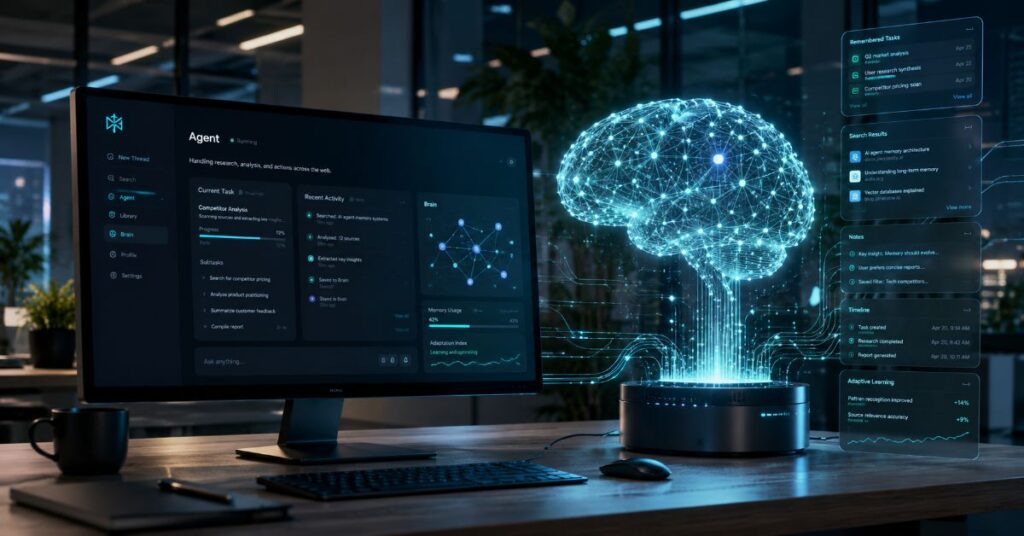
Most AI memory features are built to remember you — your name, your writing style, the fact that you prefer bullet points. Perplexity’s newest feature is built to remember something else entirely: what the AI itself got wrong last time, so it doesn’t do it again.
Perplexity launched Brain on June 18, a self-improving memory system for its agentic product Computer that builds what the company calls a living context graph of an agent’s past work — sessions, connected tools, files, decisions, and sources — and synthesizes that graph overnight into a refreshed working model the agent loads before its next task. Perplexity says early internal testing shows Brain improves task correctness by 25 percent, recall by 16 percent, and cuts the cost of context-heavy work by 13 percent on tasks that benefit from historical context.
The framing matters as much as the feature. Perplexity is explicitly positioning Brain’s memory as being about the agent’s performance, not the user’s preferences — a distinction the company calls the most important purpose memory can serve, and one that sets Brain apart from the personalization-focused memory features most competing AI products have shipped so far.
Key Developments
- Perplexity launched Brain on June 18, 2026, a self-improving memory system for its Computer agent that builds a context graph of past sessions, files, sources, and corrections.
- Brain synthesizes that graph overnight into an automatically updated “LLM wiki” that loads into Computer’s sandbox before each new task.
- Perplexity’s own first-party testing shows a 25% improvement in task correctness, 16% better recall, and a 13% cost reduction on tasks requiring historical context.
- Brain is rolling out in Research Preview to Perplexity Max ($200/month) and Enterprise Max subscribers, with memory controls accessible under “Customize.”
What Happened
According to Perplexity’s own Help Center documentation, Brain runs continuously in the background, reviewing recent activity from a user’s sessions, connector updates, files and artifacts created in Computer, and any corrections the user has made. It writes what it learns into Computer’s memory, with every entry linked back to the specific session, file, or source it came from, so users can review, verify, or delete any individual memory. The company says the same AI-based filtering used in its existing Search Memory feature is applied to Brain to reduce the chance that sensitive details such as credentials or passwords end up stored.
The context layer itself takes the form of what Perplexity calls an LLM wiki — a structured set of pages reflecting the people, projects, and ideas in a user’s work, automatically loaded onto the agent’s sandbox at the start of each new task. Rather than updating in real time, Brain refreshes this wiki at set intervals, by default overnight, synthesizing everything Computer learned during the prior day’s sessions into an incrementally better starting context for the next one.
Brain is rolling out today in Research Preview, available to Perplexity Max subscribers using Computer, with Enterprise Max access following. Perplexity has not published a public API for Brain and says additional capabilities will be announced later.
The Mechanism: Work Memory Instead of User Memory
The distinction Perplexity is drawing has real technical consequences for how the system behaves. A conventional AI memory feature stores facts about the user — their job, their tone preferences, their recurring instructions — and its purpose is largely about engagement: making the assistant feel more personalized and the interaction more comfortable. Brain instead stores facts about outcomes: which sources the agent relied on that turned out to be reliable, which connector queries led to dead ends, what specific correction a user made to a piece of agent output, and why. Its purpose, in Perplexity’s own framing, is performance rather than comfort.
That shift changes what the system actually gets better at over time. A user-preference memory makes an assistant feel more tailored to you on day one and stays roughly that useful afterward. A work-outcome memory compounds: every task Computer completes adds another data point about what worked, which means the agent’s effective competence on recurring categories of work — a weekly research pipeline, a recurring support-ticket triage flow, a familiar codebase — should, in theory, keep improving the longer a given user or team relies on it. Perplexity’s own examples lean directly into this: a data scientist running a weekly pipeline audit benefits from Brain remembering which sources were reliable last time; a support team triaging tickets through connectors benefits from Brain learning which sources resolved past tickets fastest.
The Backstory
Brain is an extension of, not a replacement for, Perplexity Computer, the agentic product the company launched on February 25 as what chief executive Aravind Srinivas called a “general-purpose digital worker” capable of orchestrating up to 19 specialized AI models to handle research, coding, design, and deployment tasks end-to-end. Perplexity’s monthly query volume has grown sharply since that launch, as Computer assignments — each of which can trigger many internal searches, model calls, and tool operations — have replaced a meaningful share of what used to be single, simple Pro Search queries.
Computer’s launch was followed almost immediately by a steep revenue inflection: Perplexity’s annualized recurring revenue jumped 50 percent in a single month to more than $450 million in March, a surge the company and outside reporting both tied directly to Computer’s adoption and a parallel shift to usage-based pricing on its premium tiers. By April, third-party estimates put Perplexity’s ARR at roughly $500 million, up 335 percent year-over-year, with the company’s overall growth and valuation trajectory now resting heavily on agentic products rather than the citation-based search experience that built its early reputation. Brain arrives as the next layer on top of that bet: having gotten users to pay $200 a month for an agent that can do real work, the company’s next problem is making that agent’s output reliable and cheap enough to keep them paying.
Memory-as-infrastructure is also not a problem unique to Perplexity, and Perplexity’s ownership and funding history shows a company that has consistently moved fast to commercialize whatever capability the broader AI ecosystem proves out next. Open-source agent frameworks including OpenClaw and Nous Research’s Hermes have been building comparable persistent-memory systems for months, using markdown files, vector databases, and explicit reliability tagging to let agents carry context across sessions. Brain brings a version of that same idea to a mainstream subscription product rather than a developer tool — the company’s familiar pattern of taking a niche technical capability and packaging it for a much larger paying audience.
Reactions
Perplexity’s own announcement leaned on the reframing of memory’s purpose: “With Brain, Computer starts each task with full context of your projects, decisions, and sources instead of from scratch,” the company said, adding that “every memory links back to the session, file, or source it came from with full transparency and control.”
Early outside coverage has been broadly favorable but careful to flag that the headline performance numbers are entirely first-party. Decrypt’s technology desk noted plainly that the 25 percent correctness, 16 percent recall, and 13 percent cost figures are “internal numbers, not third-party benchmarks,” while still calling the underlying logic sound: an agent that already knows which sources failed last week should waste less effort rediscovering that fact. Industry newsletter AI Weekly drew a similar conclusion, framing Brain’s user-memory-versus-work-memory distinction as “a more honest account of what enterprise teams actually need from an autonomous agent” while explicitly flagging that no independent validation of the performance claims has yet been published.
The Dispute: Whose Memory Is It, and What Happens to Cross-Domain Tasks
Brain’s biggest unresolved limitation, by Perplexity’s own design, is that it does not generalize across unrelated domains. Lessons Brain learns helping a user with financial research do not transfer to helping the same user debug code, even though both might run through the same Computer account — cross-domain generalization is a problem the company has not claimed to solve, and the context graph effectively functions as a set of separate, domain-bound performance logs rather than a single unified intelligence about the user’s work.
There is also a control question Brain raises that competing approaches answer differently. Brain’s context graph, LLM wiki, and full session history live entirely on Perplexity’s own infrastructure; users get visibility and the ability to review or delete individual entries, but not ownership or portability of the underlying memory store. That stands in contrast to local-first alternatives such as OpenClaw’s memory plugins, which keep the equivalent context store on hardware the user controls. For individuals or organizations with strict data-sovereignty requirements, that distinction — transparency without portability — may matter more in practice than the headline performance numbers Perplexity is leading with.
What Happens Next
Brain’s Research Preview status means its current behavior, scope, and the 25/16/13 percent figures should all be read as a snapshot of an early rollout rather than a finished product. Perplexity has said more Brain capabilities will be announced later without specifying a timeline, and the most consequential near-term question is whether the company publishes independent or third-party-verified performance data once Brain moves beyond preview — something none of the early coverage of this launch has been able to confirm one way or the other.
Why It Matters
Brain is a bet that the next competitive axis in AI agents will not be which underlying model is smartest in isolation, but which agent platform accumulates the most useful, work-specific memory the fastest. If that bet is right, it creates a meaningful lock-in dynamic: a Computer instance that has spent six months learning a specific team’s sources, workflows, and corrections becomes harder to walk away from than a generic chatbot subscription, regardless of how the underlying frontier models compare at any given moment. For an industry still arguing over whether model capability or product experience will determine who wins the AI agent race, Brain is Perplexity’s clearest statement yet that it is betting on the latter — and on memory specifically as the mechanism that makes switching costly.
Sources
Perplexity Help Center; MarkTechPost; Decrypt; AI Weekly; Yahoo Tech; VentureBeat.
