
The conventional fear about AI and jobs is that the companies leaning into it hardest will need fewer people. PwC’s newest data says the opposite is happening — for now, and for one specific kind of company.
PwC released its 2026 Global AI Jobs Barometer on June 15, an annual report analyzing more than one billion job advertisements across 27 countries and territories. The headline finding: the top fifth of AI-exposed companies grew their workforces 52 percent since 2018, compared with 36 percent at the least AI-exposed companies, even as that same top tier posted average labor productivity growth of 163 percent over the same period — nearly five times the rate of AI-exposed companies overall.
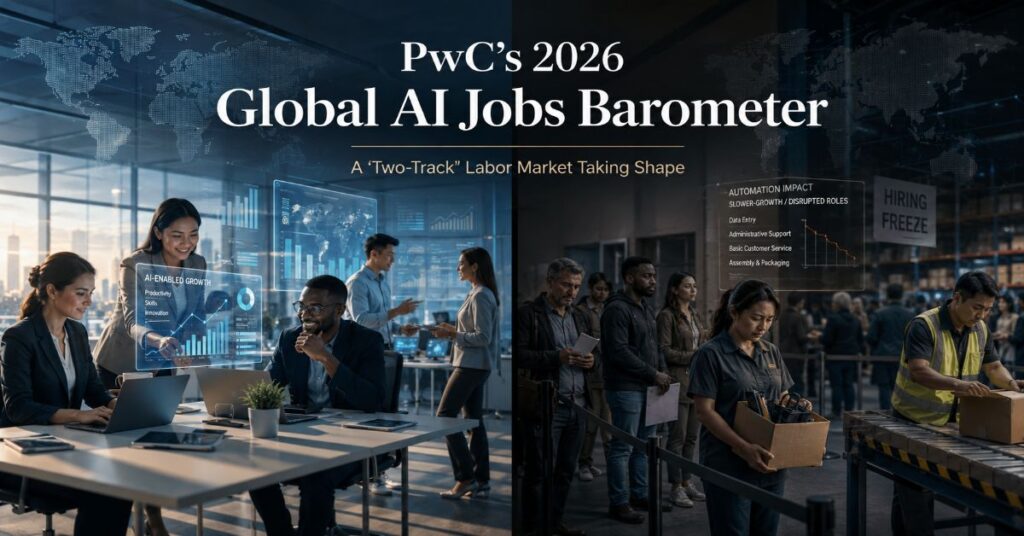
The report’s larger argument is that AI is splitting the labor market into two tracks: one where AI mostly automates routine work, and a faster-growing one where it amplifies human judgment and pays a steep premium for the people who can wield it.
Key Developments
- PwC released its 2026 Global AI Jobs Barometer on June 15, 2026, analyzing more than one billion job ads across 27 countries and territories.
- The top 20% of AI-exposed companies posted 163% productivity growth since 2018 — nearly 5x the average — while also growing headcount faster (52% vs 36%) than the least AI-exposed companies.
- The wage premium for AI skills rose to 62%, up from 57% last year; AI-skill job postings are growing 69% versus 9% for the overall jobs market.
- US entry-level roles most exposed to AI are now 7x more likely to require senior “human-intensive” skills like leadership and judgment, growing 35% since 2019 while other entry-level roles fell 10%.
What Happened
The Barometer combines large-scale labor-market data, company financial reports, and occupational task analysis to track how AI is reshaping jobs, skills, wages, and productivity. Its central framework divides roles into “professionalised” jobs — such as radiologists or recruiters, where AI automates routine tasks so human judgement and expertise become more valuable — and “democratised” jobs, such as IT service managers or medical secretaries, where AI makes the role itself easier for non-experts to perform. Professionalised roles are growing job availability twice as fast as democratised ones, with 42 percent faster wage growth.
This year’s edition added a targeted look at entry-level hiring. Analyzing 2.4 million entry-level US job postings, PwC found that roles most exposed to AI are seven times more likely to demand traditionally senior skills — leadership, creativity, complex judgement — from junior candidates than less AI-exposed entry-level roles, and that demand for these “seniorised” junior positions has grown 35 percent since 2019, even as other entry-level postings declined 10 percent over the same period.
The Mechanism: A ‘Super-Star’ Effect, Not a Uniform One
PwC’s data points to a widening gap rather than a uniform AI productivity boost. The report describes a pronounced “super-star” effect in which the most AI-exposed companies overall see real but modest productivity gains, while the top fifth within that group — the companies that have most effectively put AI to work — pull dramatically further ahead. That distinction matters because it means most of the eye-catching 163 percent productivity figure is concentrated in a relatively small number of companies that have figured out how to convert AI exposure into output, rather than describing what AI is doing for the typical business.
It also helps explain why productivity and headcount are rising together in this group rather than trading off against each other, as a simple automation narrative would predict: AI in these companies appears to be functioning more as a force multiplier for existing expertise — augmentation rather than straightforward replacement — which expands what a given employee can do rather than reducing how many employees a company needs.
The Backstory
This year’s Barometer shows the underlying trend accelerating rather than emerging from nothing. PwC’s 2025 edition, released a year earlier, found the average wage premium for AI skills at 57 percent and productivity growth in the most AI-exposed industries climbing from 7 percent to 27 percent across 2018–2024. A year on, the wage premium has risen further to 62 percent, and the productivity gap between the most and least AI-exposed companies has widened again — evidence, PwC argues, that this is a compounding structural shift rather than a one-time adjustment.
The findings also sit alongside a broader run of 2026 labor-market data on AI’s effect on hiring, including the Linux Foundation’s report on AI driving a 27 percent hiring increase across European tech roles and Microsoft’s own global AI diffusion research, both of which similarly describe AI adoption correlating with workforce growth rather than contraction in the regions and roles they studied — even as separate reporting on AI talent movement at the research-lab level tells a more turbulent story about where specialized AI talent itself is choosing to work.
Reactions
Joe Atkinson, PwC’s Global Chief AI Officer, described the findings as evidence of “a new divide” opening in the labor market, with companies that use AI to amplify human expertise outperforming those focused primarily on automation — and with demand for leadership, judgement, and creativity continuing to climb across the workforce as a result.
The Dispute: What the Averages Hide
PwC’s national and global aggregates describe an encouraging overall picture, but reporting at the industry level complicates that optimism. Speaking to Insurance Business magazine this week, MIT economist David Autor was blunt about which workers he believes are most at risk: “routine information-processing roles — adjusting insurance claims, translating documents, writing standard ad copy — face genuine displacement risk,” he said, naming insurance claims adjustment specifically rather than offering it as a generic example.
US insurance-sector hiring data backs up that concern more than PwC’s topline framing suggests: job openings in finance and insurance fell to their lowest monthly level in a decade by December 2025, dropping from an annual average of roughly 281,000 to about 138,000 openings in a single month, according to the Q1 2026 Insurance Labor Market Study from the Jacobson Group and Aon. PwC’s own “professionalised versus democratised” framework actually predicts this outcome — claims adjustment is a textbook democratised role — but the report’s headline numbers, dominated by super-star companies and aggregate national trends, can obscure just how sharply the experience differs depending on which side of that divide a given worker’s job happens to sit.
What Happens Next
PwC has signaled it will continue tracking the Barometer annually, which means the clearest test of this year’s findings will be whether the gap between professionalised and democratised roles keeps widening in the 2027 edition, or whether democratised-role hiring stabilizes once companies finish the current wave of AI-driven restructuring. Watch in particular whether other sectors begin showing the same kind of hiring pullback already visible in US insurance, which would suggest the aggregate growth figures are masking a faster unwind in specific job categories than the national numbers currently show.
Why It Matters
With more than a billion job ads analyzed across 27 countries, this is among the largest empirical datasets available on how AI is actually reshaping employment, rather than how executives or commentators predict it will. Its core finding — that AI is simultaneously a net job creator at the top tier of adopters and a genuine displacement risk for specific categories of routine, information-processing work — is a more complicated story than either the AI-will-create-abundance or AI-will-destroy-jobs narratives that have dominated public debate, and it carries direct implications for how companies design entry-level hiring and how workers in exposed roles plan their own skill development.
Sources
PwC; Insurance Business Magazine; EME Outlook Magazine; PwC Ireland press release.
