
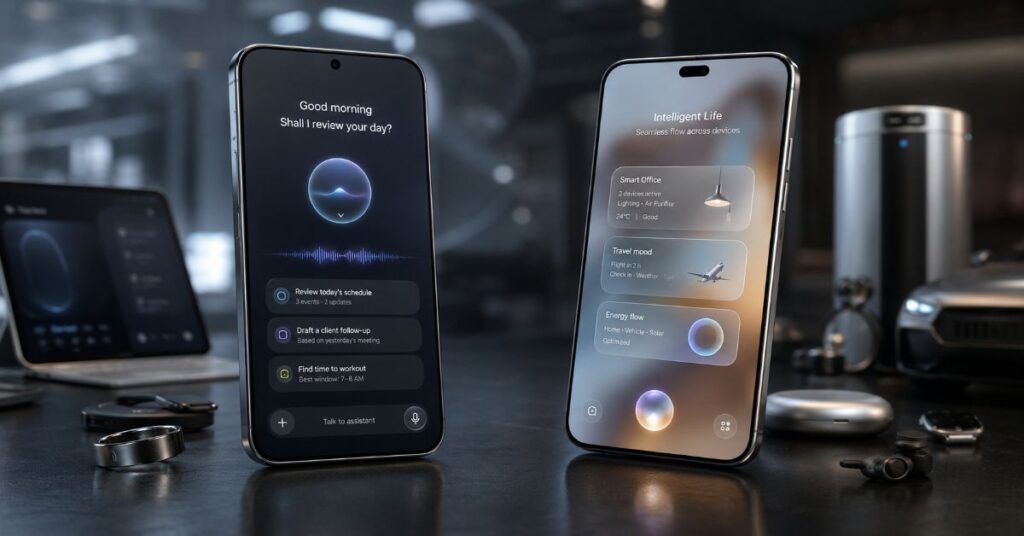
Two separate developments this month point toward the same shift: smartphone makers are betting that AI agents, not app grids, will define the next generation of mobile operating systems. OpenAI is reportedly developing a phone built around agents instead of apps, while Huawei has already shipped an agent-native operating system update to developers in China.
OpenAI’s Reported Phone: Replacing Apps With Agents
According to Apple supply-chain analyst Ming-Chi Kuo, OpenAI is working with Qualcomm and MediaTek to co-develop a custom AI-native processor, with Luxshare, an existing iPhone assembly partner, serving as exclusive manufacturer. Rather than a home screen of app icons, the reported interface would center on a live panel of AI-driven activity, where an agent completes tasks like booking flights or compiling information directly, without the user switching between separate apps.
Kuo projects the device could ship 300 to 400 million units annually if successful, a figure that would exceed current iPhone shipments, with specifications and suppliers expected to be finalized by late 2026 or early 2027 and mass production targeted for 2028. That puts a commercial launch several years away even in the most optimistic timeline.
This phone project is separate from OpenAI’s other hardware bet. The company has confirmed it is on track to announce its first hardware product in the second half of 2026, developed in partnership with former Apple design chief Jony Ive, whose studio io OpenAI acquired for $6.4 billion. Multiple reports suggest that initial device will be a pair of AI-powered earbuds designed to complement, not replace, phones, while the agent-first smartphone remains a separate, longer-horizon project that OpenAI has not officially confirmed.
Huawei’s HarmonyOS 7: The Agent Era, Already Shipping
While OpenAI’s agent-first phone remains a multi-year analyst projection, Huawei has already moved. At its Huawei Developer Conference on June 12, 2026, the company released HarmonyOS 7 to developers, transforming its Xiaoyi assistant into a system-level intelligence agent that controls more than 2,100 system capabilities and coordinates with over 2,000 third-party AI agents built across Huawei’s developer ecosystem.
The new “Intent-as-a-Service” architecture is designed to compress multi-step app navigation into a single natural-language command, with Huawei claiming a task-success rate above 90 percent, a figure the company has not had independently verified. The release is underpinned by openPangu 2.0, Huawei’s updated foundation model, available in 505-billion and 92-billion parameter variants, both supporting 512K context windows; a 30-billion-parameter on-device version is planned for Huawei’s Kirin chips by autumn 2026. Huawei also says the new release delivers 30 to 40 percent better performance and lower memory consumption than rival operating systems, and demonstrated the assistant generating a personalized marathon training plan from a user’s health data and calendar in a single command.
Richard Yu, chairman of Huawei’s Consumer Business Group, framed the release as a generational shift: in 2019, HarmonyOS was born; in 2023, native HarmonyOS apps began; in 2026, HarmonyOS enters the Agent era. The timing matters strategically. HarmonyOS first overtook Apple’s iOS in China’s smartphone operating system market in mid-2025, and as of the first quarter of 2026 held 19 percent of the Chinese market against Apple’s 16 percent, with Android holding the remaining 65 percent.
Huawei’s position has been shaped largely by necessity rather than choice: the company built HarmonyOS independently after losing access to Google’s Android ecosystem under US sanctions in 2019. That forced independence has become a structural advantage in a market where Apple has faced its own regulatory friction deploying advanced AI features in China; HarmonyOS 7 arrived just four days after Apple confirmed that its overhauled Siri would not launch in China.
Why It Matters
Both stories point to the same underlying bet: that the operating system layer, not individual apps, will be where AI agents compete next, and that owning both hardware and software gives a company more control over the data, sensors, and system access an agent needs to work well. Huawei’s live deployment shows the model already shipping at scale in one major market, while OpenAI’s reported phone project, even if it ships as projected in 2028, illustrates how seriously Western AI labs are now taking the idea that the smartphone interface itself, not just the assistant running on top of it, needs to be redesigned around agents.
Sources
TechCrunch; South China Morning Post; The Next Web; Cybernews; TechSpot; Huawei Central.
