
Summary of Major Developments
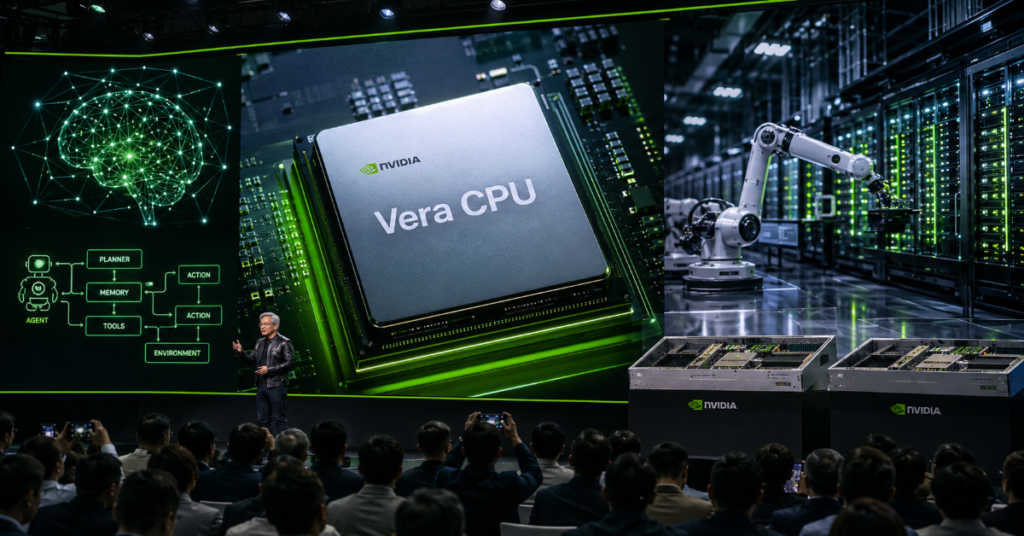
• Vera CPU full production confirmed June 1: Jensen Huang announced during his Computex 2026 keynote on June 1 that NVIDIA’s Vera CPU is now in full production. The announcement was accompanied by NVIDIA’s official newsroom disclosure that Vera Rubin — the integrated Vera CPU and Rubin GPU system — is in full-scale production across more than 350 factories in 30 countries, with 150 NVIDIA supply chain ecosystem partners in Taiwan alone.
• First customers confirmed: Anthropic, OpenAI, SpaceX xAI, Oracle, Dell, CoreWeave: NVIDIA disclosed that the first Vera CPUs were hand-delivered by Ian Buck, NVIDIA’s VP of Hyperscale and High-Performance Computing, to Anthropic in San Francisco, OpenAI in Mission Bay, and SpaceXAI in Palo Alto in the days preceding Computex. Oracle Cloud Infrastructure in Santa Clara received its delivery on Monday. NVIDIA is making ‘millions of CPUs for a market that never existed before,’ Huang stated on stage.
• Performance claim: 80% faster than x86 for agentic AI workloads: NVIDIA claims Vera CPUs complete agentic AI tasks 80% faster than equivalent x86 CPUs from AMD and Intel. Agent sandboxes run 50% faster on Vera than traditional CPUs. The chip delivers agentic AI inference at one-tenth the cost per token compared to GPU-based inference for CPU-bound orchestration workloads, according to NVIDIA’s published performance figures.
Technical Breakdown: What the Vera CPU Is and Why It Exists
NVIDIA’s Vera CPU is the product of a fundamental architectural argument: agentic AI workloads are CPU-bound at the orchestration layer, not GPU-bound. When an AI agent executes a multi-step task — searching the web, calling APIs, reading files, writing code, and synthesising results — the GPU handles the individual token generation passes, but the coordination logic, tool call management, state persistence, and inter-agent communication runs on CPU cores. As agentic workflows scale from single-agent tasks to multi-agent pipelines executing thousands of simultaneous sub-tasks, the CPU orchestration layer becomes the throughput bottleneck. Traditional x86 CPUs — designed for thread-level parallelism in software applications — are not optimised for the high-concurrency, low-latency agent state management pattern that production agentic AI requires.
Vera is NVIDIA’s purpose-built response to this bottleneck. The chip is based on an Arm architecture (NVIDIA’s Grace CPU design, previously used in the GH200 Grace Hopper Superchip for data centres), tuned specifically for the concurrent execution patterns of agentic AI orchestration. The 80% performance advantage over x86 claimed by NVIDIA reflects the specific benchmark set of agent sandbox execution — running hundreds of isolated agent environments simultaneously, each maintaining independent state, tool access, and context windows. In these workloads, Vera’s Arm architecture allows NVIDIA to optimise cache hierarchies, memory access patterns, and core count configurations specifically for concurrent agent state management rather than for general-purpose application execution.
The Vera Rubin system integrates Vera CPU and Rubin GPU into a unified data centre platform. NVIDIA’s official newsroom announced a new Vera CPU rack configuration integrating 256 liquid-cooled Vera CPUs per rack, supporting more than 22,500 concurrent CPU environments each running independently at full performance. At this density, a single rack can manage 22,500 simultaneous AI agent contexts — a scale relevant for enterprise agentic AI deployments where thousands of concurrent agents are executing background tasks for large user populations or automated business processes.
The inference economics claim — one-tenth the cost per token for CPU-bound agentic orchestration versus GPU-based inference — reflects the architectural efficiency of routing orchestration workloads to dedicated CPU silicon rather than consuming expensive GPU compute for tasks that do not require tensor operations. Specifically: tool call management, API routing, context window management, and inter-agent message passing are all CPU operations that consume GPU time unnecessarily when no dedicated CPU alternative is available. Vera allows GPU compute to focus exclusively on token generation while Vera handles orchestration, which improves both GPU utilisation and per-token inference economics.
| Specification / Metric | NVIDIA Vera CPU | Traditional x86 (AMD / Intel) | Advantage |
| Architecture | Arm (Grace design, agentic AI optimised) | x86-64 (general purpose) | NVIDIA: purpose-built for concurrent agent state |
| Agentic task speed | 80% faster than x86 equivalent | Baseline | NVIDIA: 1.8x throughput advantage |
| Agent sandbox speed | 50% faster than traditional CPU | Baseline | NVIDIA: 1.5x concurrent environment throughput |
| Cost per agent token | ~10% of GPU inference cost | N/A (CPU not used for inference typically) | NVIDIA: 10x inference economics for orchestration |
| Concurrent environments (256-CPU rack) | 22,500+ independent agent contexts at full perf. | Varies by workload | NVIDIA: purpose-designed density for agentic scale |
| Memory architecture | Coherent with Rubin GPU via NVLink | Separate CPU and GPU memory pools | NVIDIA: eliminates CPU-GPU data transfer latency |
| First enterprise adopters | Anthropic, OpenAI, SpaceX xAI, Oracle, Dell, CoreWeave | Dominant in all current AI infrastructure | NVIDIA: frontier AI lab validation secured at launch |
| Launch availability | Full production confirmed June 1; customer delivery H2 2026 | Shipping now | Intel/AMD: currently deployed; Vera is future pipeline |
Commercial and Enterprise Market Impact
The Vera CPU’s commercial significance extends beyond its technical specifications. The choice of Anthropic, OpenAI, and SpaceX xAI as first delivery customers is a deliberate signal about the frontier AI market’s infrastructure direction. All three organisations are among the highest-intensity agentic AI compute consumers in the world — OpenAI’s Codex platform alone serves 4 million weekly users generating machine-speed agentic coding sessions; Anthropic’s Claude Code is embedded in production CI/CD pipelines at enterprises spending over $1 million annually; SpaceXAI’s Grok serves both consumer and enterprise AI workloads from the Colossus compute cluster in Memphis. If these three organisations are adopting Vera as their primary CPU for agentic AI infrastructure, the signal to the broader enterprise market is that x86 dominance in the AI factory CPU layer has a credible challenger with frontier-lab validation.
For Intel and AMD, the Vera CPU’s full production announcement is the most significant competitive threat to their data centre CPU businesses since AMD’s EPYC recaptured market share from Intel beginning in 2019. Both companies have been developing their own Arm-based and AI-optimised CPU products — Intel’s Sierra Forest and Clearwater Forest efficiency cores, AMD’s Bergamo cloud-optimised EPYC — but neither has specifically optimised for the agentic AI orchestration workload pattern that Vera targets. NVIDIA’s claim of 80% better agentic task performance and 10x inference economics for orchestration creates a benchmark challenge that will force Intel and AMD to develop direct competitive responses in their next CPU generation roadmaps.
“Vera entering production with Anthropic, OpenAI, and SpaceX as first customers is the most effective commercial launch validation NVIDIA could have constructed. These are not proof-of-concept deployments — these are organisations where every point of CPU throughput improvement translates directly into revenue because their business model charges per token. When OpenAI and Anthropic adopt Vera, they are saying they measured it and it performs.” — Data Centre Infrastructure Analyst, enterprise technology research, June 1, 2026
“The 22,500 concurrent agent environments per Vera CPU rack is the specification that enterprise CIOs should be planning against. Enterprise agentic AI deployments at scale — where thousands of background agents are executing simultaneously for large user populations — require this kind of concurrent orchestration density. Traditional x86 server configurations cannot reach this concurrency at comparable power and cost.” — AI Infrastructure Architect, Fortune 500 enterprise, June 1, 2026
Frequently Asked Questions
What is the NVIDIA Vera CPU and how does it differ from standard data centre CPUs?
The NVIDIA Vera CPU is a purpose-built Arm-based processor designed specifically for agentic AI orchestration workloads. Unlike general-purpose x86 CPUs from Intel and AMD, Vera is optimised for running thousands of concurrent AI agent environments simultaneously — managing agent state, tool calls, API routing, and context windows at machine speed. NVIDIA claims Vera CPUs complete agentic AI tasks 80% faster than equivalent x86 CPUs and enable agent sandboxes to run 50% faster, while reducing per-token inference costs for CPU-bound orchestration workloads by approximately 90% compared to GPU-based inference.
Which companies are the first customers for NVIDIA Vera CPUs?
The first NVIDIA Vera CPUs were delivered by NVIDIA VP Ian Buck to Anthropic (San Francisco), OpenAI (Mission Bay), and SpaceXAI (Palo Alto) in the days before Computex 2026. Oracle Cloud Infrastructure received its delivery on Monday. Additional confirmed early customers include Dell and CoreWeave. NVIDIA stated it is manufacturing ‘millions of CPUs for a market that never existed before’ — referring to the dedicated CPU market for agentic AI orchestration infrastructure.
How does Vera Rubin relate to the Vera CPU announced at Computex?
Vera Rubin is the integrated data centre system platform that combines the Vera CPU and the Rubin GPU in a unified rack-scale architecture. Jensen Huang confirmed at Computex that Vera Rubin is now in full-scale production across more than 350 factories in 30 countries. The standalone Vera CPU — which can be deployed independently for orchestration workloads — is the CPU component of the Vera Rubin system. NVIDIA’s new 256-CPU Vera rack configuration supports 22,500+ concurrent independent agent environments at full performance, representing the density benchmark for enterprise agentic AI infrastructure at scale.
Sources
NVIDIA Newsroom. (2026, June 1). NVIDIA Vera Rubin ramps into full production to power agentic AI factories worldwide. https://nvidianews.nvidia.com/news/vera-rubin-full-production-agentic-ai-factory
NVIDIA Blog. (2026, May 28). Vera arrives: NVIDIA’s first CPU built for agents lands at top AI labs. https://blogs.nvidia.com/blog/vera-cpu-delivery/
CNBC. (2026, June 1). Nvidia jumps into PCs with new Arm-based chip debuting in laptops from Microsoft, Dell, HP. https://www.cnbc.com/2026/05/31/nvidias-new-chip-to-power-fresh-line-of-windows-laptops-by-dell-hp.html
TechFinitive. (2026, June 1). 3 things businesses need to know from Nvidia’s Computex 2026 keynote. https://www.techfinitive.com/3-things-businesses-need-to-know-from-nvidias-computex-2026-keynote/
Benzinga. (2026, June 1). Nvidia has become an infrastructure company: Jensen Huang shows off RTX Spark Superchip, Vera CPU. https://www.benzinga.com/markets/tech/26/06/52895858/nvidia-infrastructure-company-jensen-huang-computex-2026-ai-factory
TechRadar. (2026, June 1). Nvidia Computex 2026 keynote as it happened: RTX Spark announced. https://www.techradar.com/news/live/nvidia-computex-2026
Barchart / NVIDIA. (2026). Nvidia launches Vera CPU, purpose-built for agentic AI. https://www.barchart.com/story/news/778078/nvidia-launches-vera-cpu-purpose-built-for-agentic-ai
