
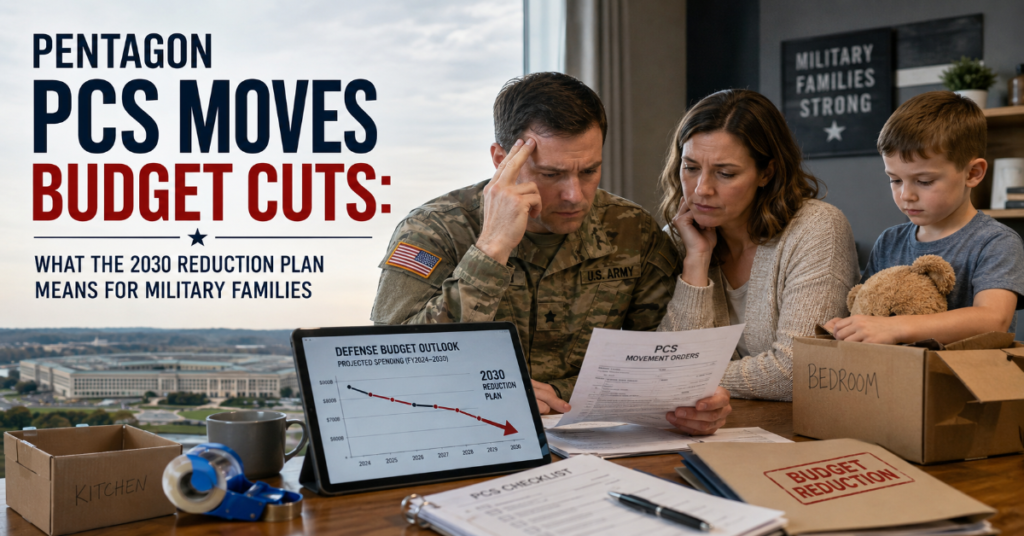
Pentagon PCS moves budget cuts are no longer a vague budget rumor. A May 2025 Defense Department memorandum directed the military departments to develop plans to reduce discretionary permanent change of station spending by 10% in fiscal 2027, 30% in fiscal 2028, 40% in fiscal 2029 and 50% in fiscal 2030, using the fiscal 2026 budget as the baseline and adjusting for inflation. The memo says the department spends about $5 billion a year moving military personnel and families between assignments.
That does not mean every service member will stop moving. The direction is narrower. The Pentagon wants the Army, Navy, Marine Corps, Air Force, Space Force and reserve components to identify lower-priority PCS moves that can be reduced without damaging mission needs. The memo specifically names operational travel, rotational overseas travel and training travel as examples of discretionary move categories that should be reviewed.
The bigger issue is not only money. PCS orders shape military careers, school continuity, spouse employment, housing costs and unit cohesion. Pentagon officials have framed fewer moves as a quality-of-life reform, not just a cost-cutting exercise. That framing matters because a poorly designed reduction could save money while shifting costs onto service members. A careful version could reduce churn, protect critical assignments and make military family life less disruptive.
What the Pentagon memo actually orders
The memo, titled “Permanent Change of Station Targeted Reductions Review and Personnel Policy Changes,” was issued by the Office of the Under Secretary of Defense for Personnel and Readiness on May 22, 2025. It says the department must determine which PCS moves are most critical for operational requirements and key professional development, while reducing lower-priority moves for families seeking more geographic stability. (U.S. Department of War)
The phased targets are clear:
| Fiscal year | Target reduction in discretionary PCS budgets | Baseline |
| FY 2027 | 10% | FY 2026 PCS budget |
| FY 2028 | 30% | FY 2026 PCS budget |
| FY 2029 | 40% | FY 2026 PCS budget |
| FY 2030 | 50% | FY 2026 PCS budget |
The memo requires implementation plans, risk identification and mitigation strategies within 120 days. It also asks the services to examine career development models for officers and noncommissioned officers, including more geographic stability and more specialization instead of constant broadening through frequent relocation. (U.S. Department of War)
A Defense Department news release later explained that military departments were being asked to review discretionary PCS budgets and build comprehensive plans, not simply cancel operationally required moves. A DOD official said some moves would remain mandatory, including assignments needed for critical missions or required career qualification. (U.S. Department of War)
Why the Pentagon is targeting PCS spending now
The financial reason is straightforward. PCS moves are expensive. The Pentagon memo puts the annual cost at roughly $5 billion. That spending includes household goods movement, travel, temporary lodging, dislocation allowances and related relocation support. (U.S. Department of War)
The human reason is more complicated. The memo says frequent PCS moves can reduce quality of life, harm spousal employment and disrupt functional communities, unit cohesion and long-term talent management. (U.S. Department of War)
Military spouse employment data supports that concern. The 2024 Active Duty Spouse Survey found that 23% of active-duty spouses had experienced a PCS move in the previous 12 months and 81% had experienced one during their spouse’s career. It also found that a PCS move within the last year more than doubled the odds that a civilian active-duty spouse was unemployed. (download.militaryonesource.mil)
That is the policy opening. Fewer moves could mean fewer broken leases, fewer school transitions, fewer job losses and more continuity inside units. But the Pentagon is also trying to solve a cost problem without weakening readiness. That is where the policy becomes difficult.
What counts as a discretionary PCS move?
The memo does not publish a final master list of every move that will be cut. Instead, it directs each military department to identify discretionary moves and propose reductions. It gives examples: operational travel inside the continental United States, rotational travel to and from overseas locations and training travel. (U.S. Department of War)
The distinction between discretionary and mandatory will matter more than any headline percentage.
| Move type | Likely policy treatment | Why it matters |
| Mission-critical assignment | Protected or reduced only with strong justification | Units still need the right people in the right billets |
| Career-broadening assignment | Subject to review | Some developmental moves may be replaced by longer tours, temporary duty or remote learning |
| Training-related PCS | Subject to review | Schools and qualification pipelines may need new delivery models |
| Overseas rotational movement | Subject to review | Affects families, operational presence and rotation planning |
| Lower-priority CONUS move | Most exposed to reduction | Easier to delay, consolidate or replace with longer stationing |
The original insight here is that the Pentagon is not only cutting travel. It is challenging a career architecture. For decades, many promotion systems rewarded breadth across assignments, commands and locations. If geographic stability becomes a formal planning goal, the services will need promotion boards to value deeper expertise, longer local tenure and specialization.
That is a personnel policy reform disguised as a budget order.
The branch-by-branch impact will not be equal
The Pentagon target applies across military departments, but each branch has a different personnel model. A flat 50% discretionary reduction would not affect every service the same way.
| Service branch | Likely pressure point | Practical risk |
| Army | Large CONUS footprint, training pipelines and broadening assignments | Longer stationing could help families, but may reduce cross-post experience |
| Navy | Sea-shore rotation logic and specialized technical communities | Fewer shore moves may help stability, but billet timing is complex |
| Air Force | Technical specialization and base-specific mission sets | More stability could strengthen expertise, but promotion culture may need adjustment |
| Marine Corps | Smaller force, deployment cycles and command development | Fewer moves may be harder to absorb if career gates are tightly sequenced |
| Space Force | Small, specialized workforce | Geographic stability may fit the mission better, but talent bottlenecks could emerge |
Federal News Network reported in 2026 that Air Force culture may complicate PCS reform because many career tracks still treat moving between assignments as part of professional development. That is the tension other branches will also face in different forms. (Federal News Network)
The most important question is not whether a branch can cut moves. It is whether it can cut moves without quietly changing who gets promoted, who gets command time and who gains access to elite career-building assignments.
Family stability is the strongest argument for the cuts
The strongest public-interest case for Pentagon PCS moves budget cuts is family stability. Frequent moves can interrupt spouse careers, child education, medical continuity and housing plans.
The Defense Department has already acknowledged spouse employment as a major PCS pain point. A 2025 DOD story about spouse survey findings said finding employment after a PCS was the biggest factor related to unhappiness with a move, with about 49% of military spouses who experienced a PCS saying employment was a large or very large problem. (U.S. Department of War)
The 2024 Active Duty Spouse Survey also found that among spouses who found work after a PCS, 28% took seven months or more to find employment. The same employment and education briefing said 35% of active-duty spouses required a state-issued license for their occupation and 28% had to acquire a new license or credential after their last PCS move. (download.militaryonesource.mil)
That creates a real cost that does not always show up in Pentagon relocation ledgers. A PCS move may be reimbursed, but a spouse’s lost wages, delayed credentialing, missed promotion or failed business restart can cost a family far more than a moving allowance covers.
The trade-off: fewer moves can also create new inequities
The policy’s risk is that “stability” could become unevenly distributed.
If high-demand career fields still require frequent moves while other fields gain longer tours, some families will benefit more than others. If elite assignments remain tied to relocation, ambitious service members may still feel compelled to move. If lower-income families are encouraged to remain in place but higher-ranking personnel can still access career-enhancing moves, the policy could deepen career inequality.
The memo itself recognizes this risk by asking services to clearly identify where proposals would impose greater costs on service members, including reductions in weight limits, temporary lodging reimbursements or dislocation allowances. (U.S. Department of War)
That line deserves attention. The easiest way to cut a PCS budget is not always to reduce disruption. It is to reimburse less. That would turn a quality-of-life reform into a cost shift. A credible implementation plan should measure out-of-pocket burden, spouse income loss and assignment fairness, not only the number of moves avoided.
How DIY move reimbursement fits into the PCS debate
The PCS reduction memo arrived alongside another important change: higher reimbursement for personally procured moves, often called PPM or DIY moves.
In May 2025, the Defense Department temporarily increased the PPM reimbursement rate from 100% to 130% of the Global Household Goods Contract rate. A Joint Travel Regulations update said the increase applied from May 15 through Sept. 30, 2025. (U.S. Department of War)
U.S. Coast Guard coverage of the change said the move was meant to better reflect market costs and reduce concern that families moving themselves would have to absorb part of the expense. (mycg.uscg.mil)
This matters because the PCS system was under pressure from two directions at once. One problem was too many moves. The other was move execution, including household goods delays, cost disputes and frustration during peak season. Raising PPM reimbursement may help some families, but it does not solve the deeper policy question: how often should military families be required to move in the first place?
Strategic implications for military careers
The memo’s career development language may become the most consequential part of the policy. It asks the services to modify officer and NCO development models to prioritize geographic stability and permit some leaders to specialize instead of gaining generalized experience across a range of functions. (U.S. Department of War)
That could produce three major changes.
First, career pathways may become more localized. A service member might build expertise at one installation or inside one mission community for longer than today’s model allows.
Second, temporary duty could replace some permanent moves. The memo gives temporary duty as an example of a way to gain broadening experience without a full PCS. (U.S. Department of War)
Third, promotion criteria may need revision. If boards continue to reward frequent movement while policy encourages stability, service members will face mixed signals. The services cannot tell families to move less while quietly treating fewer moves as a weaker career record.
This is where implementation plans will matter. A PCS cut that changes assignment frequency but not promotion incentives will fail.
The Future of Pentagon PCS Moves Budget Cuts in 2027
By FY 2027, the first 10% reduction target is scheduled to begin. That year will likely serve as the policy’s stress test. A small cut can be absorbed through delayed moves, longer tours, training substitutions and tighter approval rules. The harder question is whether those early moves create a fair foundation for the deeper FY 2028 to FY 2030 targets.
The future of Pentagon PCS moves budget cuts in 2027 will likely depend on four indicators:
| Indicator to watch in 2027 | Why it matters |
| Branch implementation plans | Shows whether reductions are strategic or blunt |
| PCS denial or deferral patterns | Reveals which career fields are most affected |
| Spouse employment outcomes | Tests whether fewer moves improve family stability |
| Promotion board guidance | Shows whether specialization is truly valued |
| Out-of-pocket moving costs | Detects whether savings are being shifted to families |
The policy direction is credible because it is tied to a real memo, a real budget target and a real family-stability problem. But the 2027 outcome is uncertain because the public has not yet seen full branch-level implementation. The Defense Department has required plans and mitigation strategies, but families will need transparent guidance before the policy changes their assignment expectations. (U.S. Department of War)
Takeaways
- The Pentagon is targeting discretionary PCS budgets, not ending all permanent change of station moves.
- The cuts are phased, which gives the services time to redesign career pathways instead of making sudden cancellations.
- Spouse employment is a central policy reason for fewer moves, not a side issue.
- The biggest risk is cost shifting, especially if reimbursements or allowances are reduced instead of unnecessary moves.
- Promotion systems must change if the services want geographic stability to become credible.
- Branch-level plans will determine whether the policy improves quality of life or simply creates assignment confusion.
- FY 2027 will be the first real test because it begins the reduction schedule while leaving room for adjustment.
Conclusion
Pentagon PCS moves budget cuts could become one of the most important military family policy changes of the decade. The headline number, a 50% reduction by FY 2030, is significant, but the deeper issue is how the services define necessity. Mission-critical moves will continue. The real debate is over the many assignments that sit between essential movement and tradition-driven rotation.
Done carefully, fewer PCS moves could give families more stability, improve spouse employment continuity and help units retain experienced people longer. Done poorly, the same policy could reduce opportunity, create uneven career pathways and shift costs onto service members.
The Pentagon has identified the right problem: frequent relocation has a financial and human cost. The next step is harder. Each service must prove that it can cut unnecessary movement without cutting fairness, readiness or career mobility.
FAQ
What are Pentagon PCS moves budget cuts?
They are planned reductions to discretionary permanent change of station spending across the military departments. The Pentagon memo directs phased reductions of 10% in FY 2027, 30% in FY 2028, 40% in FY 2029 and 50% in FY 2030. (U.S. Department of War)
Does the Pentagon plan eliminate all PCS moves?
No. The policy targets discretionary moves. Mission-critical assignments, required career moves and operationally necessary relocations may continue. The services are being asked to identify lower-priority PCS moves that can be reduced. (U.S. Department of War)
Which PCS move categories are most likely to be reviewed first?
The memo names operational travel, rotational overseas travel and training travel as examples of discretionary move categories that should be reviewed. The final impact will depend on each service’s implementation plan. (U.S. Department of War)
How could PCS cuts affect military spouses?
Fewer moves could help spouse employment by reducing job interruptions, licensing barriers and relocation-related unemployment. The 2024 Active Duty Spouse Survey found that a PCS move within the past year more than doubled the odds that a civilian active-duty spouse was unemployed. (download.militaryonesource.mil)
Will service members have to pay more out of pocket?
That is a risk, but not the stated purpose of the policy. The memo specifically tells services to identify proposals that could impose greater costs on members, including changes to weight limits, lodging reimbursements or dislocation allowances. (U.S. Department of War)
What changed with personally procured moves?
In 2025, DOD temporarily increased PPM reimbursement from 100% to 130% of the Global Household Goods Contract rate for moves between May 15 and Sept. 30, 2025. (U.S. Department of War)
Methodology
This article was developed from the uploaded production brief, then checked against primary and topic-relevant public sources. The central policy details were verified against the May 2025 Defense Department memorandum on PCS targeted reductions, including the spending figure, reduction schedule, discretionary move categories, 120-day planning requirement and career-development language. Supporting context came from Defense Department reporting, the Joint Travel Regulations PPM update, Office of People Analytics spouse survey materials and military family employment research.
References
Department of Defense. (2025). Permanent Change of Station Targeted Reductions Review and Personnel Policy Changes. Office of the Under Secretary of Defense for Personnel and Readiness. (U.S. Department of War)
Department of Defense. (2025). DOD makes plans to reduce discretionary PCS budget by half over next 5 years. (U.S. Department of War)
Per Diem, Travel, and Transportation Allowance Committee. (2025). UTD for MAP 42-25(R), Temporarily Increase Personally Procured Move Reimbursement. (U.S. Department of War)
Murray, K. (2025). Reimbursement rate for Personally Procured Moves raised to 130%. MyCG. (mycg.uscg.mil)
Office of People Analytics. (2025). 2024 Active Duty Spouse Survey key findings. Military OneSource. (download.militaryonesource.mil)
Office of People Analytics. (2025). 2024 Active Duty Spouse Employment and Education. Military OneSource. (download.militaryonesource.mil)
Department of Defense. (2025). Military spouse survey spurs DOD review of moving-related issues. (U.S. Department of War)
Federal News Network. (2026). Air Force could save millions by reducing PCS moves, but culture could complicate reform. (Federal News Network)
