
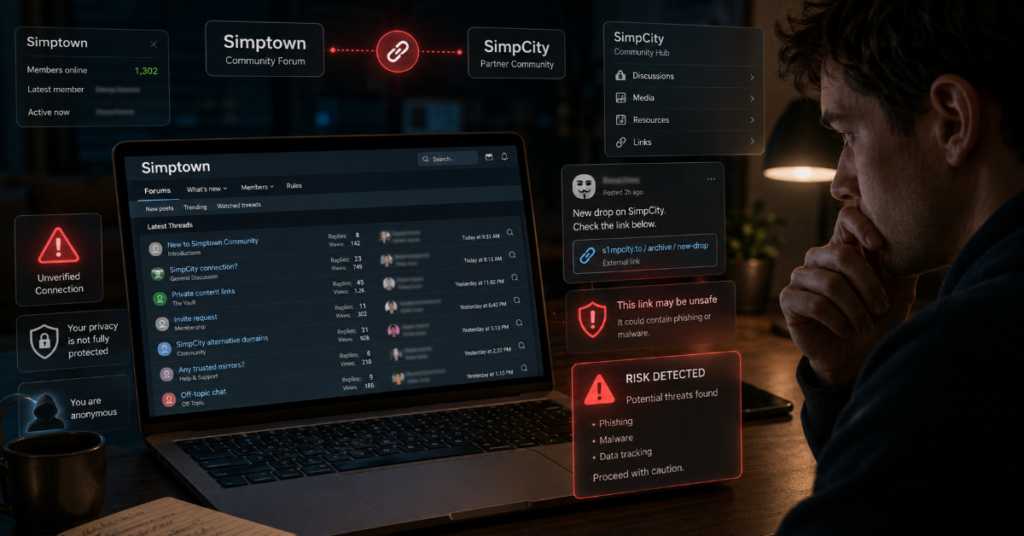
Simptown is best understood as a search term connected to forum-style adult-content communities, especially the broader SimpCity ecosystem. Public search results and forum discussions suggest that users associate it with account-based access, watched threads, reactions, progress tracking and mirror-style adult content communities. Similarweb also lists simptown.su competitors by keyword traffic and audience overlap, with SimpCity-related domains appearing in that competitive set.
That does not mean every page using the name is official, safe or stable. This is the central problem. Users searching for forum logins, migrated accounts or mirror domains often land in a messy environment where authentic pages, copycats, SEO pages, redirects and risky ads can look similar.
The safest editorial framing is therefore cautious: Simptown appears to sit inside the same user behavior pattern as adult-content forums and mirror-domain ecosystems. These platforms may offer thread tracking, reactions, forum accounts and community navigation, but they also raise serious questions about consent, copyright, privacy, malware exposure and user identity protection.
This article does not provide instructions for finding or using adult-content material. Instead, it explains the platform pattern, how it compares with SimpCity-style forums, what the security risks are, why mirror sites keep appearing and what users should check before trusting any domain.
What Simptown Appears to Be
Publicly available information around the term is fragmented. Some search results connect it with SimpCity-related traffic and competitors, while Reddit discussions mention “Simptown.su” in the context of access interruptions and lack of updates after downtime.
That pattern matters because unstable domain behavior is common in communities that rely on adult content, user submissions, third-party file hosts or mirror-style access. When a site is blocked, inaccessible or under maintenance, users often search for alternatives. This creates a cycle of copycat pages and unofficial guides.
In practical terms, Simptown appears to be associated with:
| Area | What users appear to expect | Main concern |
| Account access | Login, carried-over identity or saved forum state | Phishing and fake recovery pages |
| Forum tools | Watched threads, reactions and progress markers | Tracking of sensitive browsing behavior |
| Adult-content discovery | Community posts and linked media | Consent, copyright and moderation risk |
| Mirror-style domains | Alternate access when one domain is down | Copycats, redirects and malware |
| Related competitors | SimpCity, Bunkr-style hosts and file mirrors | Fragmented trust signals |
The keyword should not be treated as a single verified brand unless the exact domain, operator and rules can be confirmed. That uncertainty is the first safety signal.
How Simptown Compares to SimpCity Features
SimpCity is commonly described by third-party pages as a forum-based adult-content and fan-culture platform. Several public explainers frame it around profiles, posting, commenting, private discussion and community interaction.
Simptown seems to be searched in relation to that same forum logic. The uploaded brief specifically mentions account transfer, watched threads, reactions and progress, which are typical community-platform features rather than simple streaming-site features.
| Feature | SimpCity-style forum pattern | Simptown-related search intent |
| Account login | Users expect persistent profiles | Users appear to look for carried-over access |
| Watched threads | Lets users follow discussions | Suggests continuity from previous forum use |
| Reactions | Community feedback system | Implies reputation and engagement tracking |
| Progress markers | Tracks viewed or followed content | Raises privacy concerns on shared devices |
| Mirror access | Users seek alternate domains | Increases copycat and phishing exposure |
The feature comparison is important because it changes the risk profile. A simple website visit may expose browser data. A logged-in forum account can expose far more: usernames, viewing history, saved threads, notification behavior, email addresses and password reuse.
Why Mirror-Style Adult Forums Are Hard to Trust
Mirror ecosystems thrive when users want access to a site that is blocked, unstable or frequently changing domains. Similarweb data shows SimpCity-related domains appearing in competitor sets around simptown.su and simpcity.su, which supports the idea that users move across related domains rather than one stable address.
That movement creates three trust problems.
First, users may not know which domain is official. Second, a fake page can copy branding, login forms and forum language. Third, the content itself may be hosted on third-party file hosts or embedded through external links, so even a legitimate-looking forum can send users into riskier infrastructure.
Perplexity AI Magazine has covered similar mirror-domain patterns in its analysis of nhentai.nef, where unofficial variants and typo-like domains create confusion around legitimacy, hosting transparency and user safety. (Perplexityaimagazine.com)
Security Risks Associated With Sites Like Simptown
The security risk is not limited to viruses. Adult-content forums create a sensitive browsing context, which attackers can exploit because users may be less likely to report scams, account theft or unwanted exposure.
The FBI warns that ransomware and malware can spread through links, ads or websites that contain malicious code. (Federal Bureau of Investigation) The FTC also warns that fake ads and malicious downloads are common tactics used to spread malware. (Consumer Advice)
| Risk | How it appears | Why it matters |
| Fake login pages | Copycat domains asking for credentials | Password theft and account takeover |
| Malvertising | Pop-ups, fake play buttons or download prompts | Malware and unwanted software |
| Tracking scripts | Ad networks and third-party embeds | Sensitive browsing behavior can be profiled |
| Reused usernames | Same handle used across platforms | Identity linkage across adult and non-adult spaces |
| File-host redirects | Content hosted outside the forum | Higher chance of scams and deceptive buttons |
| Weak account recovery | Missing or unreliable password reset | Users may lose accounts or expose email data |
Cloudflare’s 2025 review reported that deceptive links were the top malicious email threat category in its dataset, rising from 43% in 2024 to 52% in 2025. That wider trend matters because mirror ecosystems also rely heavily on links that may not be what they appear to be. (The Cloudflare Blog)
Privacy, Consent and Legal Concerns
Adult-content forums carry unusually high privacy stakes. A leaked email address, reused username or visible posting history can reveal intimate preferences, social circles or identity clues. That is why users should treat every account-based adult forum as a high-sensitivity environment.
The FTC’s privacy and security guidance emphasizes consumer privacy, data security and responsible handling of personal information. (Federal Trade Commission) The CFPB has also warned that data broker activity can create harms when personal information is collected, analyzed and shared at scale. (files.consumerfinance.gov)
There is also a consent issue. Forums connected to adult-content sharing may include material from creators, social media accounts or subscription platforms. If content is reposted without permission, the ethical and legal risk shifts sharply. Users should not assume that content is lawful or consensual simply because it appears in a popular forum thread.
Perplexity AI Magazine’s guide to Nsfw411-style directories makes a similar point: a directory or community label does not prove that every linked destination is safe, current, moderated or consent-respecting. (Perplexityaimagazine.com)
Structured Insight Table: What Users Should Check
| Check | Safer interpretation | Red flag |
| Domain history | Stable identity and transparent operation | Frequent unexplained domain shifts |
| Login page | Clear HTTPS and expected domain | Forced re-login through unfamiliar URL |
| Password policy | Unique password and 2FA where available | Reused password from email or banking |
| Content rules | Visible moderation and removal process | No clear takedown or consent policy |
| Ads | Minimal deceptive prompts | Fake play buttons and forced downloads |
| Account recovery | Reliable email reset flow | Missing resets or suspicious support requests |
| External hosts | Known file hosts with clear warnings | Chains of redirects before content loads |
The key insight is simple: forum features make a site feel familiar, but familiarity is not trust. A watched-thread page can still sit behind weak moderation. A reaction system can still encourage harmful reposting. A clean login design can still be a credential trap.
Market and Cultural Impact
The interest around Simptown reflects a broader internet pattern: users are moving from large open platforms into niche forums, semi-private communities and domain-shifting content networks. These spaces feel more organized than random search results and more permanent than chat servers, but they often lack the governance of mainstream platforms.
The cultural appeal is clear. Forums create status systems through reactions, post counts, progress markers and thread histories. That turns browsing into participation. Users do not just consume content. They build a visible identity inside the community.
The trade-off is exposure. Once a user participates, their behavior becomes part of a record. Even if the forum uses pseudonyms, patterns can connect accounts across platforms. In adult-content communities, that record is more sensitive than in a hobby forum.
Perplexity AI Magazine’s Socialmediagirls forum analysis also notes that adult-adjacent forum structures raise privacy, legality and moderation questions that go beyond ordinary community browsing. (Perplexityaimagazine.com)
Practical Safety Guidance
Users researching Simptown or similar sites should focus on risk reduction rather than trust by default.
Use a unique email address that is not tied to work, banking or public social profiles. Never reuse passwords. Avoid downloading files from forum threads. Do not install browser extensions, media players or “verification” tools promoted by pop-ups. Do not provide payment details to unfamiliar mirror pages. Avoid posting identifying details, face images, location clues or usernames used elsewhere.
A safer approach is to separate identities. If a platform’s purpose is sensitive, the account should not connect back to a real name, professional profile or long-standing social handle.
For broader device safety, the site’s HBlock guide is useful context because it explains how blocking ad, tracking and malware domains can reduce exposure to unwanted network requests. (Perplexityaimagazine.com)
The Future of Simptown in 2027
The future of Simptown in 2027 is likely to depend on three forces: domain stability, enforcement pressure and user trust.
First, mirror-style adult forums will probably keep shifting between domains when access, moderation or infrastructure becomes difficult. Similar patterns already appear around SimpCity-related domains and related competitor sets.
Second, search quality rules are becoming tougher. Google’s spam policies cover scaled content abuse and site reputation abuse, including attempts to use established ranking signals in ways that mislead users. (Google for Developers) This matters because many mirror and adult-directory pages depend on search visibility, keyword capture and recycled explainers.
Third, users are becoming more security-aware. Malware, phishing and data-broker concerns are now mainstream internet risks, not niche cybersecurity topics. If platforms like Simptown want long-term trust, they would need clearer domain identity, transparent rules, stronger consent enforcement, better account recovery and reduced dependence on risky ads.
The uncertain part is governance. Adult-content communities can grow quickly because demand is high, but trust takes longer to build. Without transparent moderation and real takedown processes, 2027 will likely bring more copycats, more safety warnings and more confusion around which domains are legitimate.
Takeaways
- Simptown should be treated as a high-risk search term until the exact domain and operator are verified.
- SimpCity-style features such as watched threads and reactions increase convenience, but they also create a sensitive activity record.
- Mirror domains are not automatically malicious, but domain instability makes phishing and impersonation easier.
- Adult-content forums carry consent, copyright, privacy and malware risks at the same time.
- The safest browsing posture is separation: unique email, unique password, no downloads and no identifying profile details.
- Users should not assume popularity equals legitimacy. Traffic and forum activity do not prove safety.
- Strong moderation and transparent takedown processes are the clearest signs of a more responsible platform.
Conclusion
Simptown appears to sit at the intersection of adult-content forums, SimpCity-style community features and mirror-domain search behavior. That makes it more than a simple website query. It is a trust problem.
The user-facing appeal is easy to understand: accounts, watched threads, reactions and forum progress create continuity. People like platforms that remember where they left off. But those same features can expose sensitive behavior if the domain is unstable, the operators are unclear or the login flow is copied by malicious actors.
The most balanced conclusion is caution. Users should not treat Simptown-related pages as safe simply because they look familiar or connect to a known forum culture. The better standard is verification, privacy separation and minimal exposure. In adult-content ecosystems, trust should be earned through transparency, moderation and security practices rather than assumed from design or popularity.
FAQ
What is Simptown?
Simptown appears to be a search term tied to adult-content forum culture and SimpCity-style communities. Public results connect it with forum access, mirror domains and related competitors. Its exact status can vary by domain, so users should verify the specific site before trusting it.
Is Simptown the same as SimpCity?
Not necessarily. Users appear to associate it with SimpCity-like features, but that does not prove the same ownership or official connection. Similarweb lists SimpCity-related domains among competitors and related sites, which suggests audience overlap rather than confirmed identity. (Similarweb)
Are sites like Simptown safe?
They should be treated as risky by default. The main concerns are fake login pages, malicious ads, redirects, privacy exposure, account tracking and unclear content legitimacy. Adult-content forums have higher privacy stakes than ordinary entertainment websites.
What kind of content appears on SimpCity mirror-style sites?
Third-party descriptions commonly frame SimpCity-style platforms around adult content, fan culture, forum threads and community discussion. Some public pages also mention celebrity or creator-related content, which raises consent and copyright concerns.
How do reactions and progress systems work on these forums?
Reactions usually function as community feedback, while progress or watched-thread tools help users track activity across discussions. They are convenient, but they also create a record of sensitive browsing behavior if tied to an account.
What is the biggest privacy risk?
The biggest risk is identity linkage. A reused username, shared email address, profile image or repeated behavior pattern can connect adult-forum activity to a person’s broader online identity.
Should users download files from these forums?
No. Downloads from adult-content forums, file hosts and mirror pages can expose users to malware, deceptive installers or unwanted software. The FBI warns that malware can spread through links, ads and compromised websites. (Federal Bureau of Investigation)
Methodology
This article was prepared from the uploaded editorial brief, public search results, cybersecurity guidance and related coverage on adult-content forum risks. The analysis did not involve logging into, accessing restricted content from or testing any adult-content forum directly. That limitation matters because live domain status, operator identity and forum rules can change quickly.
Sources used for validation included Similarweb competitor pages, public Reddit discussions for user-reported access context, FTC and FBI safety guidance, Google Search policy documentation, Cloudflare’s threat reporting and relevant Perplexity AI Magazine articles on mirror domains, adult directories and online safety.
References
Cloudflare. (2025). The 2025 Cloudflare Radar year in review: The rise of AI and cyber threats. Cloudflare Blog. (The Cloudflare Blog)
Federal Bureau of Investigation. (n.d.). Ransomware. FBI. (Federal Bureau of Investigation)
Federal Trade Commission. (n.d.). Privacy and security. FTC. (Federal Trade Commission)
Federal Trade Commission. (2023). Ads for fake AI and other software spread malicious software. FTC Consumer Advice. (Consumer Advice)
Google Search Central. (n.d.). Spam policies for Google web search. Google Developers. (Google for Developers)
Google. (2024). New ways we’re tackling spammy, low-quality content on Search. Google Blog. (blog.google)
Perplexity AI Magazine. (2026). nhentai.nef: Mirror domain risks and safety guide. (Perplexityaimagazine.com)
Perplexity AI Magazine. (2026). Nsfw411: Reddit directory and safety guide. (Perplexityaimagazine.com)
Perplexity AI Magazine. (2026). Socialmediagirls forum analysis, safety and risks explained. (Perplexityaimagazine.com)
