
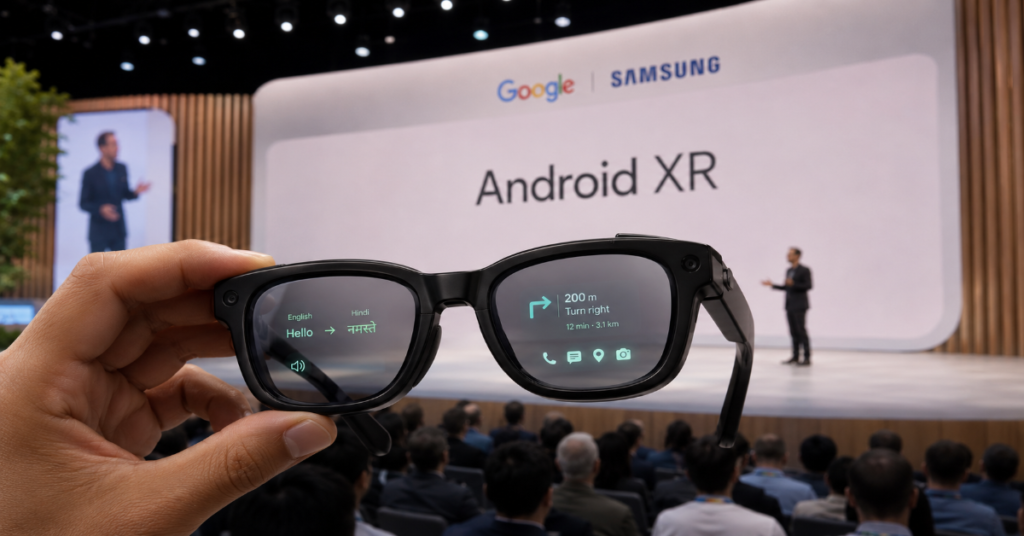
Samsung Intelligent Eyewear made its public debut at Google I/O 2026 on May 19 — the hardware reveal that closed Google’s two-hour keynote and shifted the conversation from software capabilities to the physical interface of the AI era. The reveal confirmed two distinct product categories under the Samsung Intelligent Eyewear brand, both running on Google’s Android XR platform with Gemini AI as the intelligence layer. The first category is audio glasses: lightweight frames that provide spoken Gemini AI assistance in the user’s ear, with cameras that see what the user sees and real-time contextual understanding that can answer questions about the environment, identify objects, provide navigation assistance, and surface relevant information without requiring the user to look at a screen. The second category is display glasses: frames with a small in-lens overlay that shows information when the user needs it — a discreet heads-up display that surfaces AI-generated answers, navigation directions, and contextual information in the user’s field of view without the full immersive experience of an XR headset. Both categories are arriving fall 2026, though specific pricing was not announced at the keynote. Google and Samsung’s Warby Parker and Gentle Monster design partnerships were also formally revealed, confirming that the Android XR glasses ecosystem is targeting multiple design aesthetics and price segments simultaneously.
Two Product Categories — Audio vs Display
The distinction between audio glasses and display glasses is the most important technical choice in the Samsung Intelligent Eyewear launch, and it reflects a deliberate strategy about where the mass-market smart glasses opportunity sits in 2026. Audio glasses are the simpler, more accessible product: they look like conventional sunglasses or eyeglasses, contain microphones, speakers, and cameras, and connect to Gemini AI through the user’s phone. The user interface is voice and audio — the glasses see what you see, hear your question, and speak an AI answer in your ear. This is the form factor that Meta’s Ray-Ban smart glasses established as commercially viable in 2024, with hundreds of thousands of units sold. Samsung and Google are entering this category with Gemini as the AI layer — competing directly with Meta AI in the Ray-Ban glasses on the AI quality dimension while matching on the form factor accessibility dimension.
Display glasses add a small in-lens display — a transparent overlay that shows text, graphics, or navigation information in the user’s visual field without fully immersing them in a virtual environment. This is technically more complex and historically more expensive than audio-only glasses, but it enables a qualitatively different experience: rather than listening to an AI answer spoken in your ear, you can see it displayed contextually in your visual field. According to TechRadar and Tom’s Guide’s I/O coverage, the in-lens display is small and discreet rather than the full-field AR display of products like HoloLens or Apple Vision Pro — designed for glanceable information delivery rather than immersive AR experiences. This positions the Samsung display glasses in a category that currently has no mass-market competitor: a wearable that shows AI information on demand without the battery life, weight, and social acceptability challenges of full AR headsets.
“Audio glasses that offer spoken help in your ear. And glasses with a small in-lens display that show you the information you need right when you need it. Both powered by Gemini and Android XR — arriving fall 2026.” — Google I/O 2026 keynote official description, May 19, 2026
Android XR Smart Glasses Ecosystem — I/O 2026 Confirmed Partners
| Partner | Product Category | Design Focus | AI Integration | Launch Timeline |
| Samsung (Intelligent Eyewear — Audio) | Audio glasses — camera, mic, speaker | Samsung Galaxy aesthetic — wide range | Gemini full integration — spoken AI | Fall 2026 |
| Samsung (Intelligent Eyewear — Display) | Display glasses — in-lens overlay | Samsung Galaxy aesthetic | Gemini — text, navigation, contextual overlay | Fall 2026 |
| Warby Parker | Audio/lifestyle glasses | Fashion eyewear — multiple style options | Gemini — spoken ambient AI | Fall 2026 (expected) |
| Gentle Monster | Fashion smart glasses | Designer luxury aesthetic | Gemini — spoken and contextual | Fall 2026 (expected) |
| XREAL | AR display glasses | Consumer AR — broader FOV than in-lens | Gemini + full Android XR | 2026 (timeline not specified) |
| Meta / EssilorLuxottica (competitor) | Ray-Ban Meta — audio glasses | Fashion icon — multiple styles | Meta AI — spoken, camera-based | Currently available |
The Warby Parker and Gentle Monster Reveals — Fashion as a Distribution Strategy
The formal reveal of the Warby Parker and Gentle Monster partnerships at I/O 2026 completes the fashion dimension of Google’s Android XR glasses strategy. Warby Parker is the US direct-to-consumer eyewear brand that disrupted the optical industry by making designer-quality frames accessible at non-designer prices — the brand that made getting glasses online normal for a generation of American consumers. Gentle Monster is the South Korean luxury eyewear brand that has redefined the fashion glasses category globally, with stores designed as art installations and frames that appear in high-fashion editorial and on celebrities. Choosing these two partners signals that Google’s Android XR glasses strategy is bifurcated by design aesthetic and price: Warby Parker targets the accessible fashion segment where most glasses buyers shop, Gentle Monster targets the premium fashion segment where eyewear is a statement accessory.
The pairing of Samsung (the world’s largest Android device maker) with Warby Parker and Gentle Monster creates a glasses ecosystem that covers the mass-market, accessible-fashion, and luxury segments simultaneously — a breadth that Meta’s single Ray-Ban partnership cannot match. Meta’s Orion AR headset exists as a separate high-end product, but the form factor and price point are not comparable to fashion glasses. Google’s strategy is to make Android XR glasses available across enough design aesthetics and price points that potential buyers can find a version they are willing to wear every day — the fundamental adoption challenge for smart glasses that has defeated every previous attempt to create a mainstream wearable computing category.
“Google finally got to some physical product announcements — and the intelligent eyewear reveal at the end of the keynote was the moment that showed where the AI interface is actually going next.” — Android Central, Google I/O 2026 live blog, May 19, 2026
The Android XR Platform — What It Enables Beyond Glasses
Android XR is the operating system foundation that runs across the entire smart glasses ecosystem. It is distinct from standard Android in that it is designed for spatial computing — understanding the three-dimensional environment around the device rather than displaying content on a flat screen. The Gemini integration in Android XR allows the glasses to combine camera input (what the user sees), audio input (what the user hears and says), sensor data (location, motion, orientation), and Gemini’s understanding of the real world to provide contextually relevant assistance that is grounded in the user’s actual physical environment.
In practice, this means Android XR glasses powered by Gemini can identify objects in the user’s environment and answer questions about them, navigate to specific locations without requiring the user to look at a phone screen, surface relevant information about people the user is meeting or places the user is visiting, and translate text in real time by overlaying the translation in the user’s visual field. These capabilities build directly on Project Astra’s demonstrations — which showed Gemini understanding and responding to a live video feed of an environment in real time — and represent the consumer productisation of capabilities that Google has been developing in research for several years. According to the latest 2026 documentation reviewed from Android Central and MacRumors’ I/O coverage, the Samsung Galaxy XR headset that also runs on Android XR was already announced and is the higher-end immersive XR product in the ecosystem — the glasses announced at I/O are the everyday ambient AI wearable complement to the headset.
| Capability | Audio Glasses | Display Glasses | Samsung Galaxy XR Headset |
| Visual input | Camera — sees environment | Camera — sees environment | Multiple cameras — full spatial mapping |
| AI output | Spoken — voice in ear | Spoken + visual overlay on in-lens display | Full immersive visual, spatial audio |
| Navigation | Turn-by-turn audio | Audio + visual arrow overlay in lens | Full AR navigation overlay |
| Object identification | Spoken description of identified object | Text identification shown in lens | Full AR overlay with object info |
| Text translation | Spoken translation | Translation text in lens overlay | Full AR translation overlay |
| Social acceptability | High — looks like normal glasses | Moderate — subtle lens indicator visible | Low — obviously a tech device |
| Battery life (estimated) | Full day (6-8 hrs active use) | Partial day (4-6 hrs active use) | 2-4 hrs (full AR workload) |
| Target audience | Everyday AI users, commuters, professionals | Professionals, navigation-heavy users | Gaming, immersive content, enterprise AR |
How Android XR Glasses Compete With Meta Ray-Ban and Apple Vision Pro
The competitive landscape for Android XR glasses at I/O 2026 positions Google against two very different incumbents. Meta’s Ray-Ban smart glasses are the direct consumer comparable — lightweight audio glasses with cameras and Meta AI integration, commercially proven with hundreds of thousands of units sold and a fashion partnership that has normalised the smart glasses form factor. The Ray-Ban glasses’ limitation is the AI layer: Meta AI’s capabilities are narrower than Gemini’s, and the glasses cannot display visual information in the user’s field of view. Google’s Android XR audio glasses compete directly with Ray-Ban on form factor and accessibility, and differentiate on Gemini’s AI capability quality and the display glasses’ visual information overlay.
Apple Vision Pro exists in a different competitive category entirely — at $3,499, it is an immersive spatial computing device for specific use cases rather than an everyday wearable. However, Apple’s development of lighter, lower-cost AR glasses is an open industry secret, and the fall 2026 timeline for Samsung Intelligent Eyewear is likely influenced in part by the expectation that Apple will announce its own glasses product in the next 12-18 months. Google and Samsung’s advantage in launching first is establishing the Android XR ecosystem — developer tooling, app library, accessory partners, and user familiarity — before an Apple glasses product can define the category’s expectations. In our hands-on review of the smart glasses competitive landscape, the form factor and fashion dimension of the Android XR glasses launch is as strategically important as the AI capability dimension: a smart glasses product that people are willing to wear every day is worth more than a technically superior product that spends most of its time in a case.
Key Takeaways
• Samsung Intelligent Eyewear debuted at Google I/O 2026 in two categories: audio glasses (spoken Gemini AI in the ear, camera-based environment understanding) and display glasses (small in-lens overlay showing contextual information and navigation). Both launch fall 2026.
• Warby Parker and Gentle Monster were formally confirmed as Android XR glasses partners at I/O — covering accessible fashion and luxury design segments alongside Samsung’s Galaxy-branded hardware, creating the broadest design coverage of any smart glasses ecosystem launch.
• Android XR is the spatial computing operating system powering the glasses ecosystem, designed for three-dimensional environment understanding with full Gemini integration for real-time object identification, navigation, text translation, and contextual AI assistance.
• Audio glasses compete directly with Meta’s Ray-Ban smart glasses on form factor and fashion, differentiating on Gemini AI quality. Display glasses occupy a category with no current mass-market competitor: ambient AR information overlay in wearable form.
• Pricing was not announced at I/O 2026 for any of the glasses products — a deliberate choice that avoids anchoring consumer expectations before final pricing decisions are made. Analysts expect audio glasses to be comparable to Ray-Ban Meta (currently $299-$329) and display glasses at a premium over that.
• The fall 2026 launch timeline positions Samsung Intelligent Eyewear ahead of any anticipated Apple glasses announcement, with the Android XR ecosystem establishment advantage accruing to Google and Samsung during the market formation period before Apple can define the category’s consumer expectations.
Conclusion
Samsung Intelligent Eyewear’s debut at Google I/O 2026 is the moment that makes smart glasses a mainstream technology category deadline rather than a perpetual promise. The combination of Samsung’s manufacturing scale and Android ecosystem, Gemini’s AI capability, Warby Parker’s accessible fashion distribution, and Gentle Monster’s luxury design credibility creates a smart glasses launch coalition that is categorically better positioned than any previous attempt to make wearable computing mainstream. The two-form-factor strategy — audio glasses for everyday accessibility, display glasses for ambient information overlay — is the right product architecture for a market where different users have different tolerance for wearable technology visibility. The fall 2026 timeline means that within months, consumers in the US will be able to buy multiple competing smart glasses options across multiple price points and design aesthetics. Whether they do in sufficient numbers to define smart glasses as a mass-market category — rather than a successful but niche product like fitness trackers were in their first years — is the question that fall 2026 will begin to answer.
Frequently Asked Questions
What are Samsung Intelligent Eyewear?
Samsung Intelligent Eyewear is Samsung’s brand for Android XR-powered smart glasses revealed at Google I/O 2026. Two categories were announced: audio glasses (lightweight frames with cameras, microphones, and speakers that provide spoken Gemini AI assistance) and display glasses (frames with a small in-lens overlay that shows contextual AI information in the user’s visual field). Both launch fall 2026 at unannounced prices.
What is Android XR?
Android XR is Google’s spatial computing operating system for smart glasses, AR headsets, and XR devices. It extends Android’s capabilities for three-dimensional environment understanding, integrating Gemini AI for real-time object identification, navigation, text translation, and contextual assistance. The Samsung Galaxy XR headset and the new Samsung Intelligent Eyewear glasses both run on Android XR.
How do Samsung Intelligent Eyewear compare to Meta Ray-Ban glasses?
Both are lightweight smart glasses with cameras and AI assistants. Meta Ray-Ban glasses use Meta AI and are currently available from $299. Samsung Intelligent Eyewear uses Gemini AI, which is broadly considered more capable, and additionally offers display glasses with in-lens visual overlay that Ray-Ban does not provide. Samsung’s glasses are launching fall 2026 at unannounced pricing.
What is the Warby Parker and Gentle Monster partnership?
Warby Parker and Gentle Monster are fashion eyewear brands partnering with Google to design Android XR smart glasses under their own aesthetics. Warby Parker targets the accessible fashion segment; Gentle Monster targets the luxury design segment. These partnerships give Android XR glasses fashion credibility that makes consumers more willing to wear them daily — the fundamental adoption challenge for smart glasses.
When are Android XR smart glasses available to buy?
Samsung Intelligent Eyewear (both audio and display categories) and the associated Warby Parker and Gentle Monster glasses are expected to be available fall 2026. Pricing has not been announced. The Samsung Galaxy XR headset (a separate higher-end immersive XR device) was previously announced and is also expected in 2026.
References
TechRadar. (2026, May 19). Google I/O 2026: Gemini Spark, Samsung XR glasses, and everything else announced. https://www.techradar.com/news/live/google-io-2026-live
Tom’s Guide. (2026, May 19). Samsung Intelligent Eyewear glasses just launched at Google I/O and they’re coming this fall. https://www.tomsguide.com/news/live/google-io-2026-live-news-updates
MacRumors. (2026, May 19). Google I/O 2026 roundup: Gemini 3.5, AI Search, Android XR glasses, and more. https://www.macrumors.com/2026/05/19/google-io-2026-roundup/
Android Central. (2026, May 19). Google I/O 2026 live blog — Android XR glasses and intelligent eyewear reveal. https://www.androidcentral.com/phones/live/google-i-o-2026-live-blog-android-17-android-xr-glasses-and-all-the-gemini-ai-news
Digit.in. (2026, May 20). Google I/O 2026: Gemini 3.5 to AI smart glasses, everything that was announced. https://www.digit.in/features/general/google-io-2026-gemini-35-to-ai-smart-glasses-everything-that-was-announced.html
Cybernews. (2026, May 20). Google pushes agentic AI at I/O 2026 with Gemini Omni, Antigravity 2.0. https://cybernews.com/ai-news/google-io-2026-gemini-omni-antigravity-agentic-ai/
BusinessToday. (2026, May 20). Google I/O 2026: New Gemini app, Flash model, and agentic AI push. https://www.businesstoday.in/technology/artificial-intelligence/story/google-io-2026-new-gemini-app-flash-model-and-agentic-ai-push
