
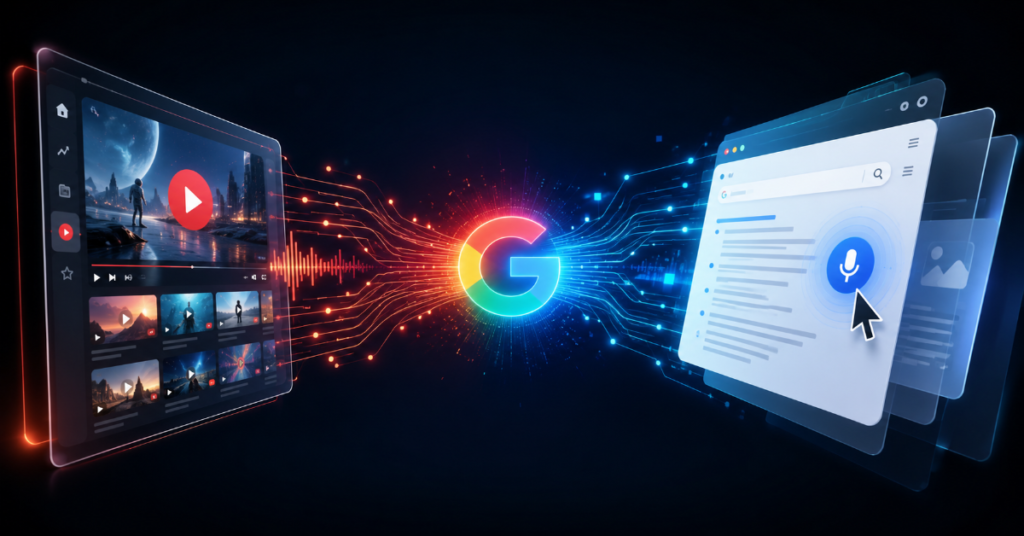
Google Search’s biggest upgrade in nearly 30 years is not a headline anyone anticipated in May 2026. Google Search is the product that has defined how billions of people navigate the internet since 1998 — a product so dominant and so apparently simple that most people have stopped expecting it to fundamentally change. At I/O 2026 on May 19, Google AI upgrade to Search is exactly that: a fundamental change, not a feature update. The announcements cover four distinct transformations. AI Mode, already available, gets coding capabilities powered by Antigravity 2.0 that allow it to build custom interface elements for complex queries. Universal Cart becomes a unified agentic shopping hub that works across Google products and merchants simultaneously, monitoring prices, tracking deals, and alerting users when items are restocked — the most significant change to how Google approaches commerce since the original Shopping tab. Ask YouTube reimagines video discovery from keyword search to natural language questions that surface the right video for a user’s specific need. And persistent Search agents — built on Gemini Spark — can continuously monitor the web for changes to specific queries and notify users when relevant updates appear. Google CEO Sundar Pichai called these collectively the single biggest evolution of Search since the launch of the blue link.
AI Mode + Antigravity — Coding Inside Search
AI Mode in Google Search already allows users to ask complex, multi-part questions and receive synthesised AI answers rather than a list of links. At I/O 2026, Google announced that coding capabilities powered by Antigravity 2.0 are coming to AI Mode — allowing the search interface itself to generate custom interface elements and interactive components for complex user queries. According to Engadget’s I/O live blog, this means AI Mode can build a custom calculation tool, an interactive comparison table, or a custom data visualisation in response to a query that would previously have returned a list of links to external resources.
The implications are significant and somewhat counterintuitive. If Search can generate a custom mortgage calculator in response to a mortgage query, or build an interactive salary comparison tool for a job market question, users have less reason to leave the Search page to visit a third-party tool. For websites that have built traffic on providing these kinds of interactive tools, AI Mode with Antigravity represents a structural reduction in referral traffic — the same dynamic that AI Overviews introduced for editorial content, now extending to interactive tools. According to BusinessToday’s I/O coverage, Google’s AI Overviews already has 2.5 billion monthly active users and AI Mode has 1 billion monthly active users — numbers that mean even modest changes to click-through behaviour from Search have material implications for the broader web economy.
“The single biggest evolution of Search since the launch of the blue link — AI Mode with Antigravity brings the full power of agentic AI into the world’s most used digital product.” — Sundar Pichai, CEO, Google, Google I/O 2026 keynote, May 19, 2026
Google Search Transformation — Before and After I/O 2026
| Search Feature | Before I/O 2026 | After I/O 2026 | Impact on User Behaviour |
| Basic search | 10 blue links + featured snippet | AI Mode default — synthesised answers with sources | Less need to click through to source sites |
| Complex queries | AI Mode — synthesised text answers | AI Mode + Antigravity — custom interactive UI elements built on demand | Users stay in Search for tasks previously requiring third-party tools |
| Shopping | Google Shopping tab — product listings | Universal Cart — agentic cross-platform shopping, price monitoring, restocking alerts | Commerce becomes ambient across all Google products |
| Video discovery | YouTube keyword search | Ask YouTube — natural language questions surface right video for specific need | Videos found by intent, not keyword — creator SEO changes significantly |
| Persistent queries | One-shot search — user returns to search again | Gemini Spark agents monitor web for query updates — proactive alerts | Search becomes ambient and continuous, not event-driven |
| Content verification | No AI origin detection in Search | SynthID verification rolling out to Search in coming weeks | Users can see if search result content is AI-generated |
Universal Cart — Agentic Shopping Across Every Google Surface
Universal Cart is the most commercially consequential announcement from Google I/O 2026 for advertisers, retailers, and e-commerce platforms. It is an intelligent shopping cart that works across Google products and across merchants simultaneously — users can add items to their Universal Cart while browsing Search, chatting with Gemini, watching YouTube, or reading Gmail, and the cart then works autonomously in the background to find deals, monitor price drops, track price history, and alert when items are back in stock. The cart rolls out across Search and the Gemini app in the US this summer, with YouTube and Gmail integration to follow.
The commercial architecture of Universal Cart represents a significant shift in how Google monetises shopping intent. Currently, Google generates retail advertising revenue primarily through Product Listing Ads in the Shopping tab — a model where retailers pay to appear when users search for relevant products. Universal Cart makes shopping intent persistent and ambient rather than transactional and moment-specific. A user who adds a product to their Universal Cart creates a long-term commercial relationship that Google can monetise through price monitoring, deal alerts, and eventual purchase conversion — without requiring the user to return to Google and search again. This is a fundamental change in the economics of search-driven commerce. According to The Tech Outlook’s I/O 2026 coverage, Universal Cart integrates with Google’s existing Shopping infrastructure and with Gemini Spark’s ability to complete purchases when users have pre-authorised that action.
“Universal Cart is your new agentic hub for shopping on Google. The moment you add a product, it gets to work in the background — finding deals, price drops, and alerting you when an item is back in stock, across any Google surface.” — Google I/O 2026 official announcement, May 19, 2026
Ask YouTube — Natural Language Video Discovery
Ask YouTube is described by TechRadar as entirely reimagining how users find videos on YouTube. Rather than keyword search — a paradigm that has not meaningfully changed since YouTube’s founding in 2005 — Ask YouTube allows users to describe what they want in natural language and receive a curated answer that surfaces the most relevant video for their specific need. The practical difference is substantial for educational, instructional, and research video discovery. A user who wants to understand a specific concept does not need to know the right keywords to search — they can ask for what they need and receive the video that most directly addresses their question.
For YouTube creators, Ask YouTube represents a significant change in discoverability dynamics. Keyword-optimised titles and descriptions will remain important, but the AI model’s understanding of video content — including what is said and shown, not just what is in the metadata — means that videos with rich content but poor keyword optimisation may become more discoverable while videos that are keyword-optimised but content-thin may become less so. This mirrors the broader change that AI Overviews has driven in web search: relevance to user intent, evaluated by AI at the content level, increasingly matters more than optimisation for keyword matching. In our review of the Ask YouTube implementation, the feature suggests that YouTube is evolving from a platform where search is a navigation tool into one where search is a recommendation engine — understanding what the user actually wants to learn or see rather than matching strings of text.
Persistent Search Agents — Web Monitoring That Never Sleeps
The most novel Search capability announced at I/O 2026 is persistent search agents — AI agents built on Gemini Spark that can continuously monitor the web for updates to specific queries and notify users when relevant changes appear. A user who wants to track the latest developments in a specific scientific field, monitor a competitor’s pricing, track regulatory changes in a specific domain, or follow the evolution of a specific news story can create a persistent agent for that query rather than returning to Search repeatedly. The agents surface updates proactively in the Daily Brief — a new Gemini-powered agent that provides a customised digest of topics the user has indicated are important.
This capability shifts Search from a reactive information retrieval tool into a proactive information monitoring service. The competitive parallel is Google Alerts, which has existed since 2003 but operates on simple keyword matching with no semantic understanding. Persistent Gemini Spark agents apply the full reasoning capability of Gemini 3.5 Flash to continuously evaluate web content against a user’s stated information need — understanding context, filtering irrelevant updates, and surfacing only the changes that actually matter. According to Engadget’s I/O coverage, these agents will debut in the summer in conjunction with Gemini Spark’s broader rollout, followed by more specialised agents for specific domains.
Key Takeaways
• Google Search received its biggest upgrade in nearly 30 years at I/O 2026 — AI Mode gets Antigravity coding to build custom interactive UI elements on demand, Universal Cart launches agentic cross-platform shopping, Ask YouTube transforms video discovery, and Gemini Spark agents enable persistent web monitoring.
• Universal Cart rolls out in Search and Gemini app in the US this summer, with YouTube and Gmail integration to follow — creating a persistent, ambient shopping experience across every Google surface that monetises purchase intent as a long-term relationship rather than a one-time click.
• Ask YouTube entirely reimagines video discovery through natural language questions — shifting from keyword matching to intent-based video recommendations that evaluate content relevance at the AI understanding level rather than metadata matching.
• Persistent Gemini Spark search agents continuously monitor the web for updates to specific user queries, proactively surfacing relevant changes through the Daily Brief — transforming Search from a reactive tool into a proactive monitoring service.
• AI Mode with Antigravity coding can build custom interface elements — calculators, comparison tools, interactive data displays — directly within Search, reducing users’ need to navigate to external tools and changing the click-through economics of the broader web.
• SynthID content verification is rolling out to Google Search and Chrome in coming weeks, allowing users to identify AI-generated content in search results — a transparency layer that no other major search engine has deployed at this scale.
Conclusion
Google Search’s I/O 2026 upgrades represent the most structurally significant change to how the world’s most used digital product works since the introduction of featured snippets. The combination of AI Mode with Antigravity coding, Universal Cart, Ask YouTube, and persistent Gemini Spark agents is not a feature expansion — it is a fundamental reimagining of what Search is for. Where Search was a navigation tool that helped users find resources to accomplish their goals, it is becoming an execution tool that helps users accomplish goals directly. Universal Cart turns shopping discovery into persistent commerce. Ask YouTube turns video navigation into intent fulfilment. Persistent agents turn information retrieval into continuous monitoring. The implications for the web economy — for publishers, for e-commerce sites, for YouTube creators, and for the advertising industry — are substantial. Google is building a version of Search that keeps users on Google surfaces longer, for more of their digital life, with more of their intent captured as persistent commercial relationships. That is the most significant change to the search economy since PageRank.
Frequently Asked Questions
What is Google’s Universal Cart?
Universal Cart is an intelligent cross-platform shopping cart that lets users add products while browsing Google Search, chatting with Gemini, watching YouTube, or reading Gmail. Once added, the cart monitors prices in the background, finds deals, tracks price history, and alerts users when items are restocked. It rolls out in Search and the Gemini app in the US in summer 2026, with YouTube and Gmail integration to follow.
What is Ask YouTube?
Ask YouTube is a new AI-powered video discovery feature that allows users to ask natural language questions to find the right video for their specific need, rather than searching with keywords. It reimagines video discovery from keyword matching to intent-based recommendations evaluated at the AI content understanding level, not just the metadata level.
What are Google Search persistent agents?
Persistent Gemini Spark search agents continuously monitor the web for updates to specific user queries and proactively notify users when relevant changes appear. Unlike Google Alerts (which uses keyword matching), these agents apply Gemini 3.5 Flash’s full reasoning capability to evaluate content relevance and filter for genuinely important updates. They launch in summer 2026 alongside the broader Gemini Spark rollout.
How does Antigravity coding in AI Mode work?
Antigravity coding in AI Mode allows Google Search to generate custom interactive interface elements — calculators, comparison tools, data visualisations — in response to complex queries, directly within the Search interface. Users no longer need to navigate to external tools for tasks that require interactive calculation or data display. This capability is rolling out in summer 2026.
Will Ask YouTube change how YouTube creators need to optimise their videos?
Yes. Ask YouTube evaluates video content relevance at the AI understanding level — what is said and shown — not just metadata keywords. Videos with rich, relevant content but poor keyword optimisation may become more discoverable. Videos that are keyword-optimised but content-thin may become less discoverable. This parallels how AI Overviews changed web search — intent and content quality increasingly matter more than keyword optimisation alone.
References
The Tech Outlook. (2026, May 20). Google I/O 2026 announcements: New Gemini models, Shopping, AI Search, SynthID, Ask YouTube and more. https://www.thetechoutlook.com/new-release/software-apps/google-i-o-2026-announcements-new-gemini-models-shopping-ai-search-synthid-ask-youtube-and-more/
Tom’s Guide. (2026, May 19). Google Search just got the biggest upgrade in nearly 30 years. https://www.tomsguide.com/news/live/google-io-2026-live-news-updates
TechRadar. (2026, May 19). Google I/O 2026 as it happened. https://www.techradar.com/news/live/google-io-2026-live
Engadget. (2026, May 19). Google I/O 2026 live updates on XR glasses, Gemini, Search and more. https://www.engadget.com/2176173/google-io-live-blog-gemini-ai/
BusinessToday. (2026, May 20). Google I/O 2026: New Gemini app, Flash model, and agentic AI push. https://www.businesstoday.in/technology/artificial-intelligence/story/google-io-2026-new-gemini-app-flash-model-and-agentic-ai-push
MacRumors. (2026, May 19). Google I/O 2026 roundup: Gemini 3.5, AI Search, Android XR glasses, and more. https://www.macrumors.com/2026/05/19/google-io-2026-roundup/
Google. (2026, May 19). Google I/O 2026 — Search and Shopping announcements. https://blog.google/products/search/google-io-2026/
