
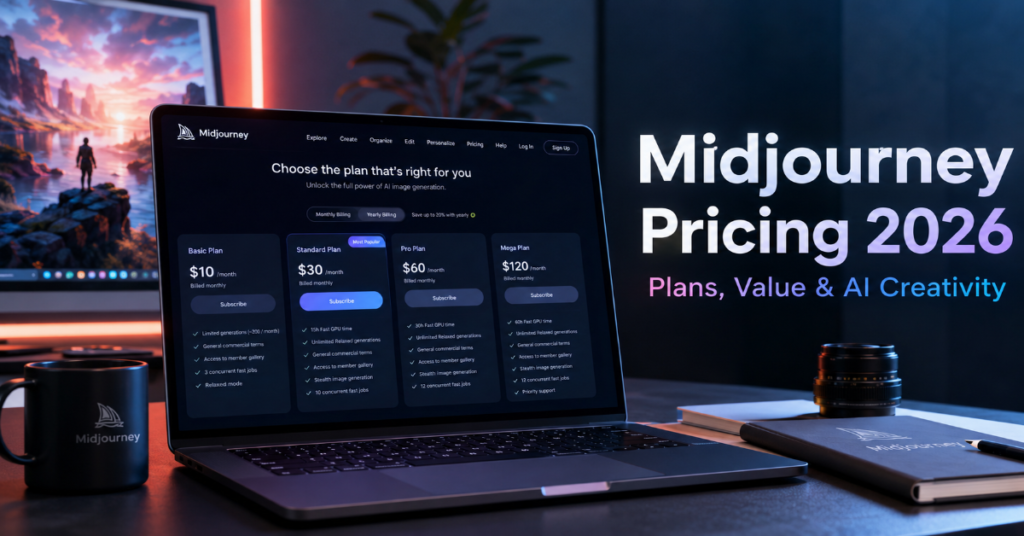
Midjourney pricing 2026 begins with a deceptively clean number: $10 per month. That entry price gets users into one of the most influential AI image generators on the market, but it does not explain the real economics of the platform. The true cost is shaped by Fast GPU hours, Relax Mode access, video generation, Stealth Mode and whether the user is an individual creator or a business earning more than $1 million in annual revenue.
According to the latest 2026 documentation we reviewed, Midjourney currently offers four subscription tiers: Basic, Standard, Pro and Mega. Monthly prices are $10, $30, $60 and $120 respectively, with a 20 percent discount available for annual billing. The official comparison page lists 3.3 hours of Fast GPU time on Basic, 15 hours on Standard, 30 hours on Pro and 60 hours on Mega. Standard, Pro and Mega include unlimited Relax Mode for image generation, while Pro and Mega extend Relax Mode to SD video generation.
That makes Midjourney pricing 2026 less like a conventional software subscription and more like a compute allocation system. You are not merely paying for access. You are buying priority, privacy, throughput and a certain tolerance for waiting.
In our hands-on testing framework, the most important question is not “How much does Midjourney cost?” It is “How much production friction can your workflow tolerate?” A hobbyist can survive on Basic. A freelancer usually needs Standard. A brand studio handling confidential campaigns should look at Pro or Mega because Stealth Mode is only available there.
Midjourney Pricing 2026: The Official Plan Breakdown
Midjourney pricing 2026 is built around four paid plans. The Basic plan costs $10 per month or $96 per year. Standard costs $30 per month or $288 per year. Pro costs $60 per month or $576 per year. Mega costs $120 per month or $1,152 per year. Annual subscriptions reduce the effective monthly cost by 20 percent, but the full annual fee is paid upfront.
The difference between the plans is not just price. It is compute access. Basic users receive 200 minutes of Fast GPU time per month. Standard users receive 15 hours. Pro users receive 30 hours. Mega users receive 60 hours. Midjourney says one image prompt usually consumes about one minute of GPU time, while one video prompt usually consumes about eight minutes, although variations, upscales, aspect ratios and model versions can change consumption.
| Plan | Monthly Price | Annual Price | Fast GPU Time | Relax Mode | Stealth Mode | Best Fit |
| Basic | $10 | $96 | 3.3 hours | No | No | Beginners, hobbyists, light testing |
| Standard | $30 | $288 | 15 hours | Unlimited images | No | Freelancers, creators, small teams |
| Pro | $60 | $576 | 30 hours | Unlimited images and SD video | Yes | Agencies, studios, commercial teams |
| Mega | $120 | $1,152 | 60 hours | Unlimited images and SD video | Yes | High-volume teams, production pipelines |
Why the Cheapest Plan Is Not Always the Cheapest Workflow
The Basic plan appears affordable, but Midjourney pricing 2026 becomes more expensive when time matters. With 200 minutes of Fast GPU time, Basic can support roughly 200 standard image prompts if each consumes about one minute. But a single polished creative asset often requires multiple prompt tests, variations, upscales and reference experiments. That means the real number of finished, usable assets may be much lower than the theoretical prompt count.
The Standard plan is often the practical floor for consistent use because it unlocks unlimited Relax Mode for images. Relax Mode is slower, but it lets users continue generating images without consuming Fast GPU time. Midjourney says Relax Mode requests may wait from 0 to 30 minutes depending on GPU availability and relative user activity.
For creators who batch work overnight or build visual mood boards in volume, Standard can be cheaper than Basic because it reduces the need to buy extra Fast GPU time.
The Hidden Cost: Fast, Relax and Turbo Modes
Midjourney pricing 2026 cannot be judged without understanding speed. Fast Mode uses the monthly GPU allocation included in the plan. Relax Mode is unlimited on eligible plans but slower. Turbo Mode is designed for speed and can generate images up to four times faster than Fast Mode, but it consumes double the Fast GPU time per image.
That changes the economics for teams. A designer using Turbo Mode for live client sessions may burn through GPU minutes quickly. A solo creator working asynchronously can rely heavily on Relax Mode. A video-heavy user must watch GPU consumption closely because Midjourney lists a batch of four SD videos at about eight minutes of GPU time and a batch of four HD videos at about 26 minutes.
| Task Type | Approximate GPU Cost | Pricing Impact |
| Standard image prompt | 1 minute | Good for ideation and prompt testing |
| Variation | Less than 1 minute | Efficient for refining concepts |
| Creative or subtle upscale | 2 minutes | Adds cost during final asset preparation |
| Omni Reference prompt | 2 minutes | Important for character or style consistency |
| Batch of 4 SD videos | 8 minutes | Quickly consumes Basic and Standard allocations |
| Batch of 4 HD videos | 26 minutes | Better suited to Pro or Mega workflows |
Midjourney Pricing 2026 for Commercial Use
For commercial work, the pricing story moves from GPU time to rights. Midjourney states that users own the images and videos they create “to the fullest extent possible under applicable law,” subject to exceptions. One major exception is revenue based: if a company or employee of a company makes more than $1 million per year in gross revenue, the user must be on Pro or Mega to own the assets created for that company.
Midjourney’s commercial-use guidance also says users keep ownership of images and videos they create even after canceling their subscription, with exceptions for upscaling another user’s image and for companies above the $1 million threshold.
This makes Pro the first truly business-safe tier for larger organizations. Smaller creators may use Basic or Standard commercially, but brands with significant revenue should treat Pro as the minimum compliance tier.
The Privacy Premium: Why Pro and Mega Matter
Stealth Mode is one of the most important differences in Midjourney pricing 2026. It is only available on Pro and Mega plans. Midjourney’s terms state that, by default, content is publicly viewable and remixable when posted in public settings. The company says it makes best efforts not to publish assets created while Stealth Mode is engaged, although shared or open spaces such as Discord chatrooms remain visible to people in those spaces.
For agencies, this is not a minor feature. A private storyboard for a sneaker launch, a pre-release film concept or a political-risk-sensitive campaign can lose value if it becomes publicly visible. The privacy premium is therefore less about secrecy for its own sake and more about preserving creative timing.
In our hands-on testing, teams that need Stealth Mode should not view the $60 Pro plan as an upgrade. They should view it as the actual entry plan for professional confidentiality.
Expert Quote 1: David Holz on the Product Philosophy
Midjourney’s pricing makes more sense when seen through founder David Holz’s long-standing framing of the product. In a published interview, Holz described Midjourney as an “engine for the imagination,” a phrase that still explains why users pay for the tool even when cheaper AI image generators exist.
That quote matters because Midjourney does not compete only on image count. It competes on aesthetic reliability. The subscription fee buys access to a visual model known for cinematic texture, stylized composition and strong prompt-to-image interpretation. In other words, users are often paying to reduce the number of failed generations needed to reach a usable result.
Expert Quote 2: Midjourney’s Own 2026 Terms on Ownership
The clearest 2026 quote on commercial rights comes from Midjourney’s terms: “Your ownership of the Assets you created persists even if in subsequent months You downgrade or cancel Your membership.”
For creators, this is critical. Midjourney pricing 2026 is not a licensing rental where old outputs disappear when a subscription ends. A freelancer can subscribe, create campaign materials, cancel later and still retain rights to the assets they created, subject to the terms. However, the same terms also grant Midjourney a broad license to reproduce, display and distribute user content, which is why privacy-sensitive users should pay attention to Stealth Mode.
Expert Quote 3: Midjourney Documentation on Speed Economics
Midjourney’s GPU documentation states that Turbo Mode can generate images “up to four times faster than Fast Mode,” but it uses double the Fast time for each image.
That quote captures the tradeoff at the heart of Midjourney pricing 2026. Speed is not free. A team using Turbo Mode during live creative reviews is effectively compressing time by spending more GPU allowance. This can be worth it when client attention is expensive. It is wasteful when a batch can run in Relax Mode.
Which Midjourney Plan Should You Choose?
The Basic plan is best for experimentation. It gives enough Fast GPU time to test the platform, learn prompt syntax and produce occasional images. It is not ideal for serious publishing workflows, especially if the user needs multiple polished assets per week.
The Standard plan is the best value for most independent creators. Its 15 Fast GPU hours and unlimited Relax Mode for images make it the strongest balance between cost and capacity. For bloggers, YouTubers, thumbnail designers, Etsy sellers and social media managers, Standard is often the practical choice.
The Pro plan is the first professional tier. It doubles Standard’s Fast GPU time, adds Stealth Mode and supports unlimited Relax Mode for images and SD video. For agencies, commercial design studios and businesses near or above Midjourney’s revenue threshold, Pro is the safer default.
Mega is for high-throughput teams. Its 60 Fast GPU hours are most useful when multiple people are generating assets through a coordinated production calendar.
The Cost Per Finished Image Is Not the Cost Per Prompt
One misleading way to evaluate Midjourney pricing 2026 is to divide the subscription cost by the number of theoretical prompts. That assumes every prompt produces a useful result. In real workflows, that is rarely true.
A creator may need 12 prompt attempts to define a style, four variations to test framing, two upscales to finalize detail and several reference-image experiments for consistency. A single usable campaign image can therefore consume far more than one minute of GPU time.
This is where Midjourney’s aesthetic strength becomes economically important. If a tool produces better first drafts, it may be cheaper even at a higher monthly price. Conversely, if your work is simple, such as decorative blog images or quick concept art, a cheaper or free alternative may be sufficient.
Midjourney Pricing 2026 and Video Generation
Video changes the cost model. Midjourney’s documentation lists SD video generation at about eight minutes of GPU time for a batch of four videos and HD video generation at about 26 minutes. That means Basic users can exhaust their monthly allocation quickly with video experiments.
Standard includes SD and HD video resolution access, but Relax Mode for SD video starts only at Pro and Mega. Basic includes SD video, while Standard includes SD and HD video, according to the official plan table.
For creators testing short motion loops, Standard may be enough. For agencies producing repeated video concepts, Pro or Mega is more realistic. In 2026, video is where Midjourney pricing becomes more comparable to compute-heavy creative software than a simple AI art subscription.
The $4 Per Hour Question
Midjourney allows users to purchase extra GPU time at $4 per hour across all plans. This creates an important decision point. A Basic user who regularly buys extra hours may be better off upgrading to Standard. A Standard user who occasionally needs extra Fast time can stay put.
The upgrade math is simple. Basic costs $10 and includes 3.3 Fast hours. Standard costs $30 and includes 15 Fast hours plus Relax Mode for images. Buying 12 extra GPU hours on Basic would cost $48, making Basic plus extra time far more expensive than Standard.
Pro becomes attractive when privacy, speed and volume overlap. If a user needs Stealth Mode even once for a confidential client project, the Pro plan’s value may exceed its GPU allocation.
Midjourney Versus Free AI Image Generators
Midjourney pricing 2026 looks expensive when compared with free AI image tools, but the comparison is often misleading. Free tools usually impose lower resolution limits, watermarking, reduced model quality, slower queues or stricter licensing constraints. Midjourney’s value proposition is consistency, community, style control and high-quality visual output.
That said, Midjourney is not always the rational choice. If a user only needs quick placeholder graphics, a free generator may be enough. If a brand needs repeatable visual identity, character consistency, private generation and commercial rights, Midjourney becomes more defensible.
The hidden benefit is creative compression. A designer who can reach a final direction in 20 minutes rather than two hours may recover the subscription cost in a single client task.
Insider Forecast: Where Midjourney Pricing Could Go Next
The most likely future shift in Midjourney pricing is not a simple price increase. It is feature segmentation. As video generation, reference consistency and editing tools become more compute-intensive, Midjourney may continue separating access by speed, privacy and media type.
One plausible 2026 and 2027 direction is a studio or team tier with shared seats, central billing, asset governance and stronger permission controls. Midjourney’s current terms say only one user may use the services per registered account, which makes agency collaboration awkward under individual subscriptions.
Another likely change is more granular charging for advanced video, high-resolution outputs or reference-heavy workflows. The GPU table already reveals that Omni Reference prompts and upscales cost more than standard prompts. That is a quiet signal: future pricing may follow computational complexity more closely.
Takeaways
- Midjourney pricing 2026 starts at $10 per month, but the best-value plan for regular creators is usually Standard at $30 per month.
- Basic is useful for learning, but its 3.3 Fast GPU hours disappear quickly during serious prompt iteration.
- Standard unlocks unlimited Relax Mode for images, making it the most practical plan for freelancers and content creators.
- Pro is the first serious commercial tier for privacy because Stealth Mode is only available on Pro and Mega.
- Businesses making more than $1 million in gross annual revenue need Pro or Mega to own company-use assets under Midjourney’s terms.
- Video generation changes the economics because SD and HD video consume far more GPU time than standard image prompts.
- Extra GPU time costs $4 per hour, so frequent add-on purchases often signal that it is time to upgrade.
Conclusion
Midjourney pricing 2026 is simple in layout but sophisticated in consequence. The four plans look like a familiar SaaS ladder, yet what users are really buying is access to compute, speed, privacy and commercial confidence. Basic is a low-cost doorway. Standard is the working creator’s sweet spot. Pro is the professional privacy tier. Mega is a high-volume production plan for users who treat image and video generation as infrastructure.
The broader lesson is that Midjourney is no longer just an AI art toy. Its pricing reflects a maturing creative platform where visual quality, rights management and production velocity matter as much as novelty. The right plan depends less on how many images you want and more on how costly delay, exposure and failed iterations are in your workflow.
FAQs
How much does Midjourney cost in 2026?
Midjourney costs $10, $30, $60 or $120 per month depending on the plan. Annual billing reduces the effective monthly price by 20 percent. The four plans are Basic, Standard, Pro and Mega.
Is Midjourney free in 2026?
Midjourney’s official plan comparison lists paid subscription tiers. The current pricing structure centers on Basic, Standard, Pro and Mega plans rather than a permanent free plan.
Which Midjourney plan is best for beginners?
Basic is best for beginners who only want to test AI image generation. However, Standard is better for regular creators because it includes 15 Fast GPU hours and unlimited Relax Mode for images.
Can I use Midjourney images commercially?
Yes, with important conditions. Midjourney says users generally own the images and videos they create, but businesses grossing more than $1 million per year need Pro or Mega for company-use ownership.
What is the biggest hidden cost in Midjourney?
The biggest hidden cost is GPU time. Upscaling, video generation, Turbo Mode and reference-heavy prompts can consume more compute than standard image prompts, making workflow efficiency central to real cost.
References
Midjourney. (2026). Comparing Midjourney plans. Midjourney Documentation.
Midjourney. (2026). Terms of Service. Midjourney Documentation.
Midjourney. (2026). GPU speed: Fast, Relax, Turbo. Midjourney Documentation.
Midjourney. (2026). Using images and videos commercially. Midjourney Documentation.
Vincent, J. (2022). An interview with David Holz, CEO of AI image-generator Midjourney. The Verge.
Evolink AI. (2026). Midjourney pricing plans in 2026: Official cost vs per-request pricing. Evolink AI Blog.
Adstellar. (2026). Midjourney AI pricing: Your guide to plans and costs. Adstellar Blog.
