
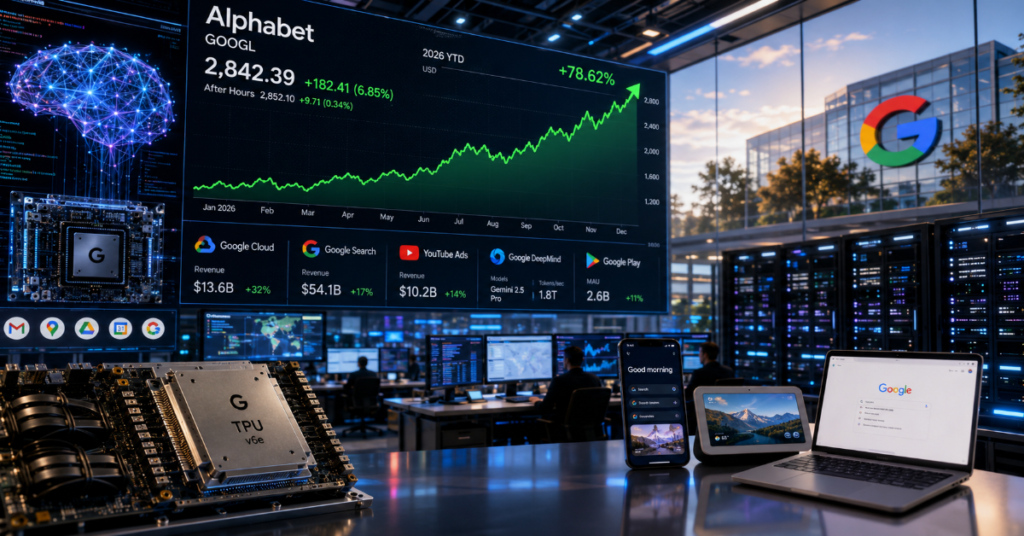
Less than eighteen months ago, the dominant narrative in technology investing was that Google had lost the AI race. OpenAI had the models, Microsoft had the enterprise distribution, and Google’s initial AI efforts — the stumbling Bard launch, the AI Overviews that served up misinformation — looked like a company playing catch-up on someone else’s terms. That narrative is now comprehensively obsolete. Alphabet stock has risen approximately 160% over the past twelve months. On May 8, 2026, the company hit an all-time high, and for a brief Alphabet Google AI stack rally 2026 moment in after-hours trading this week, it surpassed Nvidia to become the world’s most valuable company.
JPMorgan has named Alphabet its ‘top overall pick’ in all of tech. More than 80% of covering Wall Street analysts have assigned it a Strong Buy rating. None have issued a sell.
The Q1 2026 Numbers That Changed the Narrative
The inflection point was Alphabet’s Q1 2026 earnings report, published April 30. The headline figures were extraordinary. Total Q1 revenue hit $109.9 billion, up 22% year-over-year. Net income reached $62.6 billion, up 81% year-over-year. Earnings per share came in at $5.11 against a consensus estimate of $2.63 — nearly double what analysts had expected.
The standout figure was Google Cloud, which recorded $20.03 billion in revenue — a 63% year-over-year increase that was far ahead of the Street consensus near 47%. The contracted cloud backlog nearly doubled sequentially to $462 billion. A separate development underscored the depth of Cloud’s momentum: Anthropic committed to spend $200 billion on Google Cloud over five years for 5 gigawatts of compute — a commitment that, for investors, confirmed Google Cloud is now the preferred infrastructure provider for the most safety-focused AI lab in the world. Google CEO Sundar Pichai told analysts on the earnings call that AI is ‘lighting up every part of the business.’
Owning the Whole Stack
Gene Munster, managing partner at Deepwater Asset Management, offered the clearest articulation of why Alphabet’s position is structurally different from its competitors: ‘Google is one of the two best-positioned AI companies because they own most of the stack. Chips, models, infrastructure and distribution. On top of that, they’re nicely profitable.’
The stack Munster describes: Gemini for frontier AI models, custom Tensor Processing Units (TPUs) as an alternative to Nvidia’s GPUs, Google Cloud for enterprise compute with a 36% operating margin, and Google Search, YouTube, and Android as distribution channels that touch billions of users daily. No other company outside of a speculative case for Microsoft can claim all four layers simultaneously. Anthropic, committed to Google Cloud infrastructure, and OpenAI, beginning to work with Google’s TPUs, are both reinforcing Google’s position at the infrastructure layer even as they compete with Gemini at the model layer.
The Risk That Remains
Alphabet’s 2026 capital expenditure guidance stands at $180 billion to $190 billion — an extraordinary figure that will compress free cash flow and represents the company’s bet that AI infrastructure demand will sustain at current levels. Michael Burry, the investor who predicted the 2008 subprime crisis, has publicly warned that the current AI-driven speculative rally feels similar to the final phase before the dot-com bubble burst. The average analyst price target over the next twelve months implies only 5.4% additional upside from the current price — a significant moderation from a stock that has already returned 160% in a year.
Google I/O, which kicks off within two weeks, will be critical. Wall Street needs clarity on Alphabet’s agent strategy with Gemini and evidence that its AI investments are converting into sustainable revenue at the margin — not just impressive Cloud growth figures that are partly driven by other AI companies paying Google to run their own models on Google’s infrastructure.
