
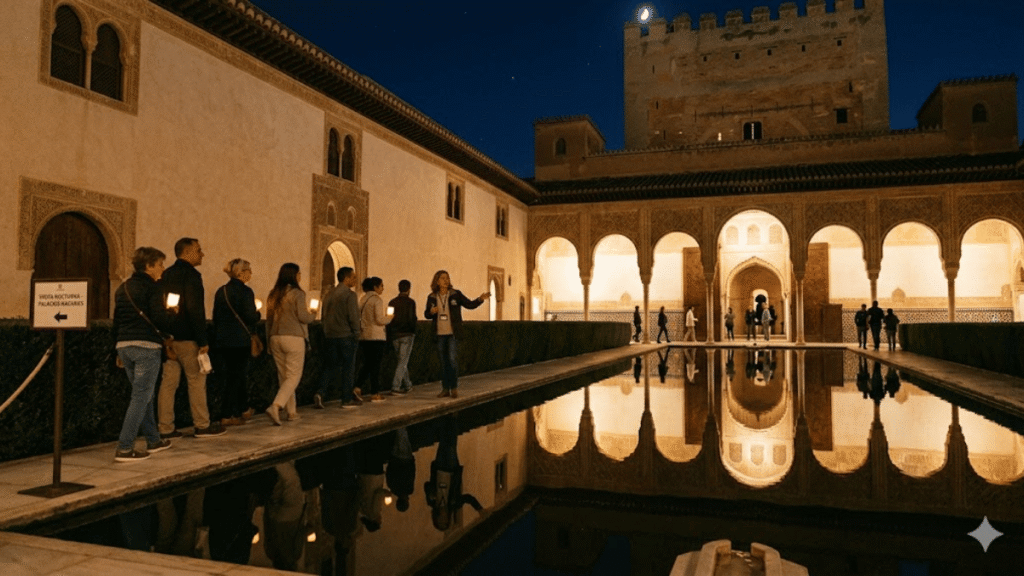
The night tour program at the Alhambra is both a cultural spectacle and a carefully managed economic strategy. For those seeking clarity, attendance for Alhambra night visits is deliberately capped—typically a fraction of daytime capacity—yet these limited tickets often generate disproportionately high revenue due to premium pricing and demand. Within the first moments of examining the numbers, a pattern emerges: exclusivity, not volume, drives profitability. – alhambra palace night tour attendance revenue.
Located in Granada, the Alhambra receives over 2.5 million visitors annually in combined day and night access. Night tours, which focus primarily on the Nasrid Palaces, operate under tighter quotas—often around 300–400 visitors per evening session. Despite this lower attendance, ticket prices for night visits are typically comparable to or higher than daytime entry, creating a high-value niche within the broader tourism economy.
The rationale extends beyond economics. Night tours reduce daytime congestion, preserve fragile architectural elements, and offer a distinct sensory experience. Yet they also raise questions: How much revenue do these tours generate relative to overall operations? Do they meaningfully contribute to sustainability, or primarily cater to high-paying tourists?
Understanding the interplay between attendance and revenue at the Alhambra’s night program provides a window into a broader phenomenon—how historic sites worldwide are rethinking access, pricing, and preservation in an era of mass tourism. – alhambra palace night tour attendance revenue.
Historical Context: Tourism Pressure and Controlled Access
The Alhambra, a UNESCO World Heritage Site since 1984, has long faced the challenge of balancing accessibility with preservation. By the early 2000s, rising visitor numbers threatened the integrity of its delicate plasterwork, gardens, and wooden structures. Authorities responded by implementing strict ticketing systems, including time slots and visitor caps.
Night tours were introduced as part of this broader management strategy. Initially conceived as a cultural enhancement—allowing visitors to experience the monument under carefully designed lighting—they quickly evolved into a practical tool for redistributing tourist flow.
According to Spain’s Ministry of Culture, visitor caps at the Alhambra are among the most stringent in Europe, reflecting both conservation priorities and the site’s popularity. Night access, limited to specific areas such as the Nasrid Palaces and occasionally the Generalife gardens, became a way to extend visiting hours without increasing overall strain.
Tourism economist Dr. Xavier Font has noted that “capacity management is essential for heritage sites, and premium experiences like night tours allow operators to maximize revenue without increasing physical impact.” The Alhambra exemplifies this model. – alhambra palace night tour attendance revenue.
Attendance Dynamics: Scarcity and Demand
Attendance at Alhambra night tours is intentionally constrained. Unlike daytime visits, which can accommodate thousands per day across multiple zones, night sessions are tightly controlled.
The table below outlines approximate attendance patterns:
| Visit Type | Daily Capacity | Annual Estimated Visitors | Experience Type |
|---|---|---|---|
| Daytime General | ~6,000 | ~2.2 million | Full complex access |
| Night (Nasrid) | ~300–400 | ~100,000–120,000 | Focused, guided experience |
| Night (Generalife) | ~200–300 | ~60,000–80,000 | Garden-focused visits |
These figures highlight a key dynamic: night tours represent a small share of total attendance but are structured to maximize perceived value. Tickets often sell out weeks in advance, particularly during peak tourist seasons.
Scarcity drives demand. Visitors perceive night access as exclusive, immersive, and less crowded. This perception allows the Alhambra’s management authority to maintain high pricing while ensuring consistent occupancy. – alhambra palace night tour attendance revenue.
Cultural heritage specialist Dr. María García Hernández has observed that “limiting access is not just about preservation—it creates a premium experience that visitors are willing to pay for.”
Revenue Structure: Premium Pricing and Yield Optimization
While exact revenue figures vary by year, the financial logic of night tours is clear. Ticket prices for night visits typically range from €10 to €15, comparable to or slightly higher than standard daytime entry for specific sections.
Given annual night attendance estimates of approximately 160,000–200,000 visitors, gross revenue from night tours can be approximated as follows:
| Metric | Estimated Value |
|---|---|
| Average Ticket Price | €12–€15 |
| Annual Night Attendance | ~160,000–200,000 |
| Estimated Revenue Range | €1.9M–€3M annually |
This revenue represents a modest but strategically important portion of total ticket income, which exceeds €40 million annually across all visits. Night tours, therefore, function less as a primary revenue driver and more as a high-margin segment. – alhambra palace night tour attendance revenue.
The economic principle at work is yield optimization—maximizing revenue per visitor rather than total visitor count. By offering differentiated experiences, the Alhambra can segment its audience and capture higher willingness to pay.
Experiential Value: Light, Atmosphere, and Narrative
What distinguishes the Alhambra night tour is not merely timing but transformation. Carefully designed lighting emphasizes architectural details—the intricate muqarnas ceilings, reflective pools, and carved inscriptions—creating an atmosphere fundamentally different from daytime visits.
Visitors move through dimly lit corridors, guided by subtle illumination that highlights key features while preserving the monument’s integrity. The absence of large crowds enhances the sense of intimacy.
This experiential dimension contributes directly to revenue. Tourists are not simply purchasing access; they are buying a curated narrative. The night tour becomes a product—one that combines history, aesthetics, and exclusivity. – alhambra palace night tour attendance revenue.
Cultural tourism expert Dr. Greg Richards has argued that “modern heritage tourism is increasingly experience-based, with visitors seeking emotional engagement rather than passive observation.” The Alhambra’s night program aligns closely with this trend.
Comparative Analysis: Night Tourism at Global Heritage Sites
The Alhambra is not alone in leveraging night tourism. Comparable strategies exist at other major heritage sites, though implementation varies.
| Site | Night Access Type | Pricing Strategy | Attendance Control |
|---|---|---|---|
| Colosseum | Guided night tours | Premium pricing | Strict limits |
| Louvre Museum | Extended evening hours | Standard pricing | Moderate |
| Angkor Wat | Sunrise/sunset access | Tiered pricing | High volume |
| Alhambra | Exclusive night sessions | Premium, limited | Very strict |
This comparison reveals the distinctiveness of the Alhambra’s approach. While some sites extend hours to increase volume, the Alhambra emphasizes scarcity and exclusivity.
Sustainability and Preservation
A central argument for night tours is sustainability. By spreading visitor flow across more ساعات, the Alhambra reduces daytime congestion, which can accelerate wear and tear on sensitive structures.
Lighting systems are designed to minimize heat and الضوء exposure, protecting fragile materials. Visitor movement is carefully controlled to prevent overcrowding in key areas.
However, sustainability is not solely environmental. It also involves maintaining cultural authenticity and visitor satisfaction. Over-commercialization risks undermining the very qualities that make the site valuable.
Dr. Harold Goodwin, a specialist in responsible tourism, has noted that “sustainability in heritage tourism requires balancing economic benefits with cultural and environmental संरक्षण.” The Alhambra’s night tours represent an attempt to achieve this balance.
Policy and Governance
The management of the Alhambra falls under the Patronato de la Alhambra y Generalife, a public संस्था responsible for conservation, research, and tourism operations. Policies governing night tours are shaped by both national heritage laws and UNESCO guidelines.
Ticketing systems are digitalized, with strict controls on resale and identity verification. These measures aim to prevent scalping and ensure equitable access.
Revenue generated from ticket sales is reinvested into conservation efforts, staff salaries, and infrastructure maintenance. This financial मॉडल underscores the role of tourism as a funding mechanism for heritage preservation.
Takeaways
- Night tours at the Alhambra prioritize exclusivity over volume
- Attendance is tightly capped, creating high demand and premium pricing
- Revenue from night visits contributes a smaller but high-margin share
- The experience is curated through lighting, storytelling, and limited access
- Sustainability goals drive the expansion of controlled night tourism
- The model reflects broader trends in global heritage site management
Conclusion
The Alhambra’s night tour program offers a compelling case study in modern heritage management. It demonstrates how cultural landmarks can adapt to the pressures of mass tourism without compromising their integrity. By limiting attendance and enhancing experiential value, the Alhambra has created a model that balances economic viability with preservation.
Yet the approach is not without challenges. Questions about accessibility, pricing equity, and long-term sustainability remain. As demand continues to grow, maintaining this balance will require ongoing innovation and careful policy decisions.
Ultimately, the success of the Alhambra’s night tours lies in their ability to transform limitation into opportunity. By embracing scarcity and focusing on quality, the monument has redefined what it means to visit a historic site—not just as a tourist, but as a participant in a carefully orchestrated cultural experience.
Click Here to Check Out More Interesting Blogs!
FAQs
How many people attend Alhambra night tours annually?
Approximately 160,000 to 200,000 visitors participate in night tours each year, significantly fewer than daytime attendance due to strict capacity limits.
Are night tour tickets more expensive?
Yes, they are typically priced at a premium or similar level to daytime tickets, reflecting their exclusivity and curated experience.
Why is attendance limited at night?
Limits help preserve the monument, reduce crowding, and enhance the visitor experience through smaller समूह sizes.
Do night tours generate significant revenue?
They generate an estimated €2–€3 million annually, representing a high-margin segment of overall ticket income.
What areas are included in night tours?
Night visits usually focus on the Nasrid Palaces and sometimes the Generalife gardens, with restricted access compared to daytime tours.
